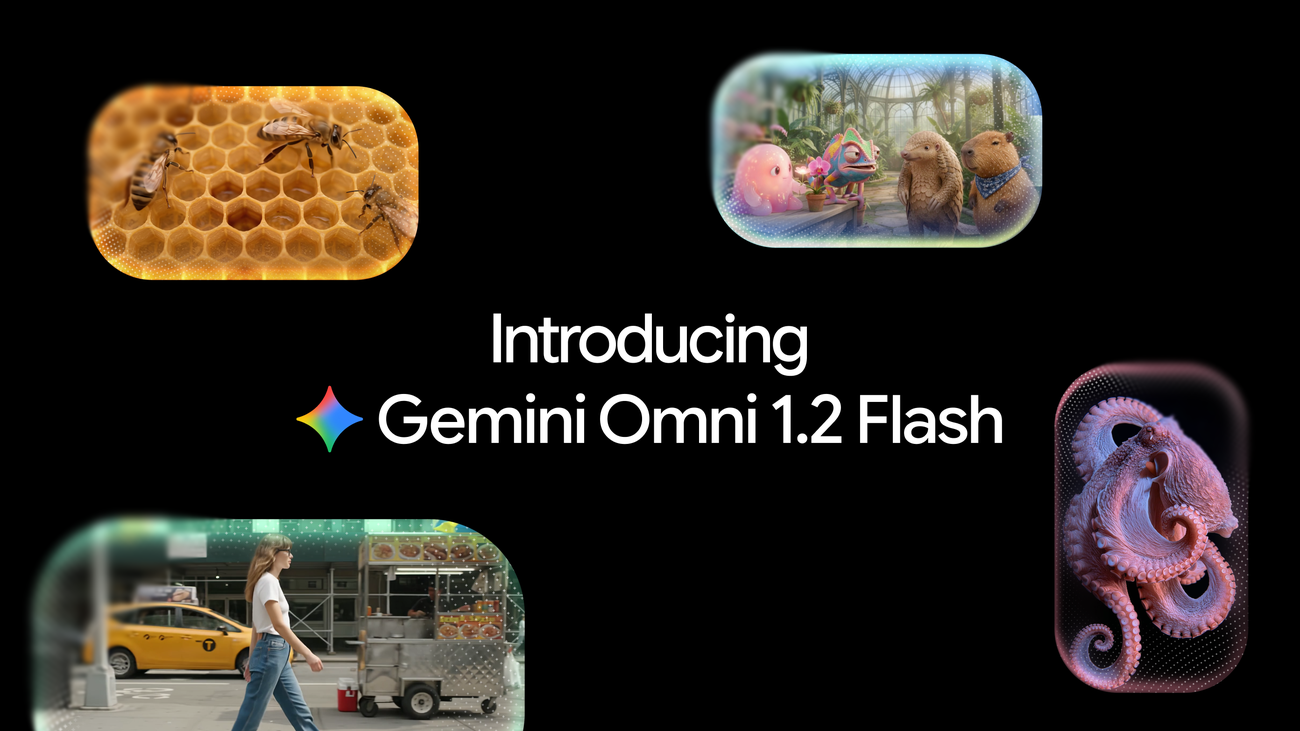
Google is making Gemini Omni 1.2 Flash generally available across the Gemini API and Gemini for business. The update extends native video generation from 10 to 15 seconds, improves adherence to visual references and lets users refine an existing clip through follow-up conversation.
The listed 720p price falls 30% from Omni 1.1 to $0.07 per second. Creators can draft at 360p or 720p, make targeted edits and upscale selected results to 1080p or 4K. That workflow is potentially more important than the per-second figure: fewer complete regenerations mean less discarded computation.
Consistency is the useful capability
Omni accepts character, product or style images, short motion clips and audio cues as references. Google says faces, garments, packaging typography and brand colours remain more consistent across camera angles and transitions. It is also targeting less visual drift when interpolating between keyframes or extending an existing shot.
For commercial production, that is the difference between a visually impressive demo and a reusable tool. A product that changes shape or a label that mutates halfway through a clip creates review work rather than removing it.
Editing changes the production loop
Multi-turn editing supports changes such as replacing a product, altering a background, adjusting lighting or switching aspect ratio while preserving the rest of the clip. Google says this works across the full 15-second duration.
The practical result is a more iterative process: establish a usable take, then produce variants rather than repeatedly briefing a fresh generation. Teams still need human review for identity, brand accuracy, unwanted artefacts and the provenance of reference material.
What to measure before adopting it
- Cost per accepted clip, including drafts, edits, upscaling and human review.
- Identity and typography consistency across the entire sequence, not just selected frames.
- How often a follow-up edit preserves the parts of a shot that already worked.
- Rights and permissions for every character, product and style reference.
The editorial lens
AI announcements arrive with competing claims about quality, openness and cost, but those properties are not interchangeable. A model that performs well in a controlled demonstration may behave differently with unfamiliar data, tool permissions, long contexts or production latency requirements. Open-weight releases add further questions about licensing, deployment responsibility and the ability of smaller teams to verify what they run. The most useful comparisons keep model version, prompts, reasoning settings, data and evaluation methodology visible, because changing any one of them can move the result.
A useful evaluation starts with the intended job and the cost of being wrong. Build a small set containing ordinary cases, difficult cases and known traps, then record the model version, prompt, reasoning settings, latency and price. Compare accepted outputs rather than raw generations, because discarded work and human correction are part of the system cost. For open weights, also check hardware requirements, quantisation, licensing, security updates and provenance. For hosted models, review retention, privacy, rate limits and incident handling. That turns a launch claim into a reproducible engineering input.
A compressed source summary cannot carry every operational detail. It may omit rollout timing, benchmark construction, eligibility, dependencies or conflicting results. That does not make the source wrong; it defines the limit of what the summary alone proves. Treat the initial report as a claim to be tested rather than a universal outcome. Check availability and version details for releases, reproducibility for research, and delivered usage for business claims. Where possible, run a small reversible evaluation and keep its measurements. Corrections and follow-up reporting can materially change the interpretation, especially when the underlying technology, pricing or policy is moving quickly. This distinction between a publisher’s evidence and its broader applicability is essential to responsible technical coverage.
Read Google’s examples and availability details.
Discover more from Sulat — AI & Tech News
Subscribe to get the latest posts sent to your email.