Exa has launched Exa for Finance, a financial-data surface in its search API. In a follow-up post, the company said the feature is live across the API at no additional cost. Standard search and agent prices still apply, and licensed sources attached through Exa Connect are billed separately.
The official account said agents can now search “over 2 billion financial documents,” including more than 110 million daily prices, more than 2 million SEC filings and earnings calls, and more than 250 million finance news articles. A more detailed breakdown is on Exa’s finance product page and in its Financial Markets documentation, which the company linked from the announcement. Exa’s public changelog didn’t yet carry a matching dated entry.
What the official pages list
The finance product page itemises the datasets Exa says are now built into the index, and searchable alongside the rest of the web:
- More than 19 million SEC filings since 1993, including annual, quarterly and current reports, registration statements, proxy statements and insider trades. The documentation also mentions international filings and those of foreign companies listed in the United States.
- 229,000 full earnings call transcripts, covering about 9,500 public companies, with prepared remarks and Q&A attributed to speakers.
- More than 110 million daily prices for stocks, indices, FX, crypto and commodities, plus live quotes and recent price history. Security profiles include key statistics and daily OHLCV history. The company also lists 2.6 million financial statements and 120 million institutional holdings from 13F filings.
- 895,000 funding rounds for 381,000 public and private companies, with 1.26 million links to their investors.
- Company websites and pricing pages, and 10 million granted US patents.
The announcement’s combined figure of “2M+ SEC filings and earnings calls” is much lower than the 19 million-plus filings on the product page. The 250 million finance news articles cited in the post don’t appear in the Financial Markets documentation. Both figures are Exa’s own, and they haven’t been independently checked.
Exa says a query about a ticker can return the quote, the latest earnings call and analyst coverage together. People can search with a company name or a cashtag such as $NVDA. For filings, the docs recommend describing the disclosure rather than only the form type, and using the financial report category to keep results to filings and reports. Structured work that needs several sources can be handed to Exa Agent, which returns schema-validated results with citations. Recurring watches go through the Monitors API. For backtests, the finance page points to Exa Snapshot, which Exa describes as more than 400 billion page snapshots across two decades, so a signal can be tested on what was public at the time.
Licensed sources such as Crunchbase can be added through Exa Connect. Financial Datasets, a Connect partner, offers structured data for more than 27,000 US tickers, including filings, statements, ownership and a stock screener. Those partner calls are priced on top of the Search API.
The benchmark claims
Exa’s announcement said the product is “state-of-the-art on FinSearchComp and other public benchmarks.” The chart attached to that post is more specific. It reports results from a company-run harness in November 2026: a GPT-6 Luna agent with up to 25 search rounds and 10 results per search, with every provider tested the same way. The comparison is between Exa Lite, Perplexity Fast, Parallel Fast and Tavily.
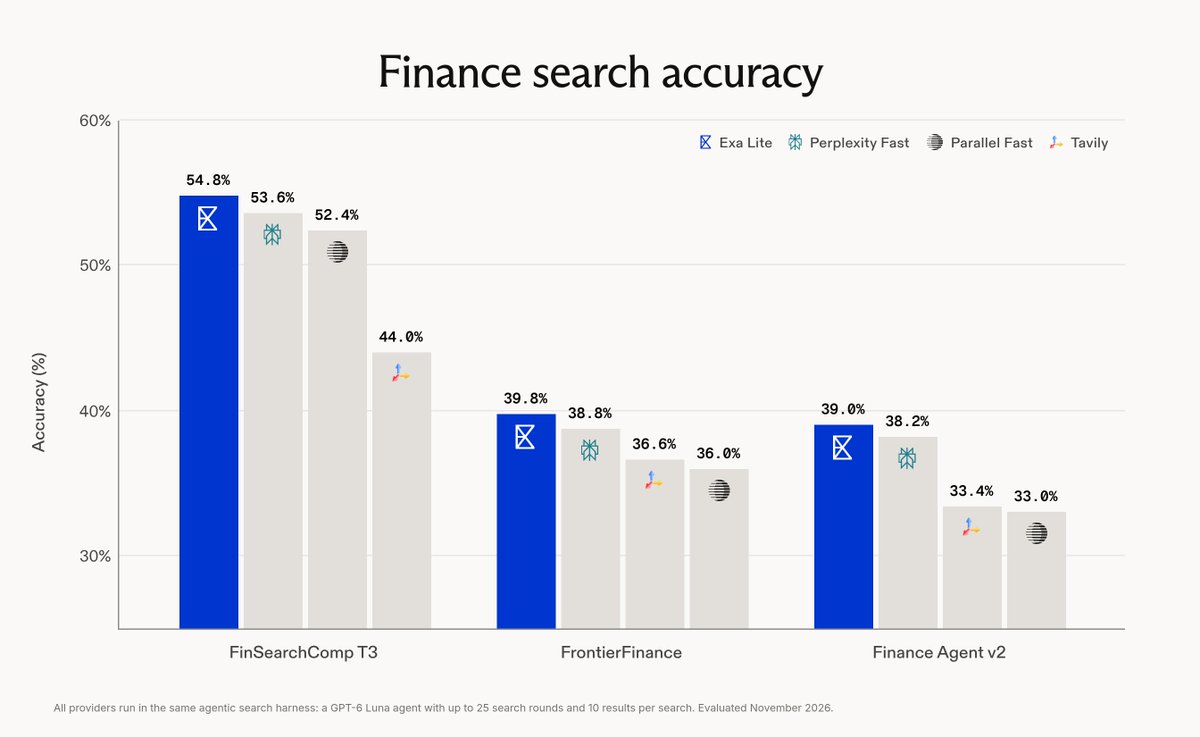
| Benchmark | Exa Lite | Perplexity Fast | Parallel Fast | Tavily |
|---|---|---|---|---|
| FinSearchComp T3 | 54.8% | 53.6% | 52.4% | 44.0% |
| FrontierFinance | 39.8% | 38.8% | 36.0% | 36.6% |
| Finance Agent v2 | 39.0% | 38.2% | 33.0% | 33.4% |
FinSearchComp, released by ByteDance Seed and Columbia Business School, is a public benchmark of 635 expert-written questions across three analyst-style tasks: time-sensitive data fetching, simple historical lookup, and complex historical investigation (T3). The official leaderboard evaluates end-to-end web products, not standalone search APIs. On that board, Grok 4 (web) led the global subset at 68.9%, still below the 75% human-expert baseline, and scored 51.2% on the global T3 split. Exa’s chart measures only T3, with a different agent and a field of search APIs, so the percentages aren’t directly comparable with that leaderboard.
The other two tests are also public agent benchmarks. FrontierFinance, from Samaya, uses 220 expert-authored queries and more than 11,000 grading rubrics. Finance Agent v2 is an open evaluation harness from vals-ai. In Exa’s run, Exa Lite leads each column by a narrow margin: 1.2 percentage points over Perplexity Fast on FinSearchComp T3, and one point on the other two sets. All four systems are below 40% on FrontierFinance and Finance Agent v2. These figures are Exa’s own and haven’t been independently repeated here.
Separately, the finance product page reports an Exa-built test of 970 finance searches across filings, earnings calls and market data, in which Exa Lite scored 60.3% and Exa Auto 58.9%, ahead of several Perplexity, Brave and Parallel settings. Exa’s wider evaluations page says that finance set is drawn from production traffic and kept private. The same site lists Exa 3.0 at 71.4% on FinSearchComp, above Parallel at 68.0% and Perplexity at 63.4%; that table isn’t the T3-only chart in the launch post, and Exa doesn’t publish the raw traces for either run.
Customers, limits and access
The finance page includes a customer example from Revolut, which Exa says built the search API into a securities-monitoring agent so users can read the story behind a large price move in the app.
When we benchmarked search providers for our agentic workflows at Revolut, Exa was on top for the queries that actually matter in production.
Iaroslav Amerkhanov, AI Product Owner, Wealth and Trading, Revolut, quoted on Exa’s finance page
Exa says it is SOC 2 Type II audited, honours GDPR and CCPA rights, and can offer a BAA and a custom MSA and DPA on enterprise plans. Zero data retention, under which queries and results aren’t stored or used for training, is available on an annual plan. For KYC, KYB and adverse-media screening, the company says a query can return registration details, officers, a website and adverse media as structured, cited fields. It also says it supplies evidence for that review and doesn’t issue a compliance decision.
Search starts at $4 per 1,000 Lite requests, or $7 per 1,000 for Auto, for up to 10 results, with a free tier that credits $10 and resets each month. Exa’s “no additional cost” claim is that the financial datasets are included in those existing search prices, not that search itself is free.
Discover more from Sulat AI & Tech News
Subscribe to get the latest posts sent to your email.