Menlo Ventures says healthcare is now the largest vertical market for AI, with spend growing 2.5x to US$3.7 billion in 2026. The firm published the figures on 16 November in its State of AI in Healthcare report, written by six Menlo investors including partners Greg Yap, JP Sanday and Croom Beatty.
Menlo announced the report on X, listing five spending categories and how fast each is growing. The post says administrative AI still has the biggest budgets, while clinical care and drug discovery are gaining ground.
Our latest report breaks down where healthcare’s $3.7B in AI spend goes, and where it is growing fastest:
— Menlo Ventures (@MenloVentures) November 16, 2026
➡️ Ambient scribes: $950M (1.6x)
➡️ Coding and billing: $600M (1.3x)
➡️ Clinical copilots: $550M (5.5x)
➡️ Patient engagement and front office: $450M (4.5x)
➡️ Pharma discovery and research: $600M (28.6x)
Administrative AI still commands the biggest budgets, with clinical care and drug discovery gaining ground.
Read Menlo’s State of AI in Healthcare report here: https://t.co/XfzVhfDOsK
Menlo’s funds hold stakes in several companies the report names, including Anthropic, OpenEvidence, Chai Discovery, Benchling and Assort Health. The report marks them with asterisks and lists them as portfolio companies in its closing section.
The numbers rest on a Morning Consult survey run in September 2026 for Menlo. It covered 550 executives who had helped buy an AI product: 150 technology decision-makers at providers, 100 senior executives at health plans and 300 at pharma and biotech companies.
Where the money goes
Menlo says providers account for 77% of the spend, US$2.9 billion, up nearly 2x from US$1.5 billion last year. Payers spent US$150 million, about 4% of the market. Half of healthcare’s AI money goes to industry-specific applications, about twice the share across all enterprises, Menlo says. General-purpose model providers such as Anthropic, OpenAI and Google take the other half, against 76% across enterprises generally.
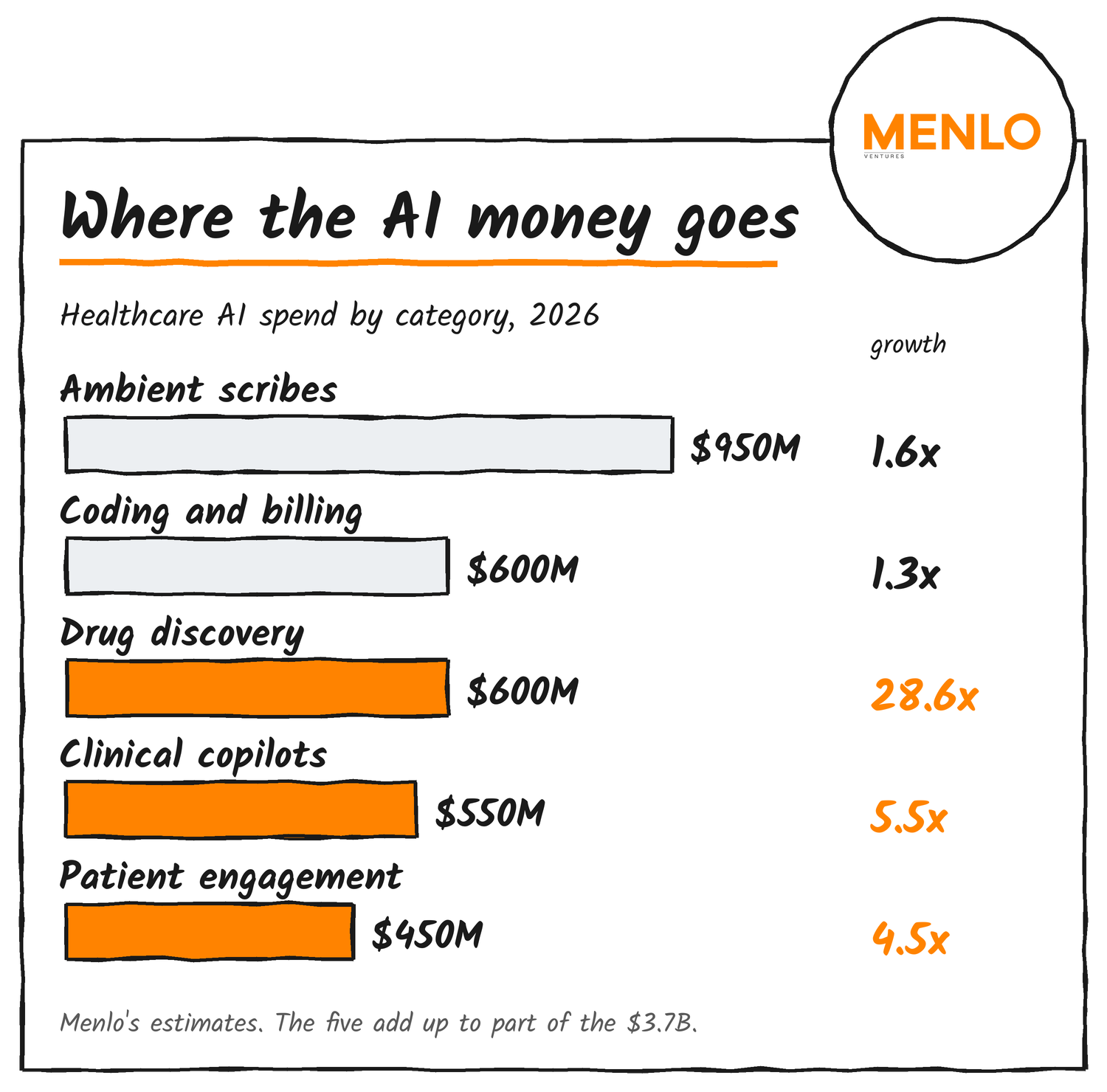
Scribes (US$950 million, 1.6x) and coding and billing (US$600 million, 1.3x) still lead. The fastest growth is in drug discovery (28.6x), clinical copilots (5.5x, US$550 million) and patient engagement and front office (4.5x, US$450 million).
Incumbents struck back in scribing
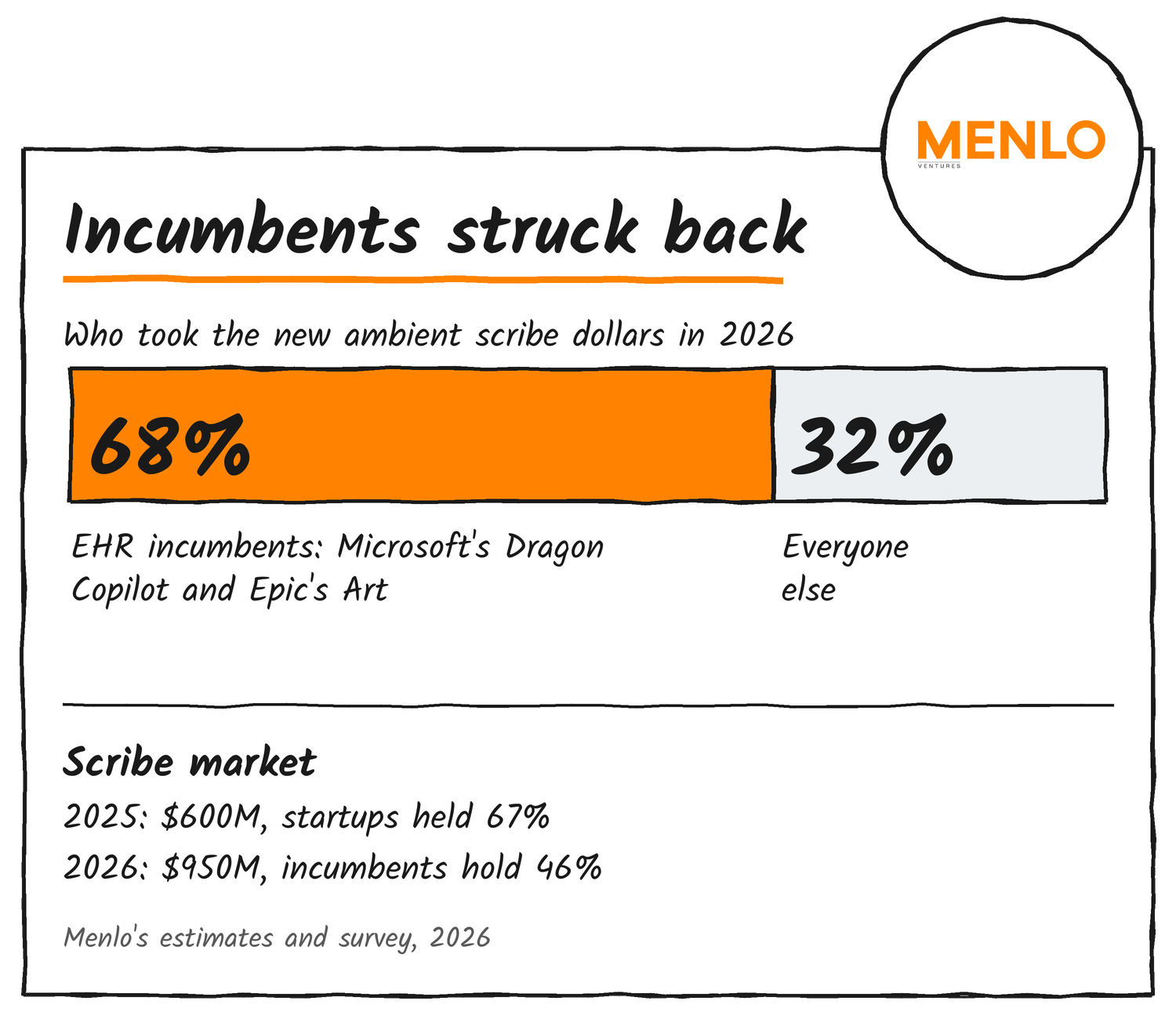
Last year’s report predicted that incumbents would hit back in scribing, and Menlo says they did. In 2025, startups held 67% of a US$600 million scribe market. In 2026, electronic health record (EHR) incumbents hold 46% of US$950 million. Add-ons led by Microsoft’s Dragon Copilot and Epic’s Art won 68% of new scribe dollars and grew 120%, while AI-native scribes grew 28% and lost 13% market share.
Epic, Oracle, athenahealth and Meditech all now ship a built-in scribe, Menlo says, and most AI-native scribe companies no longer call themselves scribes. Abridge, for one, partnered with Availity in January to build real-time prior authorisation from what’s said in the visit.
Provider preferences explain part of it. Menlo’s survey found 71% of providers would ideally buy coding and billing from their EHR vendor, and 75% would buy chart review there. Further from the core record the preference flips: 55% prefer a third party for prior authorisation and 51% for patient navigation.
Buying has slowed too. Menlo says the time from first meeting to closed deal rose from seven to 10 months for health systems and from five to 11 months for outpatient providers. The US Department of Veterans Affairs assessed more than 150 vendors and ran an 11-month pilot at 10 medical centres before picking Knowtex and Abridge for its US$776 million ambient scribe contract. Even so, 42% of healthcare organisations have implemented healthcare-specific AI, up from 22% last year.
Startups head for the patient
Menlo says startups can focus on work closer to the patient, where incumbents have less of an advantage. It estimates OpenEvidence takes 64% of clinical copilot revenue, more than six times the next vendor; OpenEvidence is a Menlo portfolio company. In patient engagement it names scheduling and care navigation companies including Assort Health, Prosper, Valerie Health and Tennr, and says best-in-class scheduling call resolution tops out at 60% to 80%. It also notes that Oura has agreed to acquire Counsel Health for US$625 million.
Drug discovery
Pharma’s AI spend jumped from US$30 million to US$700 million, a 23x rise Menlo calls the fastest of any healthcare segment. The 28.6x figure covers external spend on drug discovery alone: US$600 million on models, platforms, data and the software built around them, not counting drug candidates. Menlo says 43% of life sciences companies now run AI at scale, up from 12% in 2025. The figure is 51% for pharma and 35% for biotech.
Chai Discovery signed seven drugmakers in 2026, including Lilly, Pfizer and Novartis, Menlo says. Among R&D leaders surveyed, 84% expect AI to cut at least a year from new programs within three to five years, and 93% expect the first approval of an AI-discovered drug within five years. Only 28% expect one within two. Menlo notes the Wall Street Journal has reported pushback from some drugmaker chief executives.
Payers get the bill
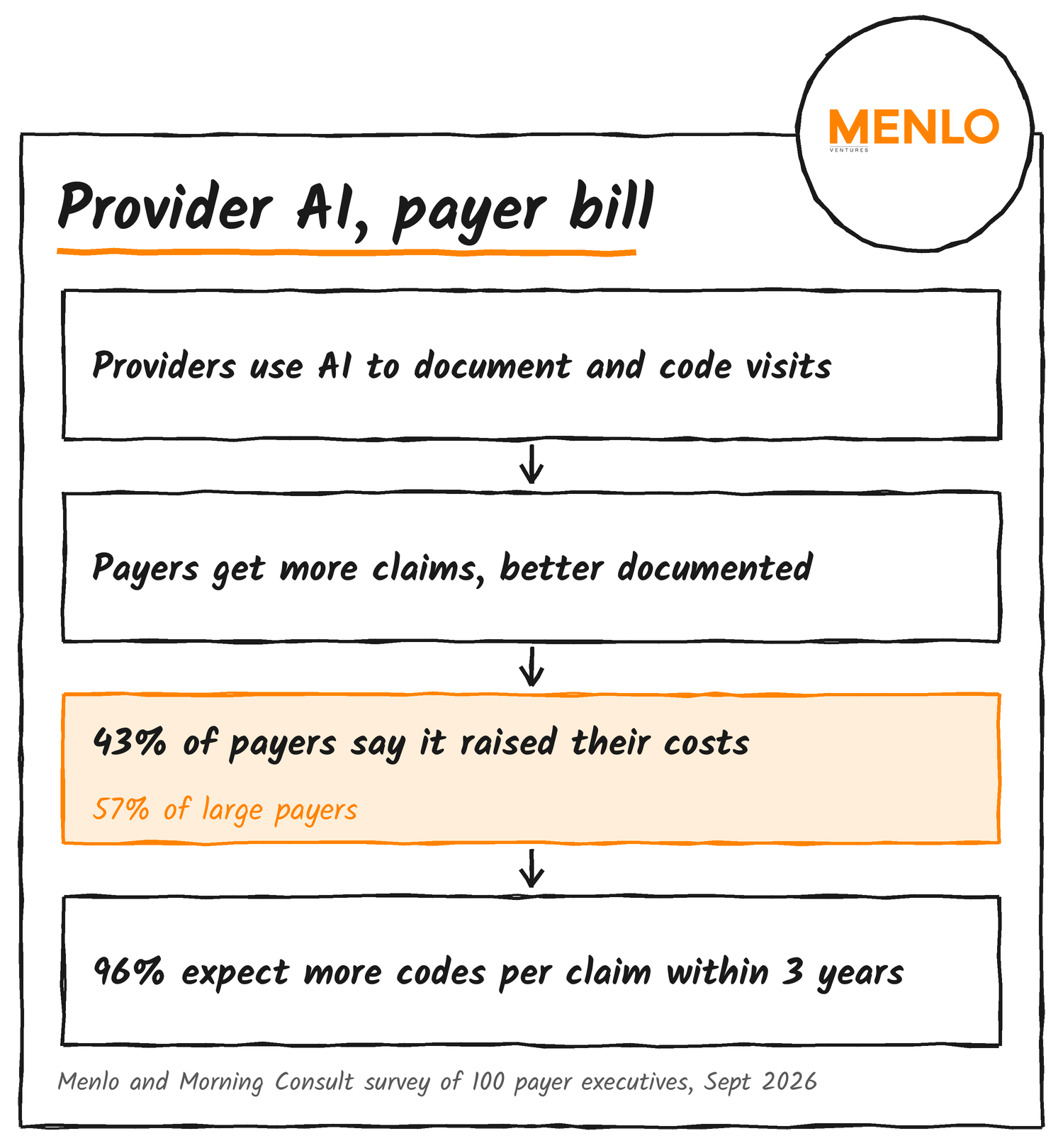
Payers are the laggards. Their AI spend is 19x lower than providers’, though 71% have an AI strategy against 61% of providers. Menlo says 43% of payers, and 57% of large payers, report that provider documentation and coding AI raised their medical cost trend in 2026, up from 23% in 2025. And 52% of payers rank AI-enabled provider coding among their top three cost drivers, behind only specialty drugs and provider rate increases, and 96% expect more codes per claim over the next three years.
A federal rule is shaping what payers buy. Menlo says prior authorisation is now their top AI priority at 82%, up from 59%, after the Centers for Medicare & Medicaid Services set 72-hour and seven-day decision deadlines this year. The rule also requires electronic submission through standardised APIs by January 2027.
The spend totals and category shares are Menlo’s. The report’s methodology section describes the survey sample but doesn’t say how survey answers become dollar figures.
Sources
Discover more from Sulat AI & Tech News
Subscribe to get the latest posts sent to your email.