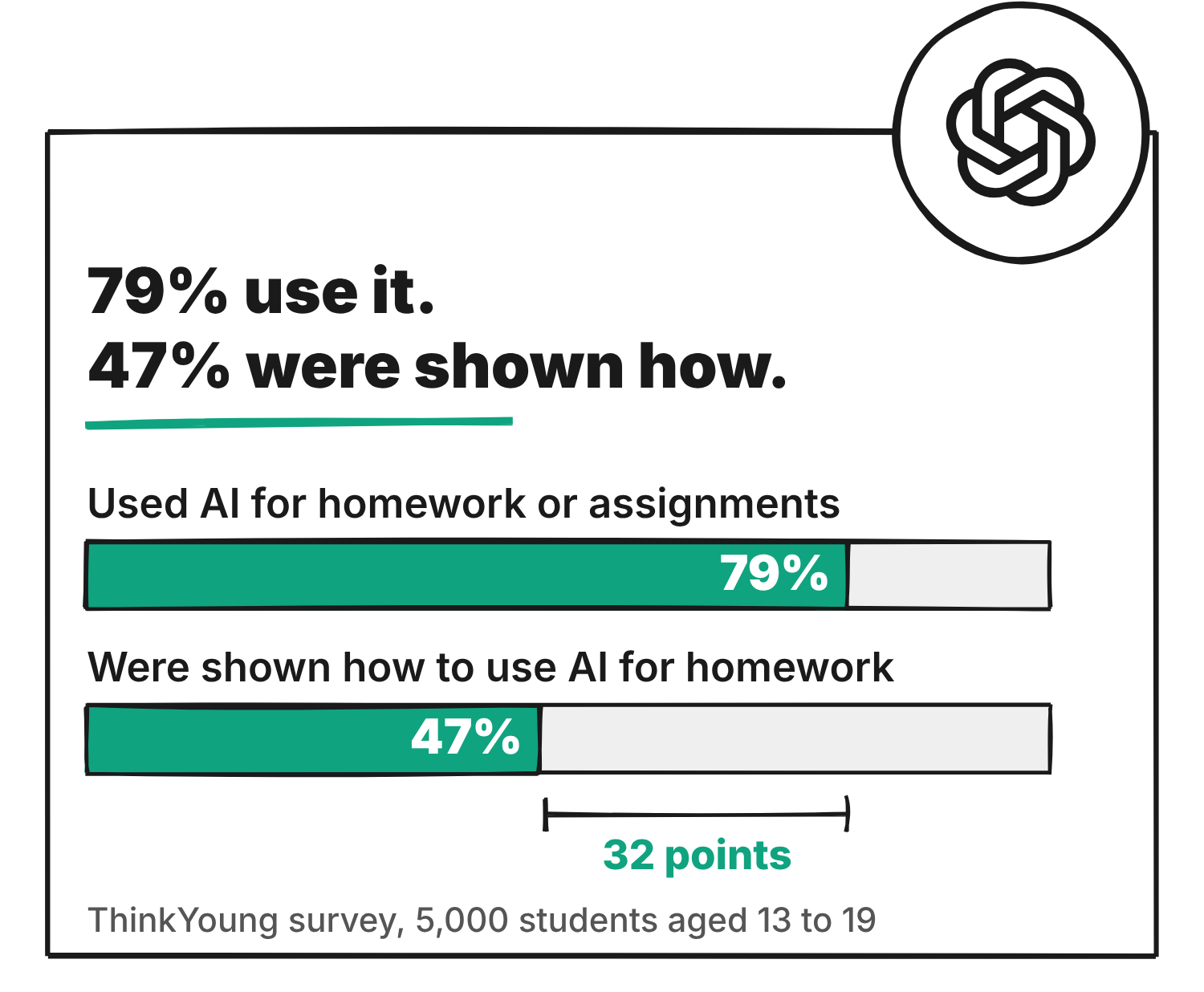
OpenAI published a report on 10 November that cites a survey of 5,000 European secondary students by the think tank ThinkYoung: 79% had used AI for homework or assignments, and 47% had been shown how to use it for those tasks. OpenAI’s own post and the 19-page report both lead with the gap between the two numbers.
The post, “Closing the AI guidance gap in education”, is by Tom Duff Gordon, OpenAI’s VP of Global Affairs for Europe, the Middle East and Africa (EMEA), and Leah Belsky, its VP of Education. The report, “Responsible AI in Education”, covers OpenAI’s education partnerships with governments in Estonia, Slovakia, Greece and Italy. eWeek covered it on 17 November.
What the survey found
ThinkYoung describes itself as an independent, non-profit think tank. Its survey ran from 14 April to 15 May 2026, with 500 students aged 13 to 19 in each of Austria, Estonia, France, Germany, Greece, Italy, Poland, Spain, Sweden and the UK. Quotas were set by gender and region. The full report, dated August 2026, adds a survey of 600 teachers and eight focus groups with students, teachers and parents.
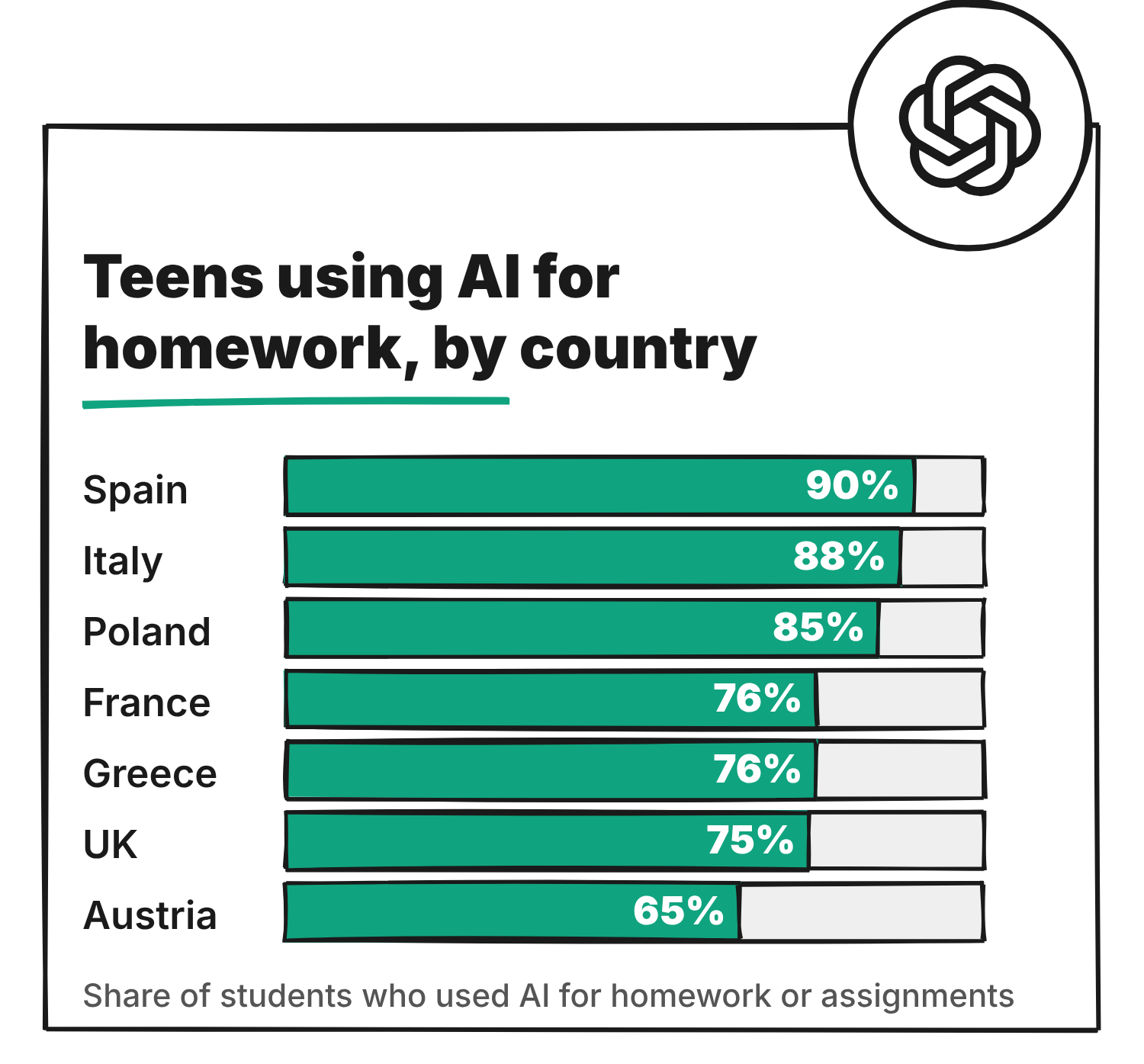
The 79% figure covers all 5,000 students. ThinkYoung’s report puts use highest in Spain at 90%, Italy at 88% and Poland at 85%. France and Greece sit at 76%, the UK at 75% and Austria at 65%.
Among the students who use AI for homework, ThinkYoung says 61% use it to clarify doubts, 47% to look up concepts and 44% to write answers to questions.
The 47% figure is the share who say they’ve been shown how to use AI for homework. A small majority, 57%, say their school has clear AI guidelines. On permission, 43% had their teacher’s approval the last time they used AI for schoolwork, 36% didn’t, and 21% weren’t sure.
Guidance and behaviour
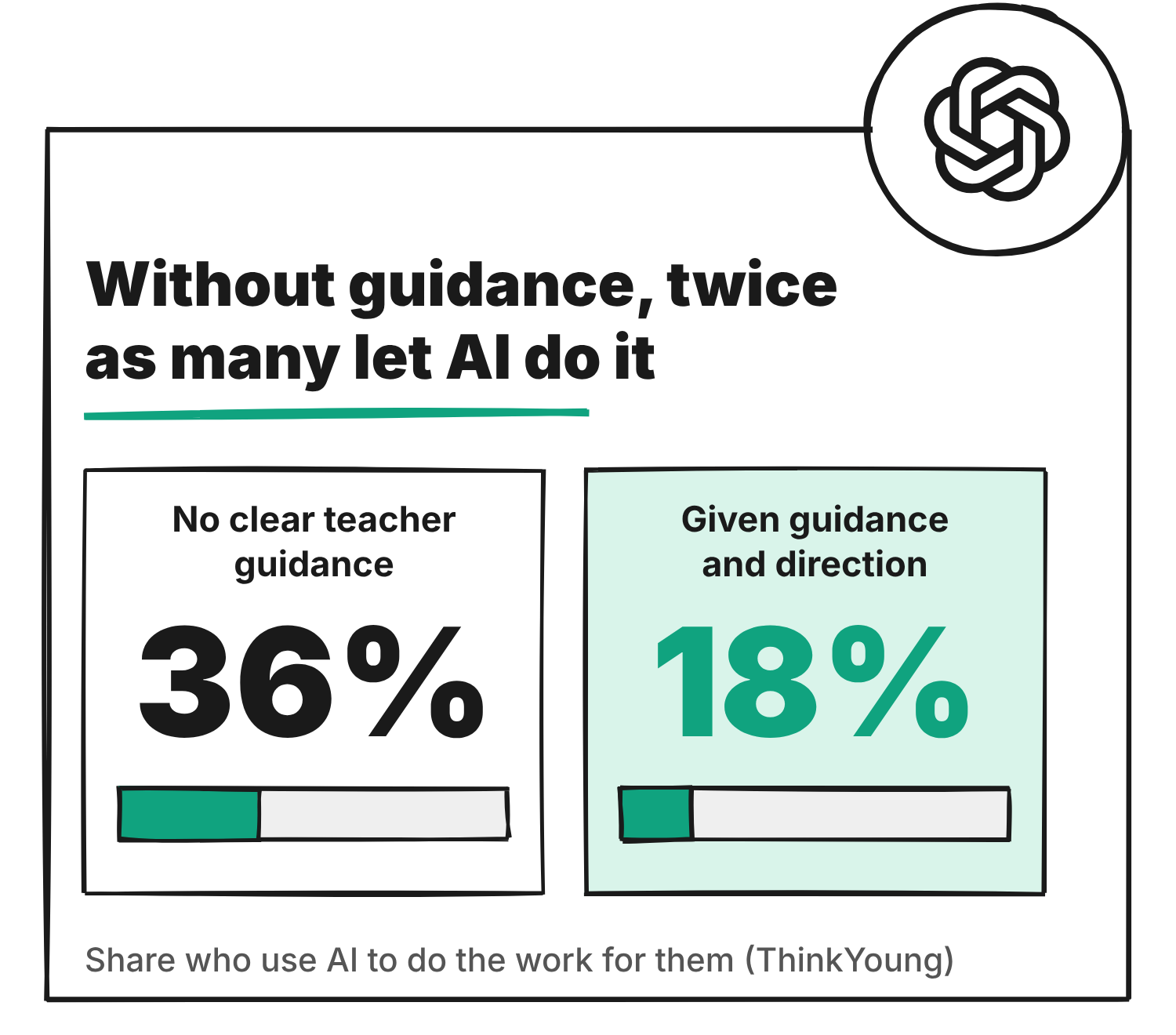
ThinkYoung found that students without teacher guidance were twice as likely to use AI to do the work for them: 36%, against 18% for students who get guidelines and direction. Its report calls teacher stance the most consistent predictor of how students behave with AI.
Students also describe their own habits. 88% say they add their own thoughts to AI output and 74% say they check its accuracy, yet around half say they’d copy AI straight into homework. Only 35% have been shown how to spot bias or misinformation.
What OpenAI’s report adds
OpenAI uses the survey to argue that governments need to give students clearer expectations and equip teachers. Its report is organised around five priorities: a national learning mission, leading with educators, local partnerships, AI literacy and evaluation of outcomes.
The Estonia section covers the AI Leap programme, which gave teachers ChatGPT access in August 2025 and added a customised ChatGPT for learning in January 2026. In a spring 2026 survey, 794 of 828 teacher respondents said they used AI in their work, and 723 estimated they saved 1.8 hours a week. Students were less enthusiastic about the ITI tutor, a customised learning app built on ChatGPT Edu: the report cites a Net Promoter Score of −27.5 and an average satisfaction of 3.07 out of 5 among 182 students. OpenAI’s report says those figures describe how participants experienced the app, and don’t show whether it improved learning.
Greece published a joint ministerial decision in May 2026 that sets common rules for AI in secondary schools. It combines voluntary participation with trained teacher oversight, rules for exams and assignments, and a required AI coordinator in each participating school. It bans fully automated assessment decisions and profiling of students and teachers.
On evidence, the report points to Stanford’s SCALE review, which found only 20 high-quality causal studies among more than 800 papers on AI in K-12 education. It adds that adoption, usage and satisfaction figures don’t by themselves show gains in learning.
ThinkYoung’s full report is available from its site, and OpenAI’s post links to its own report PDF.
Sources
- Closing the AI guidance gap in education, OpenAI, 10 November 2026
- Responsible AI in Education, EMEA report, OpenAI, November 2026
- Views, Experiences and Expectations for AI in Education, ThinkYoung, August 2026
- OpenAI Finds AI Guidance Gap in European Schools as Student Use Surges, eWeek, 17 November 2026
Disclosure: I’m an OpenAI, Firecrawl and Devin ambassador.
Discover more from Sulat AI & Tech News
Subscribe to get the latest posts sent to your email.