Juozas Kaziukėnas reports that ChatGPT is developing a dashboard showing businesses how often they appear in its answers and how many people click through to their websites. He says it counts appearances by brand, not by product.
For a shop owner, that could reveal mentions that never turn into website visits. But a mention alone would not show whether ChatGPT recommended the shop or described its products correctly.
Kaziukėnas posted the finding on 6 November on LinkedIn and X. Search Engine Roundtable’s report was the lead for this article.
What businesses would see
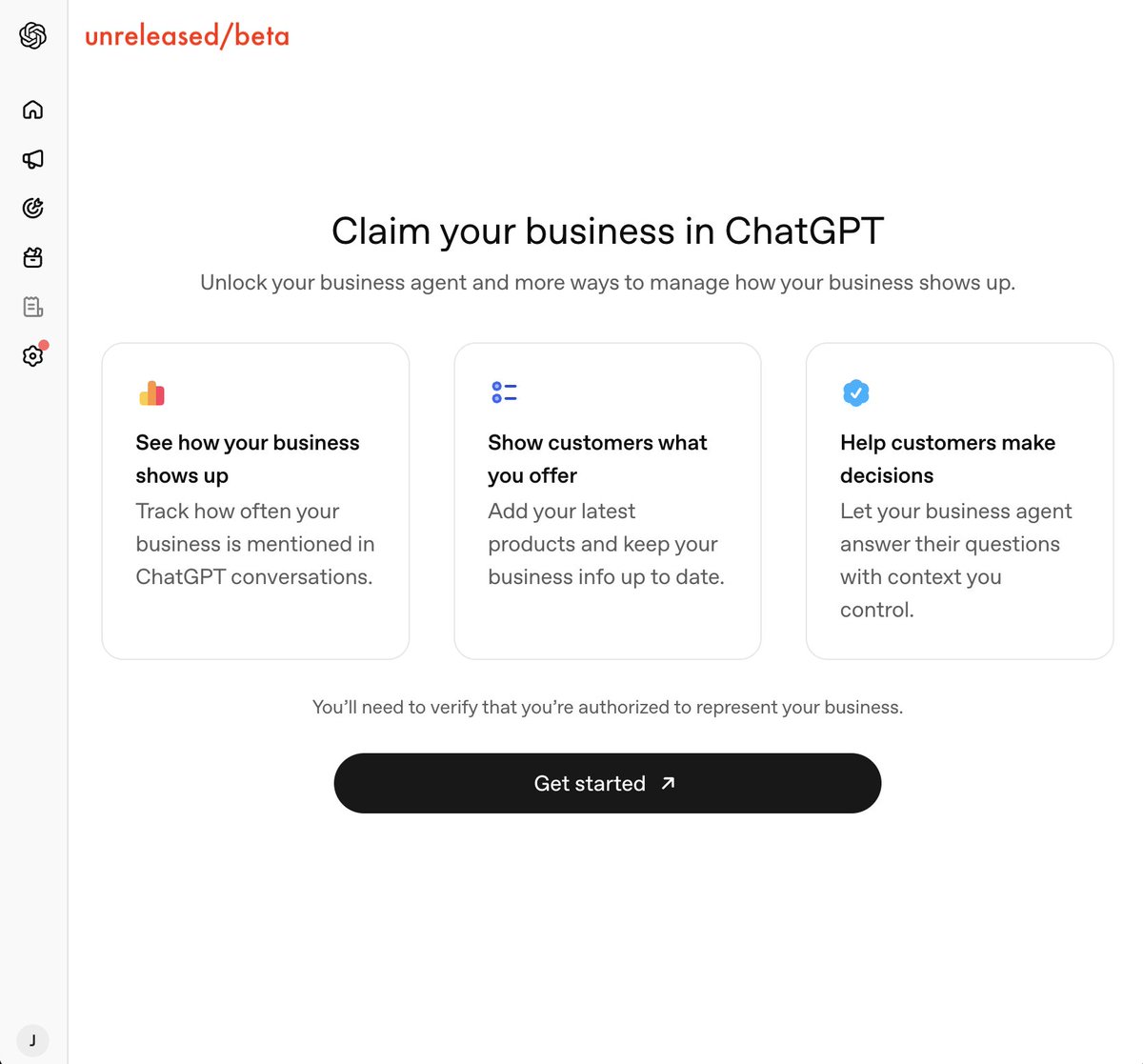
The screenshot opens with “Claim your business in ChatGPT”. Below it are offers to track mentions, add products and update business information, and let a business agent answer customer questions using information the business supplies. Users would have to verify that they are authorised to represent the business.
Kaziukėnas describes a daily chart of impressions and clicks. Here, an impression means the business appeared in a ChatGPT response; a click means someone followed a link to its website. He places the feature inside a wider Business Hub and says connecting a Shopify store is one way to verify ownership.
He also says the tool shows no prompts, user data, competitor benchmarks or rankings. You would get counts of activity, but not the questions that produced it or a league table of other businesses.
Brand totals won’t identify individual products
A reader in the original thread asked whether the counts were for products or brands. Kaziukėnas answered: “Per brand today.”
That matters if you sell several products. A rise in your brand’s total would not tell you which item appeared, whether its specifications were right, or whether ChatGPT suggested buying it. You would need to check those things separately.
The reader, Ulysse HC, put the problem plainly: “A store named for the wrong product, or with a spec it contradicts, would still show up as a win in that chart.” His profile says he checks AI answers about Shopify products and co-founded GEOAngelsAI, so he has a commercial interest in this kind of monitoring. His comment is a question about the metric, not an account of using the dashboard.
A mention is also different from a citation. ChatGPT can name your business in an answer; it can cite a page by linking to it as evidence. The report describes appearances of a business, rather than a count of every time its website is used as a source.
How it differs from the Shopify tools already available
If you sell on Shopify, you may already have products appearing in ChatGPT without access to this reported dashboard. Shopify documents that discovery channel, while OpenAI separately documents an advertising integration. They serve different purposes.
| Tool | What it measures or does | Access and cost |
|---|---|---|
| Reported Business Hub | Daily brand mentions and website clicks, as described by Kaziukėnas. | Requires verified ownership, he says. Launch, price and country rollout are unconfirmed. |
| Shopify product discovery | Makes eligible catalogue products available in ChatGPT; customers buy on your website. | Shopify says stores must sell to US customers, but can be based elsewhere. Standard payment processing fees apply; it lists no additional ChatGPT selling fee. |
| ChatGPT Ads for Shopify | Connects catalogue information and commerce events to paid campaign reporting. | OpenAI says the integration is available to Shopify customers in the US. Its help page does not give an advertising rate card. |
Shopify’s ChatGPT guidance says the discovery channel is active by default for eligible stores. Customers who find a product complete their purchase on the merchant’s checkout, in an in-app browser or a new browser tab. OpenAI points Shopify merchants to that guidance.
A New Zealand Shopify store selling to US customers may qualify, subject to Shopify’s other eligibility requirements.
The advertising integration is a separate connection to ChatGPT Ads Manager. It synchronises product information and commerce events for campaigns, with performance reports available through Shopify and Ads Manager. Buying ads is not the same as measuring unpaid appearances in answers.
What you can check now
Start with the traffic and orders you can already see. Shopify says an order’s conversion summary can show chatgpt.com as a referrer and identify the page where a customer arrived. Even a limited summary may keep that information when a full visit history is unavailable.
Some orders have no conversion details, and summaries can take up to 48 hours to appear. If a sale has no recorded ChatGPT referrer, you cannot tell from that absence alone whether the customer saw your business there.
Next, check your product pages. Do they give the right prices, availability and specifications? If the dashboard eventually shows more mentions, you will still want to know that customers are being sent to accurate information.
If you rely on web search rather than a Shopify catalogue, OpenAI says your site must allow OAI-Searchbot and its published IP addresses through your host or content delivery network to be eligible for search inclusion. Allowing the crawler makes the site accessible; it does not guarantee placement.
Keep a dated record of changes to your pages. If mentions or clicks rise later, that record gives you something to investigate. Seasonal demand, different customer questions and changes to ChatGPT could also move the totals, so a rise after an edit would not prove the edit caused it.
What remains unconfirmed
The screenshot is labelled “unreleased/beta”. We have not accessed the dashboard, checked its counts or found an OpenAI launch announcement in the official material reviewed. Kaziukėnas is the source for the new feature; the help pages confirm the surrounding Shopify and advertising tools.
There is no confirmed public launch date, price or country rollout for the reported Business Hub in those sources. They also leave out the reporting history, export options and counting rules, including how repeated appearances or businesses with similar names would be handled.
That makes comparisons with Google Search Console premature. There are no reported query-level results or rankings, and a promise to supply context for a business agent does not mean a company can control every ChatGPT answer about it.
If you get access, check how the service defines a mention and a click before comparing them with your own reports. Then follow those clicks through to enquiries or orders. Brand appearances, website visits and paying customers are different measures; the reported dashboard would cover only part of that journey.
Sources
- Juozas Kaziukėnas: original report on LinkedIn
- Juozas Kaziukėnas: original X post and screenshot
- Juozas Kaziukėnas: “Per brand today” clarification
- Search Engine Roundtable: the lead report, 6 November 2026
- Shopify: Selling on ChatGPT
- Shopify: Viewing order conversion summary
- OpenAI: Set up ChatGPT Ads for Shopify
- OpenAI: Searching the web with ChatGPT
- OpenAI: Shopping from Shopify merchants in ChatGPT
- Ulysse HC: question about brand totals and incorrect product mentions
Discover more from Sulat — AI & Tech News
Subscribe to get the latest posts sent to your email.