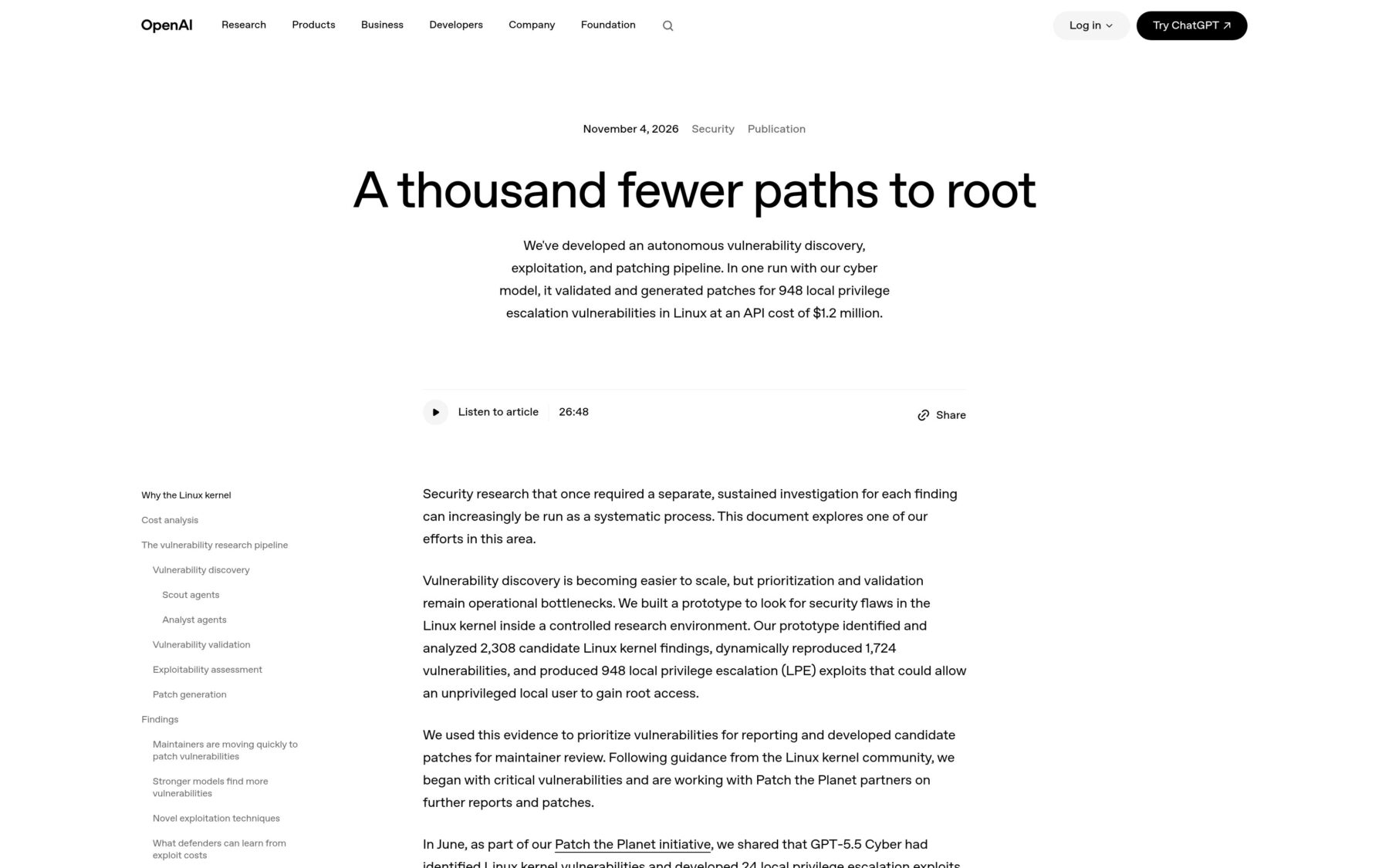
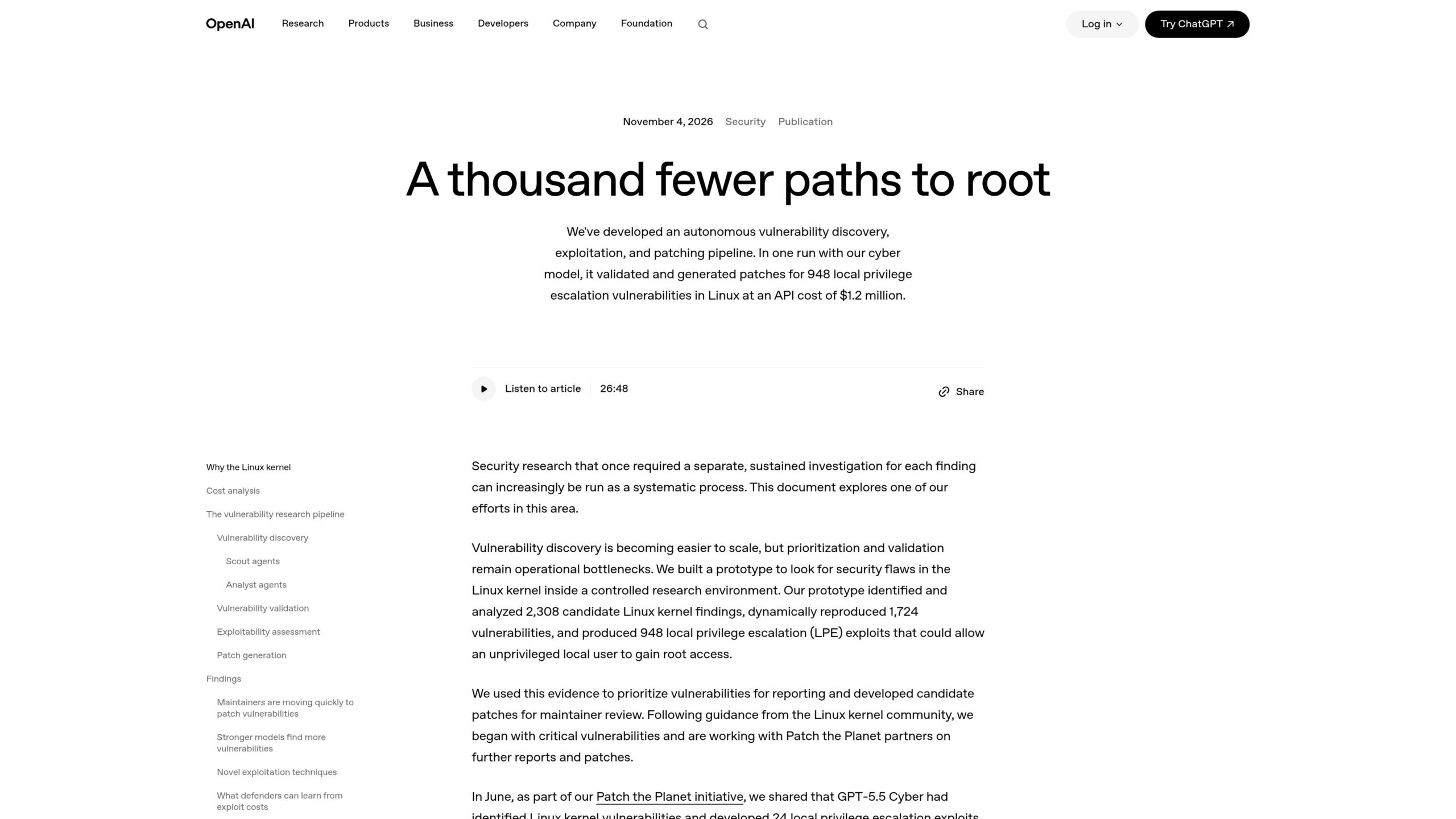
OpenAI has detailed an autonomous vulnerability-research pipeline that moves from discovery to validation, exploitability assessment and candidate patches. In a mid-October run against a commonly used Linux distribution, it reports 948 working local privilege-escalation exploits and 291 information-leak proofs of concept.
The run began with 2,308 candidate findings and dynamically reproduced 1,724 vulnerabilities. OpenAI puts the total API cost at $1,213,430, or about $1,279 per working LPE exploit. That number is important: the work demonstrates scale, but not cost-free or fully autonomous security.
Validation is the operational bottleneck
Finding suspicious code is only the first step. The pipeline uses static analysis to propose findings, isolated dynamic testing to reproduce them, and exploitability assessment to understand which security boundary is crossed. It then produces a root-cause analysis, minimal crashing case, candidate patch and supporting exploit for expert review.
OpenAI says human researchers reviewed the outputs before reporting vulnerabilities and patches. That division of labour is the meaningful architecture: machines generate and test candidates at scale; maintainers and experts remain responsible for correctness, severity and integration.
The findings do not map neatly to immediate risk
The research environment was controlled and the target was a stock desktop installation rather than a deliberately weakened system. Even so, the number of working research exploits is not the same as the number of unpatched vulnerabilities exposed in every production environment. OpenAI notes that maintainers patched or staged fixes for more than 100 Linux LPEs during the scan window, with hundreds more under public discussion.
The defensive conclusion is less dramatic but more actionable: patch cadence, attack-surface reduction, least privilege and isolation layers such as Firecracker and gVisor still determine the blast radius.
A new maintenance equation
OpenAI reports that its newer model found more than five times as many novel LPEs as an earlier run, despite intervening hardening. If discovery continues accelerating, patch review and coordinated disclosure become even more important.
For operators, the response is not to reproduce the research exploits. It is to track upstream advisories, reduce unnecessary kernel features, test updates and assume that local compromise can become privilege escalation on unpatched systems.
The editorial lens
A security headline is the beginning of a risk assessment, not its conclusion. The important details are the affected versions, prerequisites, reachable attack surface and available fixes. Responsible coverage distinguishes a demonstrated research result from evidence of active exploitation, and it keeps the emphasis on defensive prioritisation rather than attack instructions. Isolation and least privilege remain important because a single component can fail; the host, kernel, service account and deployment configuration all influence the blast radius.
Start with the affected asset inventory and the vendor’s exact version and configuration guidance. Establish whether the vulnerable path is reachable, what privileges an attacker would need and which controls limit the result. Patch or mitigate in a test environment first, then verify the deployed version and watch relevant logs. Research claims can be urgent without being universally exploitable. Careful triage keeps teams focused on exposure and remediation instead of headline severity.
A compressed source summary cannot carry every operational detail. It may omit rollout timing, benchmark construction, eligibility, dependencies or conflicting results. That does not make the source wrong; it defines the limit of what the summary alone proves. Treat the initial report as a claim to be tested rather than a universal outcome. Check availability and version details for releases, reproducibility for research, and delivered usage for business claims. Where possible, run a small reversible evaluation and keep its measurements. Corrections and follow-up reporting can materially change the interpretation, especially when the underlying technology, pricing or policy is moving quickly. This distinction between a publisher’s evidence and its broader applicability is essential to responsible technical coverage.
Read OpenAI’s methodology, cost breakdown and defensive reflections.
Discover more from Sulat — AI & Tech News
Subscribe to get the latest posts sent to your email.