Safari 27.3 beta introduces Adaptive Dark Mode, a user-enabled feature that turns light websites dark even when their authors never supplied a dark theme. WebKit cites a substantial mismatch: nearly 40% of page loads come from users in dark mode, while only about 10% support it.
The feature leaves pages alone when they declare dark-mode support through color-scheme or already have a predominantly dark appearance. For other sites, Safari analyses the page and applies transformations inside the browser engine.
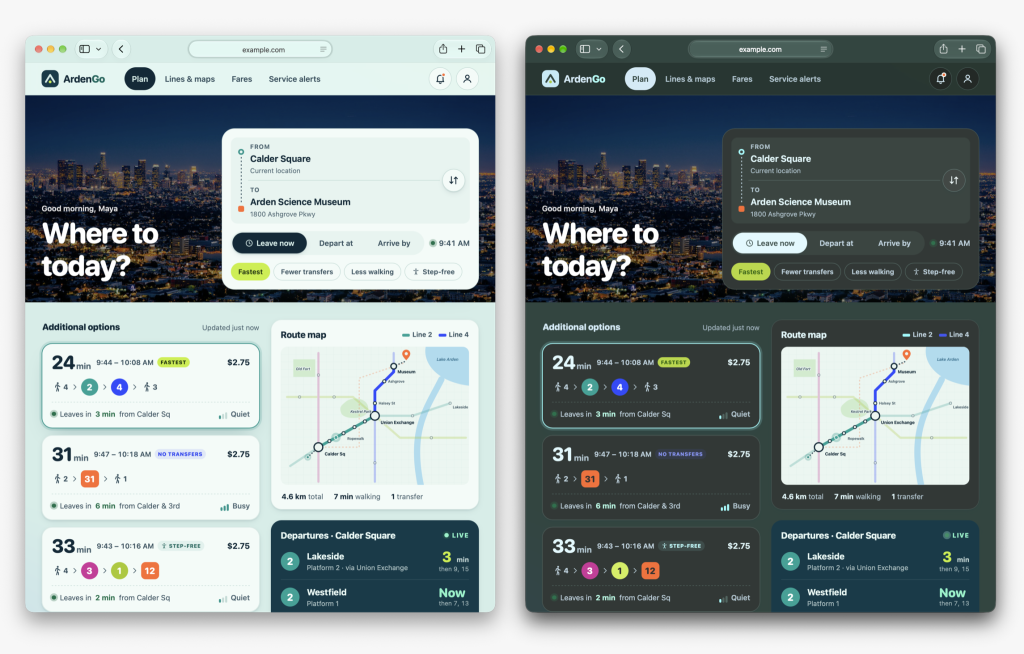
Inversion without losing meaning
WebKit developed a colour matrix that changes luminosity while preserving hue. Text transformation targets the WCAG 4.5:1 contrast ratio, and light gradients become dark. The browser also makes contextual decisions about buttons, menus and text over images rather than applying a single global filter.
Images require particular care. Most remain unchanged, but SVGs can be transformed when contrast demands it, and simple black-and-white bitmap logos can be inverted after histogram analysis. Canvas content stays original because its semantics are difficult to predict.
Good markup still wins
WebKit recommends modern CSS colours and gradients, SVG icons, transparent content images and adequate container padding. Sites can declare color-scheme: light dark, use prefers-color-scheme, picture sources and light-dark() to provide a deliberate experience.
A light-only declaration will tell Safari not to transform a site or a particular element, although WebKit notes that the only keyword is not supported in the first beta. Early implementation details may therefore change.
Privacy is part of the rendering design
If a website could detect adaptive transformation, that preference would become another fingerprinting signal. Safari therefore returns authored colours to JavaScript and keeps canvas image data in its original form.
For site owners, the practical response is straightforward: declare supported schemes early in HTML or CSS, test both appearances and treat dark mode as an accessibility and design-system feature rather than an afterthought.
The editorial lens
Software changes become consequential when they meet existing code, deployment habits and user expectations. Compatibility, observability and maintenance capacity often determine the real cost of adopting a new architecture or framework. That is particularly true for foundational libraries and infrastructure, where a small behavioural change can propagate through many downstream systems. In infrastructure, the crucial follow-through is boring but decisive: reproducible benchmarks, clear failure modes, rollback plans and predictable behaviour under load.
Before adopting a technical change, reproduce it on a representative codebase and document the migration path. Compare behaviour, resource use and failure modes with the existing implementation. Check whether tests cover edge cases and whether logs make failures diagnosable. Review release cadence, maintainer responsiveness and the effort required to roll back. A feature that saves time in a demo can create years of maintenance if its abstractions are difficult to inspect or its compatibility story is vague.
A compressed source summary cannot carry every operational detail. It may omit rollout timing, benchmark construction, eligibility, dependencies or conflicting results. That does not make the source wrong; it defines the limit of what the summary alone proves. Treat the initial report as a claim to be tested rather than a universal outcome. Check availability and version details for releases, reproducibility for research, and delivered usage for business claims. Where possible, run a small reversible evaluation and keep its measurements. Corrections and follow-up reporting can materially change the interpretation, especially when the underlying technology, pricing or policy is moving quickly. This distinction between a publisher’s evidence and its broader applicability is essential to responsible technical coverage.
Read WebKit’s implementation and authoring guidance.
Discover more from Sulat — AI & Tech News
Subscribe to get the latest posts sent to your email.