PostgreSQL major releases have settled into a predictable rhythm, but version 19 will probably miss it. Major contributor and committer Robert Haas says the release is likely to arrive in November, with further delay possible. His explanation is not a sudden collapse in code quality—it is a sudden improvement in bug discovery.
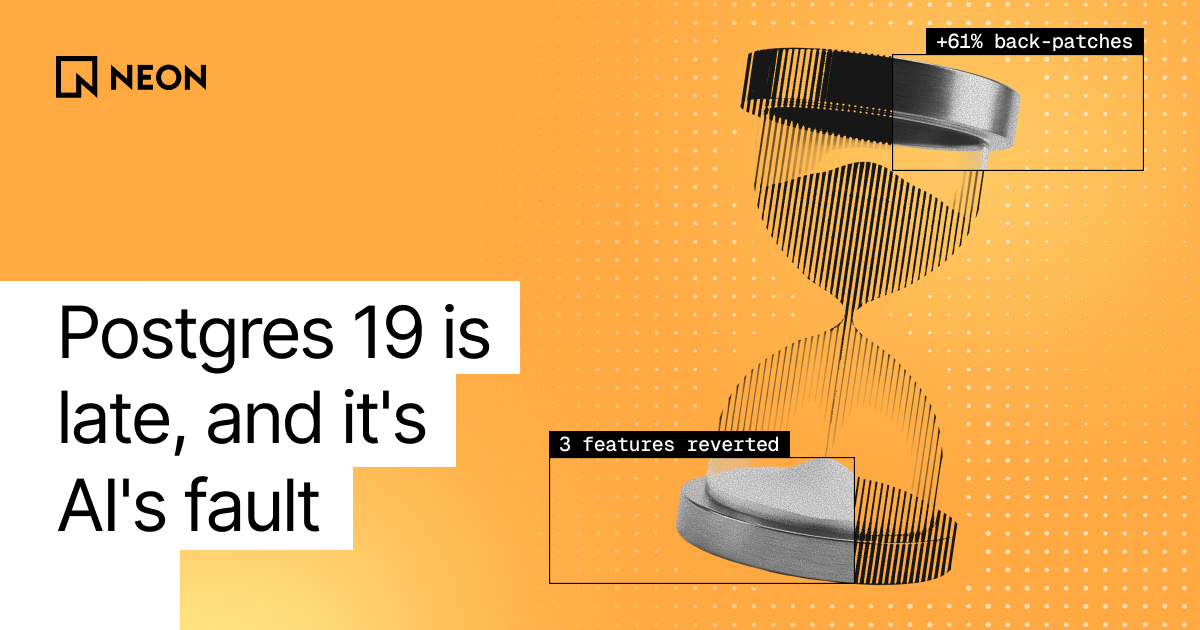
Haas reports that between April 8 and September 25, commits to the current stable branch rose from 724 in 2025 to 1,169 in 2026, an increase of more than 60%. Fixes reaching at least one prior release rose by more than 74% over the same comparison.
Discovery scaled faster than review
Haas’s assessment is that many more people are reporting PostgreSQL bugs found with LLMs. The models can also draft fixes, but those fixes still need to be correct, robust and compliant with project standards. Experienced reviewers have not become proportionally faster.
That diverted time from evaluating new release features and contributed to several late reversions, including SQL Property Graph Queries and partition-related changes. The delay is therefore a maintenance-capacity story rather than simply an AI-success or AI-failure story.
A short delay can be a healthy decision
Haas does not present the postponement itself as especially concerning. Shipping later to address defects and remove features that are not ready is consistent with the project’s quality goals.
The harder question is what happens when decades of latent defects become discoverable faster than maintainers can process them. A project can appear to slow down precisely because it is fixing more important problems.
Every maintainer needs a triage strategy
Projects should expect more reports with uneven quality. Reproduction requirements, deduplication, security triage, automated regression tests and clear contribution standards become essential filters. Model-generated fixes need the same scrutiny as model-generated feature code.
For users, the practical response is to value back-branch fixes and maintenance work, not just headline features. For contributors, the opportunity is to make review easier with minimal reproductions, careful root-cause analysis and tests that demonstrate why a fix is safe.
The editorial lens
Software changes become consequential when they meet existing code, deployment habits and user expectations. Compatibility, observability and maintenance capacity often determine the real cost of adopting a new architecture or framework. That is particularly true for foundational libraries and infrastructure, where a small behavioural change can propagate through many downstream systems. In infrastructure, the crucial follow-through is boring but decisive: reproducible benchmarks, clear failure modes, rollback plans and predictable behaviour under load.
Before adopting a technical change, reproduce it on a representative codebase and document the migration path. Compare behaviour, resource use and failure modes with the existing implementation. Check whether tests cover edge cases and whether logs make failures diagnosable. Review release cadence, maintainer responsiveness and the effort required to roll back. A feature that saves time in a demo can create years of maintenance if its abstractions are difficult to inspect or its compatibility story is vague.
A compressed source summary cannot carry every operational detail. It may omit rollout timing, benchmark construction, eligibility, dependencies or conflicting results. That does not make the source wrong; it defines the limit of what the summary alone proves. Treat the initial report as a claim to be tested rather than a universal outcome. Check availability and version details for releases, reproducibility for research, and delivered usage for business claims. Where possible, run a small reversible evaluation and keep its measurements. Corrections and follow-up reporting can materially change the interpretation, especially when the underlying technology, pricing or policy is moving quickly. This distinction between a publisher’s evidence and its broader applicability is essential to responsible technical coverage.
Read Haas’s full analysis.
Discover more from Sulat — AI & Tech News
Subscribe to get the latest posts sent to your email.