Apple’s newly announced AI system puts writing assistance, image creation and a more context-aware Siri inside its operating systems. But the useful distinction isn’t simply whether a task happens on a phone or in the cloud. Apple has described three processing paths, with different controls over what leaves the device and who handles it.
The June 10 announcement presents Apple Intelligence as a free addition to iOS 18, iPadOS 18 and macOS Sequoia. Its initial beta is planned for the northern autumn, not the day’s operating-system developer betas. Eligible hardware is iPhone 15 Pro or Pro Max, and iPads and Macs with M1 or later. Both Siri and the device must use U.S. English. Apple says some features, platforms and additional languages will follow over the next year.
File photo: Apple logo on an iMac, © Håkan Dahlström, 2010. CC BY 2.0, via Wikimedia Commons. Resized and cropped; this isn’t an Apple Intelligence launch photograph.
Local work and Apple’s cloud aren’t the same path
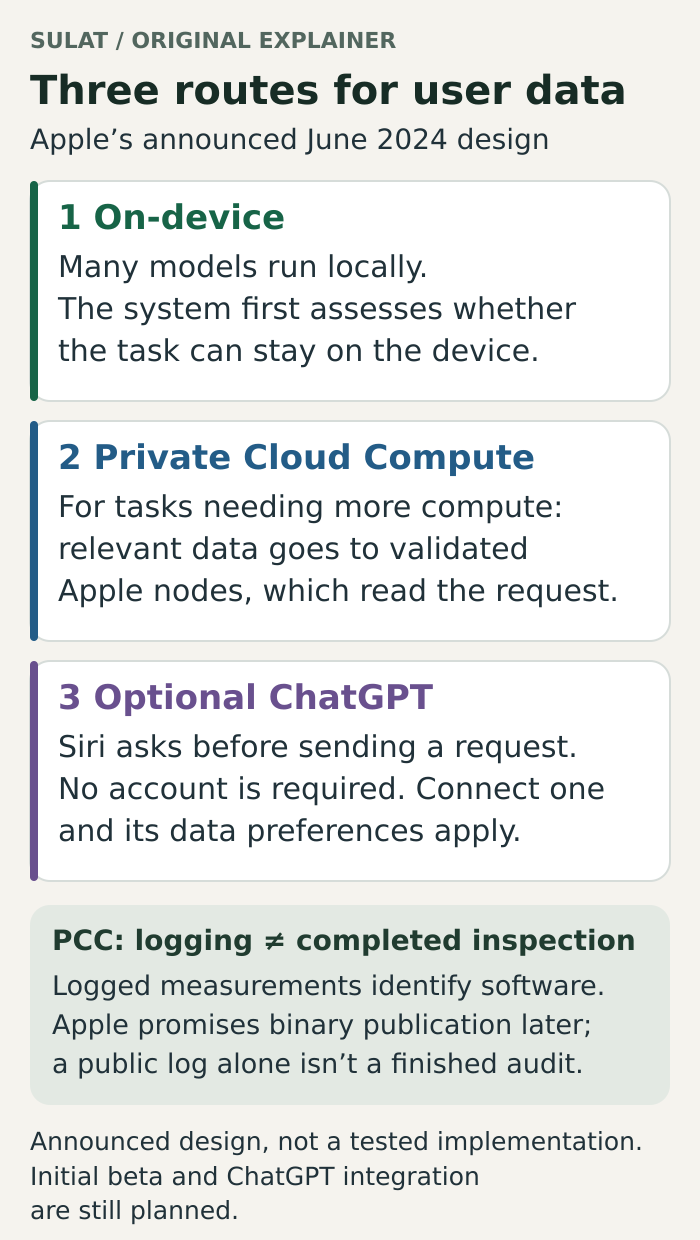
Many of Apple’s models will run entirely on the device. Image Playground is one concrete example: Apple says its images are generated locally. That doesn’t mean every feature or every request will stay there.
Apple’s separate privacy announcement says the system first assesses whether a request can be handled on-device. When it needs more computing capacity, it can send relevant task data to Private Cloud Compute, or PCC, running on Apple silicon servers.
The initial PCC technical overview explains an important distinction: the server must read the request to perform inference. The request is encrypted from the device to validated PCC nodes, but the computation itself isn’t performed on unreadable encrypted data.
Apple’s proposed protection therefore depends on restricting those nodes. Its design excludes remote shells and interactive debugging, limits operational reporting to specified logs and metrics, and deletes request data after answering. These are Apple’s architectural claims, not an independent security certification. Encryption in transit and restrictions on processing are complementary measures, not interchangeable descriptions of privacy.
Inspectable software is a separate commitment
PCC also links the device’s decision to send data to evidence about the receiving software. Apple says a device will encrypt its request only for nodes whose attested software measurements match a release in a public transparency log.
A logged measurement, however, isn’t the same thing as an immediate public review of the corresponding software. Apple commits to publishing production binary images within 90 days of their inclusion in the log, or after relevant software updates become available, whichever is sooner.
The company also promises a Mac-based virtual research environment and periodic publication of a subset of security-critical source code. Those are forthcoming research facilities in this initial announcement, not tools this report has tested. The distinction matters: the design ties requests to identifiable software, while outside examination still needs the promised artifacts and research work.
ChatGPT is an optional handoff, not PCC
The GPT-4o-powered ChatGPT integration is a separate route planned for later this year. Siri will ask before sending questions and accompanying documents or photos to ChatGPT. Writing Tools will also offer ChatGPT for composition and image generation.
Apple and OpenAI’s announcement says access will be free without an account, with IP addresses obscured and requests not stored by OpenAI. People who connect a ChatGPT account instead bring their data preferences under ChatGPT’s policies; subscribers can access paid features.
That account choice is distinct from the decision to approve a Siri handoff. Neither should be confused with PCC’s server-attestation mechanism. For anyone evaluating the announcement, the relevant questions are which system receives a particular request, what consent applies, and which implementation details are available for inspection.
Discover more from Sulat AI & Tech News
Subscribe to get the latest posts sent to your email.