Google has introduced Willow, a 105-qubit quantum processor that improves the reliability of stored quantum information as more physical qubits are used to protect it.
Published online in Nature on 9 December 2024, the result demonstrates progress in quantum memory, not a finished general-purpose quantum computer.
More qubits, fewer logical errors
Quantum error correction spreads one logical qubit across physical qubits. Extra hardware helps only below an error-rate threshold. Otherwise, additional mistakes overwhelm the protection.
Google’s researchers reduced logical errors roughly twofold at each increase in surface-code distance, from three to five to seven. This below-threshold behaviour is essential for scaling.
The largest memory experiment used 101 physical qubits and recorded a logical error rate of 0.143% per correction cycle. Its logical memory lasted about 2.4 times as long as its best individual physical qubit.
A separate sampling benchmark
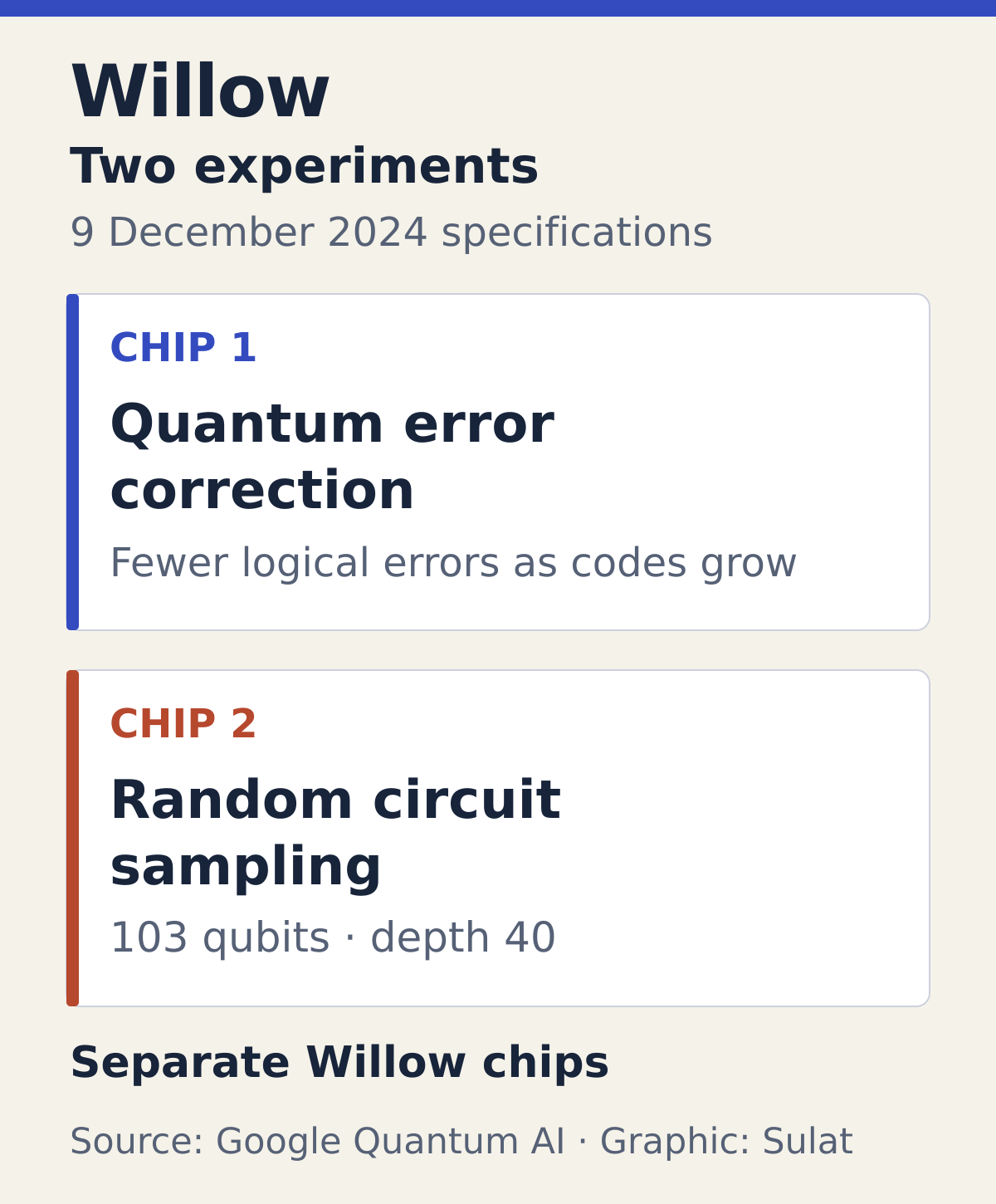
Google also reports random-circuit-sampling results. Its 9 December specification sheet lists separate Willow chips for the error-correction and sampling experiments. The sampling run used 103 qubits.
Random circuit sampling tests a processor using specially constructed quantum circuits. It does not demonstrate an advantage on a useful commercial workload, a distinction Google makes in its announcement.
What still needs work
Google’s technical explanation identifies remaining obstacles. Separate repetition-code tests, which protect against a narrower class of errors, hit an error floor whose cause remains under investigation. Decoding delays can also slow some error-corrected operations, even when the decoder keeps pace with incoming measurements.
Preserving this performance on much larger processors remains an engineering challenge. Willow strengthens the case for scalable error correction; running large, reliable algorithms is still the task ahead.
Featured illustration: Sulat. Official logo: Google. Decorative lattice, not a hardware diagram.
Discover more from Sulat AI & Tech News
Subscribe to get the latest posts sent to your email.