Three US House committee chairs want Jensen Huang to explain what happened around one of Nvidia’s customers. The questions reach beyond the chief executive’s contacts: they want to examine how the company protects information, recognises a suspect business relationship and responds when government officials raise concerns.
In a letter dated 4 November, reviewed by Reuters, the chairs sought a closed-door briefing on Nvidia’s safeguards.
“security protocols against foreign adversary espionage”
Excerpt from the House chairs’ letter, quoted by Reuters, 5 November.
On 7 November, the Financial Times reported, citing people familiar with the matter, that a US intelligence-based memo alleged a romantic relationship between Huang and Alice Huang, an executive associated with Singapore-based Nvidia customer Megaspeed. It said US intelligence believed she had been recruited by China’s Ministry of State Security. Nvidia declined specific comment to the FT on the memo and intimate-relationship assertions.
That allegation remains unproven in the public material reviewed for this article. Nvidia has described the business contacts as ordinary and denied sharing sensitive information. China has rejected the espionage report. Singapore, meanwhile, has publicly disputed a part of the reporting about its own authorities.
The documents put a more substantial question beneath the controversy: how much can Nvidia demonstrate about a customer relationship after hardware has left its control, and how should outsiders test the answer? Company filings, export-policy documents and technical specifications provide a way to examine that question without assuming the most dramatic claims are true.
About this investigation
A public-record review and analysis, current to 8 November 2026. Sulat has not obtained the intelligence memo, independently verified its allegations or interviewed the people involved. Quoted responses below are attributed to the publications that obtained them.
The rebuttal that cannot be left out
The Wall Street Journal described concerns among officials in the US, Singapore and Taiwan about Alice Huang, also known as Huang Le and unrelated to Nvidia’s chief executive. Its sources said US officials had concluded that she was sharing information with Beijing.
On 31 October, Singapore’s Ministry of Home Affairs published the Journal’s questions and the government’s response. The ministry denied that its officials had expressed the reported concerns. Its annex separately confirmed a company investigation.
ALICE HUANG
“And there were no such investigations conducted in respect of Alice Huang.”
Singapore’s Ministry of Home Affairs
MEGASPEED
“Investigations into Megaspeed are ongoing.”
Police reply reproduced in the same statement
Source: Singapore Ministry of Home Affairs, 31 October. The Journal subsequently included the ministry’s denial.
The distinction cuts both ways. Singapore’s rebuttal does not clear Megaspeed, while an ongoing investigation into the company does not establish that Alice Huang was an intelligence asset. The statement also does not resolve what US officials may know.
A list of countries can make an allegation appear independently corroborated. But officials might possess separate evidence, share a single assessment or be discussing the same report. The public accounts do not establish which happened here. Singapore’s published correspondence makes that uncertainty impossible to dismiss as a technicality.
From a newspaper report to a congressional request
The original allegations appeared in The New York Times on 29 October, according to ABC’s subsequent reporting. In the following days, the story produced company responses, a Chinese denial, Singapore’s rebuttal and a request from Congress. Those are different kinds of developments: a response verifies a position was taken, not the underlying accusation.
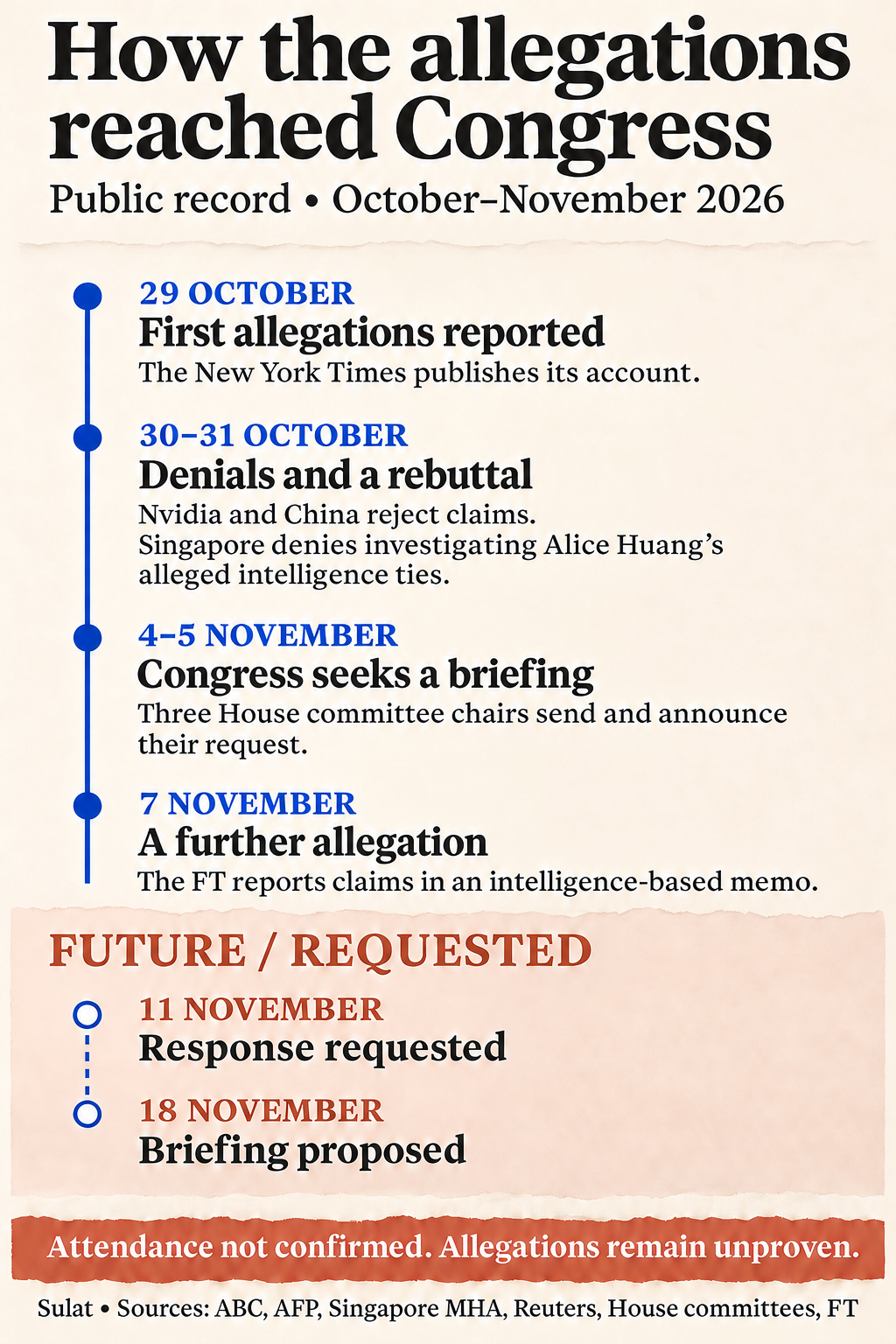
The 5 November announcement identifies the chairs as Brian Mast of Foreign Affairs, John Moolenaar of the China select committee and Rick Crawford of Intelligence. They requested a joint briefing on 18 November and asked Huang to accept that date or propose another by 11 November.
The requested session is closed-door. As of this review, attendance is not established. The public sources examined also do not establish criminal charges or a judicial finding against either Huang in this matter; this was not an exhaustive court-docket search, and sealed proceedings would not be visible.
Congress can investigate a risk before prosecutors establish a crime. That is a reason to take the request seriously, while preserving the difference between scrutiny and a finding. The quality of the eventual answers will depend on whether lawmakers obtain records that test the claims, rather than simply asking the company and officials to repeat their positions.
What Nvidia has actually denied
Nvidia’s defence begins with the nature of the relationship. In a statement obtained by ABC News, it characterised the contacts as normal dealings between a chief executive and a customer representative.
“Jensen’s interactions with Ms. Huang are not unusual or unexpected”
Nvidia spokesperson, in a statement to ABC News, 31 October.
The company also told ABC it receives and acts on government updates about parties of concern. That assertion supplies a specific line of inquiry: what information reached Nvidia, who received it and what response followed? It does not establish that officials delivered any particular warning about this person, or that Nvidia ignored one.
To AFP, Nvidia said customer discussions involved ordinary business information, not national-security information or sensitive trade secrets. It also said earlier allegations of chip smuggling involving Megaspeed had been investigated and disproved. Those statements address information-sharing and hardware diversion. They should not be stretched into an independently verified finding about the separate personal allegation.
Beijing’s response was categorical:
“The report in question is based on groundless speculation”
Foreign ministry spokesperson Guo Jiakun, as rendered in English by AFP, 30 October. The ministry’s official English transcript uses different wording for the same denial.
The responses deserve to sit beside the allegations, with their scope intact. Describing a meeting as routine can explain why it occurred. Establishing what was said requires something more specific. Equally, a claim that somebody represented an intelligence service needs evidence of that connection; it cannot be inferred from nationality, customer access or a shared surname.
The three questions that keep getting entangled
Executive contacts, physical shipments and remote computing access are related business activities. They leave different records. A persuasive inquiry would follow each, then establish any connection between them, rather than use uncertainty in one area to fill a gap in another.
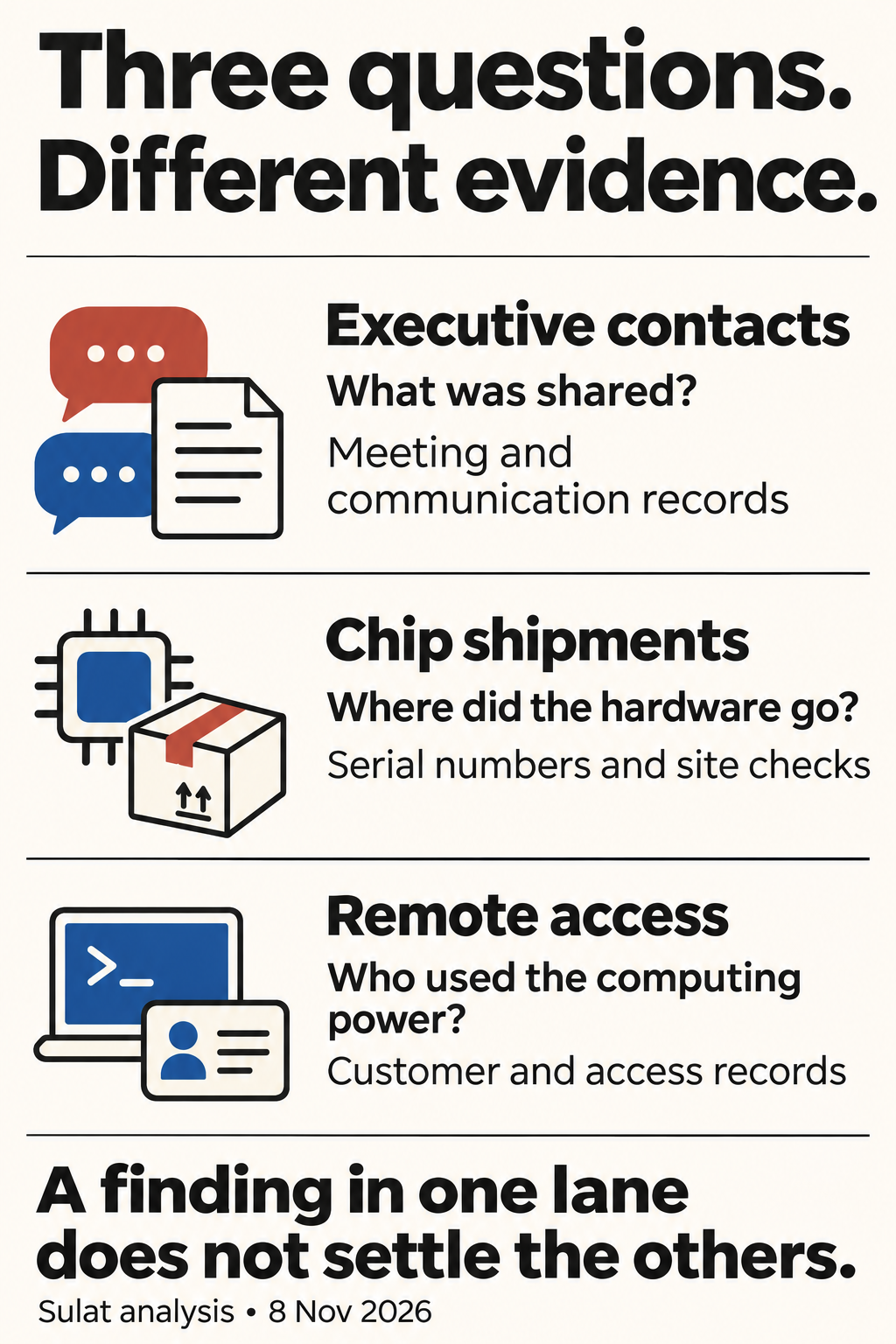
For executive contacts, the central question is what information passed between people and under what circumstances. A calendar entry can establish a meeting. A conversation record, contemporaneous note or properly authenticated communication could help establish its substance. Neither would automatically prove that a recipient acted for a foreign government.
For hardware, the task is to reconcile identifiable equipment across sales, delivery, installation, movement and retirement. A total count is useful only when reviewers know what population was counted, on what date and against which baseline. Missing equipment would warrant investigation, but a discrepancy could have several explanations that records would need to resolve.
Why the server’s address is only one answer
A server can stay in one country while customers use it from another. Its physical location does not, by itself, identify the people using its computing power.
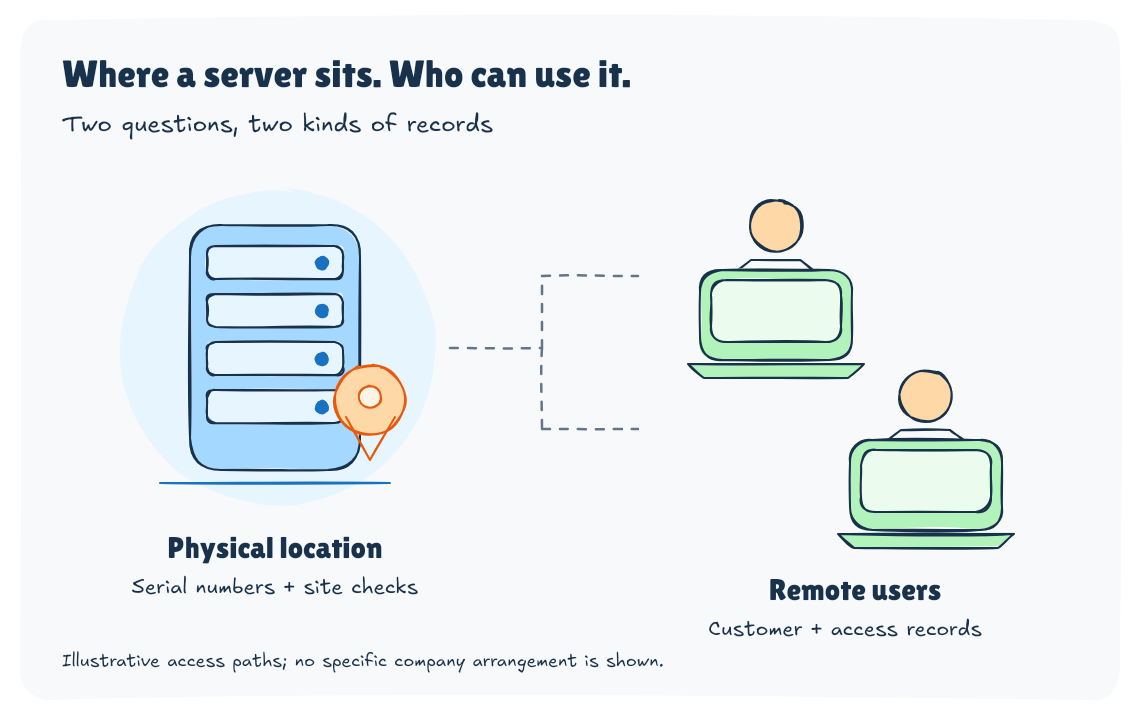
Remote access therefore calls for a further examination of the service relationship: customers, authorised accounts, permitted uses and relevant access records. Whether a particular arrangement is lawful depends on the applicable rules, parties and use. It would be misleading to treat every foreign customer of a server outside China as evidence of a prohibited export.
These distinctions offer a practical protection against both evasion and overstatement. An equipment inventory cannot settle an allegation about a conversation. An unverified personal allegation cannot establish where a processor went. If investigators find a connection, they should be able to explain the evidence that joins those questions.
The commercial pressure, in Nvidia’s own words
Access to China is not simply an on-or-off policy. On 13 January, the US Bureau of Industry and Security announced case-by-case licence review for Nvidia H200 processors, AMD MI325X chips and comparable products, subject to security conditions. These included customer screening and independent testing in the United States.
That policy is a useful example of why the details matter: a permitted shipment to an approved buyer and a prohibited shipment routed through an intermediary are not interchangeable. The January announcement is not a complete account of every rule or licence that could apply to a particular transaction. Any case has to be tested against the conditions in force for that product, customer and date.
Nvidia’s quarterly filing for the period ending 26 July gives the commercial problem a measurable scale. It reports a US$400 million H200-related charge for excess inventory and purchase obligations during the first half of its fiscal year. Licensed H200 shipments, it says, accounted for less than 1% of Data Center revenue in the most recent quarter.
In the same filing, Nvidia acknowledges a limit on its ability to supervise products after delivery:
“we do not have physical control of our products after sale”
The company says it consequently relies on customers’ and partners’ compliance programmes. It also warns that unsubstantiated diversion allegations can harm its business and reputation.
That is the commercial and compliance tension in a few paragraphs. Nvidia has a financial interest in lawful access to customers, and its responsibility to assess risk extends into relationships it cannot physically supervise at every moment. A business incentive to argue for market access is not evidence of foreign direction. The more useful question is whether the procedures supporting those sales produce records strong enough to test later assurances.
A review should be capable of vindicating the company as well as identifying failures. If shipments reconcile, warnings were handled appropriately and controls operated as described, those are meaningful findings. If exceptions remain, a review should explain their scale and consequences rather than hide them inside a sweeping claim that everything was checked.
Counting chips is a claim that can be tested
One of the strongest public assurances came from Huang himself. Bloomberg reported on 6 November that he had said the preceding week:
“we’ve studied all their deployments of our GPUs and counted every one”
Jensen Huang on Megaspeed, quoted by Bloomberg, via The Edge Malaysia. This is his assertion, not an independently verified count.
Bloomberg said Nvidia declined questions about additional checks supporting that assurance. The report also described a new requirement for Southeast Asian customers seeking official Nvidia Cloud Partner status to enrol in Fleet Intelligence. Whether existing partners would have to join to retain that status remained unresolved.
Participants were not required by default to share location data with Nvidia or US authorities, the report said. Megaspeed has denied wrongdoing. These qualifications matter when assessing what a monitoring programme actually establishes.
What the software measures
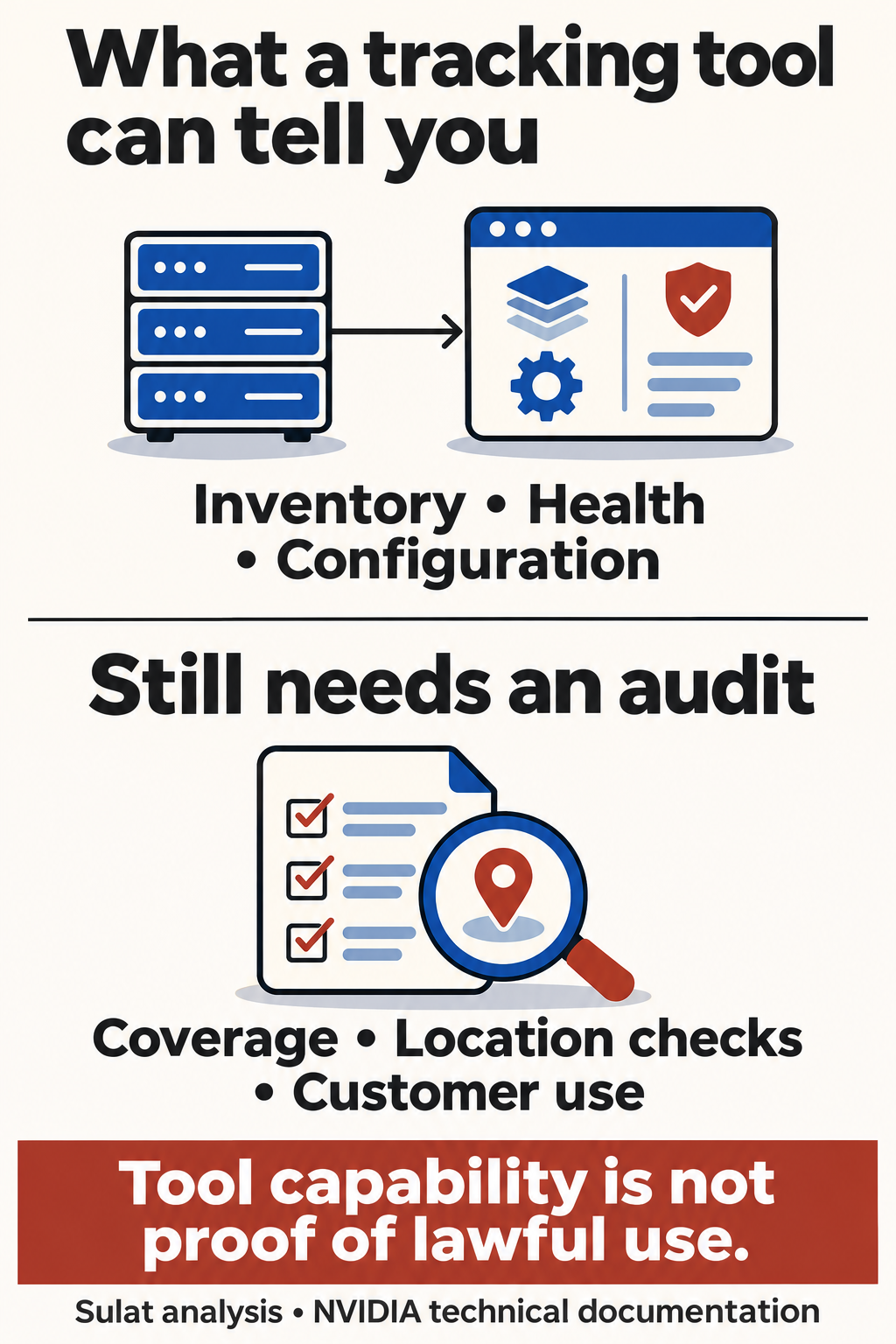
Nvidia’s Fleet Intelligence documentation describes a host-based agent that sends machine telemetry to a managed service. It is read-only and collects operational state rather than changing the host’s configuration. Operators can view inventory, utilisation, health and configuration information.
The system can also check hardware integrity through attestation: measurements from the GPU are digitally signed and compared with expected values. Nvidia lists broader service support for Vera Rubin, Blackwell and Hopper, but says attestation is supported only on Vera Rubin and Blackwell.
Those are useful technical capabilities. They should not be represented as an automatic verdict on export compliance. A valid integrity check answers a question about a participating machine’s configuration. It does not, by itself, establish that the complete shipment population is enrolled, identify every customer using the machine or settle whether a transaction met its licence conditions.
What an audit would need to establish
Start with coverage. If a dashboard sees only enrolled machines, the reviewer needs a separate baseline against which to judge what is absent. Shipment and installation records provide a starting point. Equipment that was resold, replaced, retired or temporarily disconnected needs an explanation that can be checked.
Then establish the time period. A clean snapshot on one date does not explain every earlier movement. A continuing monitoring programme would need to show how exceptions are recorded and resolved, who can alter the records and which checks are independent of the customer supplying the information.
Finally, connect the technical record to the relevant commercial and legal conditions. Knowing that a machine is healthy answers an operator’s question. Knowing who bought it, where it is operating and who may use it answers other questions. The evidence becomes more persuasive when those records reconcile, with the remaining exceptions disclosed.
Nvidia could explain the scope, dates and independent checks behind a count without publishing customers’ infrastructure maps. Such a disclosure would let outsiders evaluate the assurance instead of choosing between a corporate statement and an allegation.
The board already has a route to the records
The company’s own governance documents identify a body equipped to test those assurances. Nvidia’s audit committee charter, effective 3 March 2025, permits the committee to retain outside advisers and access company records and personnel. It assigns responsibilities for risk management and information-security oversight.
The charter does not disclose what the board has done in this case. It does show that an independent review need not depend entirely on management choosing which documents to provide. Its powers could support a focused examination of customer checks, warning handling and the basis for public statements.
Three records that would move the story forward
- A warning-and-response chronology. What information reached the company, who assessed it, what precautions followed and when directors were informed.
- A reconciled equipment record. The scope of the count, its dates, independent checks and unresolved differences.
- A statement-to-evidence comparison. What each public assurance meant and which records supported it when it was made.
Sulat’s proposed lines of inquiry, not findings of misconduct.
If the chief executive’s own contacts fall within the review, independence would matter both in commissioning the work and assessing its conclusions. That protects the credibility of an exonerating result as much as an adverse one. The relevant question is not whether a review uses the word independent, but who sets its scope, sees the underlying records and decides what exceptions can remain unexplained.
Washington has obligations in this process, too. If officials held actionable intelligence, the record should establish who was warned, how specific the warning was and what steps were recommended. An anonymous account of official concern does not establish that the company received information it could act on. Conversely, a company’s general statement that it works with government does not explain a particular exchange.
A closed briefing could allow those matters to be examined without exposing sensitive sources or methods. The useful public result would be a sufficiently detailed unclassified account: what was examined, what was substantiated, what was disproved and what remains unresolved.
The controversy began with allegations that readers cannot independently test from the material now public. The next stage need not remain there. Singapore has shown the value of releasing the correspondence behind a contested account. Nvidia’s filings identify the limits of its control; its technical documents explain the tools available; its board rules provide a route to records.
Whether those records support the company’s assurances, expose failures or leave important questions open is still to be established. The test now is whether scrutiny produces findings that can be evaluated, rather than another round of claims that must simply be believed.
Sources, quotation checks and reporting limits
This article combines primary documents with attributed reporting. Primary material includes the House committee announcement, Singapore’s clarification and published correspondence, China’s foreign-ministry transcript, US export-policy guidance, Nvidia’s SEC filing, audit committee charter and Fleet Intelligence documentation. Links appear beside the relevant claims.
The short Reuters excerpt was checked in its credited Investing.com syndication; the Bloomberg quotation was checked in its credited The Edge Malaysia syndication. ABC and AFP quotations were checked in accessible original articles. Quotes are reproduced briefly and retain their speaker and context. AFP’s English rendering of China’s response is not combined with the differently worded official English transcript.
Full FT text was not accessible; its allegation is described narrowly from public excerpts, without a verbatim quotation. Some Wall Street Journal reporting was also available through public excerpts. Neither publication’s reported intelligence claims have been independently verified by Sulat. Repetition by another outlet is not treated as separate corroboration.
No classified assessment, private correspondence, interview or complete court-docket search underlies this review. ABC reported that Alice Huang and Megaspeed had not responded to its enquiries; that describes ABC’s outreach, not every publication’s contact. No silence is treated as evidence of guilt.
The timeline and explanatory graphics are original Sulat work, editorially checked against the linked sources. They are conceptual explanations and chronology, not evidence of wrongdoing or diagrams of a verified operation. The featured illustration uses NVIDIA’s official logo as a visual reference.
Discover more from Sulat AI & Tech News
Subscribe to get the latest posts sent to your email.