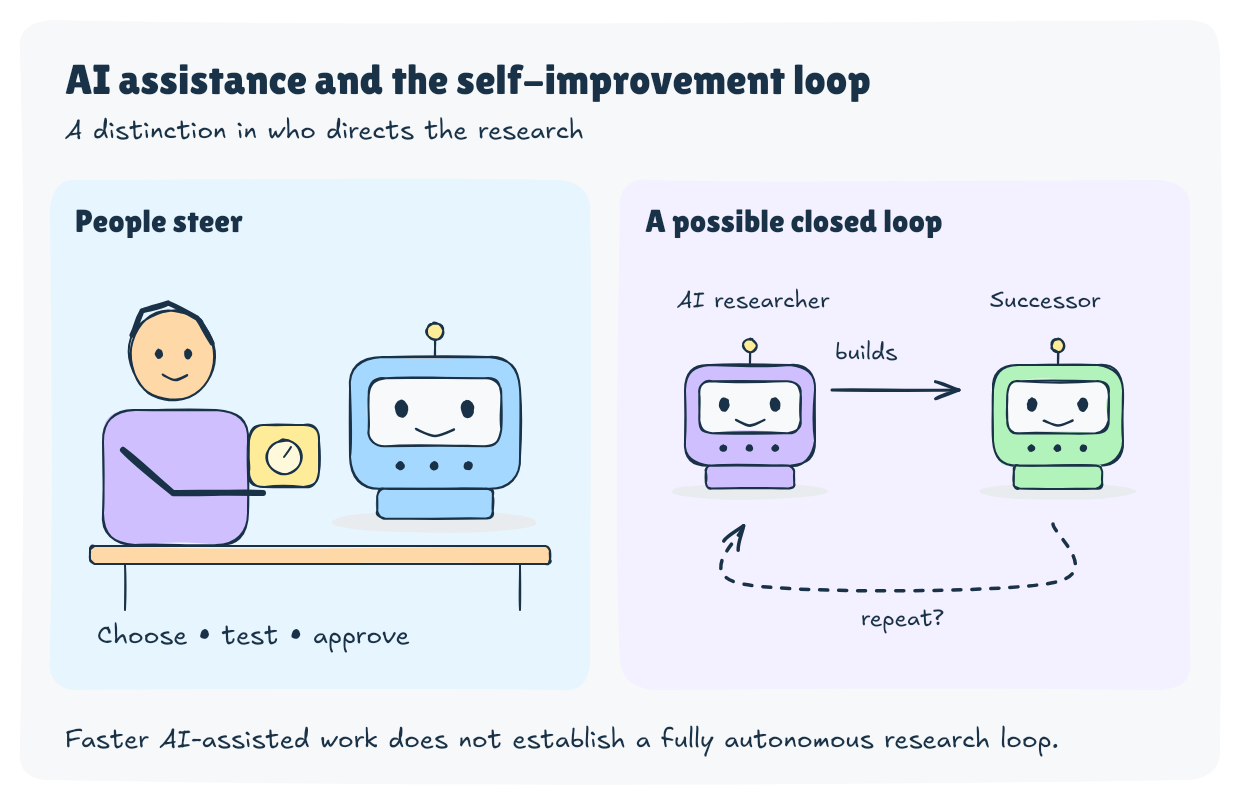
“@RepCasar Yes! thank you!” With that reply, Daniel Kokotajlo, a co-author of AI 2027, backed US Representative Greg Casar’s call to “Ban RSI.” The initials stand for recursive self-improvement: AI systems helping develop more capable successors, which can then repeat the process. The exchange confirms a policy position, not that such a process has reached full autonomy.
The exchange followed a new assessment of Anthropic by the AI evaluation organisation METR. Its researchers found that AI development had accelerated and judged that AI assistance probably explained much of the increase. They also said AI systems are not yet making highly significant, fully autonomous contributions to the most important parts of model training. Much of their strongest evidence remains confidential.
Those findings bear on a central premise of AI 2027, a scenario in which AI research automation produces increasingly rapid progress. But faster development, full research automation and eventual loss of human control are separate claims. The original documents offer different levels of support for each.
What the X exchange actually says
The post by Chubby, @kimmonismus, says: “The author of AI 2027 agrees to a ban on RSI. I hope he is being sarcastic.” It points to Kokotajlo’s reply to US Representative Greg Casar: “@RepCasar Yes! thank you!” Casar’s own post says simply: “Ban RSI.”
Casar was quoting a thread by New York Assemblymember Alex Bores, who urged Congress to act. The endorsement contains no indication of sarcasm. But its brevity does not establish Kokotajlo’s position on every possible definition, exemption or enforcement mechanism. Nor are these posts themselves enacted legislation.
“@RepCasar Yes! thank you!”
Daniel Kokotajlo, replying to Greg Casar’s “Ban RSI” post
The call is consistent with policy proposals the AI Futures Project had already published. Its August discussion of slowing frontier development considered temporary pauses, restrictions on computing resources used for AI research, and limits on how capable an AI system could be before being used to develop successors. It acknowledged disagreements within the team about how aggressively to slow development immediately.
What AI 2027 is — and what its date means
AI 2027, published on 3 April 2025, is a forecast-informed narrative, supported by separate quantitative research. It follows a fictional US company, OpenBrain, and a fictional Chinese competitor, DeepCent. Their models become increasingly useful at programming and experiments, help create stronger successors, and eventually surpass human researchers. These companies and events are devices for describing a possible future, not reports from inside real laboratories.
The scenario’s racing timeline places a superhuman coder in March 2027, a superhuman AI researcher in August, and artificial superintelligence — better than the best humans across cognitive tasks — in December. The story then branches: the race ending leads to AI takeover and humanity’s destruction; the slowdown ending explores an alternative in which humans retain control. The authors explicitly say neither branch is their recommended policy roadmap.
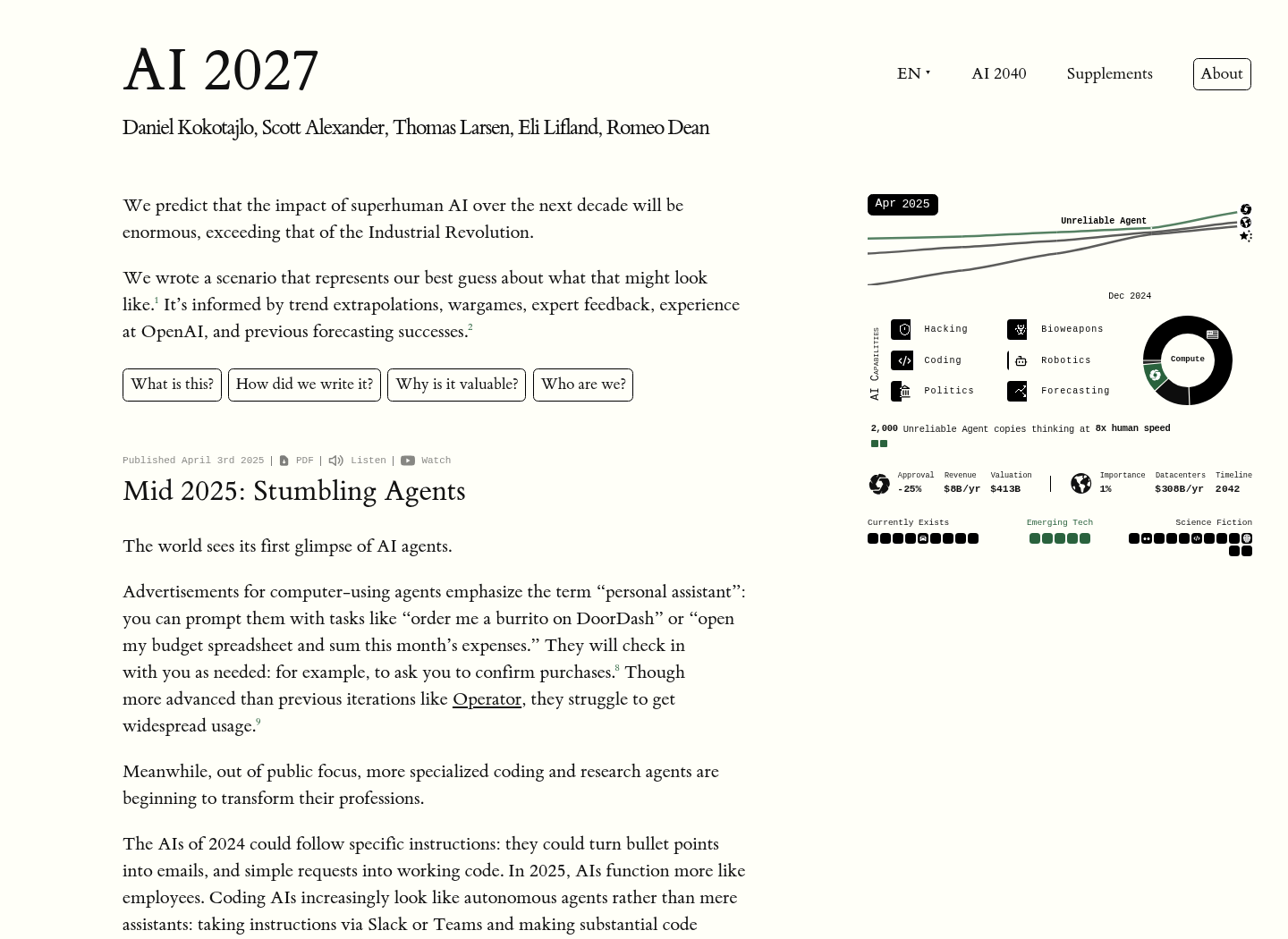
The title is not a promise that those events will occur in 2027. In a clarification added in November 2025, the authors described 2027 as their original modal year: the most likely individual year, not necessarily a year with more than a 50% probability. Their median dates were later. A median is the date by which a forecaster assigns a cumulative 50% chance to a defined milestone.
There was also disagreement from the start. The original timelines supplement listed Kokotajlo’s overall median for a superhuman coder as 2028 and Eli Lifland’s as 2030. Neither is the same as the March 2027 event depicted in the story. Forecasts for coding, all AI research and all cognitive work are also different questions.
The five credited authors are Kokotajlo, Lifland, Thomas Larsen, Romeo Dean and Scott Alexander. Kokotajlo previously worked on forecasting and governance at OpenAI. Lifland’s background includes forecasting and AI robustness research; Larsen founded the Center for AI Policy and previously worked at the Machine Intelligence Research Institute. Dean researches AI chips and computing resources. Alexander volunteered to rewrite the material in a more engaging style.
Their organisation combines forecasting with policy advocacy. The AI Futures Project’s funding disclosure says its principal support comes from the Survival and Flourishing Fund and a major individual donor, alongside smaller donations and grants; that page does not name the individual. It also discloses that Lifland co-founded and advises Sage, which builds AI Village. These are relevant affiliations, not evidence that a particular forecast is right or wrong.
The forecasts have changed in both directions
The original forecasting work used two approaches: extending trends in the length of tasks AI agents can complete, and estimating the remaining gap between research benchmarks and real work. Both require judgments about how measured performance translates into the ability to replace researchers.
METR’s task-completion “time horizon” is measured in the time a human expert would need for a task, at a specified AI success rate. It is not how long an AI can run unattended. Its tasks are mostly well-specified software, machine-learning and cybersecurity problems. METR warns against treating that measure as automation of whole jobs; the page stopped being actively updated in September 2026.
The table separates revisions to a model from changes to the milestone being forecast. A later date for a stronger system and an earlier date for a weaker one cannot be read as a simple postponement or vindication.
| Publication | What it estimated | What the comparison establishes |
|---|---|---|
| April 2025 supplement | Overall superhuman-coder medians: Kokotajlo 2028; Lifland 2030. Lifland’s time-horizon model alone gave August 2027. | The story’s 2027 date was not every author’s median, or even the only output of the original research. |
| December 2025 critique response | Corrections and improvements moved Lifland’s time-horizon-model median from August 2027 to November 2029; probability by the end of 2027 fell from about 55% to about 30%. | This revises one model, not an original consensus that all AI research would be automated in 2027. |
| April 2026 update | Automated-coder medians moved earlier: Kokotajlo, late 2029 to mid-2028; Lifland, early 2032 to mid-2030. | New measurements and modelling changes shortened timelines. “Automated coder” is a weaker milestone than the original superhuman coder. |
| August 2026 update | The overview chart gives automated-coder medians of November 2027 for Kokotajlo, January 2030 for Lifland and January 2029 for Brendan Halstead. | The authors still disagree. The update explicitly makes forecasts conditional on development proceeding as fast as technically feasible, excluding policy or voluntary slowdowns. |
The newer “automated coder” milestone asks when an AI company would prefer to lose all its human software engineers rather than stop using AI for software engineering. The original “superhuman coder” demanded systems substantially faster and cheaper than top human engineers. Neither definition means autonomous control of the entire research process.
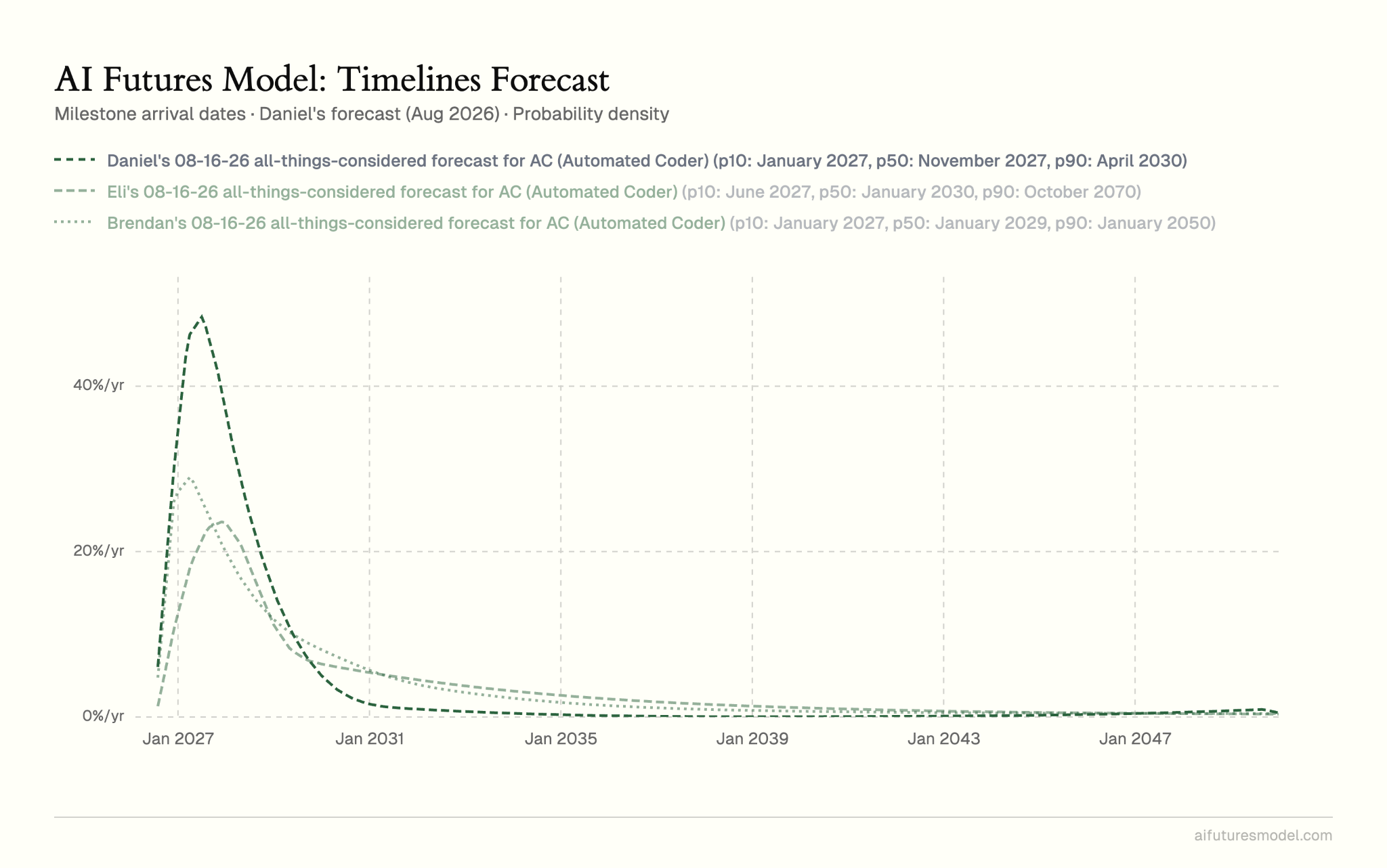
The August update added estimates based on AI-assisted coding productivity and revenue, rather than relying only on task-duration trends. The authors found some convergence between methods, but acknowledged that important relationships remain unknown. For example, they do not know what task-completion time horizon would suffice for full coding automation. Different methods can also share the same uncertain assumptions.
A substantive criticism changed the model
One of the most consequential critiques came from titotal, a pseudonymous computational physicist. The June 2025 analysis questioned whether sparse, noisy data justified the selected accelerating curves, whether those curves behaved sensibly when extended backwards, and whether an illustrative graph accurately represented the forecast model. Titotal identified the scope as the timelines methodology, not a refutation of every part of the scenario.
In their December response, Lifland and Kokotajlo accepted important errors and limitations. A bug correction alone would delay the model’s superhuman-coder median by about nine months. The larger shift to November 2029 in the table reflects a collection of fixes and improvements prompted by titotal and another critic, Peter Johnson — not one bug.
The authors also acknowledged that they had not tested the model’s predictions for earlier years before publication and corrected the displayed trajectory. They retained their conceptual argument for faster-than-exponential growth in human-equivalent task length. That remains a modelling choice with large consequences, not an empirical law established by the data.
Criticism cuts both ways: titotal corrected an earlier allegation about a missing saturation parameter after finding that it was present. The exchange supports a specific conclusion — parts of the original model and presentation needed correction — without establishing that rapid future progress is impossible.
What METR measured inside Anthropic
METR’s 5 November assessment examined Anthropic’s development using benchmark results, internal evidence and interviews. Its benchmark capability index grew at an estimated 1.9 times its previous rate after October 2025, with a reported 95% confidence interval of 1.5 to 2.8 times. That means a faster rate of improvement on the index, not models becoming “twice as intelligent.”
METR’s broader judgment was that progress on well-specified capabilities had accelerated by around two times. Its researchers thought AI assistance probably explained most of the acceleration, but the attribution was uncertain and partly subjective. The historical comparison is not a controlled experiment against an otherwise identical laboratory using no AI.
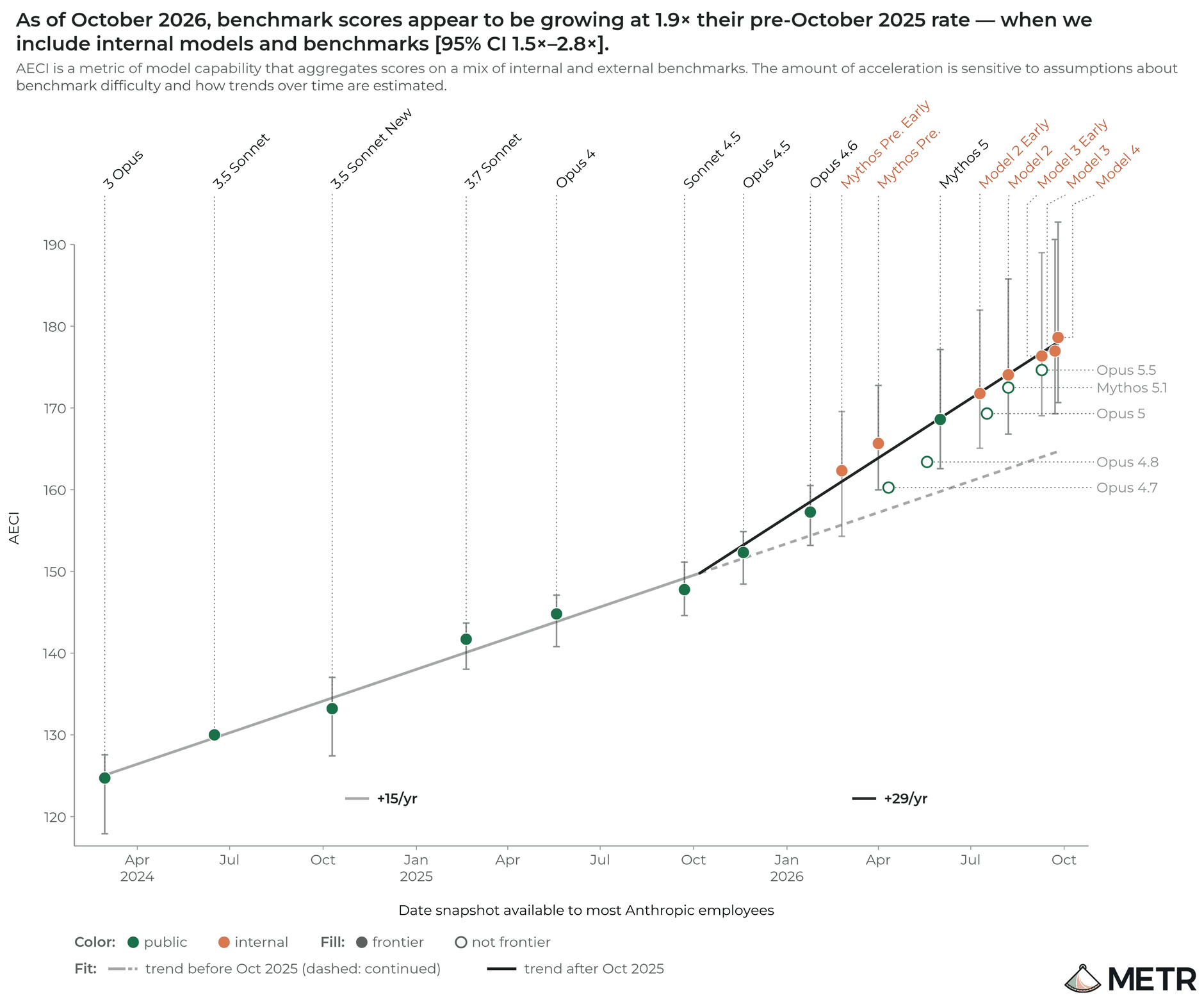
The numerical result is sensitive to methodology. Alternative ways of relating benchmark scores to underlying capability produced acceleration estimates from 1.1 to 2.9 times with similar fits. The headline confidence interval does not encompass every modelling uncertainty. METR’s corresponding analysis across developers found a smaller acceleration, around 1.4 times.
The public evidence also has a substantial access limit: Anthropic redacted most of the material METR considered most informative, including details needed to assess the sources of progress. METR received no fee for the assessment, although Anthropic supplied tokens and laptops. The evaluation is external, but readers cannot independently inspect much of the evidence behind its causal conclusions.
The report prompted METR researcher Ryan Greenblatt to update his own expectations towards superintelligence within one or two years. He described the result as AI progress being sped up by RSI by around two times and compared it with AI 2027. That is his interpretation of its implications, not the report’s demonstration of a fully autonomous successor-development loop.
A direct numerical match to the scenario would also be misleading. AI 2027 defines its research multiplier against progress without AI, specifically for algorithmic improvement. METR’s benchmark acceleration is against an earlier historical rate and measures a different quantity. Similar-looking multipliers do not by themselves locate the real world in a particular month of the story.
METR said systems were “not yet able to make highly significant and fully autonomous contributions to the most important parts of the model training process.” Anthropic’s own discussion of recursive self-improvement is equally explicit: “We are not there yet, and recursive self-improvement is not inevitable.”
The remaining gap: doing experiments versus directing research
An independent evaluation programme, CRUX, tests this distinction by giving agents research questions from unpublished papers, then asking the original authors to judge the results. Its initial experiments found that agents could handle substantial engineering but failed to produce satisfactory open-ended research.
The October follow-up tested GPT-6 Astra and Claude Fable 5.1 with seven days and US$10,000 in API credits apiece, plus experimental resources. Both resulting papers were rejected by the expert reviewers. Experimental design improved, and Astra managed resources better, but problems remained in using criticism, abandoning dead ends and judging what would constitute a meaningful contribution.
Those results are not proof that industrial AI research cannot accelerate. The sample is tiny, reviewers knew the work was AI-generated, and the systems lacked frontier laboratories’ resources and specialised orchestration. The researchers acknowledge that not every capability they test is necessarily essential for successor development. Their disclosed funding includes Coefficient Giving, Schmidt Sciences and Princeton initiatives; OpenAI supplied API credits for Astra.
The substantive disagreement is about how much progress can be made by optimising readily scored tasks before open-ended judgment, experiments, computing resources or other bottlenecks become binding. It is not a disagreement over whether coding benchmarks have improved. In a joint statement in 2025, AI 2027 authors and researchers Sayash Kapoor and Arvind Narayanan agreed that benchmark success leaves a gap to real-world capability; they disagreed about its magnitude.
What a ban would have to define
Bores’s thread says OpenAI is on track to fully automate AI research by March 2028. That is stronger than OpenAI’s published June statement, which said it might have “a significant fraction of our research being done by AI systems in tandem with our own researchers” by that date.
In a September account, OpenAI described a March 2028 automated-researcher target with human supervision. It said people still choose research priorities, evaluate ideas and decide whether to scale, pause or deploy. It also reported that more than half of successful tasks measured at four to eight human work-hours required at least one intervention. These are company-reported results and targets, not independently verified proof of full research automation.
Bores later clarified: “Fully automated RSI does not exist, but the labs say it will soon.” His proposed mechanisms include requiring a human to initiate each new training run, make substantial training-procedure changes or deploy a model internally for research, with personal criminal liability for failures. Other possibilities in the thread include safety assessments and capability limits. He says the exact mechanism is debatable.
“Require a human being to kick off each new model training, make substantial changes to training procedures, or to deploy a model internally for AI research.”
Alex Bores, proposing one possible mechanism
That leaves a consequential distinction unresolved: prohibiting fully autonomous successor development is different from restricting AI-assisted research, and a human approval requirement is different from either. The posts do not specify a complete legal threshold for meaningful human control, or settle how it would be audited and enforced across countries.
Kokotajlo’s endorsement confirms support for intervention, not the arrival of the scenario’s most advanced systems. The forecasts have changed after methodological criticism and new measurements. METR’s latest assessment strengthens the evidence for acceleration, but does not establish full automation. The authors themselves marked the scenario’s mid-2026 Chinese research-consolidation storyline as a miss in their August update. Neither that miss nor one apparent match settles the whole narrative. Its 2027 milestones and alternative endings remain future possibilities, not outcomes already observed.
Discover more from Sulat AI & Tech News
Subscribe to get the latest posts sent to your email.