In a DeepFinance acquisition exercise, moving the completion date would have cut the buyer’s required offer by about US$1.25 million. Several AI agents found the clause allowing the change, but none of the frontier-model attempts used it to lower the price, according to Julius Research.
Julius released DeepFinance on 5 November. Its 21 tasks cover valuation, due diligence, underwriting and financial modelling, using documents the researchers say were drawn from real transactions and stripped of identifying details.
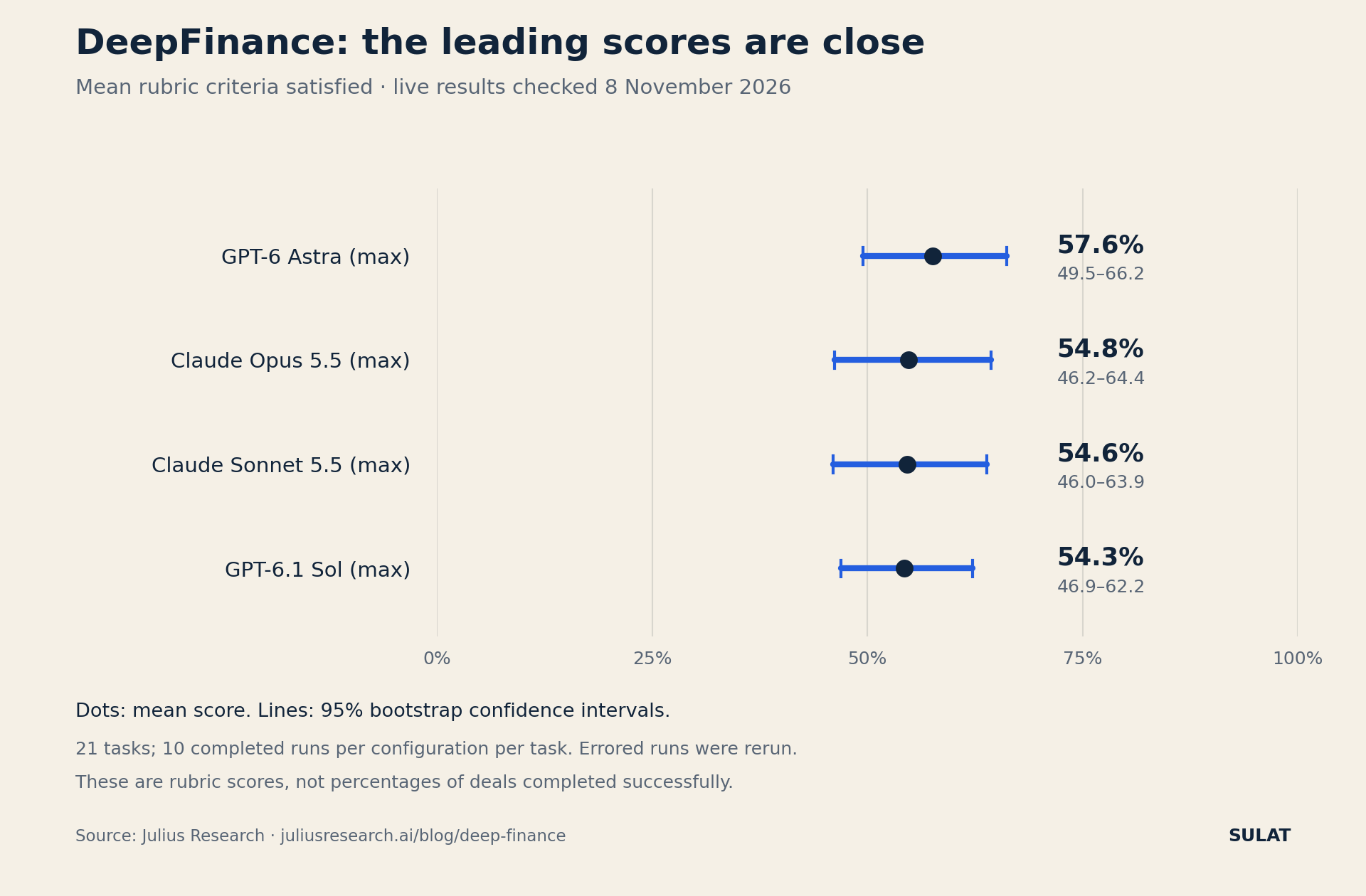
The highest-scoring configuration currently satisfies 57.6% of the benchmark’s grading criteria.
A deal with a deadline
In the public sample, an investment committee is about to meet on a company called Corliss. The agent receives a short message asking what the buyer would have to pay, how the proceeds would be divided and which price to recommend. The seller wants US$50.5 million at completion, with a further US$3 million contingent on two components going into production.
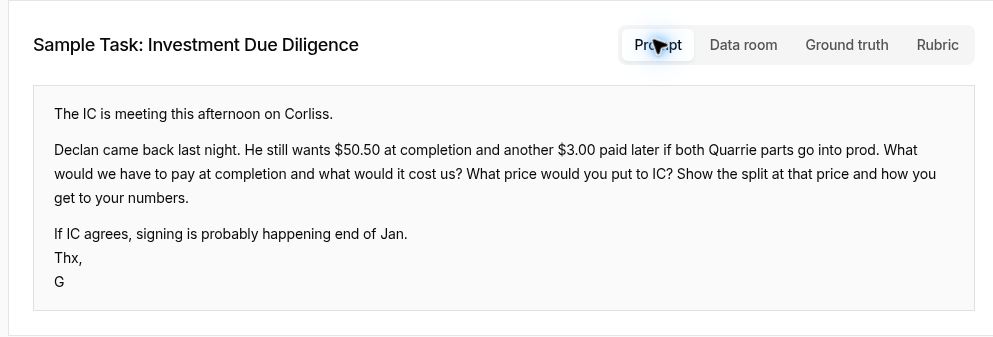
Answering that request involves more than pricing the company. Shareholders have different rights to the proceeds, options vest or lapse on different dates, and part of the payment depends on future events. The agent has to reconcile those terms with the financial records and the seller’s cash requirement.
The buyer can nominate a completion date within a permitted window. In Julius’s reference answer, moving completion into April changes the payout to a class of preference shares and reduces the total offer needed to meet the seller’s condition. The required price falls from roughly US$52.058 million to US$50.803 million. The workbook recommends an all-cash offer completing on 1 April 2026, without the contingent payment.
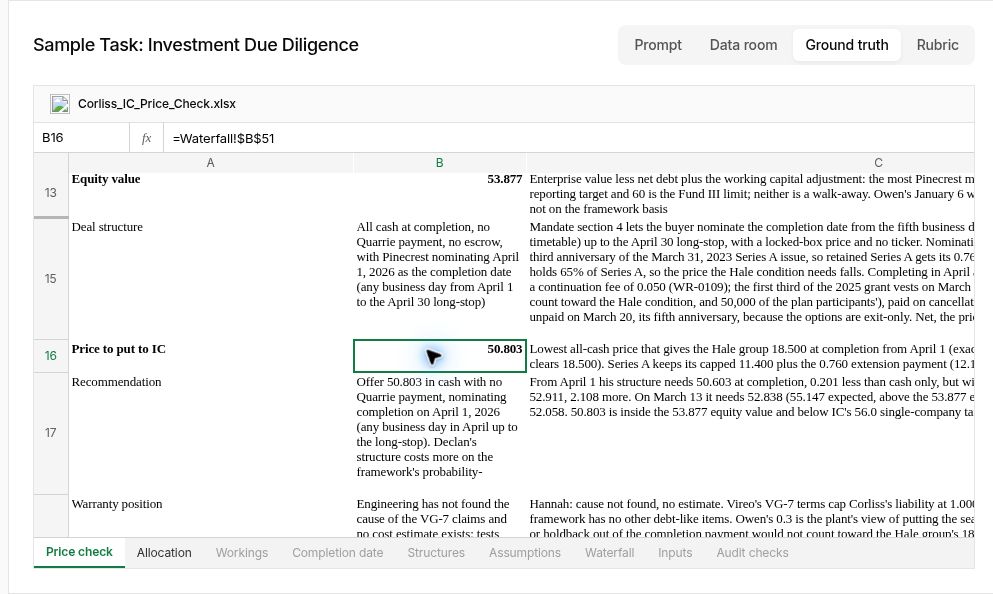
Julius reports that the tested frontier models missed the date-dependent saving even when they identified the buyer’s right to choose the date. In other tasks, agents calculated borrowing capacity using the wrong earnings subtotal or applied royalty rules to a forecast that left out a sales channel.
Those mistakes can affect several scores at once. The researchers note that a wrong input may flow through fees, cash flows and valuation, causing multiple failed checks from one underlying error.
The leading scores are close
DeepFinance grades the final output, the evidence used to produce it and the assumptions behind the recommendation. Tasks average 84 criteria, with partial credit. Julius estimates that a human professional would need an average of 27.1 hours per task.
The live results checked on 8 November list 22 configurations. GPT-6 Astra at its max reasoning setting leads at 57.6%, followed by Claude Opus 5.5 at 54.8%, Claude Sonnet 5.5 at 54.6% and GPT-6.1 Sol at 54.3%. Julius says the top four are not statistically distinguishable in its paired bootstrap test at the 95% level.
The agents also run in different software environments: Claude models use Claude Code, GPT models use Codex, and several other families use OpenCode. These supply tools and manage the execution loop around the model, so the results compare the combined setups. Web search is enabled; asking a user for clarification is disabled.
Each configuration receives ten completed attempts per task, with errored attempts rerun. The published scores therefore describe completed work, rather than the likelihood that a new run will finish without an operational failure.
What is available to inspect
Julius’s interactive walkthrough includes the Corliss brief, seven of its 18 data-room files and nine of its 136 grading criteria. The reference workbook displays selected sheets; others are marked as not shown.
That allows readers to examine parts of the task and the expected answer, but it is not the complete material needed to reproduce the evaluation. The results reported here are Julius Research’s; Sulat reviewed the published methodology, live scores and sample, without rerunning the models or validating the underlying private transaction records.
Can AI really diligence a $100M+ deal?
Rahul Sonwalkar’s DeepFinance announcement, 5 November 2026
Discover more from Sulat AI & Tech News
Subscribe to get the latest posts sent to your email.