A coding agent building an interface with Astryx can look up a button’s properties, find a page template and retrieve the project’s styling rules from the terminal. The same component library and reference material are available to the developer reviewing its work. That shared toolkit is the organising idea behind Meta’s open-source design system.
Meta launched Astryx on 18 June 2026. It remains in beta, with a 7 November update, version 0.7.11, adding mobile interaction improvements and changes to the tools agents use to find components.
From internal tools to a public component library
A design system brings reusable interface elements together with rules for their appearance and behaviour. A table, date picker or form can then work consistently across applications without each team maintaining its own implementation.
That was the problem inside Meta, according to the team’s technical account of Astryx’s origins. Different groups were building their own tools and repeatedly solving the same interface problems. Meta says the underlying system developed over eight years and came to power more than 13,000 internal products. Those are company-reported figures, rather than an independently audited count of public Astryx applications.
The public library supplies typed React components and precompiled CSS, the stylesheets that determine how a page looks. Developers can use the supplied styles or work from the source. Astryx exposes smaller component building blocks as well as complete controls, allowing developers to assemble interfaces at different levels.
The current project website advertises more than 180 components, while the June announcement and repository overview say more than 150. The catalogue spans packages with different release statuses.
What the agent actually receives
Astryx’s command-line interface, or CLI, exposes component references, design tokens, templates and migration tools. Design tokens are named values for choices such as spacing and colour. An agent can retrieve those values instead of inventing a separate convention for each screen.
The CLI reference describes several distinct operations:
- Find:
astryx searchreturns ranked matches across components, documentation, templates and themes. - Read:
astryx componentprovides a component’s reference material. - Start a page:
astryx buildreturns a kit identifying a starting template, alternatives and relevant pieces. - Copy a template:
astryx templatecan scaffold page or block source into a project.
A build kit tells an agent where to start. The coding agent still assembles and edits the application, using the suggested template and components.
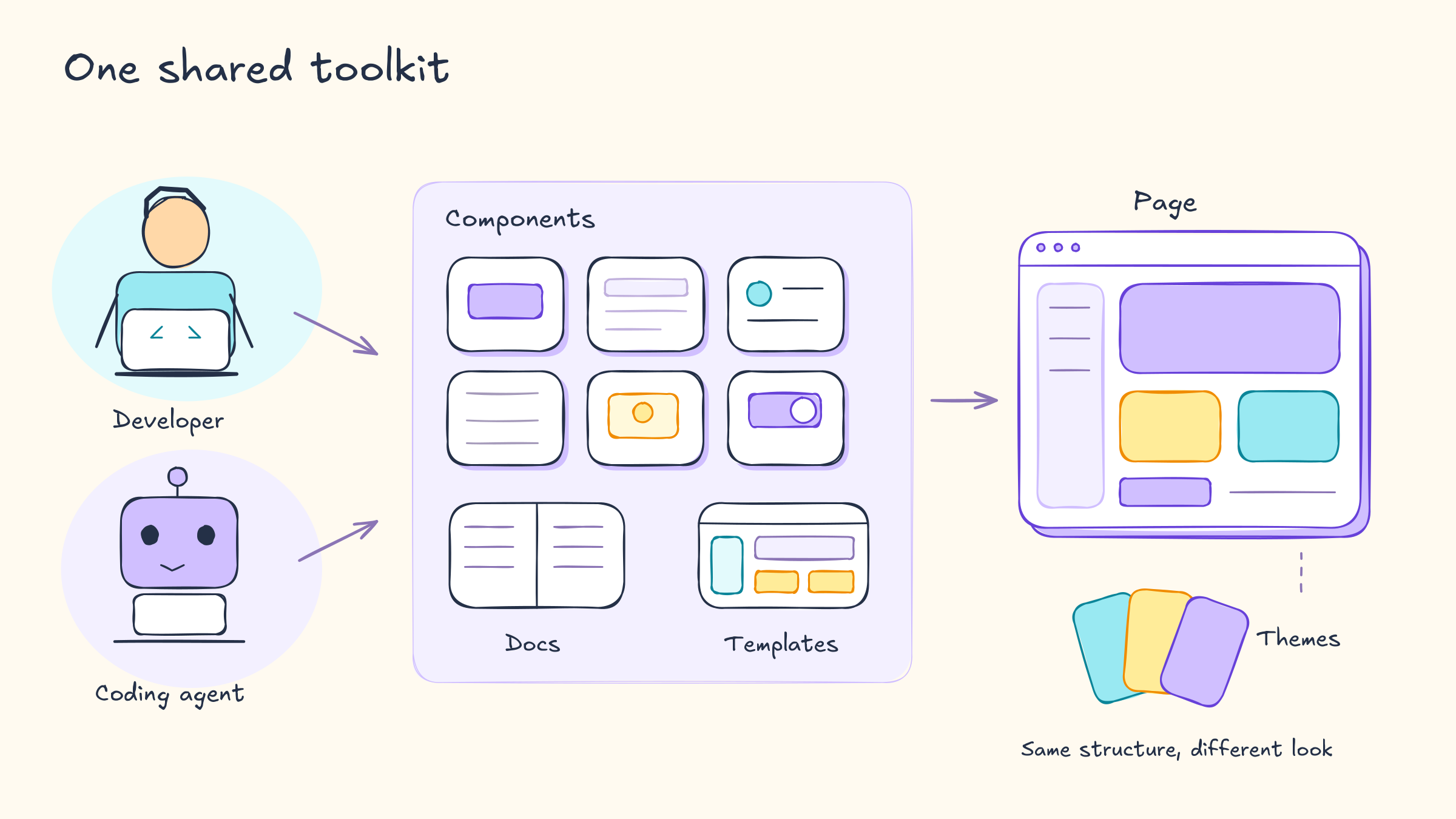
In a July explanation of the build command, Meta described examples at three sizes: complete pages, composable blocks and individual component examples. It said early templates encouraged agents to use too little of the library, prompting the team to revise both the examples and their grading rubric. That account describes Meta’s development process; it does not establish a comparative success rate for outside developers.
Meta’s CLI overview says the documentation website consumes the CLI’s reference material, so people and agents read from the same source. The homepage also advertises documentation access through Model Context Protocol, or MCP, which gives compatible assistants a standard way to call tools.
Changing the look without replacing the controls
Astryx separates theme configuration from component code. Its theming guide lists seven supplied themes and explains how to extend one with a project’s own colours, typography and component styling. A theme can also define light and dark appearances.
Extending an installed theme keeps it as a base. Ejecting copies the source into an independent local fork, which no longer receives the package owner’s updates. The documentation reserves that operation for developers who want to maintain the full source themselves.
For server-rendered applications, the guide recommends built theme files so component overrides are present when the page first appears. Runtime-only overrides can otherwise arrive after hydration, the step when React attaches client-side behaviour to server-rendered HTML, producing a visible change in styling.
The repository overview also describes ordinary CSS, CSS Modules and Tailwind overrides through className. Astryx uses StyleX to author its own styles, but a consuming application can retain another styling approach.
The changes in version 0.7.11
The 7 November release notes concentrate on practical interface behaviour. Touch popovers gain animations that expand from their triggers, buttons become easier to hit on touchscreens, and several fixes address on-screen keyboards and bottom sheets.
Accessibility fixes include restoring button names in VoiceOver on macOS 14 and improving contrast for avatar initials and status indicators. A timestamp option lets applications specify a time zone explicitly, helping server and browser output agree.
The release notes also describe changes to how astryx build ranks some component blocks and orders alternative page templates, along with a reduction in repeated filesystem work during component discovery.
Compatibility and beta limits
The installation guide requires React and React DOM 19 or later. Setup includes the core library, a theme, the CLI and the StyleX peer dependency. Running the initialisation command adds agent guidance to the project.
Package versions need to move together. The guide says each theme names the exact core release it works with, so upgrading the core while leaving a theme behind can produce a mismatch. It provides an upgrade command that applies migrations after the packages are updated.
Availability also varies by package. The repository says experimental lab components are used internally for Storybook and the sandbox but are not published to npm. Its Vega wrapper and chart packages are available only under the canary tag, with no stable release yet.
Astryx is distributed under the MIT licence, which permits commercial use, modification and redistribution subject to its notice requirements.
Reporting note: This explainer is based on Meta’s documentation, repository and release notes checked on 8 November 2026. Sulat has not installed Astryx or run a hands-on evaluation of its components, agent workflow or MCP server.
Discover more from Sulat AI & Tech News
Subscribe to get the latest posts sent to your email.