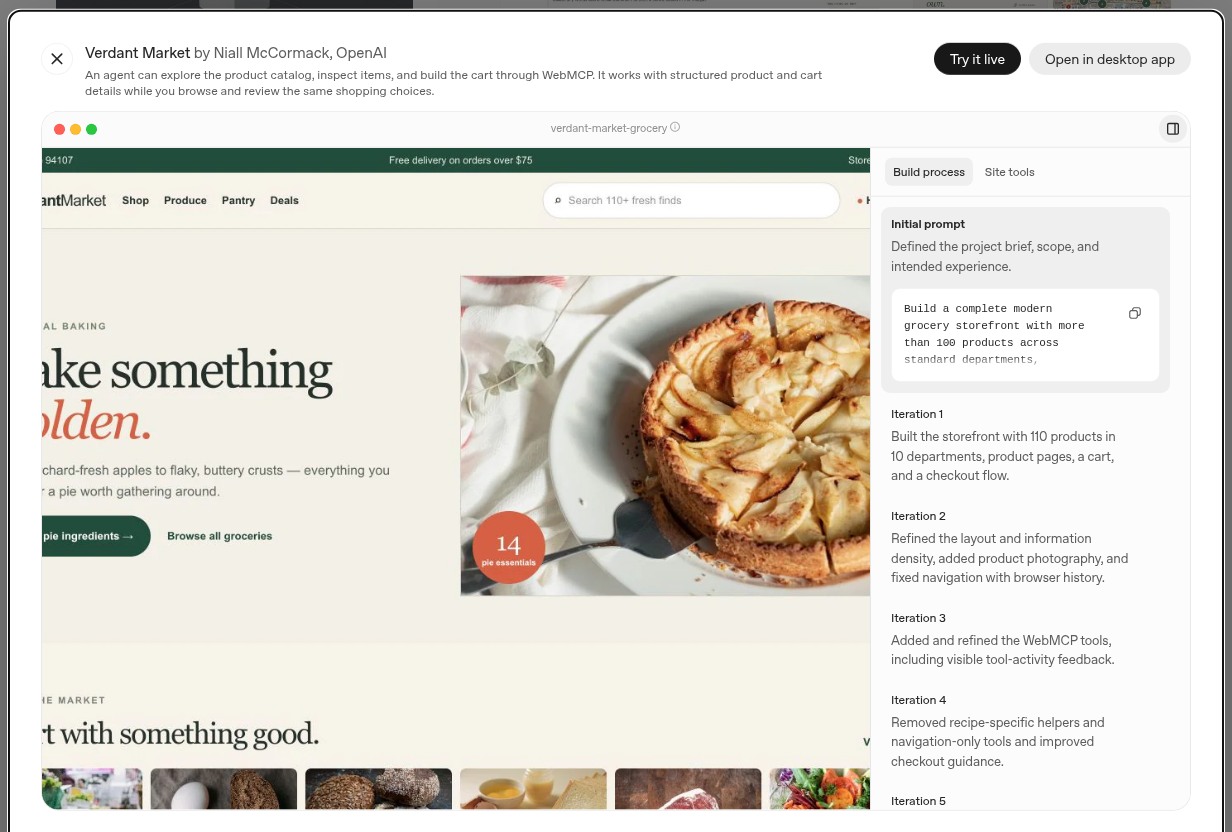
Verdant Market is a fictional online grocery shop with 110 products and ten departments. It also has controls that let an AI agent and a person work on the same shopping cart. Its build history records a fix to the deployed site’s tool definitions, followed by the removal of a recipe feature and the data it kept behind the scenes.
The showcase page credits OpenAI’s Niall McCormack as its builder and publishes the starting request plus six rounds of changes. The record covers navigation, product photography, agent controls and features that were ultimately cut.
Thomas Ricouard works on developer experience for Codex at OpenAI. Posting as Dimillian, he pointed people to the developer showcase after repeated requests for the prompts behind his demos. He wrote: “Everyone keeps asking when I share demos to share prompts.” He explained that his demos often involve iterations that he needs to format before sharing the raw material.
The collection includes OpenAI and community projects: games, design tools, storefronts, data visualisations and tutorials. Some entries show how a project changed after its first request. Others demonstrate software that uses an AI model while it runs. Those are different things: an app can be built with a coding agent without needing an AI model for every subsequent button press.
A shopping site with controls for people and agents
Verdant Market’s initial brief asked for a complete grocery storefront with more than 100 products, including conventional and organic baking ingredients. It specified product pages, a cart and checkout, plus tools for an agent to browse departments, search, inspect products and manage the basket.
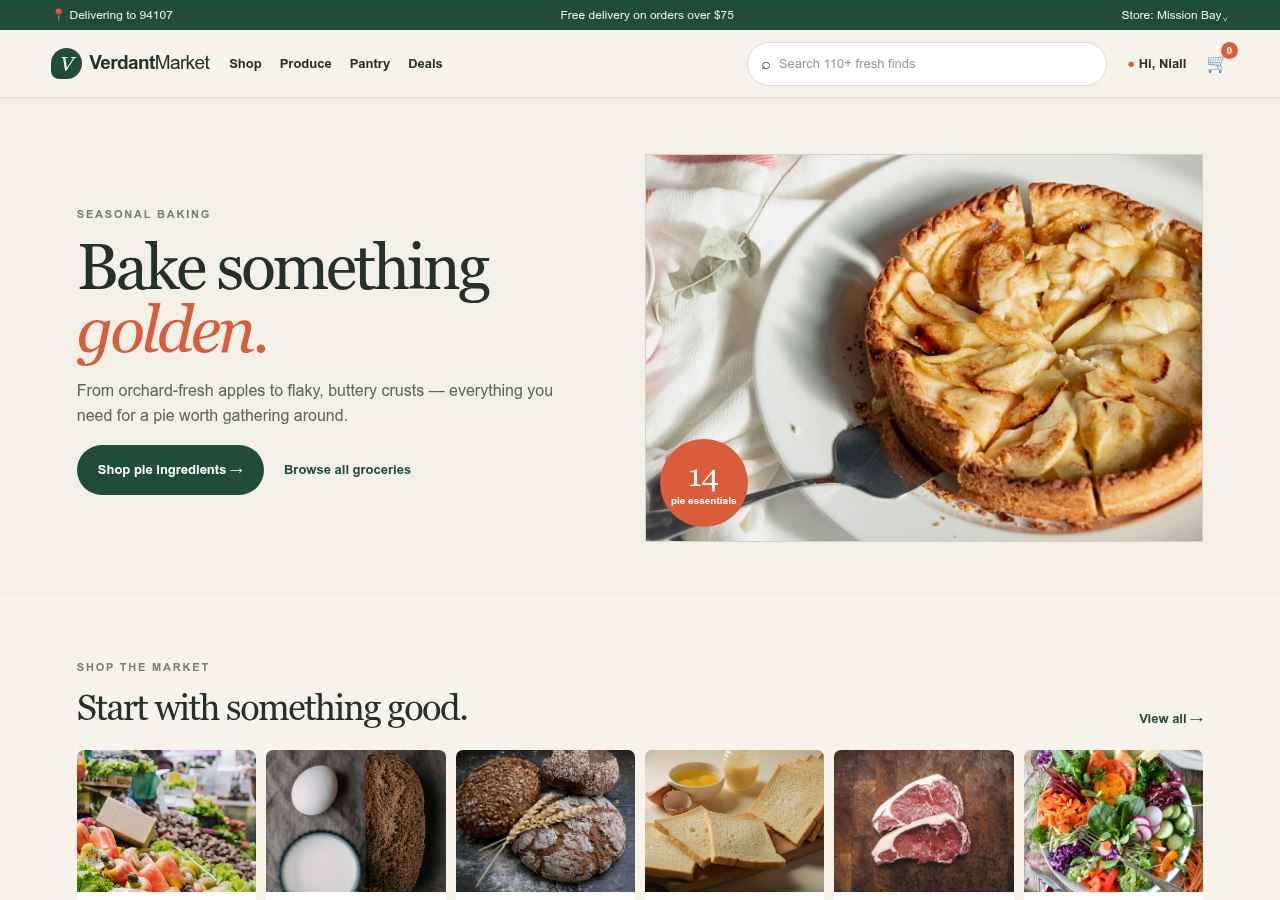
These agent controls use WebMCP, a proposed standard that lets a website offer named actions alongside its ordinary interface. Rather than requiring the agent to work solely by clicking through the screen, the site can describe actions it already supports. A person and an agent can then work with the same live page and signed-in session.
A tool’s input schema is the description of the information that action accepts: for a shopping action, that might include a product and a quantity. Verdant Market’s fifth recorded iteration fixed empty tool input schemas on the deployed site and checked them again after a fresh reload. The page describes a correction to the agent-facing controls, not just a change to how the shop looked.
| Stage | Recorded change |
|---|---|
| Iteration 2 | Refined the layout, added product photography and fixed navigation with browser history. |
| Iteration 3 | Added and refined WebMCP tools, including visible feedback when a tool was used. |
| Iteration 5 | Fixed empty tool input schemas on the deployed site and verified them after a fresh reload. |
| Iteration 6 | Removed the recipe-kit interface and its hidden state to focus on general grocery shopping. |
The live demo is a storefront, not a real grocery-delivery service. OpenAI’s documentation says its implementation of site tools currently runs only in the ChatGPT desktop app’s built-in browser. Access also requires a supported model and is subject to account or workspace policy and site permissions.
The tools belong to the page that provides them; closing it or navigating away can make them unavailable. OpenAI also says normal safety reviews and confirmation policies still apply to consequential actions such as purchases. Registering a tool does not make the website or its output trustworthy.
A tutorial with an ongoing maintenance loop
Another detailed build record belongs to Codex 101, a bilingual Korean and English guide by Seowoo Han. Codex is OpenAI’s coding agent: software that can read and modify project files and use tools to carry out development tasks. Han’s guide covers its desktop, command-line, code-editor and web workflows.
The initial request named specific source material, including OpenAI’s skills documentation and public skills repository. Skills are reusable instructions for carrying out a kind of task. The brief asked for a guide that Korean developers could follow, including practical examples beyond the official site while remaining grounded in facts.
The record then traces a move from the first Korean guide to a broader bilingual tutorial. Later revisions added a recurring documentation-review task using OpenAI’s documentation MCP service. MCP, short for Model Context Protocol, is a way for an AI application to connect to external tools and information; here, it provided access to documentation.
The maintenance loop reviewed model pages, announcements, pricing, configuration and platform guidance. The next recorded iteration refined that automation and manually filled gaps when Codex missed details in the daily refresh. A final pass used computer interaction to review and improve the interface.
Han’s original site now presents 21 chapters and a Korean/English language toggle, with its source repository publicly available. It is a community-maintained tutorial rather than official product documentation. Its build history records both automated upkeep and manual corrections, not an unattended process that was complete after the first prompt.
Games that can leave the browser
The showcase also links to a ModRetro collection made in collaboration with OpenAI. It brings Codex-built games to the ModRetro Chromatic handheld and other compatible Game Boy Color hardware.
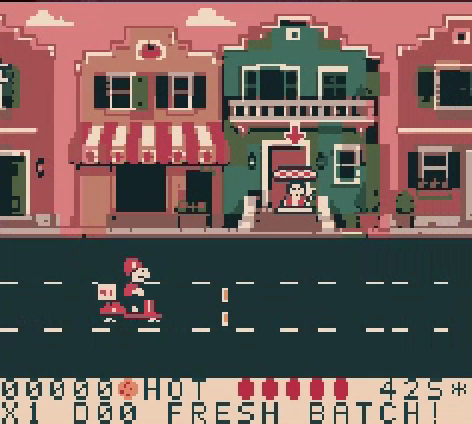
The collection lists 13 games, including FlapGPT, Ash & Oath, Codex Land and Pizza Dash. The collection offers browser play and ROM downloads. A ROM is a game file that compatible hardware or an emulator can load; an emulator is software that reproduces the behaviour of a games system.

This gives the collection a different kind of output from a hosted web app: a downloadable game targeting an existing hardware format. OpenAI says the games were built with Codex. The collection page does not provide the same step-by-step iteration histories as Verdant Market and Codex 101.
What the finished demos do and do not document
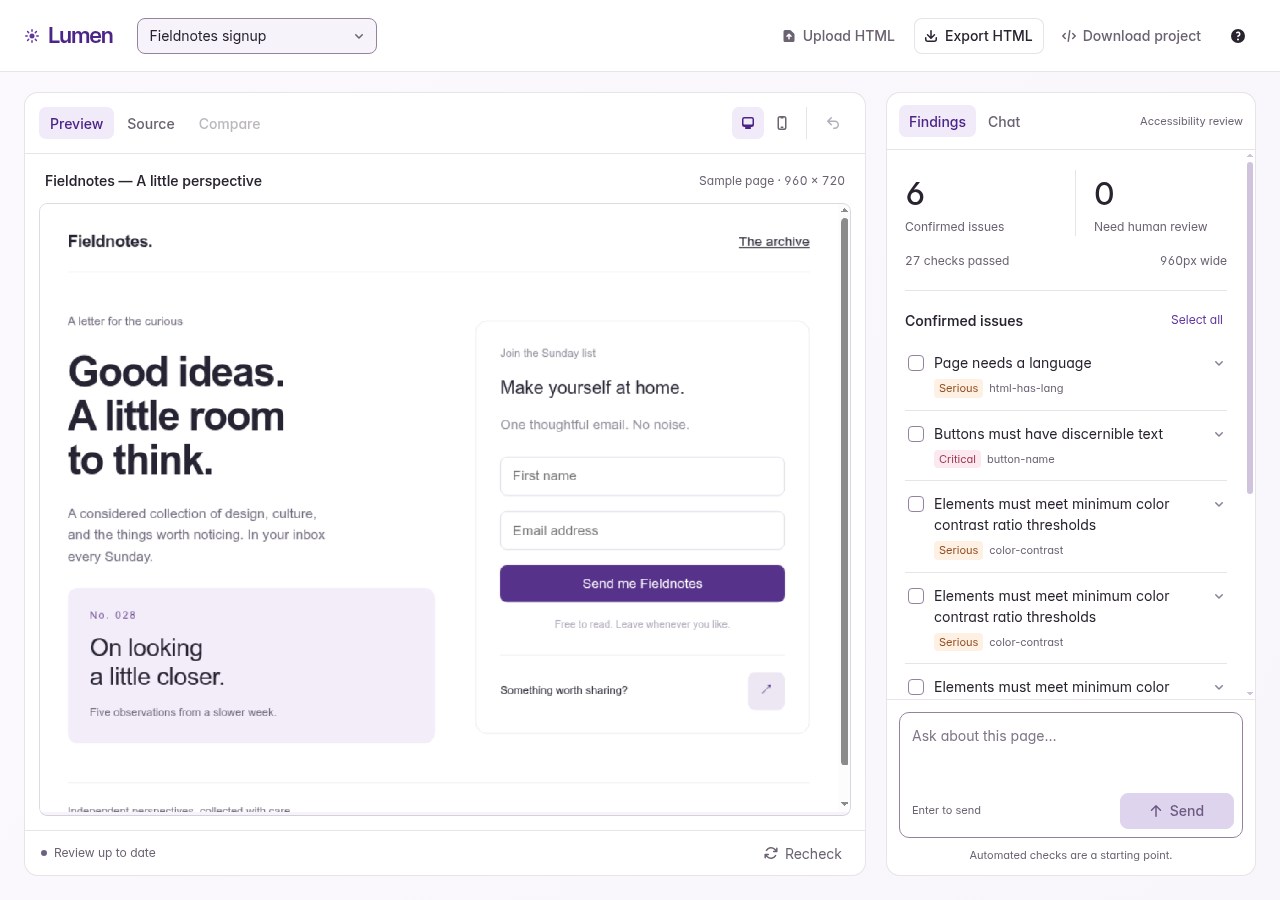
Other OpenAI-authored entries focus on changing existing work. Lumen is described as finding accessibility issues, applying selected fixes and comparing results. Loupe compares an implementation with a reference design and fixes the source. Both pages identify GPT-6 Astra as their model.
The evidence differs between projects. Verdant Market and Codex 101 publish a starting prompt and summaries of later changes, not complete message-by-message transcripts. Neither build record gives a total development time or build cost. Their visible histories establish that revisions occurred; they do not establish how often another person would obtain the same result.
A customer example on OpenAI Academy makes the distinction between a working demo and deployed business software explicit. In its account of Proaction, a five-person fleet-software startup, co-founder Colin Knudsen uses Codex to turn customer conversations into tailored prototypes.
One example is a driver issue-reporting form that asks for a licence plate, a photo and whether the vehicle can still operate. According to the account, a prospect can submit a test report and see its data appear in a dashboard. Knudsen builds these experiences in isolated environments using demo data, then hands engineers a feature description, call transcripts, screenshots and a working prototype.
Proaction’s engineering team still builds the secure production version. The demo supplies a concrete workflow for the customer and engineers to discuss; it is not the production system itself.
Discover more from Sulat AI & Tech News
Subscribe to get the latest posts sent to your email.