Baidu has released ERNIE 5.5 Flash Base, a language model with 280 billion parameters, under a licence that excludes use in the European Union, the United Kingdom and South Korea. The November 5 release makes the model's weights available for further training, with separate conditions for commercial users and restrictions extending to generated output.
The model uses a mixture-of-experts architecture that activates 14 billion parameters per token. Baidu says the checkpoint comes directly from pretraining, before any mid-training or post-training. It is intended for work such as domain adaptation, instruction tuning and reinforcement-learning research. A post-trained ERNIE 5.5 Flash is due to follow, according to the release announcement.
Baidu trained the model from scratch on 33.5 trillion tokens. Its maximum pretraining context was 128K tokens, while fine-tuning and inference support 1M. The model card gives the precise limits as 131,072 and 1,048,576 tokens respectively. The larger figure describes supported use after pretraining, rather than the context length used to train the released checkpoint.
Restrictions extend to outputs
The geographic limits appear in the ERNIE 5.5 Flash Base Model License Agreement v1.0. Section 1.11 defines its territory as the world excluding the EU, UK and South Korea. Section 5.3 applies that boundary to the licensed materials, derivative models and their outputs, prohibiting their use, reproduction, modification, distribution or display outside the permitted territory.
The licence's definition of derivative models includes fine-tuned, quantized and pruned versions, adapters, and models created through distillation or training on synthetic data from ERNIE. Outputs do not become derivative models merely by being generated, but they remain covered by the express output restrictions.
| Use | Commercial condition | Attribution |
|---|---|---|
| Non-commercial | No commercial notice required. | No commercial branding requirement. |
| Commercial, related annual revenue at or below US$50 million | No model licence charge. One-time notice before first use. | “Powered by ERNIE” attribution required. |
| Commercial, related annual revenue above US$50 million | Prior written authorisation; any fees set by a separate agreement. | “Powered by ERNIE” attribution required. |
For commercial operators within the US$50 million tier, the notice must identify the operator, model version, products or services, purposes and contact details. Qualifying use may begin once the notice is sent, without waiting for a response.
Commercial products and services must also display “Powered by ERNIE” prominently in an accessible interface, website or documentation. The licence permits documentation-based attribution for APIs, backend services and internal business use. It does not require the branding on every individual output.
The revenue test uses the preceding 12 months and is assessed continuously. It counts the whole revenue of a related product or service even when that product also uses other models or technologies. The calculation also aggregates entities under common control. Funding, valuation and profit do not substitute for revenue.
An operator approaching the US$50 million threshold must obtain written authorisation before exceeding it, or suspend affected commercial use once it does.
Compressed attention and code training
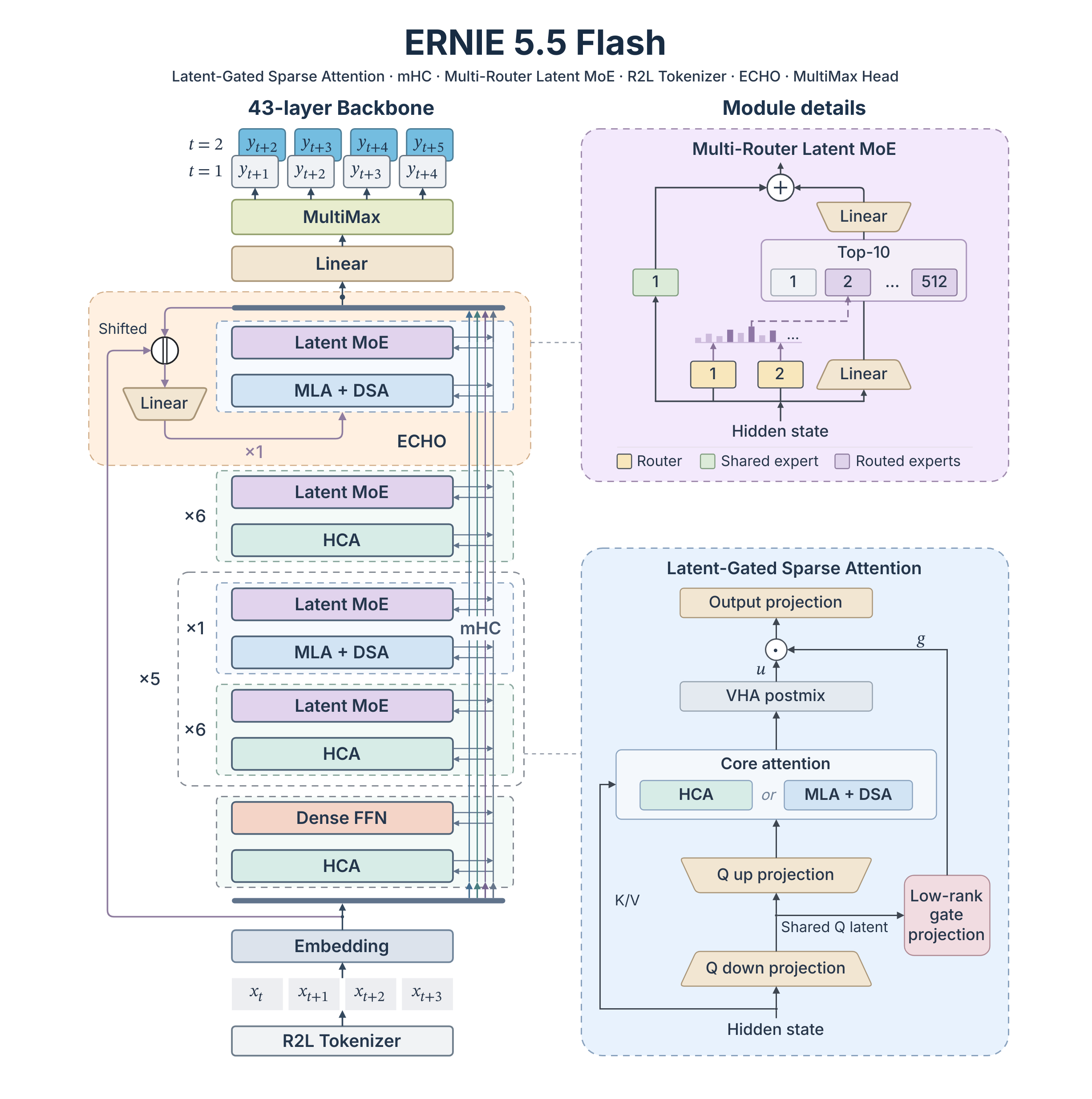
The model has 43 Transformer layers. In 37 of them, heavily compressed attention stores one cached entry for every 128 tokens, alongside a short window of recent uncompressed tokens. Six other layers retain token-level access to the context and select positions through sparse attention. Baidu says this arrangement is designed to reduce the memory and computation costs of long inputs.
Its training corpus includes multilingual web material, code repositories and long documents. The code data goes beyond source files to include commits, issues, pull requests, reviews, generated tests and fixes verified through continuous integration. Baidu says these sources target reasoning across repositories and software-engineering tasks.
Baidu's evaluation compares the released checkpoint with DeepSeek V4 Flash Base, Hy3 preview Base and MiMo V2.5 Base using the same evaluation setup. It reports 78.4 on MMLU-Pro and 82.3 on HumanEval+, ahead of those three models in its tests. Results vary by benchmark: ERNIE trails Hy3 preview on FullStackBench and DeepSeek on HELMET-Rerank. These are Baidu's reported results, rather than independent testing by Sulat.
The weights are available on Hugging Face in FP8 and BF16 formats. Baidu provides serving instructions for SGLang and vLLM, using a completions endpoint for the base model. Its announcement does not give a release date for the post-trained version.
Discover more from Sulat AI & Tech News
Subscribe to get the latest posts sent to your email.