NVIDIA has introduced GR00T 2, a robot model aimed at delicate manipulation, alongside simulation and evaluation tools that give developers more ways to test a robot before putting it to work.
The 9 November announcement at the Conference on Robot Learning in Austin spans several stages of readiness. GR00T 2’s project page promises code in December. Two benchmark projects, DexBench and VABAR, have already released code. Isaac Lab 3.0, the simulation framework underpinning much of the work, reached general availability on 20 October.
That distinction matters for teams deciding what they can build today. The announcement offers a new model to evaluate when its release arrives, and inspectable tools for testing robot behaviour now. It also exposes a familiar difficulty in robotics: succeeding once at many tasks and succeeding consistently are different measurements.
Reading the GR00T 2 results
GR00T 2 is a world action model built on NVIDIA Cosmos, trained on robot experience and human video. NVIDIA says its training includes an openly available collection of 100,000 hours of egocentric human data, within a larger pretraining corpus. The proposed use is a reusable foundation for skills such as handling cables or small components, which can be adapted to a particular robot and task.
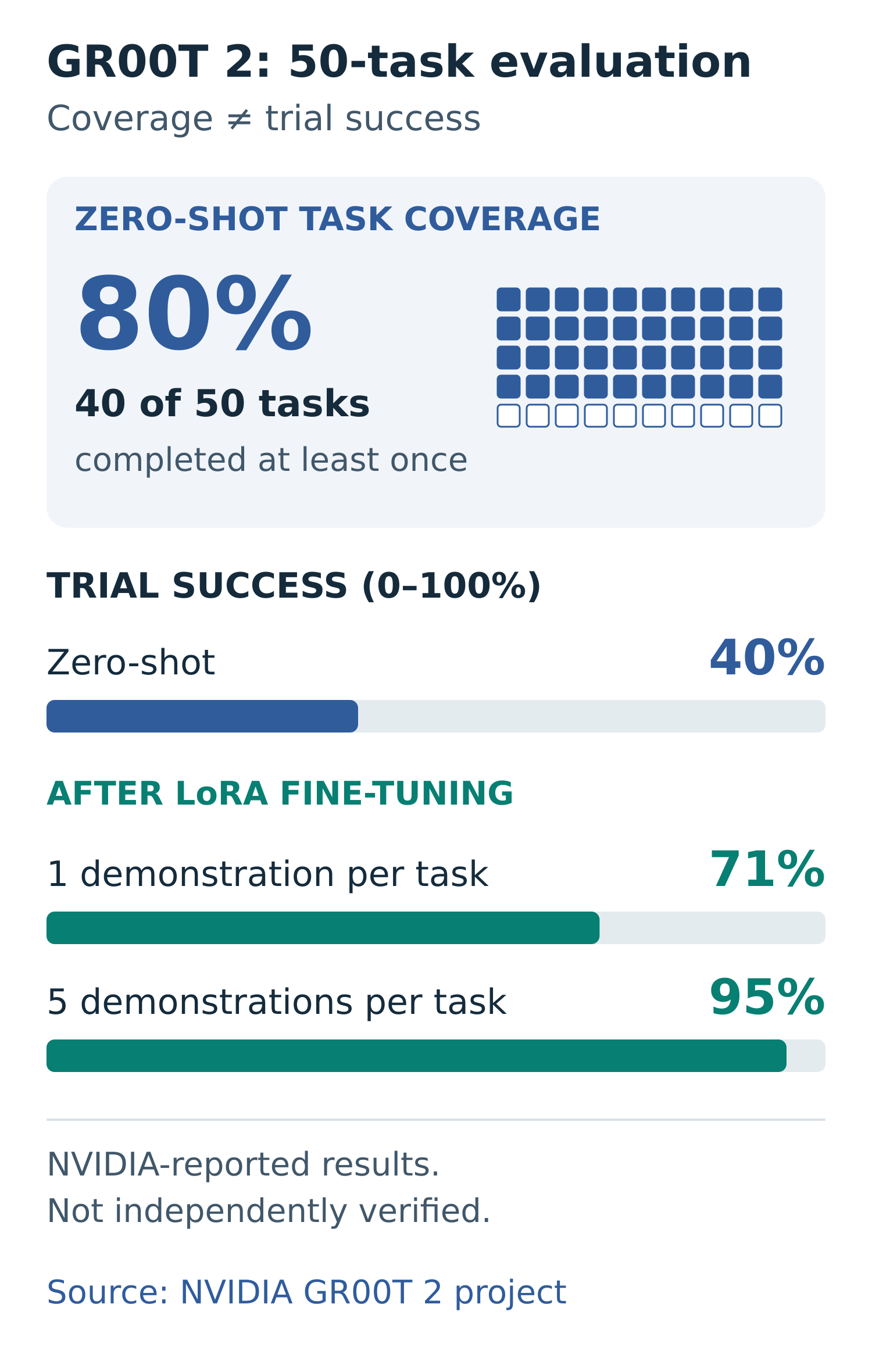
On its 50-task evaluation, NVIDIA reports that the model completed 40 of 50 tasks at least once without task-specific demonstrations on the target robot. That is 80% task coverage. Across the actual zero-shot trials, however, the reported average success rate was 40%. A task can count towards coverage even if the robot fails on its other attempts.
With one demonstration per task followed by LoRA adaptation, NVIDIA reports 71% average success. With five demonstrations per task, it reports 95%. Those higher figures involve post-training, rather than simply handing an unchanged model a demonstration at inference time. The project describes roughly 30 minutes of adaptation on one RTX 5090.
The initial zero-shot setting also needs its full context: the model had seen task-relevant experience through other robot embodiments or human video. The missing examples were task-specific demonstrations for the target robot. All these figures are NVIDIA-reported; Sulat has not independently tested them.
The project page currently says “Code Available in December.” We could not verify downloadable GR00T 2 weights or a model licence. The announcement’s description of the model as open therefore leaves practical release details to be established.
Simulation tools with different release dates
Isaac Lab 3.0 gives developers a more modular training environment, with different physics and rendering backends. Its source is available, with a BSD-3-Clause licence for the core and separate terms for included components. It is an existing October release highlighted at CoRL.
The integration with the Newton physics engine is relevant to manipulation because cables, cloth and articulated hands place demands on a simulator beyond rigid objects moving across a table. NVIDIA reports up to 2.5 times the training throughput from Isaac Lab 3.0 with Newton compared with Isaac Lab 2.3 and PhysX in a vision-based dexterous-manipulation benchmark.
That comparison changes both the framework version and the physics backend. It establishes a reported result for that workload, rather than a universal Newton speed-up or a measure of real-world robot reliability.
Isaac Lab-Arena 0.4, focused on evaluating policies across varied conditions, is listed as an upcoming release, with a developer preview already available on the main branch. The public repository describes its current code as alpha, with unstable interfaces and incomplete features, and warns against production use.
What developers can inspect now
DexBench, developed by RLWRLD with NVIDIA, published its first version on 9 November. It covers 15 manipulation tasks across four scenes, initially using a bimanual robot with five-finger hands. The tests vary objects, placement and physical conditions so that researchers can examine where a policy stops working.
The repository includes evaluation and OpenXR teleoperation code, but omits data-generation and model-training scripts. RLWRLD-authored code uses Apache 2.0; assets, datasets, models and runtime components have their own terms. The project identifies measuring how simulation results correlate with real-world performance as future work.
UC Berkeley and NVIDIA’s VABAR also released code on 9 November. It defines six industrial task classes in bounded workcells, with variations and standardised evaluation. Its coding-agent study covers five of those classes, excluding tool sorting, and a harder test set remains forthcoming. The code is Apache-2.0 licensed, with separate notices for robot models and other assets.
The emphasis on varied demonstrations continues a line of work covered in Sulat’s look at Google’s RT-1. The new evaluation projects make another part of that work explicit: recording the conditions under which a learned skill fails. They provide repeatable experiments for developers; evidence of dependable operation on a physical deployment still has to come from that deployment’s own tests.
Featured image: NVIDIA’s Santa Clara headquarters sign, photographed on 31 October 2020. © 2020 Will Buckner, CC BY 2.0. Cropped for display. This is a company-identity photograph, not a photograph of the CoRL event.
Discover more from Sulat AI & Tech News
Subscribe to get the latest posts sent to your email.