Google introduced Robotics Transformer 1 (RT-1) on 13 December, a robot-control model trained on roughly 130,000 demonstrations covering more than 700 tasks. Thirteen Everyday Robots machines collected the experience over 17 months.
Sulat illustration. Google is a Google LLC trademark; no endorsement or affiliation.
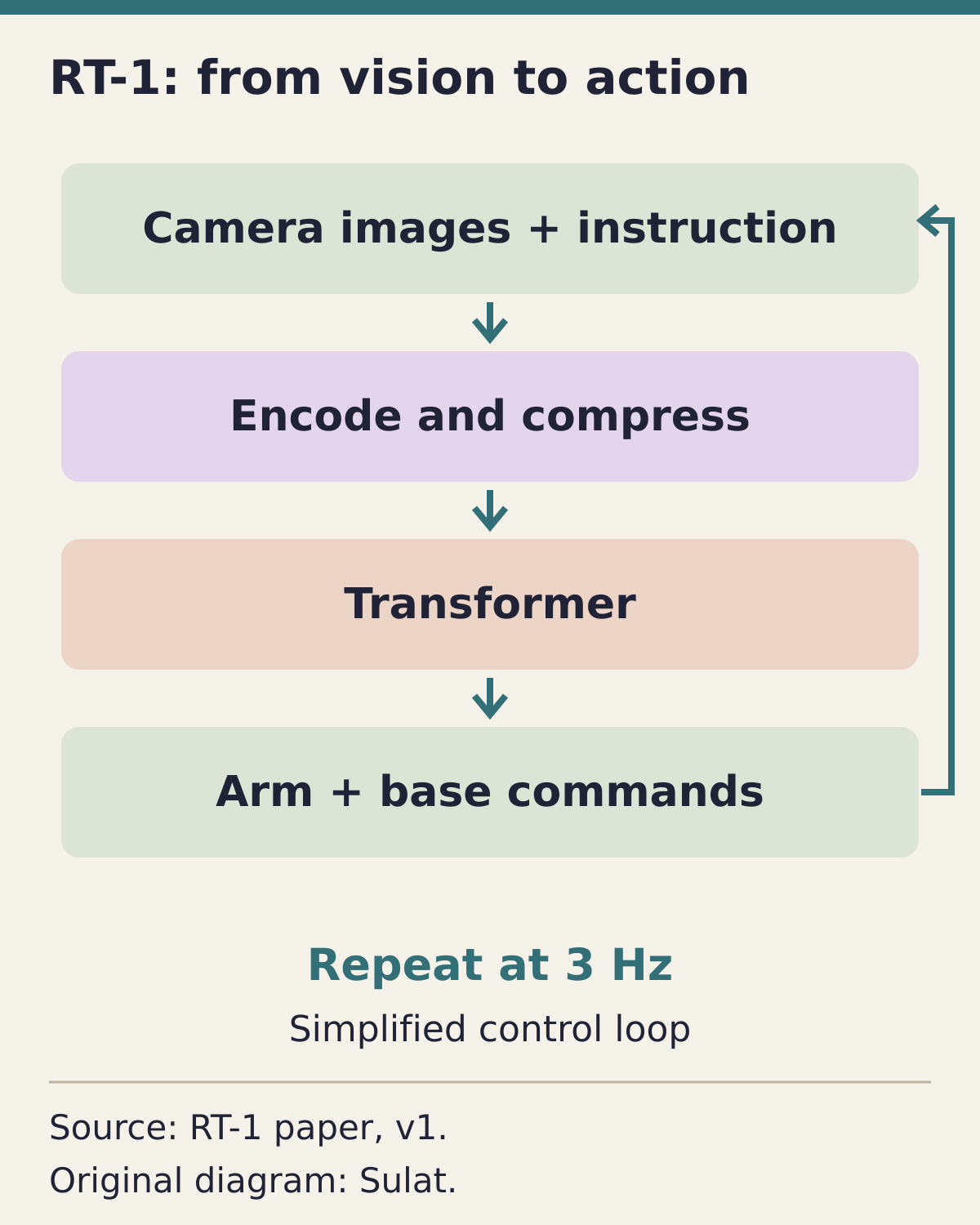
The model combines camera images and written instructions to choose actions. Google is testing whether one model can absorb varied experience and apply familiar skills in new situations, reducing the need to train a separate system for every task.
A language-conditioned image encoder and token compression feed a 35-million-parameter Transformer. It selects discretized arm and base commands at three updates per second. That speed matters because the model must respond while the robot is moving, rather than produce an answer after an entire task finishes.
What the tests show
The original paper reports 97% success on seen tasks and 76% on unseen instructions that combine previously encountered concepts. The comparison trained alternative architectures on the same dataset. It does not compare complete commercial robot systems.
Performance falls to 59% when backgrounds change. The authors also say RT-1 cannot yet learn wholly new motions from an unfamiliar instruction, and imitation learning may limit it to the quality of its human demonstrations.
What researchers can use
The release repository contains libraries, testing utilities and three TensorFlow checkpoint variants: a model trained on the main task collection, one combining data from two robot types, and one mixing simulation with real experience. Its README describes an initial release and explicitly says the project is not an officially supported Google product.
Discover more from Sulat AI & Tech News
Subscribe to get the latest posts sent to your email.