NVIDIA, Rebellions and SK Telecom have announced a development agreement for Korean AI infrastructure using NVLink Fusion. Rebellions’ R200 neural processing units would handle part of the inference workload, with systems expected to be ready for deployment in 2028.
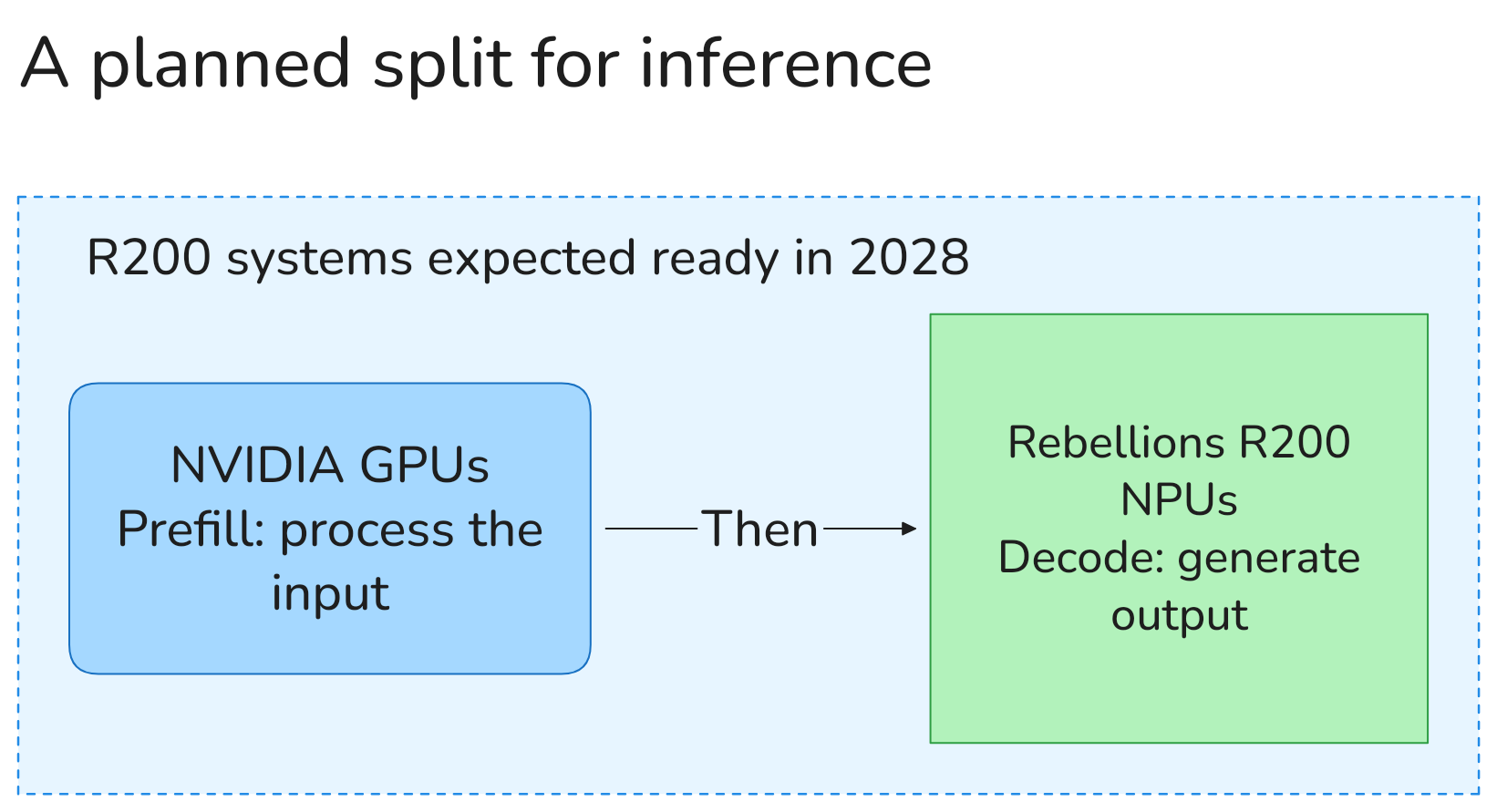
The companies plan to pair NVIDIA GPUs for prefill with Rebellions NPUs for decode. SK Telecom intends to deploy the systems, built around NVIDIA’s MGX rack architecture, for its models and services. Korea’s Ministry of Science and ICT supports the collaboration.
Two stages, different processors
Prefill processes the input before generation begins. Decode produces the output tokens that follow. As Sulat’s recent examination of inference speed explained, faster decoding improves only one part of an application’s response time. Queueing, input processing, reasoning and tool execution can still dominate a complete task.
NVLink Fusion supplies interconnect technology and intellectual property for bringing custom processors into NVIDIA infrastructure. Its role extends beyond a single chip: NVIDIA describes a shared architecture through which XPU systems can integrate with its GPU racks. MGX supplies the rack-level foundation.
The R200 announcement sets out the intended division of work. It provides no matched performance result or price for the combined system.
A separate software push
Alongside the hardware agreement, NVIDIA is promoting B200 deployment recipes for four Korean model families: SK Telecom’s A.X K2, LG AI Research’s K-EXAONE 2.0, Upstage’s Solar Open 2 and Motif Technologies’ Motif-3.
Those recipes are already present in Dynamo v1.6.0, released on 22 October. Their availability predates the Seoul announcement. They configure existing models for NVIDIA GPU serving; they do not establish that the planned R200 system has shipped.
Discover more from Sulat AI & Tech News
Subscribe to get the latest posts sent to your email.