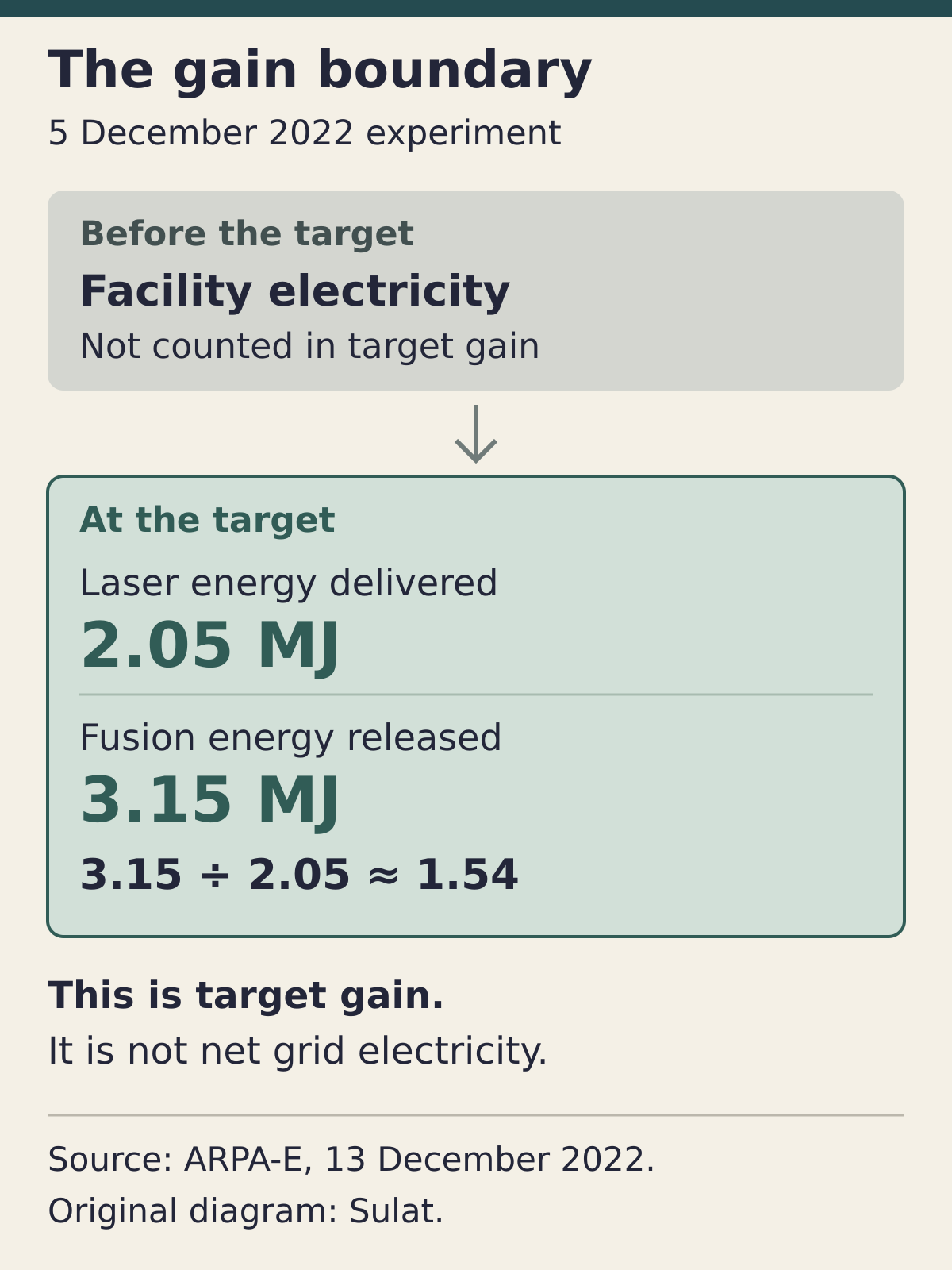
The U.S. Department of Energy announced on 13 December that an experiment at Lawrence Livermore National Laboratory had achieved fusion ignition. The 5 December shot at the National Ignition Facility produced more fusion energy than the laser energy delivered to its target.
Illustration: Sulat. Logo: LLNL.
The measurement is target gain, excluding the facility’s electrical input. It also does not measure electricity delivered to the grid. Those boundaries matter when translating a laboratory result into power-generation claims.
Lasers compress the fuel
NIF uses indirect-drive inertial confinement fusion. Its laser beams heat a small gold enclosure containing a capsule of deuterium and tritium, forms of hydrogen. The enclosure emits X-rays that compress the fuel. The University of Rochester’s Laboratory for Laser Energetics describes this approach as distinct from its own direct-drive experiments, in which laser beams strike the capsule directly.
As Imperial College London’s researchers explain, fusion reactions produce alpha particles that deposit heat in the surrounding fuel. That heating can drive further reactions. The December result demonstrates the process at an energy scale that researchers have spent decades trying to reach.
The ARPA-E analysis separates this from NIF’s August 2021 hot-spot ignition result, whose yield remained below incoming laser energy. December’s experiment crossed the additional target-energy threshold.
The power-plant work ahead
Imperial physicist Jeremy Chittenden identifies three further needs: larger energy gain, much more frequent operation and substantially lower costs. His assessment leaves the timetable uncertain. A successful experimental shot is an important physics result, but a useful generating station has to repeat the process reliably and economically.
The experiment also serves an immediate national-security research mission. Rochester’s laboratory says the result advances work supporting the U.S. nuclear stockpile. Its researchers contributed diagnostics and reviewed initial results, while its facilities train scientists and test ideas before experiments are scaled to NIF.
Discover more from Sulat AI & Tech News
Subscribe to get the latest posts sent to your email.