United Airlines says it’s restricting access for “unauthorized, third-party personal AI agents or assistants”, both on its own app and website and indirectly through travel agencies and aggregators. The airline announced the change in a news release dated 11 November 2026, and TechCrunch reported it the next day.
United gives three reasons. It says sharing account credentials with third-party AI assistants “can expose sensitive information”, and that the tools’ actions “may result in unintended purchases, account changes, or use of MileagePlus miles”. It also says automated AI actions could breach US Federal Aviation Administration and Department of Transportation rules, using flight check-in as its example: a person has to acknowledge that their bags don’t hold banned substances such as explosives. The release says the work includes updates to United’s “booking, ticketing and distribution policies”.
What changed in the contract
United’s Contract of Carriage, marked as revised on 11 November 2026, now defines an “AI Agent” as any software or service that takes autonomous or semi-autonomous action to discover, search for, book, purchase, ticket, service or manage anything United offers. The definition applies “whether or not” the passenger or another person supervises or approves what the tool does. It names AI assistants built into social media, messaging or search platforms, AI-enabled browsers, standalone agents, and third-party assistants that reach United through a tool supplied by a travel agency.
Rule 6 of the contract adds “the use of AI Agents to make, modify or service a Ticket, and/or to purchase any service or product” to its list of prohibited practices. Rule 5 now lists “reservations made, modified or serviced by AI Agents” among the improper reservations that United says it will cancel without notice.
What United says it means for travellers
United’s Digital Trust Center page on third-party AI agents fills in the practical side. Bookings an agent made before 11 November 2026 won’t be cancelled, though United recommends reviewing them. Using AI to research a trip is fine, it says, as long as the tool doesn’t access united.com or the United app. Travel agencies and booking platforms can’t use third-party AI agents to search for, book or manage United travel, and can only use their own AI tools with United’s permission. Assistive technology for customers with disabilities isn’t affected.
Asked whether it works with any third-party AI agents, United’s answer on that page is “Not yet”. It tells customers who’ve shared MileagePlus login details with an AI agent to change their password straight away.
Where it sits among other companies
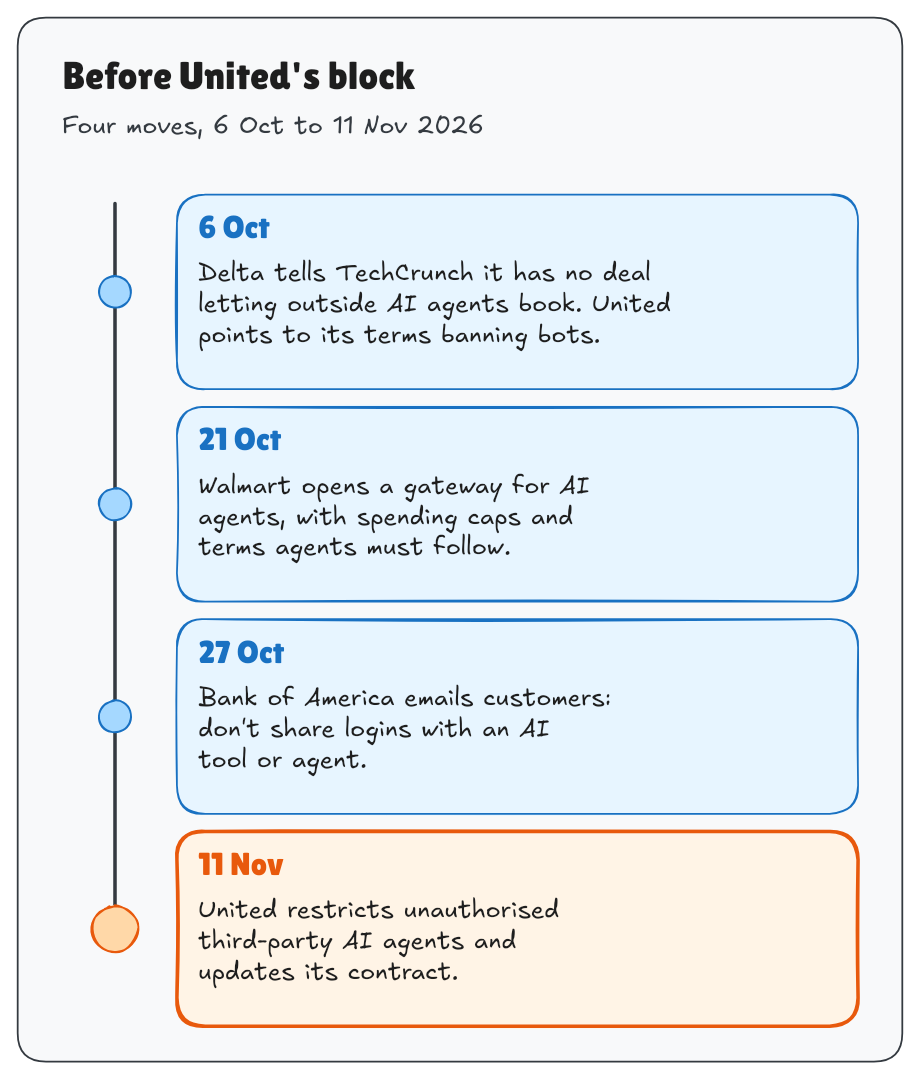
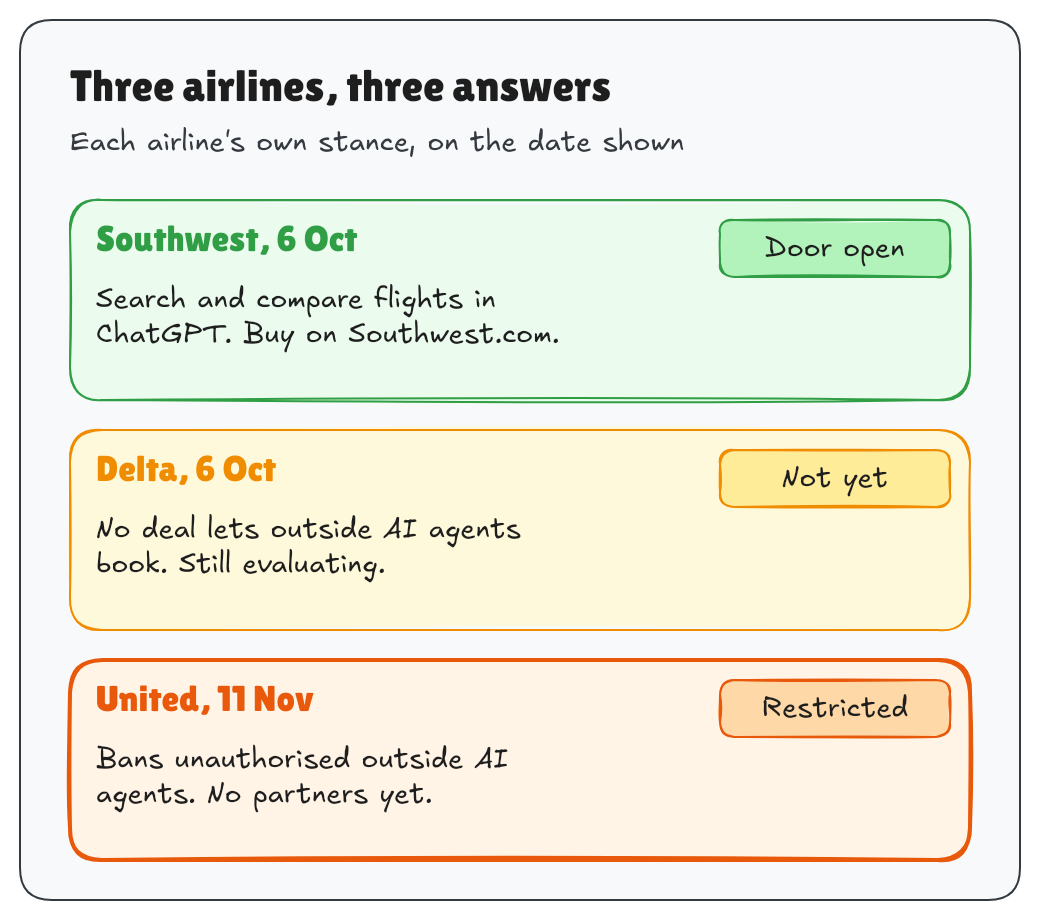
United’s release says “corporate leaders in the banking and retail industries have taken similar actions regarding AI agents”, and encourages others to consider measures that protect customer data and strengthen safety. Delta, Walmart and Bank of America had each spoken in the weeks before. On 6 October, Delta told TechCrunch it had no “partnership or integration that enables a third-party AI agent to shop for or book Delta flights”, while it continued to evaluate external agents. In the same story, a United spokesperson pointed TechCrunch to its terms of use, which bar robots and other automatic devices.
On 21 October, Walmart announced Agent Profiles, a Walmart Agent Gateway and terms for AI agents, including spending limits customers set and approval of agent purchases by default. On 27 October, Bank of America emailed customers asking them not to share their username and password with an outside service, “including an AI-enabled tool or agent”, TechCrunch reported.
Another airline has gone the other way. On 6 October, Southwest launched a plugin in ChatGPT that lets travellers discover and shop for its flights, with OpenAI and Amazon Web Services. Travel Weekly reports that buyers are handed off to Southwest.com to complete the purchase, and Southwest says it plans to expand the AI-powered booking over time.
What the news doesn’t show
Neither United’s release nor its help page says how it will tell an agent acting for a customer from the customer, and neither names a specific AI product.
United’s pages disagree on searching. The contract’s prohibition covers making, modifying or servicing a ticket and buying a product, but its definition of an AI Agent also includes discovering and searching. United’s help page calls a tool that searches united.com for you without permission “unauthorized”, and its website terms bar automated agents from searching or booking without written permission. PPC Land reads the contract as leaving search open; TechCrunch’s story and United’s release don’t draw that line.
United says it will keep evaluating how personal AI assistants interact with its services.
Discover more from Sulat AI & Tech News
Subscribe to get the latest posts sent to your email.