MotherDuck CEO Jordan Tigani has proposed a new job title, the Data Intelligence Engineer, for the person who runs a data team’s AI agents instead of working its ticket queue. He makes the case in a MotherDuck blog post dated 11 November 2026, after proposing the name in a talk at Data Outpost on 4 November.
MotherDuck sells a cloud service built on DuckDB, the open-source analytics database, and the post ends with a list of its products that fit the role. The claims below are Tigani’s and MotherDuck’s, and the post cites no study or customer data.
No backlog, more checking
The post opens with Nick Ursa, MotherDuck’s lead data engineer and a co-founder, who told Tigani: “This is the first time in my career with no backlog.” Tigani says Ursa is busier than ever anyway. His job used to be making sure the numbers he computed were right, and now it’s making sure the numbers an LLM or agent produces are right.
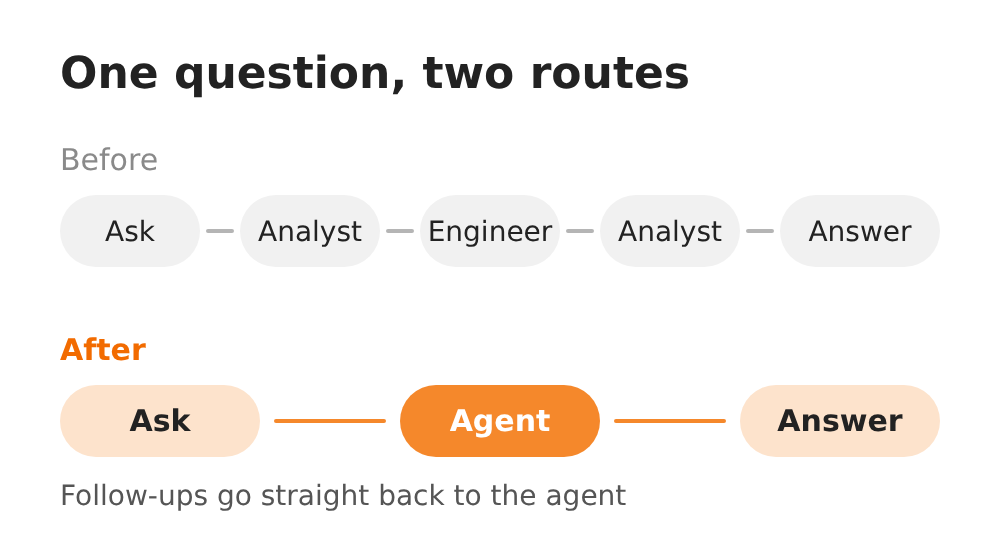
Tigani describes how a question becomes an answer as a relay. A marketing leader sees churn spike on a Monday and files a ticket. An analyst finds that some data isn’t exported from one source and files a ticket with a data engineer, who changes the pipeline, tests it, runs the backfill and tests that too. Only then can the analyst build the dashboard. By the time it ships, the marketing leader can’t remember why they asked, and churn had recovered on its own a couple of weeks earlier.
Tigani says nobody in that relay did anything wrong, but every handoff means waiting and lost context. He adds that the earlier generation of AI copilots sped up some steps without removing the handoffs.
What he says changed after December 2025
Tigani says the case against AI for analytics was easy to make before December 2025: models wrote bad SQL and business logic was unknowable. He says newer models got better at SQL, agents can work out business logic when given context, and agents went multi-turn, so they can run a query, look at the result and try again like a human analyst. “Put those together and it … just … works,” he writes.
His evidence is his own talk. He built the Data Outpost presentation as an app made with MotherDuck and Claude, using live data from four sources and interactive, animated charts, and says he didn’t look at a single line of code or SQL. He says business people who can ask their own questions ask more of them, and can follow up while they still hold the context.
Which jobs can be a prompt
Tigani says writing SQL queries, creating dashboards and building dbt pipelines, dbt being a tool that turns raw tables into modelled ones with SQL, won’t need specialised knowledge in the not too distant future. He says agents are “likely better than humans at these tasks already”. As an example, he says Ursa moved MotherDuck from one version of the Airflow workflow scheduler to another in a weekend with minimal supervision, a job that once would have taken a week.
Writing the code was never the whole job, Tigani says. Someone still has to own a clean data model with context and annotations, keep terms consistent across the company and sign off that a number is right. A model knows SQL, he writes, but not how a company counts revenue or which of several similar tables is the real one, and his joke example is revenue_cpx_new_revised_v2_use_this_one. Ursa’s line is that data engineering “is an accountability function”.
Tigani calls context a crutch that’s hard to maintain, and says a clean data model beats it. In his analogy, context is a manual for agents, and a simpler model saves them time and tokens.
What a Data Intelligence Engineer does
Tigani says the role automates the data engineer’s work, ingestion, and the analytics engineer’s work, transformation and modelling, by creating and conducting software agents. It also writes the company’s knowledge into shared context, such as which fields can be joined and what someone means by “ARR”. And it runs evals, system tests that ask questions with known answers and check the agent gets them right. He says evals also show when something breaks.
The goal is self-service. Tigani says anyone in the company should be able to open Claude, ChatGPT or another agent, get correct answers about the business, build apps and visualisations from them, and decide with data. MotherDuck published the role as a job description. He says data engineers, analytics engineers and analysts will recognise parts of it, because those roles were already blending.
How closely to supervise agents
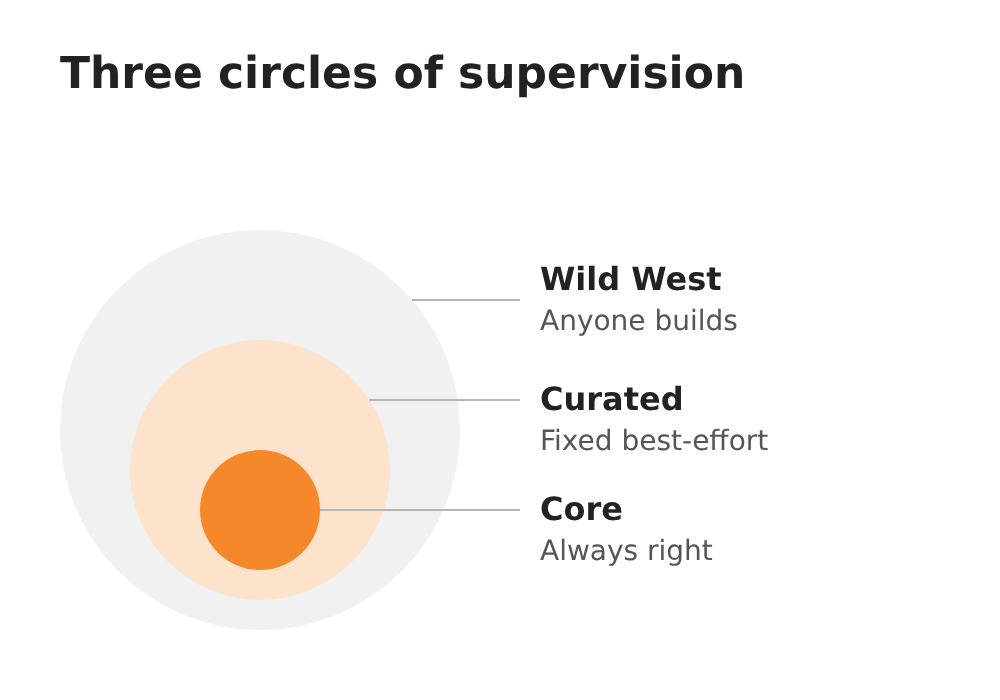
Tigani raises the obvious objection himself: more people building means more chances to be wrong, with less oversight. He gives two answers. People close to a problem spot errors, and he says MotherDuck has found results improve because the business owner knows when a number looks off. And Ursa’s rule is “Agents need supervision proportional to their blast radius.”
Tigani turns that into three circles. In the outer one, the Wild West, anyone can build and the data team keeps its hands off. In the middle one, Curated, sit the dashboards, apps and metrics that matter to the business, and the data team makes a best effort to fix them when they break. The Core holds the key metrics, which the data team keeps high quality and predictable at all times, and the board number lives there.
Where MotherDuck’s products fit
The post closes by naming MotherDuck products for each part of the job. All of them are reachable from SQL, Tigani says, so one person or agent can work a problem from ingestion to apps without a handoff between tools.
| Product | What MotherDuck says it is |
|---|---|
| Flights | Vibe-codable pipelines that pull data into your warehouse and translate it into a sane model |
| Guides | Markdown files describing your data model and business; private at first, and an admin can promote one to the whole organisation |
| Dives | Data visualisations that agents create |
| Ducklings | A dedicated DuckDB instance for every person and agent |
What the post doesn’t show
The post gives no figures on accuracy, time saved or cost, and no customer examples. Its evidence is Tigani’s own talk and one MotherDuck engineer’s account. It describes evals in general terms and doesn’t say how the three circles are enforced. MotherDuck sells the tools it lists as fitting the role. Tigani ends by asking readers who does this job at their company, and what they call them.
Discover more from Sulat AI & Tech News
Subscribe to get the latest posts sent to your email.