Epic Games has added Nicole Saharsky, a Mayer Brown lawyer who has argued 32 cases at the US Supreme Court, to its team for Apple Inc. v. Epic Games, Reuters reported on 13 November. The court’s docket lists her as Epic’s counsel of record, and the justices hear the case on 11 January 2027.
Reuters’ Mike Scarcella writes that Saharsky works alongside Epic’s longtime lawyers at Cravath, Swaine & Moore. Apple is represented by Gregory Garre of Latham & Watkins, a former US solicitor general. Reuters shared the story on X.
Epic Games adds to legal lineup for Supreme Court showdown with Apple https://t.co/VjgcImilmJ
— Reuters (@Reuters) November 14, 2026
What the court is deciding
Epic sued Apple in 2020 over App Store rules. The district court’s injunction barred Apple from prohibiting developers from putting buttons, links and other calls to action in their apps that send customers to other ways of paying. Apple then charged a 27% commission on those linked-out purchases and added design rules for the links. The district court held Apple in contempt, which means it found Apple had broken a court order. The Ninth Circuit upheld that finding on 11 December 2025, but threw out the ban on charging any commission on linked-out purchases and sent that part back to the lower court.
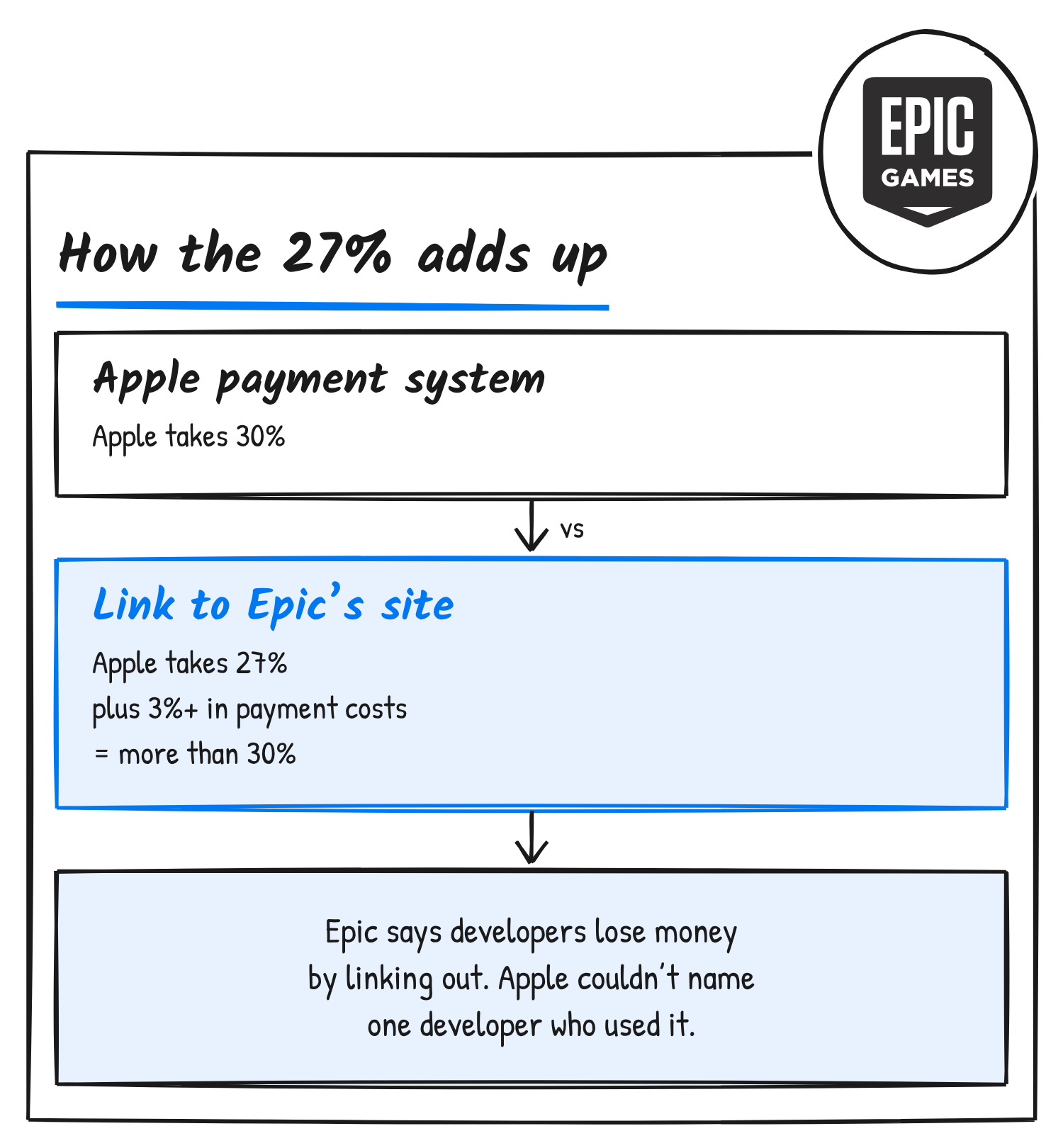
The Supreme Court granted Apple’s petition on 30 June 2026, limited to one question. In Apple’s brief, that’s whether a court can hold someone in contempt for breaking an injunction’s “spirit” when the order is silent on the conduct, or only when the order clearly and unambiguously bans that exact conduct.
Epic’s case: the 27% sums
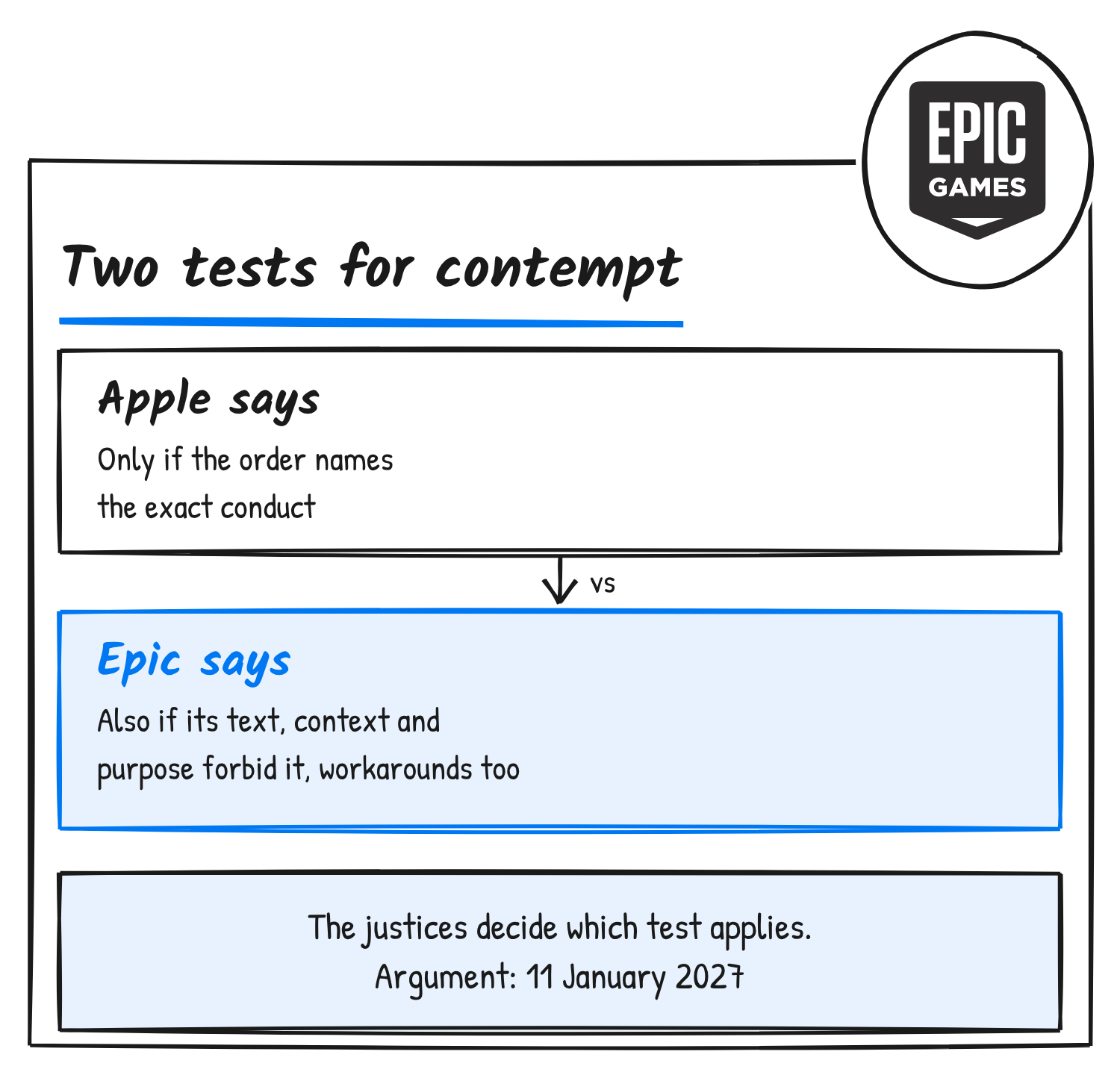
Epic’s brief, filed on 13 November, says Apple picked 27% knowing that developers’ payment-handling costs of more than 3% would push a linked-out sale above Apple’s 30% in-app purchase commission. It quotes an Apple executive saying every linked-out transaction “is going to be more expensive” for a developer than an in-app purchase at 30 percent.
The brief says Apple couldn’t name a single developer that used the 27% route, and that the district court found a report Apple commissioned to justify the rate was “sham” evidence. Epic asks the justices to uphold the contempt finding or, if they set a new standard, send the case back to the lower courts to apply it.
Apple’s case and the US government’s view
Apple says the injunction never mentions commissions, so it can’t be in contempt over one. Reuters reports Apple argues it can’t be punished on a hindsight reading of an order’s unstated “spirit”. The Ninth Circuit itself wrote that the text of the injunction “does not address commissions at all”, though it held the 27% rate broke the order because its effect was prohibitive.
The US government filed a brief supporting neither party on 21 September. It says contempt needs “no fair ground of doubt” that the order barred the conduct, and that the injunction can’t reasonably be read to ban a 27% commission, or at minimum leaves a fair ground of doubt. Epic’s brief says the government largely agrees with its legal standard and never addresses the district court’s findings of knowledge and bad faith.
Apple’s reply brief is due on 14 December, 9to5Mac reports, ahead of oral argument on 11 January 2027.
Discover more from Sulat AI & Tech News
Subscribe to get the latest posts sent to your email.