Docker has launched a new brand, a redrawn Moby whale and a pitch it describes as built to run on trust. Chief marketing officer Terri Avnaim announced it in a blog post dated 19 November US time (20 November in New Zealand), saying Docker “is not just about containers anymore”. To show what that means, her post tells readers to try two products: Docker Sandboxes, which run AI coding agents inside microVMs, and Docker AI Governance.
Kartik, an X user, summarised the news as “Introducing Docker, the sandbox company” while quoting Docker’s own announcement. The line is his, not Docker’s. Avnaim writes that the containers “you know and love aren’t going anywhere”.
Introducing Docker, the sandbox company
— Kartik (@kartiksmath) November 19, 2026
Behind the new look sits a year of product work: a sandbox that gives each agent its own kernel, a file format for writing down what an agent may touch, a cloud version priced by the second, and an enterprise policy layer. This piece goes through each, using Docker’s own posts and docs, and marks where the claims are Docker’s alone.
What the rebrand changes, and what it doesn’t
Avnaim says Docker worked with the brand agency Motto on a new Moby, and that the company has a new website. She says openness, a developer-first stance and simplicity stay. The palette and typefaces come from a separate write-up.
Docker Captain Mohammad-Ali A’râbi covers those details on containersecurity.dev, a site that says it isn’t affiliated with Docker. He says the familiar bright blue gives way to a more violet-toned base blue, the typefaces are GT Planar and GT Standard Mono, and Docker’s messaging now rests on three pillars: a trusted runtime, a trusted supply chain and a trusted ecosystem. He lists two lines of Docker’s new messaging, “Trust Docker for the agents you don’t” and “Contain your agents, not your ambition”. The design detail is his reading, and he links Docker’s brand guidelines for the official version.
The argument: containers isolate applications, agents act
Docker lays out the case in a 5 November post by Srini Sekaran and Oleg Šelajev. A container, they write, is an isolated process that shares the host’s kernel, the core of the operating system, with everything else on the machine. A Docker Sandbox is a microVM, a small virtual machine, with its own Linux kernel, filesystem, network and Docker Engine.
The post says Docker President Mark Cavage made the point in a keynote at WeAreDevelopers North America: containers do the job they were designed for, but agents ask them to do a different one. A coding agent clones repositories, installs packages, starts databases and retries for hours, and it can act on instructions in files, web pages and tool output nobody reviewed.
Docker says its keynote demo showed the gap. An agent in a container started with the Docker socket mounted, the long-standing way to give a container Docker access, found a secrets file on the host with no zero-day exploit. Docker’s argument is that agents probe their surroundings as part of the job, so a gap in the configuration will get found.
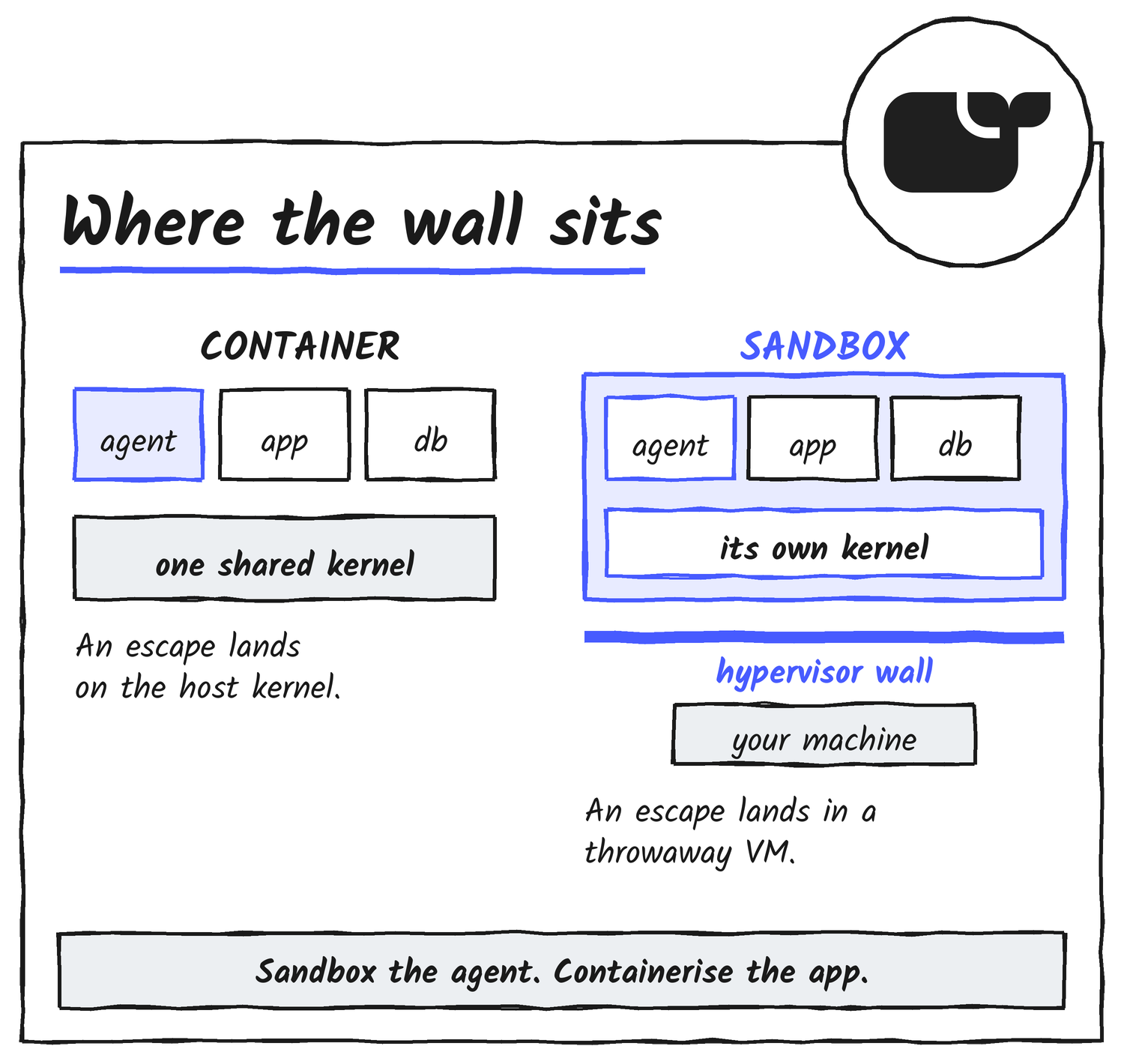
The shared kernel isn’t only a vendor talking point. Xint, the security firm behind the nginx2root research, says its chain escaped a Docker container running nginx and reached root on the host through a Linux kernel bug, as covered in nginx2root: five critical nginx flaws. Docker adds a limit to its own claim: on Docker Desktop for macOS and Windows, the shared kernel belongs to Docker Desktop’s VM, so an escape lands in that VM rather than the host system.
What a sandbox is, and what it costs you
A sandbox runs the agent inside a microVM, where it gets sudo, a private Docker Engine and room to build images or start a whole Compose application. Docker says the host’s Docker daemon, the host filesystem outside the workspace and other sandboxes stay out of reach. The command is sbx run claude, using sbx, the standalone Docker Sandboxes CLI, and Docker’s product page says it doesn’t need Docker Desktop. Docker says a sandbox keeps its packages, images and agent history until you remove it with sbx rm.
| Agent in a standard container | Agent in Docker Sandboxes | |
|---|---|---|
| Kernel | Shares the host kernel | Runs its own Linux kernel in a microVM |
| Docker | Needs the host socket or a nested daemon | Uses a private Docker Engine inside the microVM |
| Workspace | Sees the host paths you mount | Direct read-write mount, or an in-VM private clone |
| Network | Container network and whatever controls its operator adds | Outbound traffic goes through a host proxy, deny by default |
| Credentials | Commonly environment variables, files or mounted sockets | Injected by the host for supported HTTP services |
| State | Usually rebuilt from an image and volumes | Kept until sbx rm |
The cost is hardware and setup. Docker says a sandbox needs a supported hypervisor: Apple silicon on macOS 14 or later, Windows Hypervisor Platform, or KVM on supported Ubuntu systems. Running inside another VM needs nested virtualisation, and the separate kernel and engine use more memory and disk than one more container would. Docker’s 5 November post also says Kits are in early access and environment files are experimental, so both may change.
Rules the agent can’t edit
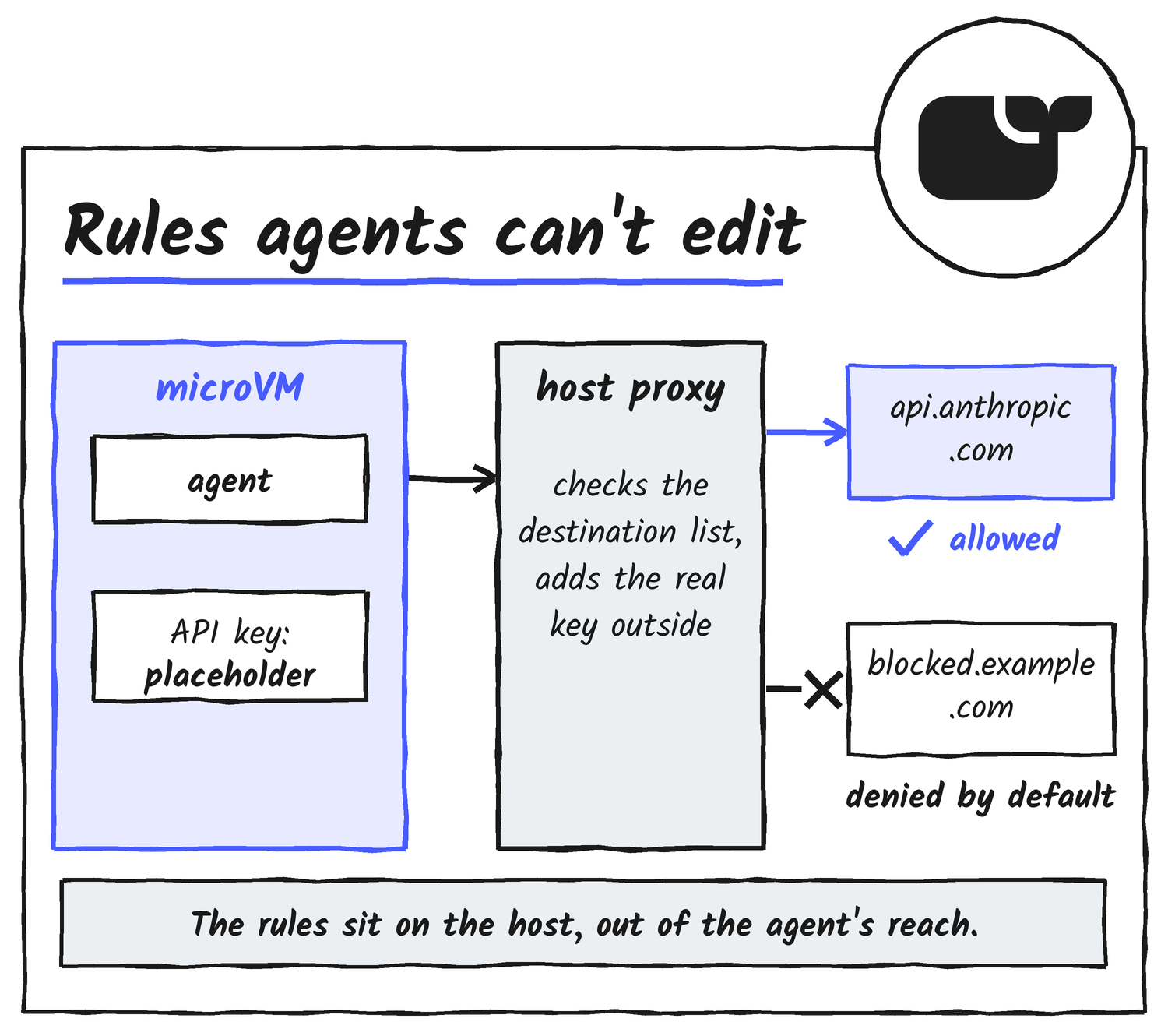
Docker puts most weight on where the controls live. Outbound traffic from a sandbox goes through a proxy on the host, which blocks any destination nobody has added to the list. For supported HTTP services the same proxy adds the real credential to outgoing requests, so the key never enters the VM. Docker’s reasoning is that a rule the agent can reach is a rule it can work around.
A developer can ask the active policy a question before starting the agent. Docker’s governance post shows sbx policy check network api.anthropic.com returning “Allowed” and sbx policy check network blocked.example.com returning “Denied”.
Docker’s product page goes further on one claim. Its FAQ answers the question “Is YOLO mode actually safe here?” with “Yes”, saying the sandbox is the safety and agents run unattended with permission prompts skipped by default. The 5 November post is more careful. It says the boundary lets you stop approving every command, and it lists what the agent can still reach.
That list is the workspace, which mounts read-write by default so the agent can edit or delete project files, plus local MCP servers and shared agent skills, which run from the host. Clone mode gives the agent a private copy inside the VM to protect the host working tree, though Docker says the original repository stays readable. Docker’s advice is to read the diff before running modified code.
Kits: writing an agent’s authority down
A sandbox on its own is an empty room. Something still has to say which agent runs, which tools it gets and what it may touch. Docker’s answer is the Kit, and on 24 September senior principal engineer Christian Dupuis published the Docker Sandboxes Kit Specification v3, open source under Apache 2.0 at docker/sandbox-kit-spec.
A Kit is now an ordinary OCI image, the container image format registries already handle. It builds with docker buildx build, pulls with docker pull and goes through the scanning and signing tools a team already runs. The manifest carries a descriptor listing what the Kit asks for. Dupuis describes two kinds: a workload, which supplies the root filesystem, and a mixin, an overlay such as a command-line tool with its network rule or a credential binding. A launch takes one workload and any number of mixins.
His example is part of the GitHub CLI mixin in the repository:
capabilities:
  - type: com.docker.sandbox/network-policy@2
    config:
      runtime:
        allow:
          - github.com
          - hosts: [api.github.com]
            methods: [GET, HEAD, POST, PATCH, PUT, DELETE]
        deny:
          - hosts: [api.github.com]
            methods: [DELETE]
            paths: [/repos/**]
Dupuis reads it as a permission slip. The Kit asks to reach GitHub and nowhere else, and to use most of the API except deletes under /repos/**, because a deny rule wins. In the full file the token is proxy-managed, so the sandbox holds only a placeholder and the host injects the real value.
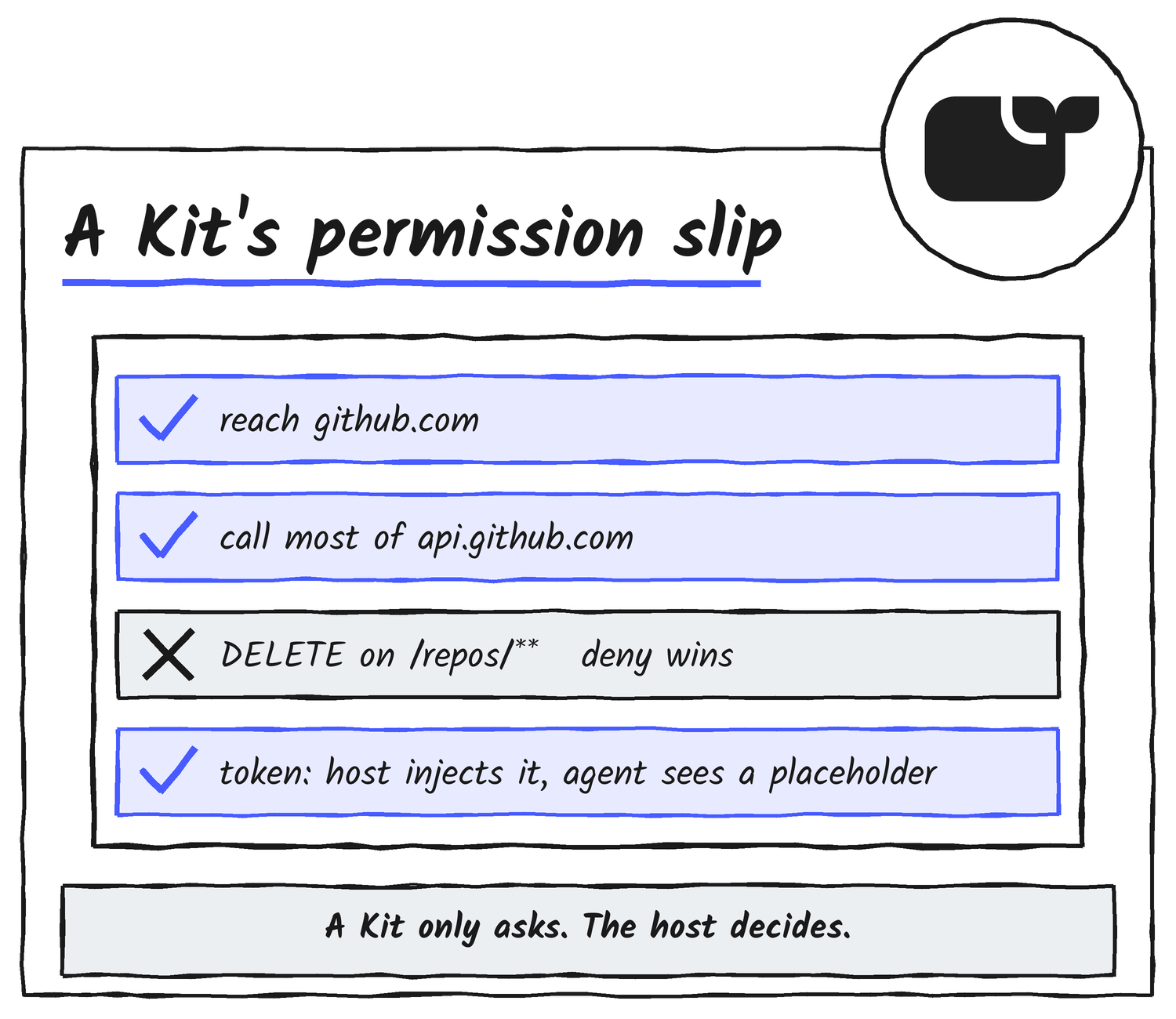
He leans on two words, “asks” and “conforming”. A Kit grants itself nothing, and only a runtime that implements the specification enforces it. Without one, he writes, the descriptor does nothing. Docker Sandboxes is the first conforming runtime. A required request the host can’t satisfy refuses the launch rather than starting the agent with less or more authority than declared.
Updates are where teams benefit. Dupuis says a new version of a Kit that asks for another host or a second credential is a change in authority, and it shows up in a pull request as added lines a person can refuse. The specification also defines an automatic gate: a runtime records everything a Kit was granted, applies a version that stays inside it, and stops to ask when a new one widens it. Removing a deny rule counts as widening.
Docker maintains the specification today. Its keynote recap says Docker has committed to submitting it to the Cloud Native Computing Foundation, and quotes the foundation’s CTO, Chris Aniszczyk, saying the cloud native community looks forward to working with Docker to bring the work under neutral governance. Nous Research also joined Cavage onstage to show its Hermes agent running as a Kit. None of the sources say the submission has been accepted.
Cloud Sandboxes, priced by the second
The 24 September announcement by Timir Karia and Srini Sekaran puts the same microVM on Docker-managed machines. sbx move my-project --to cloud captures the sandbox’s filesystem and recreates it on the other side, and the move works in both directions. Docker says each cloud sandbox gets its own microVM, secrets and network policy, and that Claude Code, GitHub Copilot, Hermes and other agents are ready as Kits.
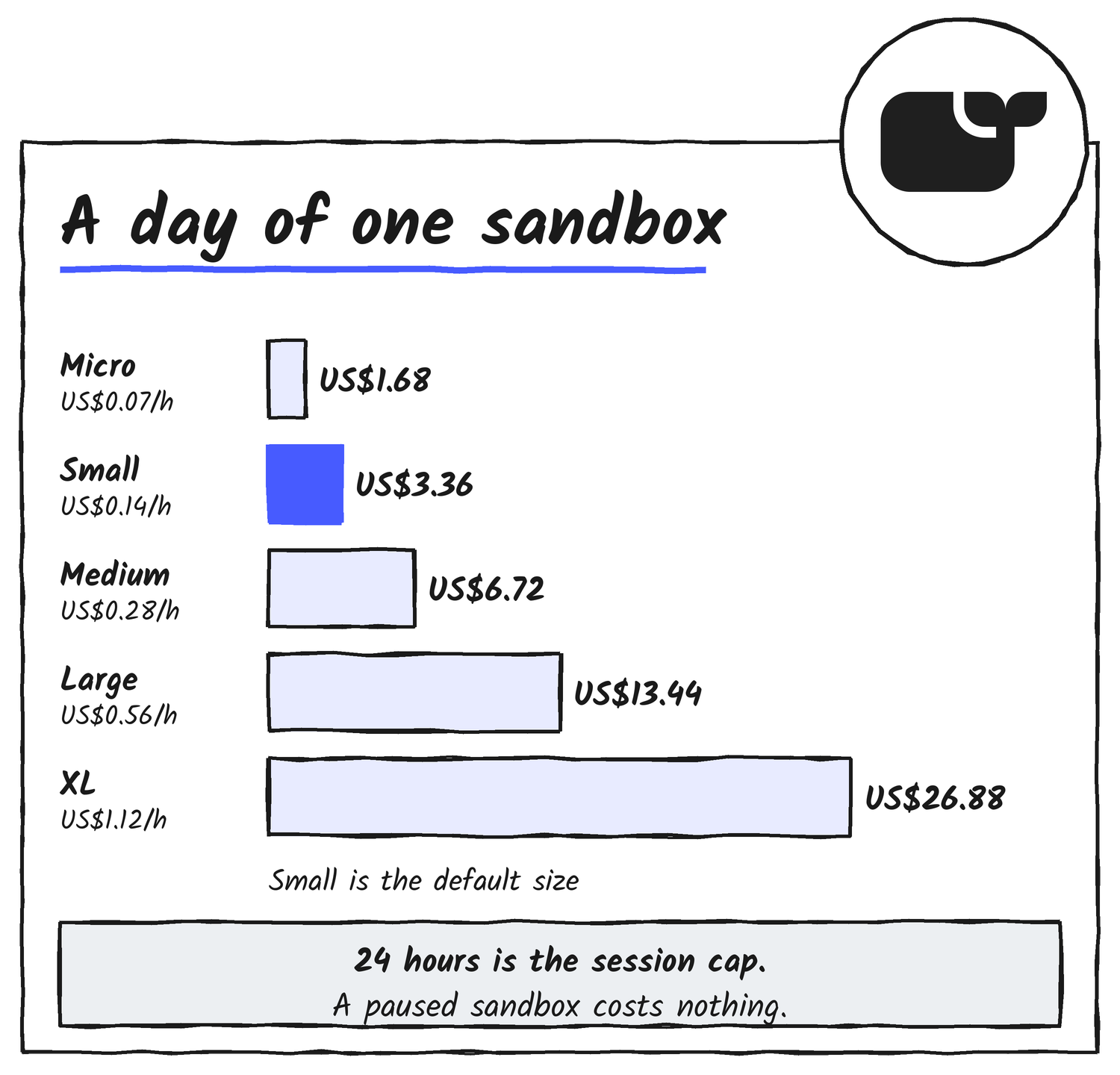
Pricing is pay as you go, metered by the second. Docker says a paused sandbox costs nothing, and volumes, egress and hosting public images and Kits are free. A session runs for one hour by default and up to 24 hours, and you can bring your own model key.
| Size | vCPUs | Memory | Per hour | 24 hours |
|---|---|---|---|---|
| Micro | 1 | 2 GiB | US$0.07 | US$1.68 |
| Small (default) | 2 | 4 GiB | US$0.14 | US$3.36 |
| Medium | 4 | 8 GiB | US$0.28 | US$6.72 |
| Large | 8 | 16 GiB | US$0.56 | US$13.44 |
| XL | 16 | 32 GiB | US$1.12 | US$26.88 |
You need sbx 0.45.1 or later and the pay-as-you-go plan, which Docker says is available on Personal and Pro accounts. New accounts get US$250 in free credit for a limited time, according to Docker. Local and cloud sandboxes keep separate secrets, templates and network policies, so a local workflow doesn’t carry over untouched.
Docker’s product page says no rival does what it does. Its comparison table lists E2B, Daytona, Modal and Cloudflare, and shows Docker as the only one with microVM isolation on your own machine and a single command to move a sandbox between laptop and cloud. The cloud announcement makes the same claim in softer words: “As far as we know, no other agent sandbox works this way.” Those rows are Docker’s own description of its competitors.
Governance and the supply chain
For companies, Docker AI Governance adds central control. A post by Karan Verma on Docker’s blog, dated 18 November, describes three parts. Sandbox policies set network and filesystem rules at the proxy and mount layers. MCP tool governance writes rules in Cedar, a policy language, for activity that goes through Docker’s MCP Gateway, and denies governed requests unless a policy permits them. Audit records capture the principal, action, target, decision and time, can be sent to a SIEM (security information and event management) tool, and don’t include prompt or response contents.
The post marks its own limits. MCP policies cover only traffic through the gateway, so a direct connection to a remote MCP server from inside a sandbox falls under network policy instead. The example policy that allows read-only tool calls relies on a readOnly annotation the server supplies, which the post calls advisory.
The third pillar, the trusted supply chain, rests on Docker Hardened Images, which Docker says ship with signed SBOMs (software bills of materials), VEX information and SLSA Build Level 3 provenance. Docker’s 19 November post shows the pitch in use: it says Docker published rebuilt NGINX images on 18 November, the day nginx 1.30.7 and 1.31.9 shipped, and began publishing fixed Java runtimes for the Java4Shell flaw the same day, with Eclipse Temurin images still waiting on upstream builds.
What the launch doesn’t show
Nearly every claim above comes from Docker’s own posts, product pages and documentation. The one outside write-up covers the branding, not the security. None of the sources include an independent test of the microVM boundary, the proxy’s credential handling or cloud pricing at scale, so those remain Docker’s description of its product. The Kit specification is still maintained by Docker alone, and the foundation hasn’t been reported as accepting it.
What the rebrand does settle is the direction. Avnaim’s post names Sandboxes and AI Governance as the products to try, the keynote recap and the cloud launch both treat the sandbox as the base, and the Kit specification and governance layer sit on top of it. Whether “sandbox company” fits is a matter of weighting. Docker says containers stay, and the company’s newest work is about what happens around them.
Discover more from Sulat AI & Tech News
Subscribe to get the latest posts sent to your email.