Five separate flaws in nginx, the web server that sits in front of a huge share of the internet, each let an unauthenticated attacker run commands on the server. Xint, the security firm that reported them, calls the set nginx2root. F5, which maintains nginx, shipped fixes on 18 November US time in nginx 1.31.9 on the mainline branch and 1.30.7 on the stable branch, and nginx’s own advisory list marks 1.31.8 and everything older as vulnerable.
The worst of the five, CVE-2026-123007, has sat in the HTTP/2 code since nginx 1.9.5 in 2015 and needs nothing more than HTTP/2 switched on. Wiz got code execution out of it on a server that only serves static files, with no backend app and no third-party modules. Xint’s write-up goes a step further: it chained the flaw with a separate Linux kernel bug to take root on the host, including from inside a Docker container.
Neither Xint nor Wiz reports attacks in the wild, and both have held back their exploit code. Xint’s demos on AWS, GCP, Azure and bare metal are on nginx2root.com. Wiz expects attackers to go after packaged products first, where lots of customers run the same build and configuration.
Five flaws, five different triggers
Each flaw is its own way in, and each needs a different configuration. Check your setup against every row, because a server that dodges one can still be open to another.
| CVE | What triggers it | Affected versions | Does turning off HTTP/2 block it? |
|---|---|---|---|
| CVE-2026-123007 | HTTP/2 is on | 1.9.5 to 1.31.8 | Yes |
| CVE-2026-123633 | HTTP/2, with requests passed to a backend | 1.19.7 to 1.31.8 | Yes |
| CVE-2026-121810 | HTTP/3 (QUIC), with requests passed to a backend | 1.25.0 to 1.31.8 | No |
| CVE-2026-123634 | A DNS resolver plus a proxy_pass that uses a variable | 0.6.18 to 1.31.8 | No |
| CVE-2026-113425 | Mail proxy with proxy on and auth_http | 0.5.33 to 1.31.8 | No |
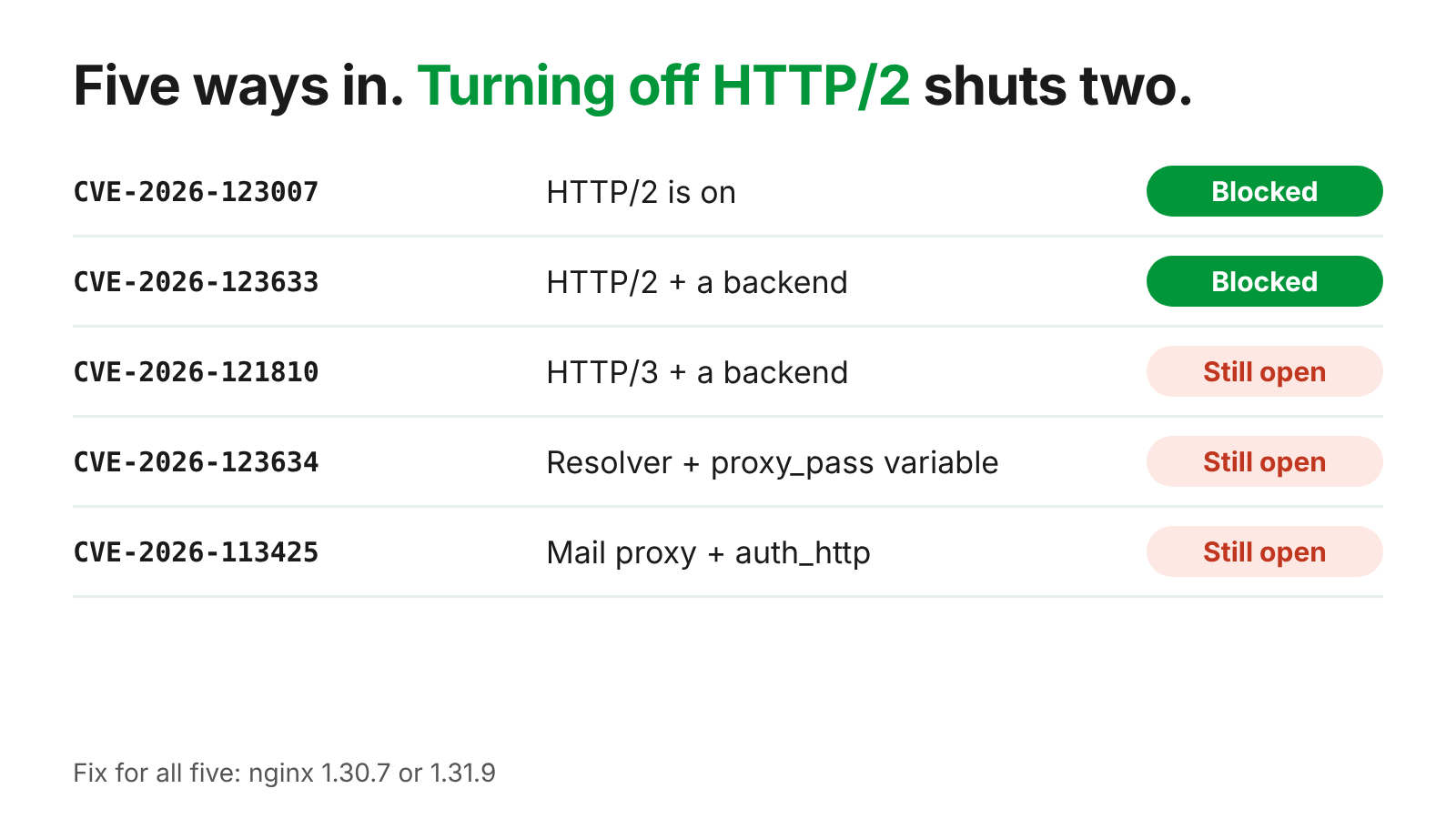
For CVE-2026-123633, F5 says the worker also has to be running low on free connections. For CVE-2026-123634, Xint tested the bug through the mirror directive, but other features that spawn subrequests, such as server-side includes, can reach the same code, so switching mirroring off doesn’t make a server safe.
The ratings differ by source. nginx’s list marks CVE-2026-123007 and CVE-2026-113425 as major and the other three as medium. Xint calls all five critical. Wiz scores CVE-2026-123633 and CVE-2026-123007 at 9.2 on the CVSS 4.0 scale. nginx’s list also carries CVE-2026-118899, an infinite loop when reading a request body over TLS 1.3, which the same two releases fix. It isn’t part of nginx2root.
How the HTTP/2 bug works
HTTP/2 lets one connection carry many requests, and flow control stops the server sending more data than the client can take. nginx keeps a running allowance for the whole connection. When it queues response data, it subtracts the size from that allowance. When a request is cancelled before the data goes out, it hands the unused amount back.
That refund is where it breaks. An attacker holds data in the queue, tops the allowance up to the maximum, then cancels the requests. The refund lands on top of an allowance that’s already full, and nothing checks it against the HTTP/2 ceiling. Past the ceiling, the check that should reject further top-ups subtracts in unsigned arithmetic and wraps around to a huge number, so nginx keeps accepting them.
Eventually the oversized value turns into a negative length, then into an out-of-bounds memory copy. Xint says that gives an attacker a way to leak memory addresses and overwrite a function pointer that runs when the connection is cleaned up. The result is commands running with the privileges of the nginx worker, with the output coming back over the same connection. Wiz confirmed code execution with an ASLR bypass on official 1.31.7 and 1.31.8 builds, over HTTP/2 on TLS on 64-bit systems.
The other four are use-after-free bugs, where nginx frees memory and then keeps using it. CVE-2026-123633 and CVE-2026-121810 are the same pattern on HTTP/2 and HTTP/3: nginx closes a connection while a request on it is still opening a link to the backend. CVE-2026-123634 sits in the DNS resolver when a request and its mirror copy wait for the same lookup. CVE-2026-113425 is in the mail proxy, when a client drops the connection during an auth_http check.
The kernel bug that turns it into root
Code running as the nginx worker is boxed in, because workers normally run with few privileges. Xint says it found a zero-day in the Linux kernel’s SCTP code that removes the box. SCTP is a transport protocol like TCP and UDP. The bug is a use-after-free in its send path, where a waiting send can free an association that has since moved to another socket. It entered the kernel in Linux 4.15 in 2018.
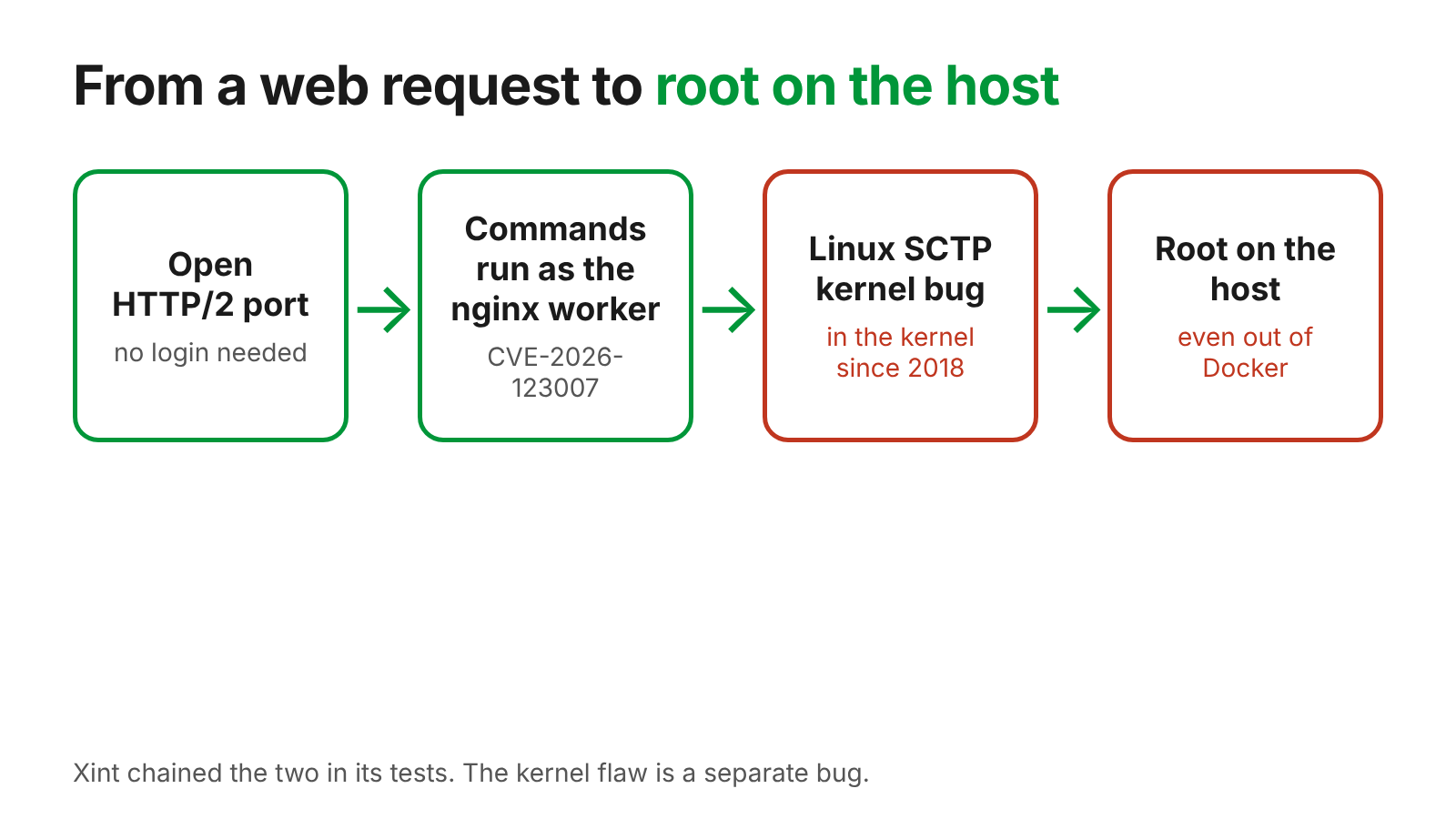
In Xint’s tests, an attacker already running as an nginx worker reliably got root, and the chain escaped a Docker container running nginx to reach the host. Many distributions ship the SCTP module and load it the first time a program opens an SCTP socket, though whether it’s reachable on a given host depends on the kernel and the container’s limits. Xint’s write-up gives the kernel flaw no CVE number and is withholding most of the details until a kernel patch exists. On hosts that don’t use SCTP, you can block the module now:
install sctp /bin/falsePut that line in a .conf file under /etc/modprobe.d/. It stops loading through modprobe. It doesn’t unload a module that’s already running, and it does nothing if SCTP is compiled into the kernel.
How many servers sit in range
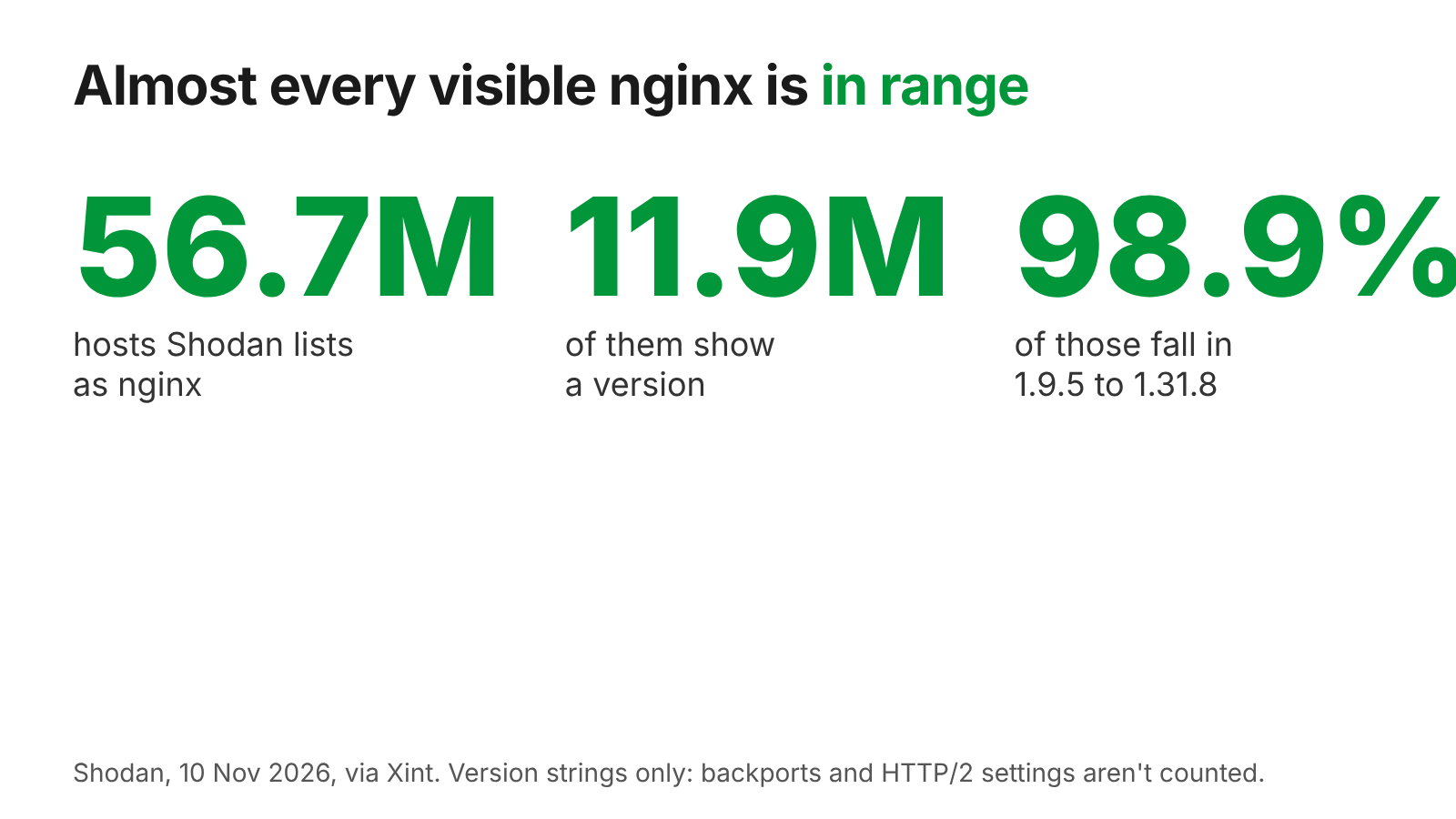
On 10 November, Shodan listed 56.7 million hosts running nginx, according to Xint. Only 11.94 million of them, 21.1%, gave a version string, and 98.9% of those fell inside the range for CVE-2026-123007. That counts version strings only. It doesn’t count servers where HTTP/2 is off or where a distribution has backported the fix. Wiz cites Netcraft’s September survey of more than 225 million sites using nginx, which counts sites, not vulnerable servers.
Who found them, and when
Xint’s researchers (Soomin Shin, Joohyun Park, Tim Becker and Yves Bieri) found CVE-2026-123007 while preparing for ZeroDay Cloud 2026. A few days later a fully automated Xint scan turned up the other four without human guidance. Wiz Research, Ikotas Labs, Metnir and Rapid7 independently found one or both of the HTTP/2 bugs as well. Wiz told F5 about CVE-2026-123633 on 21 October and was told another team had reported it first.
| Date (UTC) | What happened |
|---|---|
| 11 Oct | Xint finds the flaws |
| 16 Oct | Xint reports them to F5 through HackerOne |
| 27 Oct | Reports reach F5’s nginx team |
| 10 Nov | Xint finishes validating the patch |
| 16 Nov | Wiz reports CVE-2026-123007 to F5 |
| 18 Nov | nginx 1.30.7 and 1.31.9 ship |
Xint says nginx’s advisory list recorded two new vulnerabilities in 2025 and 26 by 17 November this year, not counting nginx2root, and credits AI-assisted research for the jump.
How to fix it
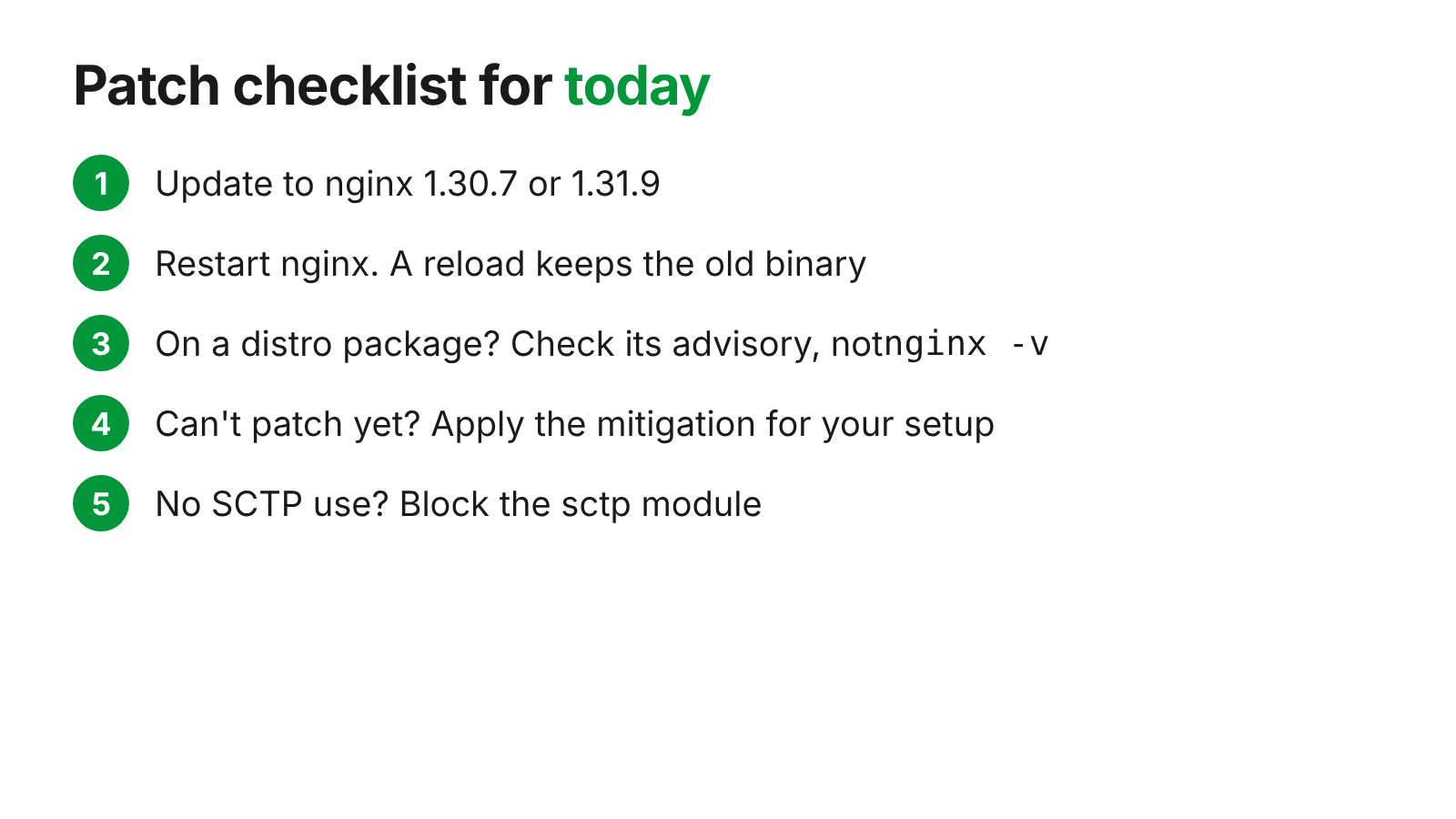
- Update to nginx 1.30.7 (stable) or 1.31.9 (mainline). nginx’s list marks both as fixed for all five CVEs. For NGINX Plus, Cyber Security News lists the HTTP/2 fixes as 37.0.7.1 and 37.2.0.1 for CVE-2026-123633, and 37.0.8.1 and 37.3.0.1 for CVE-2026-123007. Plus R34 to R36 have no fix, so move to a 37.x build.
- Restart nginx. A reload doesn’t replace the running binary, and old workers keep serving open connections under the old code. Look for “worker process is shutting down” in
psand restart through your service manager if any linger. - If nginx came from a distribution, check the distribution’s security notice, not
nginx -v. Aikido lists Ubuntu 24.04 at 1.24.0, Ubuntu 22.04 at 1.18.0, Debian 12 at 1.22.1 and Debian 13 at 1.26, all inside the affected range. Distributions backport fixes without changing that number. Ubuntu 22.04’s package, for example, has reached 1.18.0-6ubuntu14.22 while still printing 1.18.0. - If you run Kubernetes, check ingress-nginx. Aikido says it’s vulnerable to CVE-2026-123633 and won’t get a patch, so turn off HTTP/2 and plan a move to a maintained ingress or a build on nginx 1.30.7 or 1.31.9.
To see whether HTTP/2 is reachable on a server, run this from outside your network. Aikido and Xint both say a CDN or reverse proxy in front only tests the proxy, so point it at the nginx server directly too.
openssl s_client -connect HOST:443 -servername HOST -alpn h2 < /dev/null 2>&1 | grep -E 'ALPN protocol:|No ALPN negotiated'“ALPN protocol: h2” means the server takes HTTP/2 from the internet. “No ALPN negotiated” means it doesn’t.
If you can’t patch yet
Xint’s stopgaps only block the paths they target, so pick the ones that match your configuration.
- CVE-2026-123007 and CVE-2026-123633: turn off HTTP/2. On nginx 1.25.1 and later, set
http2 off;in each affected server block and drop any legacy http2 flag from its listen lines. On older versions, remove http2 from the listen line. Native gRPC needs HTTP/2, so it breaks. - CVE-2026-121810: remove the QUIC listeners, set
http3 off;and replace any Alt-Svc header that advertises HTTP/3 withAlt-Svc 'clear'. Then check that nothing still listens on UDP 443. - CVE-2026-123634: point proxy_pass at a fixed upstream group so nginx doesn’t look up DNS during a request. Setting mirror_request_body on also stopped Xint’s exploit, but it doesn’t fix the resolver bug.
- CVE-2026-113425: bind mail proxy listeners to a loopback address, or let only trusted IPs reach them through your firewall.
Reload, then restart if old workers linger. Wiz adds that a CDN or web application firewall that terminates HTTP/2 may blunt parts of the CVE-2026-123007 exploit, because the exact payload never reaches nginx. How much it helps depends on the implementation.
Checking whether you were hit
An attack on CVE-2026-123007 can leave almost nothing in the access log. The WINDOW_UPDATE and RST_STREAM frames it relies on aren’t logged as requests, and TLS hides them in transit. Xint points to four other places to look:
- Programs started by nginx workers. A worker has no normal reason to run a shell, so an auditd rule on execve for the worker’s user ID is the clearest signal.
- One external IP holding a connection open for minutes while bytes received climb fast and bytes sent stay small.
- A gap between the bytes received on a connection and the request lengths in a log format that records connection IDs.
- Repeated worker crashes, with signal 11 or segfault in the error log, which a failed attempt can cause.
Each sign can have an innocent cause on its own. A worker that runs a program is the one that needs immediate attention. An empty audit log can’t rule out an attack from before the rule went in.
PHP is also due a critical security release at about 3am Friday NZ time. I’ve covered that one separately in PHP schedules a critical security release for 3am Friday NZ time.
Discover more from Sulat AI & Tech News
Subscribe to get the latest posts sent to your email.