PHP will ship security releases for every supported version on Thursday 19 November UTC, which is about 3am on Friday 20 November in New Zealand. The PHP security team posted the notice on 18 November and rated the worst issue critical. Fixed version numbers and the CVE list arrive with the releases, and neither is public yet.
PHP says the critical issues need a non-default configuration or an uncommon setup. That echoes what it told admins in October about CVE-2026-115560, the one issue in this round that’s already on the public record. You can close that path today with one setting.
What PHP has said so far
The notice on php.net is short. The releases land between 14:00 and 14:30 UTC, which is 3:00am to 3:30am NZDT on Friday. They belong to PHP’s regular four-week cycle and cover security vulnerabilities in all supported versions. PHP tells users to prepare to upgrade promptly once they’re out.
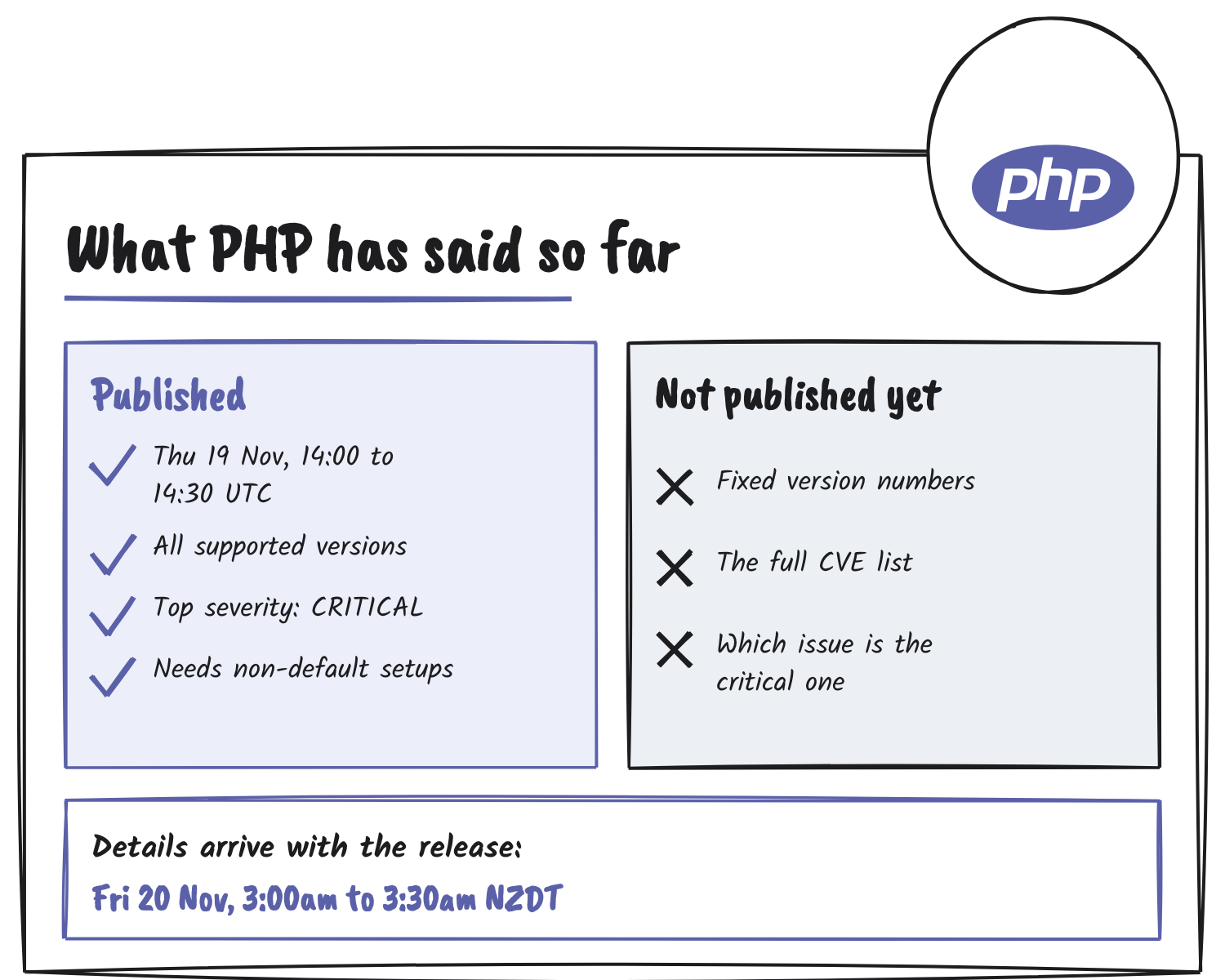
PHP hasn’t said which issue carries the critical rating or how many CVEs the releases fix. The same day was already pencilled in for PHP 8.6.0, the first general release of that branch, according to PHP’s release-candidate notices.
CVE-2026-115560 is the one you can check for now
PHP published an informational advisory for CVE-2026-115560 on 23 October, two days after it fixed the PHP2Shell bugs, and said the full advisory would come with its next regular release. Aikido counts the 19 November releases as that release. It’s a remote code execution vector in session upload progress, and the 21 October patches don’t fix it. An application is exposed only when all three of these are true:
- Its configuration sets
session.serialize_handlertophp_binaryorphp_serialize. - Its code switches the handler back to
phpwithini_set()before it callssession_start(). - Session upload progress is still on, and PHP leaves it on by default.
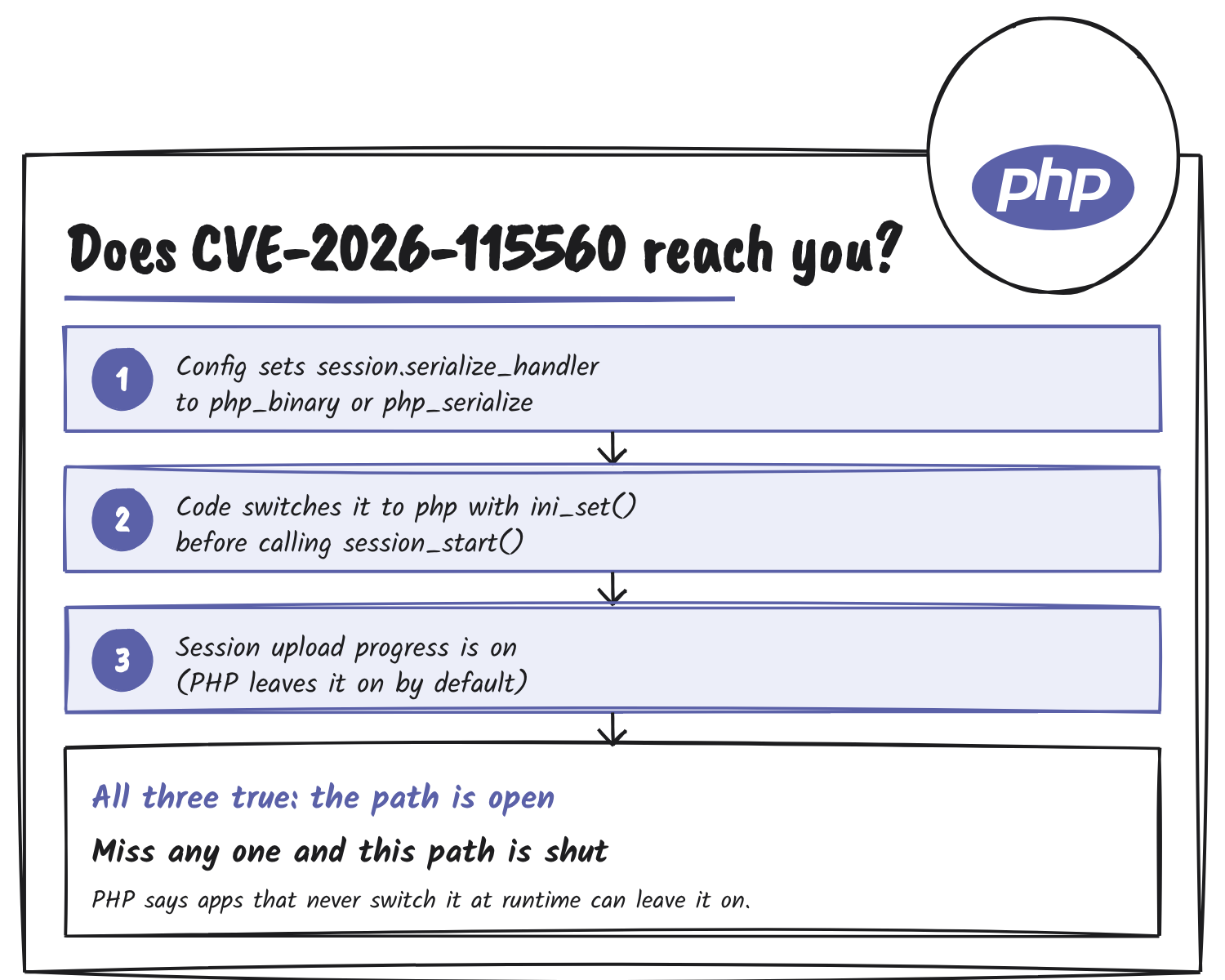
PHP calls that combination unlikely in practice. It says applications that never change the serialize handler at runtime can leave upload progress on. It hasn’t published affected versions or a severity score for this CVE. Security Affairs reported on 23 October that no attacks on it had been seen.
What to do before the patch lands
PHP’s advice is to set session.upload_progress.enabled=0 until the fix ships. If you applied it in October as a PHP2Shell mitigation, it’s still in place and you don’t need to do anything more.
- Put the setting in
php.ini, an FPM pool or server configuration, somewhere that applies before PHP parses the request. PHP says not to rely onini_set()or an FPM.user.inifile. - Restart every worker. Red Hat’s bulletin says a reload isn’t enough because existing workers can hold on to state from earlier requests. In containers, replace the pod.
- Search your code for runtime switches of the handler, using the command below.
- Check nothing turns it back on. Red Hat says to audit
.htaccess, virtual hostphp_valuelines and.user.inifiles, and to set the value withphp_admin_valueso applications can’t override it.
; php.ini (or php_admin_value in the FPM pool or Apache config)
session.upload_progress.enabled = 0

# find code that switches the handler at runtime
grep -rnE "ini_set\(\s*['\"]session\.serialize_handler" /var/www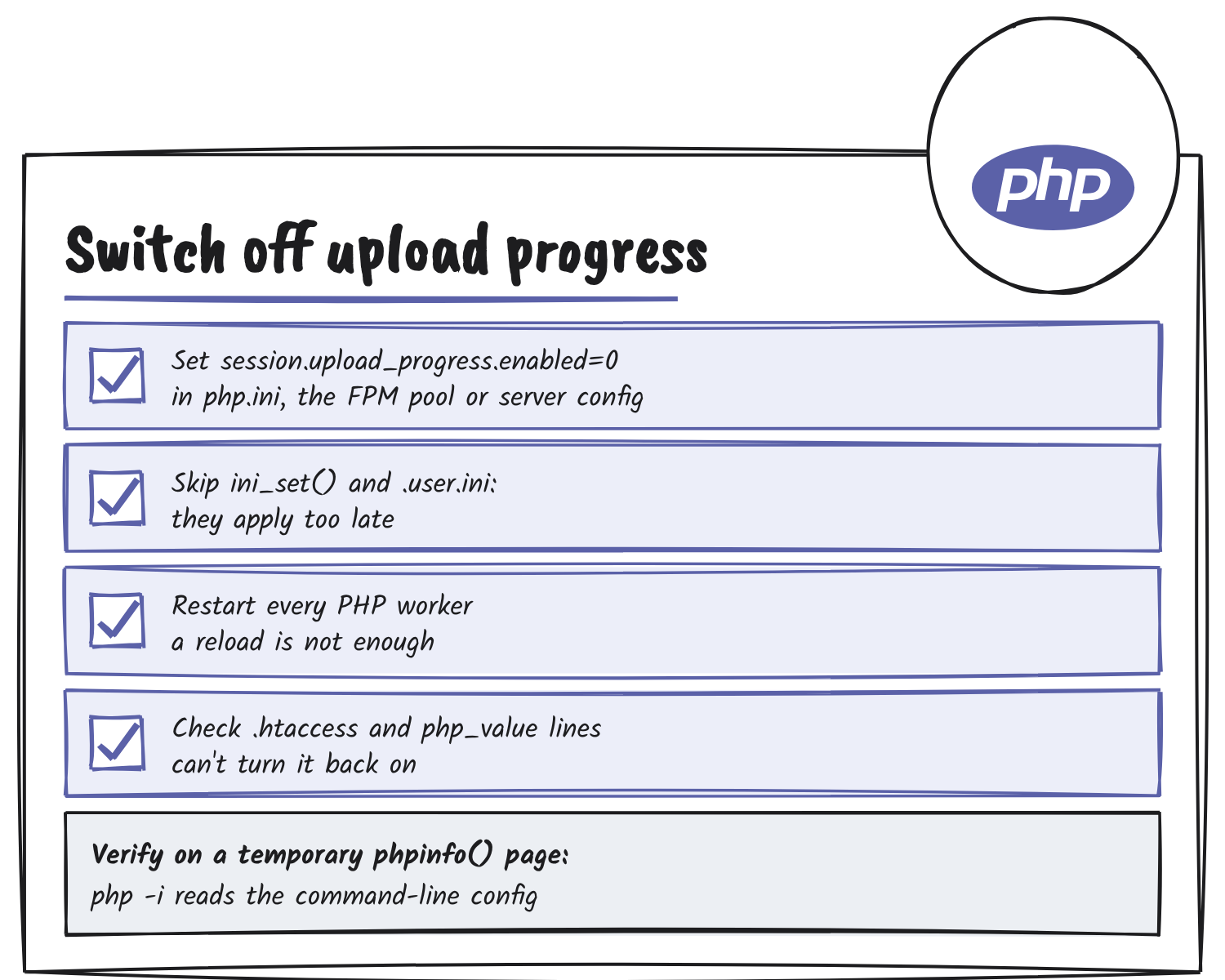
Two gotchas from Red Hat. The php.ini it ships has the directive commented out, and the feature defaults to on, so uncommenting the line leaves it enabled. You have to set it to 0. To confirm the change took, load a temporary phpinfo() page, because php -i reports the command-line configuration and not the web one.
The cost is small. Red Hat warns that applications using PHP’s native session upload-progress reporting will stop getting progress data, while applications that report upload progress in the browser are unaffected.
PHP2Shell is still the bigger fire
If you haven’t applied the 21 October fixes, don’t wait for Friday. PHP2Shell is a pair of critical bugs, CVE-2026-109618 and CVE-2026-109619, that PHP rates CVSS v4.0 9.2 and says can give an unauthenticated attacker remote code execution. The fixes are in PHP 8.5.12, 8.4.27, 8.3.36 and 8.2.35. CISA added both CVEs to its Known Exploited Vulnerabilities catalogue on 26 October, and BleepingComputer cited VirusTotal’s estimate of more than 5.1 million PHP hosts exposed online.
PHP 8.1 and older get no upstream fix. PHP published minimal source backports for 7.4, 8.0 and 8.1 for people who build from source. Aikido has a free checker that tests a public URL and reports whether it’s vulnerable, mitigated or patched. If nginx fronts your PHP, Aikido also flagged five critical nginx flaws on 18 November, covered in my nginx2root report.
When the releases land
Check php.net for the fixed version numbers, then update and restart every worker. Rebuild container images as well, since patching a running container leaves the image exposed, as Aikido’s PHP2Shell guidance points out. Linux distributions often backport fixes without changing the version number, so look for the CVE IDs in your package changelog instead of trusting the version string.
Discover more from Sulat AI & Tech News
Subscribe to get the latest posts sent to your email.