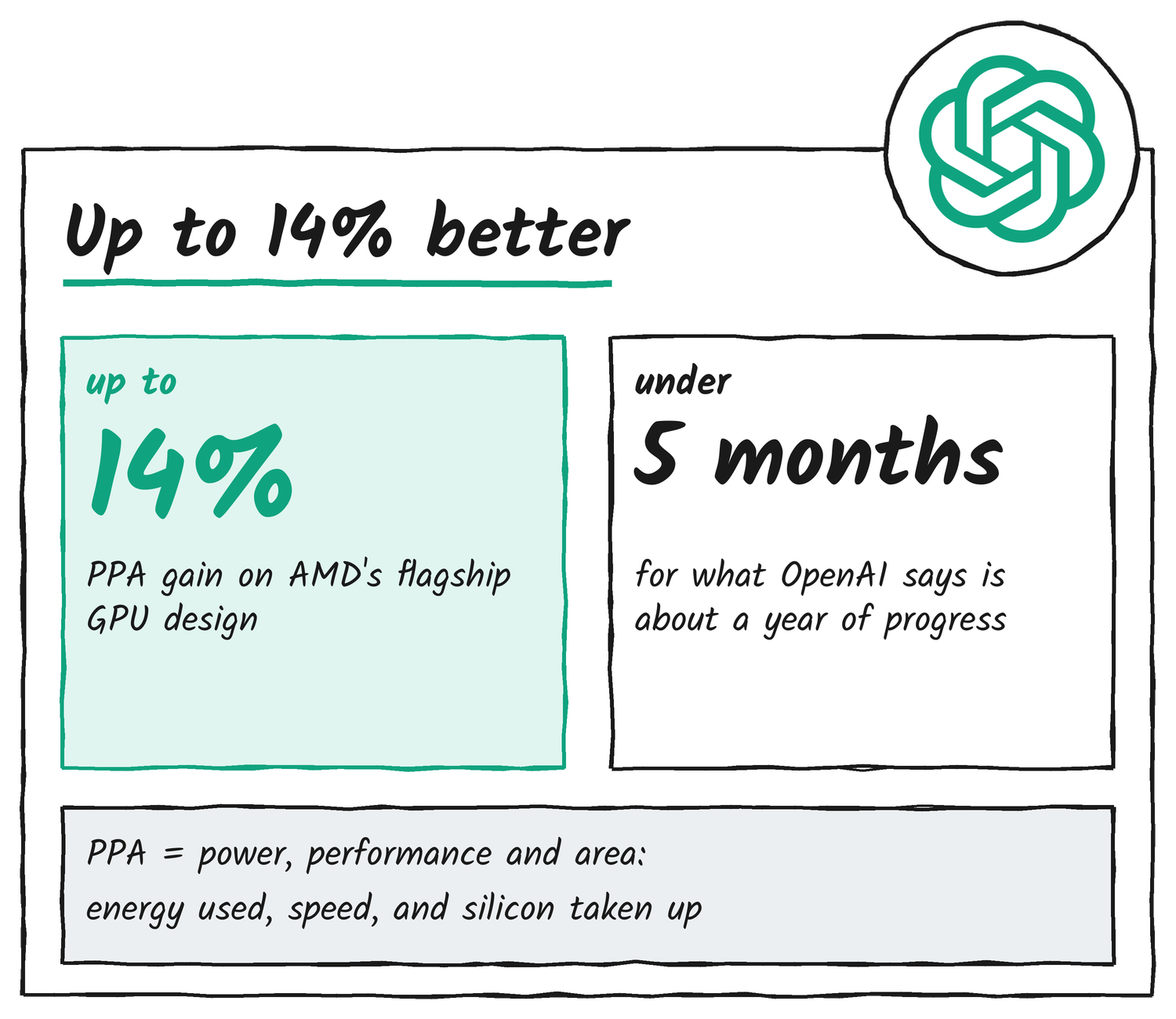
OpenAI says its models found up to 14% better power, performance and area on AMD’s flagship GPU design in under five months, improving circuit code that AMD’s engineers had spent years optimising. OpenAI detailed the work on 18 November in a write-up titled Advancing chip design with OpenAI models.
AMD has already put some of the changes into a recent design it sent for manufacturing, and added others to its production design files for future versions, OpenAI says. The company announced the results on X the same day.
Working with @AMD, our models identified up to 14% PPA improvement on flagship GPU IP in less than five months—building on designs AMD’s engineers had already spent years optimizing.
— OpenAI (@OpenAI) November 18, 2026
The same approach helped improve Jalapeño, our first custom inference chip, with gains verified on real silicon.
New evaluations also show our models getting better at certain chip design tasks.
We’re sharing these results and how we’re working with @Synopsys to bring our model capabilities and their trusted EDA design and validation tools to more chip designers.
What the models changed on AMD’s chips
Power, performance and area, shortened to PPA, is how chip designers score a block of circuitry: how much electricity it draws, how fast it runs and how much silicon it takes up. OpenAI measured the 14% against what it calls heavily optimised baselines on the flagship GPU, and describes the result as roughly a year of progress compressed into less than five months.
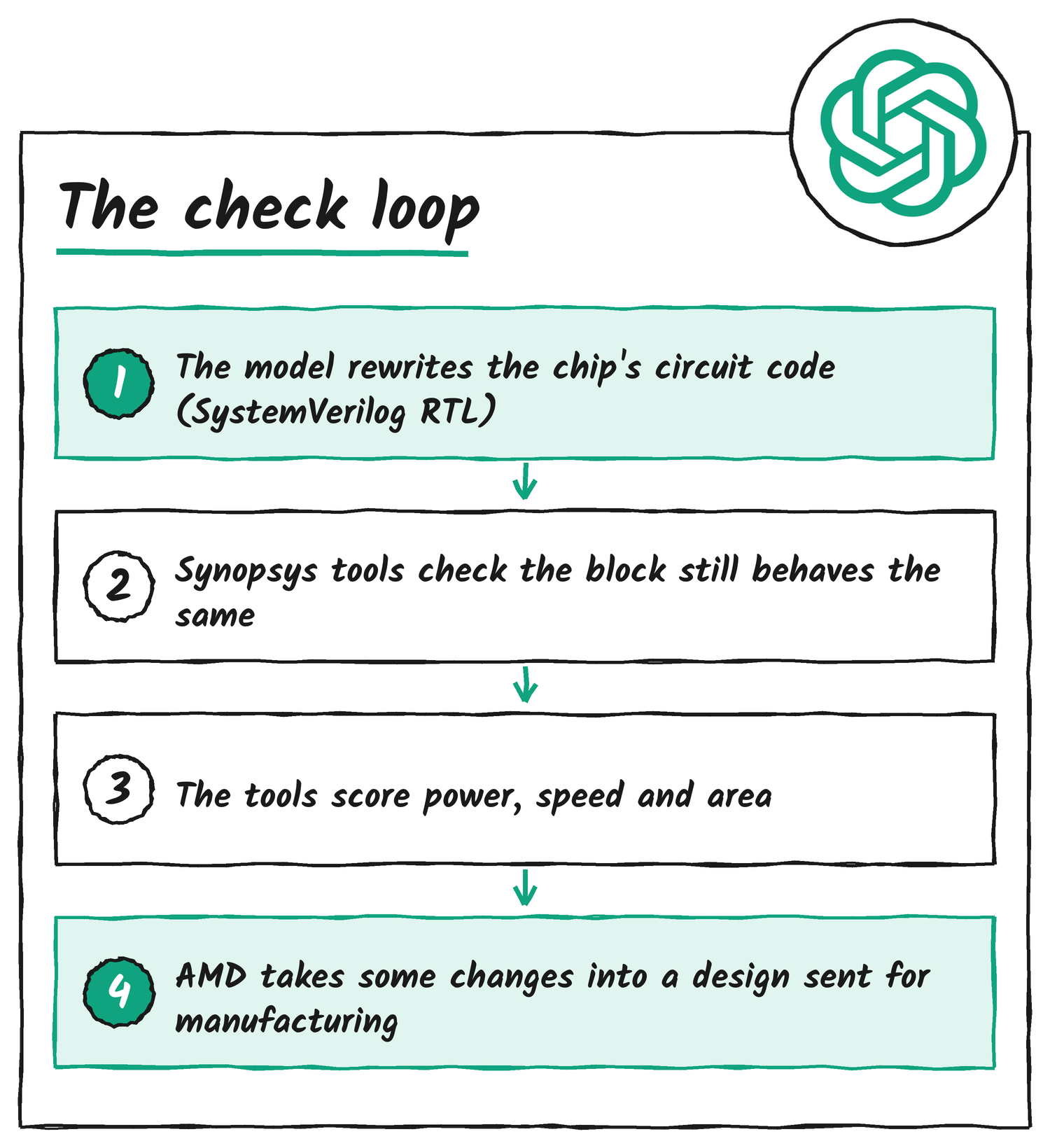
The model worked on the SystemVerilog RTL, the code that describes a chip’s circuits, rewriting parts that perform calculations, control operations and move data. OpenAI says it reasoned about that code at the level of an expert microarchitect, the engineer who decides how a processor’s insides are laid out, and used Synopsys tools to confirm each rewrite left the block’s behaviour unchanged and to weigh the trade-offs in power, performance and area.
AMD also verified single-digit percentage PPA gains across key blocks of its upcoming flagship CPU, using designs the model wrote. OpenAI expects further gains on both the GPU and the CPU against the most optimised baselines.
Jalapeño: gains proven on silicon
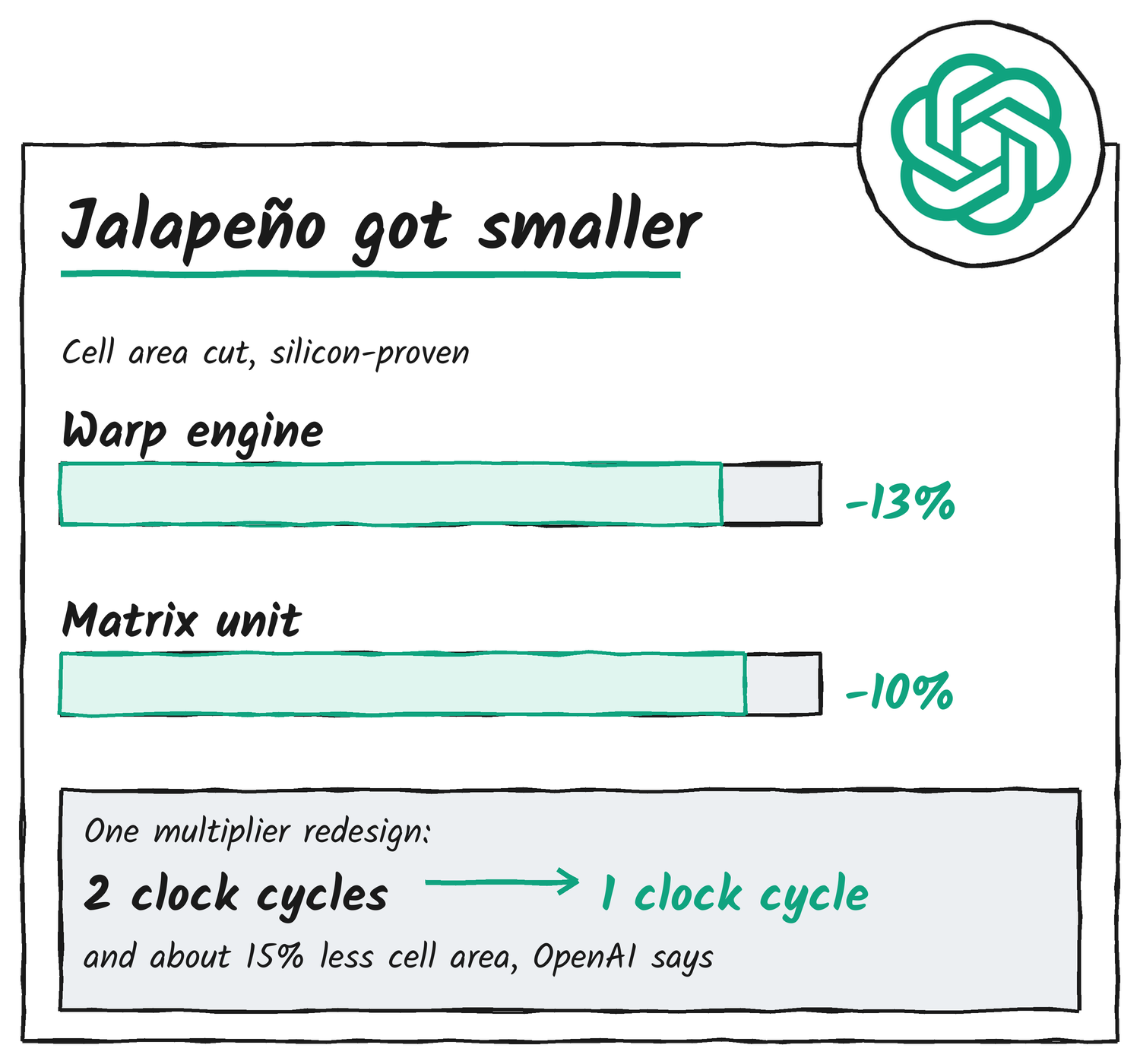
Jalapeño is OpenAI’s first custom inference chip, the kind built to run a trained model and answer requests. OpenAI says its team started using GPT-4o on the design in early 2025, and estimates that model-proposed changes cut standard-cell area by about 13% in the warp engine, which manages and runs parallel work, and about 10% in the matrix unit, an arithmetic block. Both were proven on silicon during Jalapeño’s bring-up, the post says.
Two examples came from the matrix unit. One multiplier redesign used about 15% less cell area in synthesis and cut latency from two clock cycles to one, and a separate adder redesign saved about 15% of its area while keeping a two-cycle latency.
In an August post on Jalapeño’s first results, OpenAI reported 1.5 to 1.9 times more AI work per watt at peak throughput than the comparison systems, and said it plans to begin deploying the chip in its own infrastructure by the end of the year.
How the models scored on open-source cores
To track progress from one model generation to the next, OpenAI tested models on two open-source 32-bit RISC-V cores. PicoRV32 is a compact core built for FPGAs, which are reprogrammable chips, and Ibex is the embedded processor in OpenTitan’s security chip. Each model got the original hardware description and was asked to raise throughput, the number of instructions the core finishes per second. Designs that failed a simulation check or used more than 16 times the original core’s area scored zero.
At a comparable budget of about 112,000 tokens a run, GPT-6.2 Astra had the highest average score on both cores, and GPT-6.1 Sol outscored GPT-5.6 Sol on both. On PicoRV32, OpenAI says Astra’s score at that budget is about twice GPT-6 Astra’s.
A second task gave each model written requirements instead of the existing design. At the same budget all five models scored higher that way than when optimising the original core, and the full evaluation covered 9,881 scored runs. Starting from requirements lets a model leave out features the original cores carry, such as performance counters and extra instructions, OpenAI says.
Synopsys and what comes next
Synopsys makes the electronic design automation (EDA) software engineers use to design and check chips. OpenAI and Synopsys announced GPT-Synopsys on 30 September, a multi-year agreement to build a specialised model that operates Synopsys tools, with revenue sharing and joint sales to customers. Synopsys says it will run on OpenAI-hosted infrastructure and that customer design data isn’t used to train it.
OpenAI says it’s now training GPT-Synopsys to use those tools the way expert chip designers do. Synopsys said at the announcement that early technology engagements with leading semiconductor customers were under way.
Disclosure: I’m an OpenAI, Firecrawl and Devin ambassador.
Discover more from Sulat AI & Tech News
Subscribe to get the latest posts sent to your email.