Google began rolling out Genie 4 to eligible Google AI Ultra subscribers in Project Genie on 18 November (US time), three weeks after Google DeepMind announced the world model on 27 October. The update also adds a Project Genie agent that builds worlds from a conversation, a community gallery for sharing and remixing worlds, and longer runs for Genie 3. Google AI Pro members can join a waitlist.
Diego Rivas, a group product manager at Google DeepMind, and Pavan Kumar, a group product manager at Google Labs, wrote the announcement. A world model is an AI model that generates an interactive environment frame by frame as you move through it, instead of playing back something pre-rendered. Project Genie is the Google Labs web app that put Genie 3 in front of Ultra subscribers in January, and Google’s own thread for the launch summarises the update in four points.
Genie 4, our most realistic and interactive world model from @GoogleDeepMind, is now available in Project Genie 🌐
— Google (@Google) November 18, 2026
Here’s what’s new:
Genie 4: Edit environments mid-session with text prompts, paired with real-time native audio and dialogue.
Project Genie agent: Co-create worlds conversationally with custom soundtracks and live Gemini guidance.
What the update adds
Genie 4 lets you type a new prompt while you navigate a world to change it. Google’s examples are shifting the weather, dropping in a character or redirecting the action. Google says Genie 4 pairs those visuals with real-time native audio for the first time, with sound that adapts as the scene unfolds, from ambient soundscapes to character dialogue.
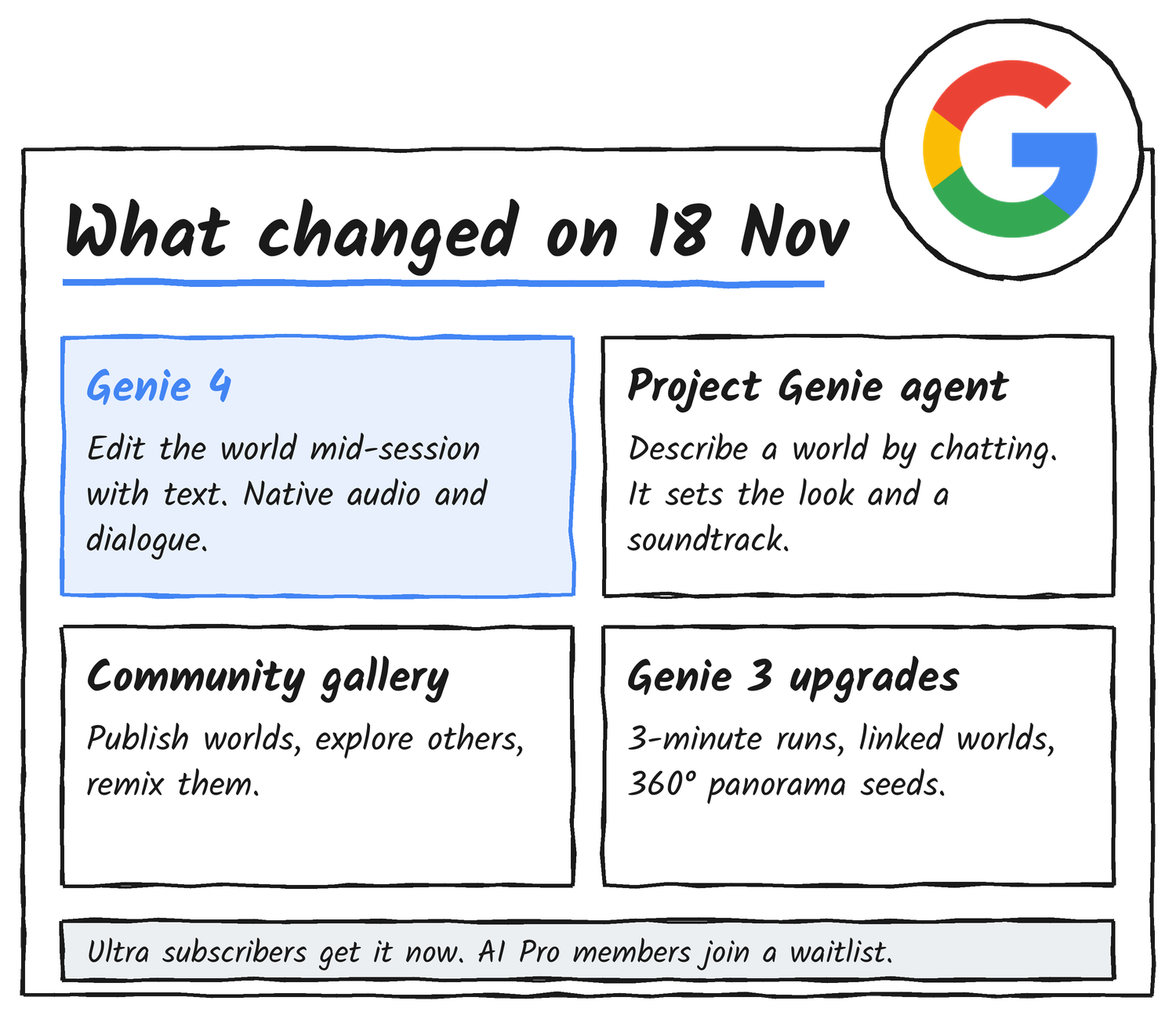
The Project Genie agent replaces the single text or image prompt with a conversation. You describe your vision and, according to Google, the agent orchestrates its multimodal models to create initial visuals that set the world’s signature look, plus a custom score to match the mood. While you explore, Gemini models watch what’s on screen, surface suggestion chips for where to go next and trigger in-world events automatically. Google’s launch thread gives the example of adding an avalanche mid-ski run.
The new gallery holds curated worlds and community ones. You can publish your own, or start from any world and use the agent to change its landscape, soundtrack or rules; Google’s example turns a daytime ski course into a floodlit night run. Google names three gallery worlds: “Living Memory”, which turns personal photos into explorable spaces, “Dino Field Guide”, built on 360-degree panoramas, and “Rock Paper Scissors”, where Gemini referees themed objects on a desk.
Creators with early access made two of the gallery worlds. “Villa Giallo”, built with creative technologist Will, who goes by BLVCKL!GHT, is a room-by-room mystery set in a gothic manor. “The Life of Ants”, built with filmmaker Anand Gandhi, lets you move through a colony from an ant’s point of view.
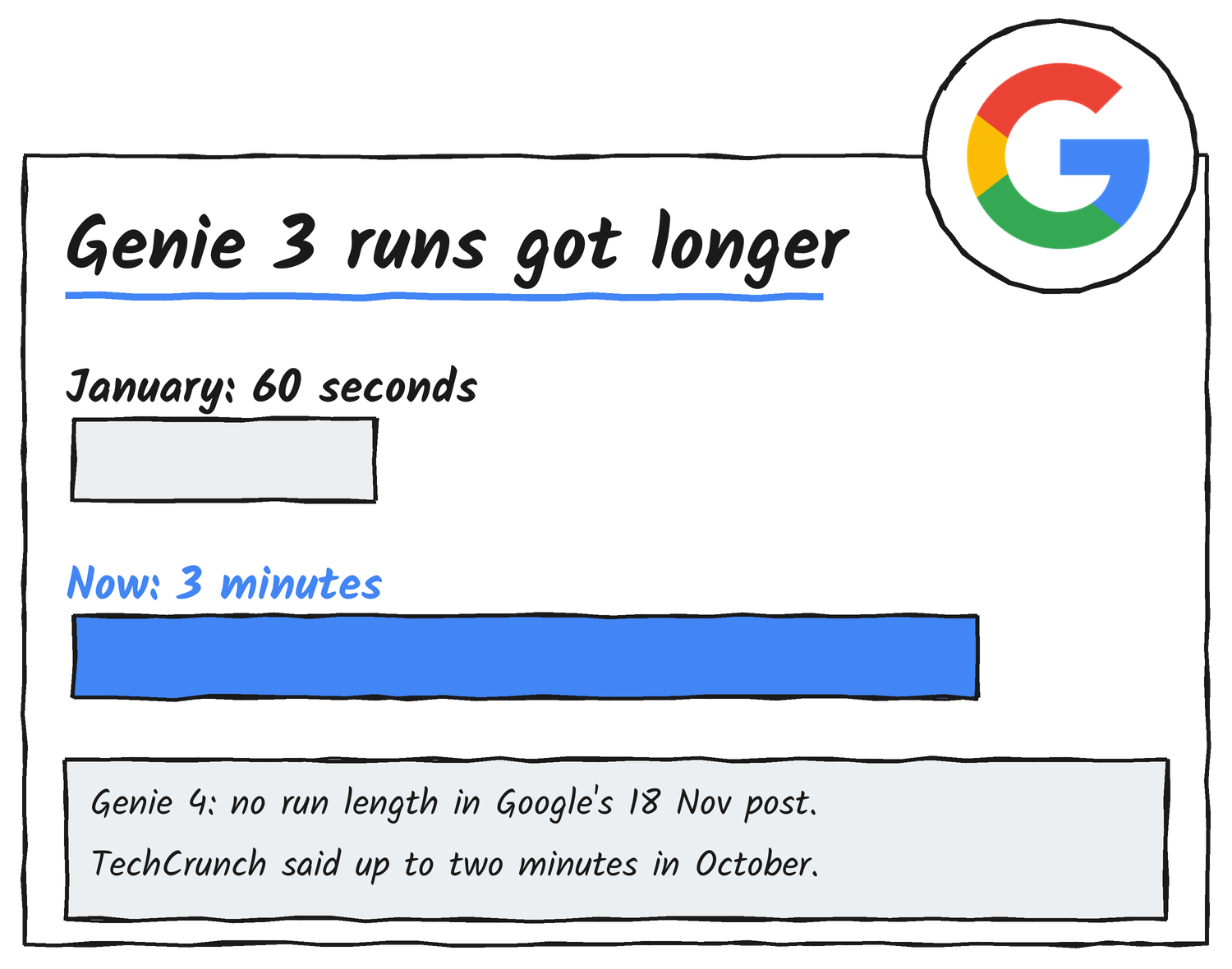
Genie 3 stays in Project Genie’s model picker for longer runs. Google says it now explores for up to three minutes per generation, up from 60 seconds, can link several worlds into one journey, can seed a world from a 360-degree panorama image and accepts natural-language prompts that change the environment as you explore.
How Genie 4 works with Gemini
The technical detail is in DeepMind’s 27 October announcement, which the 18 November post links to. Google says Genie 4 builds on the Gemini family: Gemini Omni anchors the simulation in real-world appearance and behaviour, and other Gemini models supply the reasoning that keeps it coherent. Gemini 3.8 Flash acts as a guiding agent in the loop. As Genie generates the world, Gemini watches the scene, breaks a goal into steps and reviews incoming frames to check that each step worked. When you step in with a new prompt, it changes the plan on the spot.
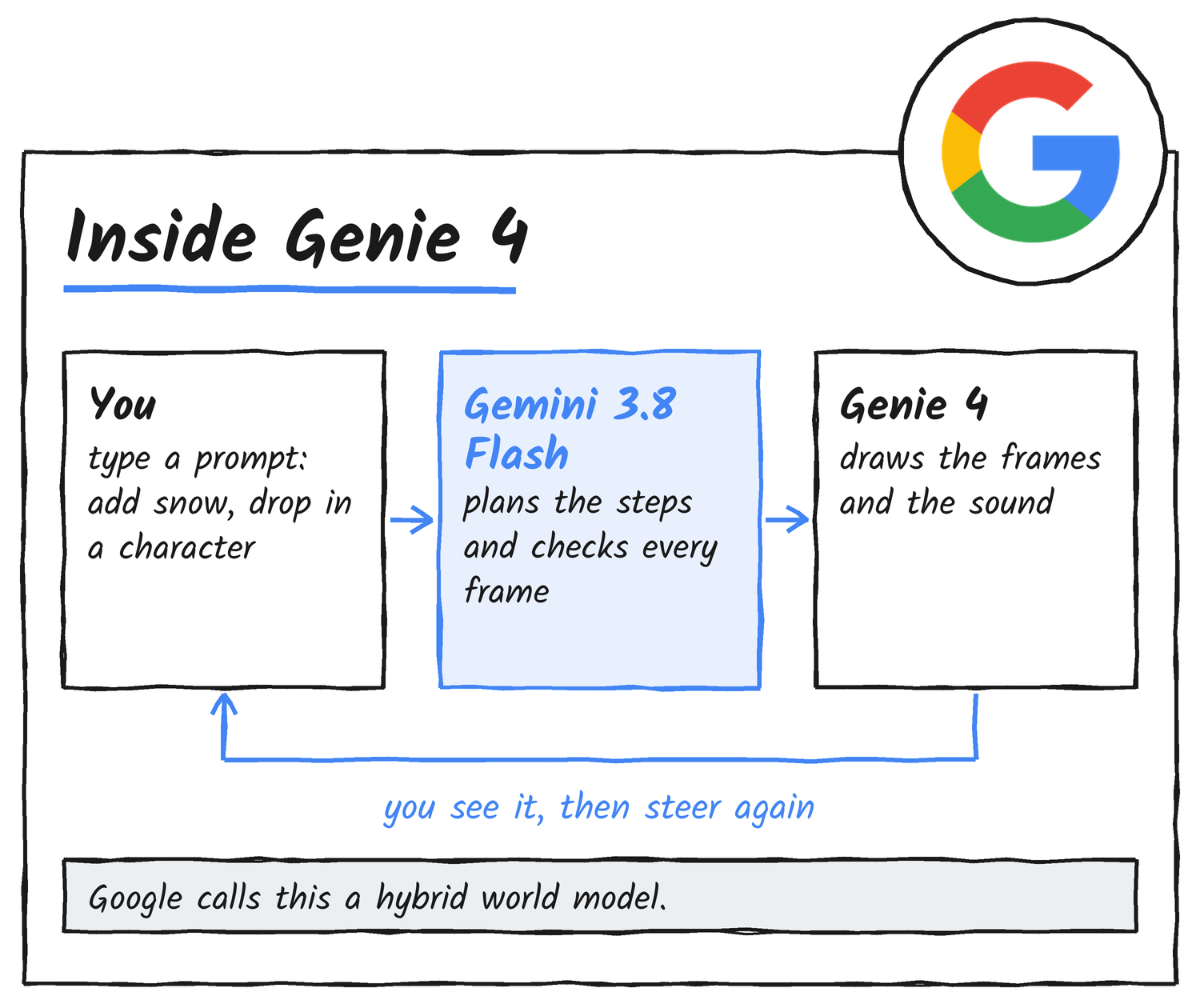
Google calls this approach a hybrid world model: code and language models handle structured reasoning and the world model handles pixel-level simulation. Tejas Kulkarni, a research director at Google, told the October press briefing that more of these are coming, with Gemini writing code and text and Genie simulating reality from it, TechCrunch reported.
The October post also describes a robotics experiment. Gemini 4 Argon, Google’s reasoning model, broke a task into steps and fed them to Genie 4 as text captions while it rendered Apptronik’s Apollo humanoid playing checkers with a person. DeepLearning.AI’s The Batch notes that Google didn’t describe a robot control system in the loop. Google also says trusted testers across creative industries, journalism, education, gaming and engineering used Genie 4 for previsualisation, turning a single archival photograph into a simulated environment, and prototyping game ideas without engine code.
What Google has and hasn’t shown
Google hasn’t published a technical report or benchmark results for Genie 4. The Batch reported on 6 November that Genie 4 had no technical report and that Google’s announcement offered no quantitative evaluations. The Batch also spotted a physics slip in one of Google’s demos, where a marble bust dropped onto a watermelon settles on its plinth instead of toppling off.
Google’s own limitations list says visual details and object permanence can drift as a simulation runs longer, after several complex prompt edits or while you move through a scene. It names modelling other agents, real-world locations, legible text and real-time audio accuracy as open problems. The 18 November post adds camera latency and intricate physical interactions to the work in progress.
Google’s 18 November post gives a three-minute run length for Genie 3 only and sends you to Genie 3 for longer runs. TechCrunch reported in October that Genie 4 holds a consistent scene for up to two minutes, and The Batch, citing Bloomberg, says DeepMind research engineer Hang Qi noted that reaching the limit doesn’t guarantee consistency throughout.
On safety, Google says all video and audio generated in Project Genie carries SynthID, its imperceptible watermark, and that all model inputs and outputs go through safety screening.
Who can use it
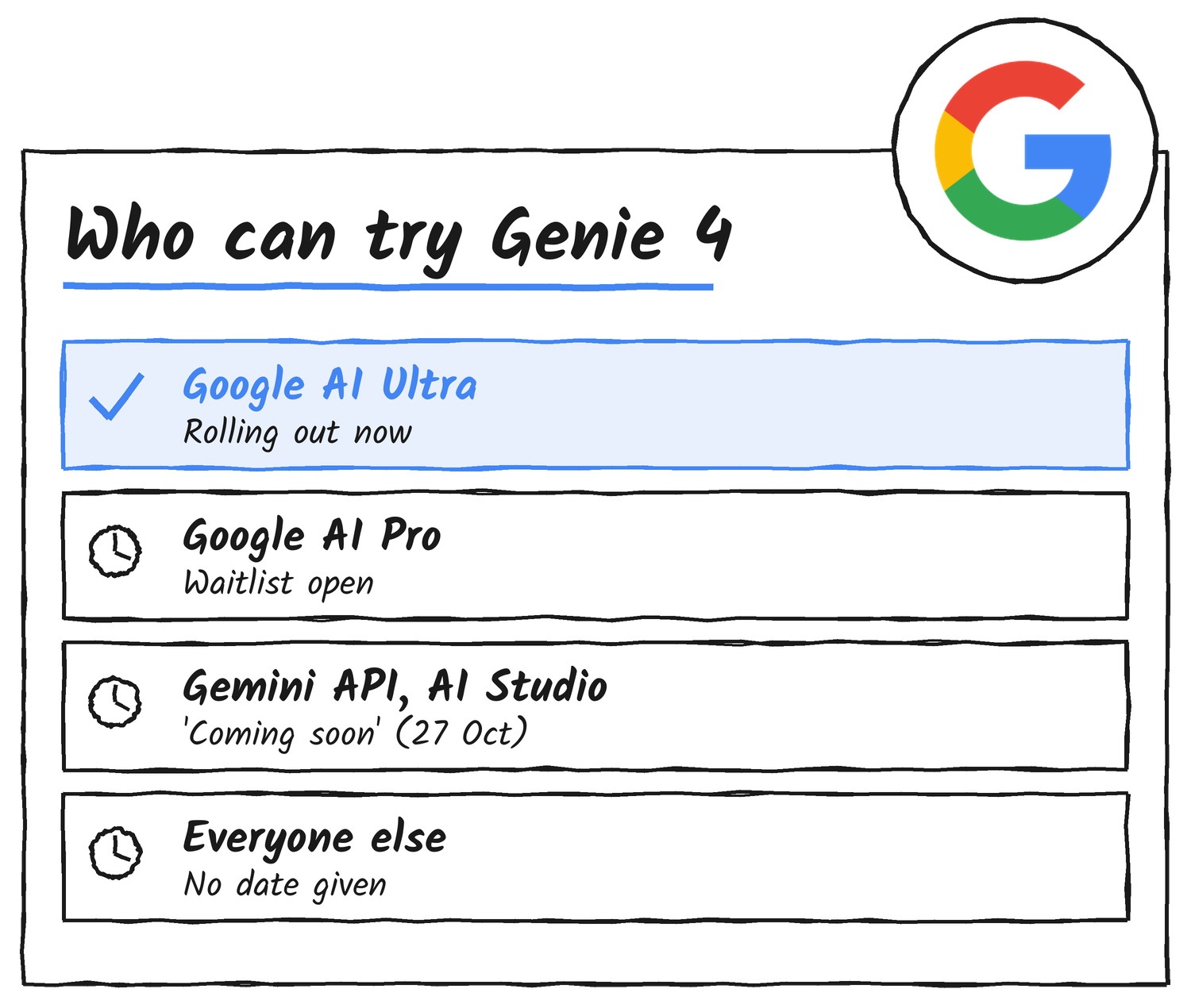
Eligible Google AI Ultra subscribers can use the new Project Genie at labs.google/projectgenie from 18 November, and Google AI Pro members can join the waitlist on the same page. Project Genie’s Labs help page says it’s for Ultra subscribers who are 18 or older, where Ultra is available. Ars Technica reported in October that Ultra plans start at US$100 a month. Google’s post doesn’t list countries, usage limits for Genie 4 or a date for Pro waitlisters.
For developers, the 27 October post said Genie 4 was “coming soon” to early access partners of the Gemini API and Google AI Studio. The 18 November post doesn’t mention either, and Ars Technica reported in October that API pricing wasn’t available.
Where it sits in the field
Project Genie’s first launch, on 29 January, put Genie 3 in front of US Ultra subscribers with a 60-second limit. The next day Take-Two’s shares closed down 7.93%, Roblox’s 13.17% and Unity’s 24.22%, The Verge reported, citing Reuters. Runway’s GWM Worlds 2 also generates video in real time, while World Labs’ Marble and Tencent’s open-weights HY-World 2.0 build persistent 3D scenes instead, according to The Batch.
Google’s Genie 4 research overview has the full limitations list.
Discover more from Sulat AI & Tech News
Subscribe to get the latest posts sent to your email.