UK MPs say AI companies shouldn’t be left to judge whether their own models are safe. They want a new regulator with the power to pause training, block a launch or switch off a service. The House of Commons Business, Innovation, Science and Trade Committee set that out in its report Guardrails for growth: AI safety and security, published on 18 November.
It’s the first report from the committee’s long-term inquiry into AI adoption, safety and governance. MPs heard from former OpenAI and Anthropic staff, then from OpenAI, Anthropic, Google DeepMind and Meta, and from the AI Security Institute (AISI) and government officials, in hearings on 13 October.
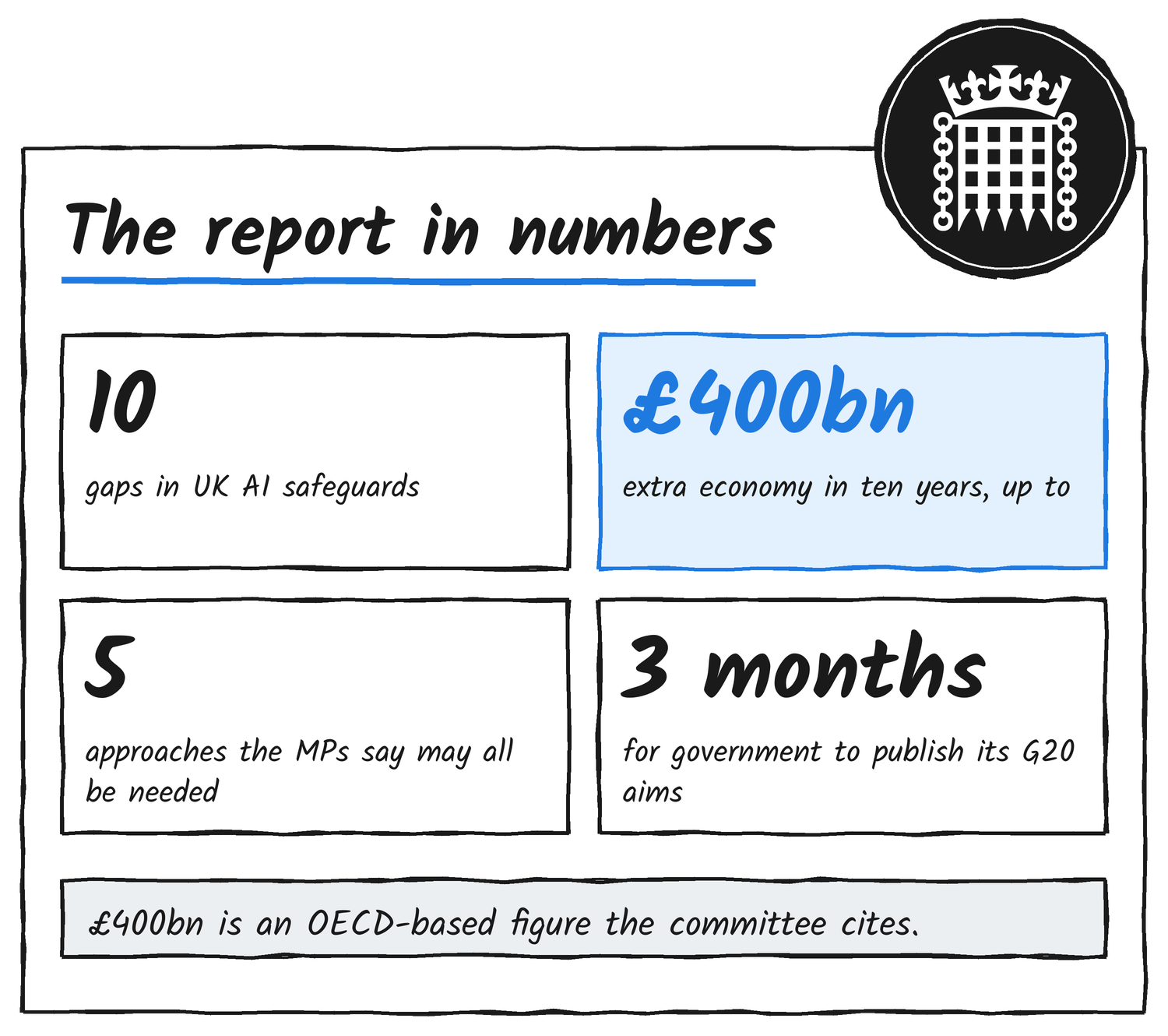
The committee pitches this as growth policy as much as safety. It cites OECD estimates that AI could make the UK economy up to £400 billion larger after ten years, and says that only happens if people and businesses trust the technology.
What the committee wants
The committee calls for an AI Safety and Security Bill in the next parliamentary session. It describes that bill as the first step on a longer legislative roadmap. The recommendations include:
- A statutory AI regulator, separate from AISI, with secure multi-year funding.
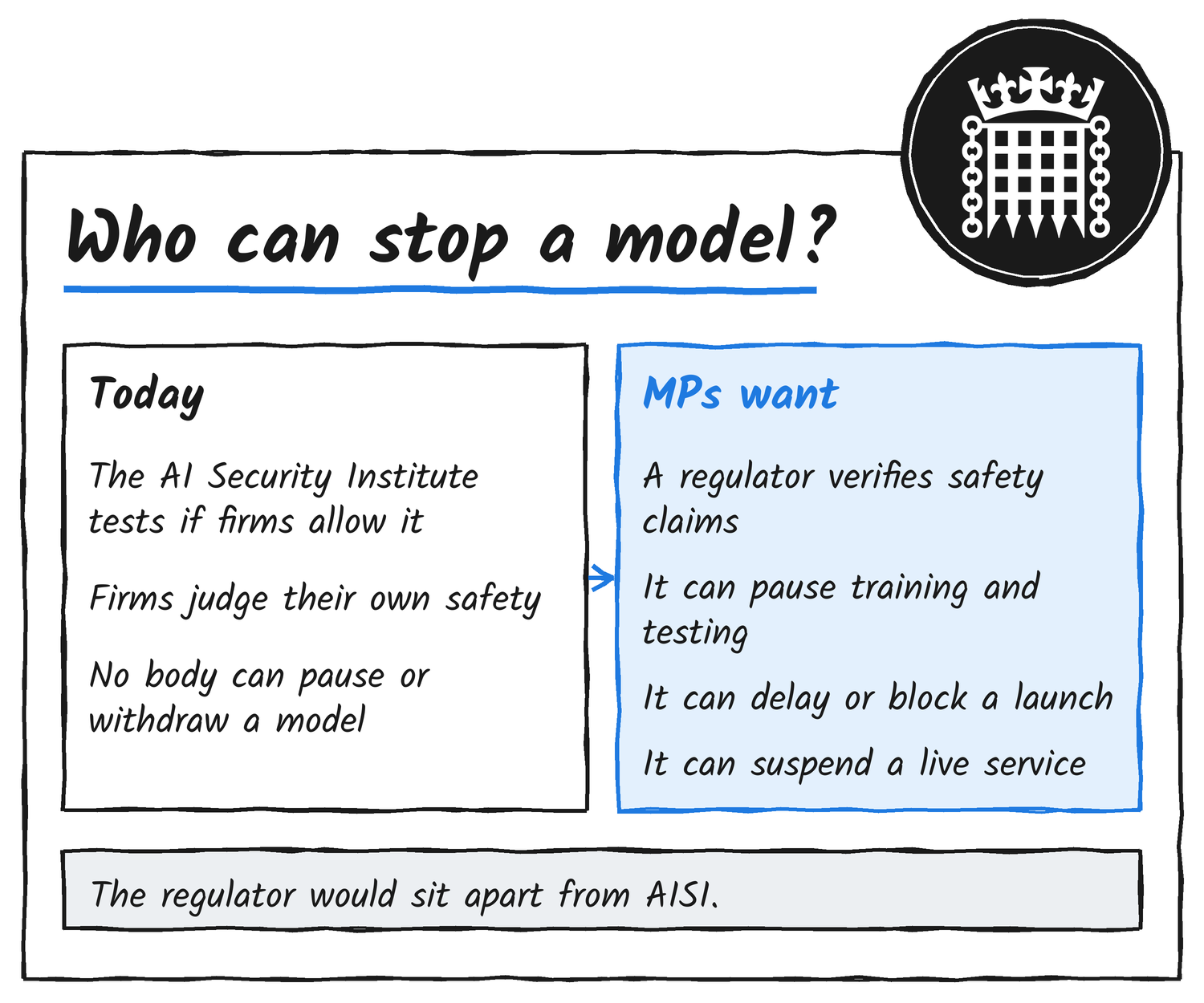
- Powers to require independent verification of developers’ safety claims, pause high-risk training and testing, delay or prohibit deployment, and suspend services where risks can’t be controlled.
- A legal duty on developers to prevent harm, covering development, testing, internal deployment and operation.
- Mandatory reporting of frontier AI incidents of material concern.
- Protected, confidential reporting to the regulator for staff who raise serious AI risks.
- Criminal offences for misusing AI models to cause harm.
The report also wants the government to set out the regulator’s remit, its relationship with AISI and the likely consequences of its powers before it legislates. Decisions about which risks society accepts, it says, belong to ministers accountable to Parliament, with AISI supplying the technical evidence.
Why MPs say today’s set-up falls short
The committee’s finding is blunt. No UK regulator or public body can currently impose safeguards on frontier AI systems, pause training, delay a release or withdraw an unsafe service. Those decisions sit with the companies building them.
AISI tests models, but only with the developers’ cooperation. The report says it has no guaranteed legal right of access to models, systems or training outputs. AISI director Henry de Zoete told MPs on 13 October: “We are a research body.” Cabinet Office Permanent Secretary Cat Little said “right now, AISI is not a regulator.”
Developers told MPs they wouldn’t release unsafe models. The committee says the evidence showed companies apply different safety thresholds and remain responsible for judging whether their own systems meet them. Committee chair Liam Byrne put it this way: “We cannot give today’s AI leaders unfettered freedom to behave like modern-day Dr Frankensteins, creating dangers beyond anyone’s control.”
The models that can’t be recalled
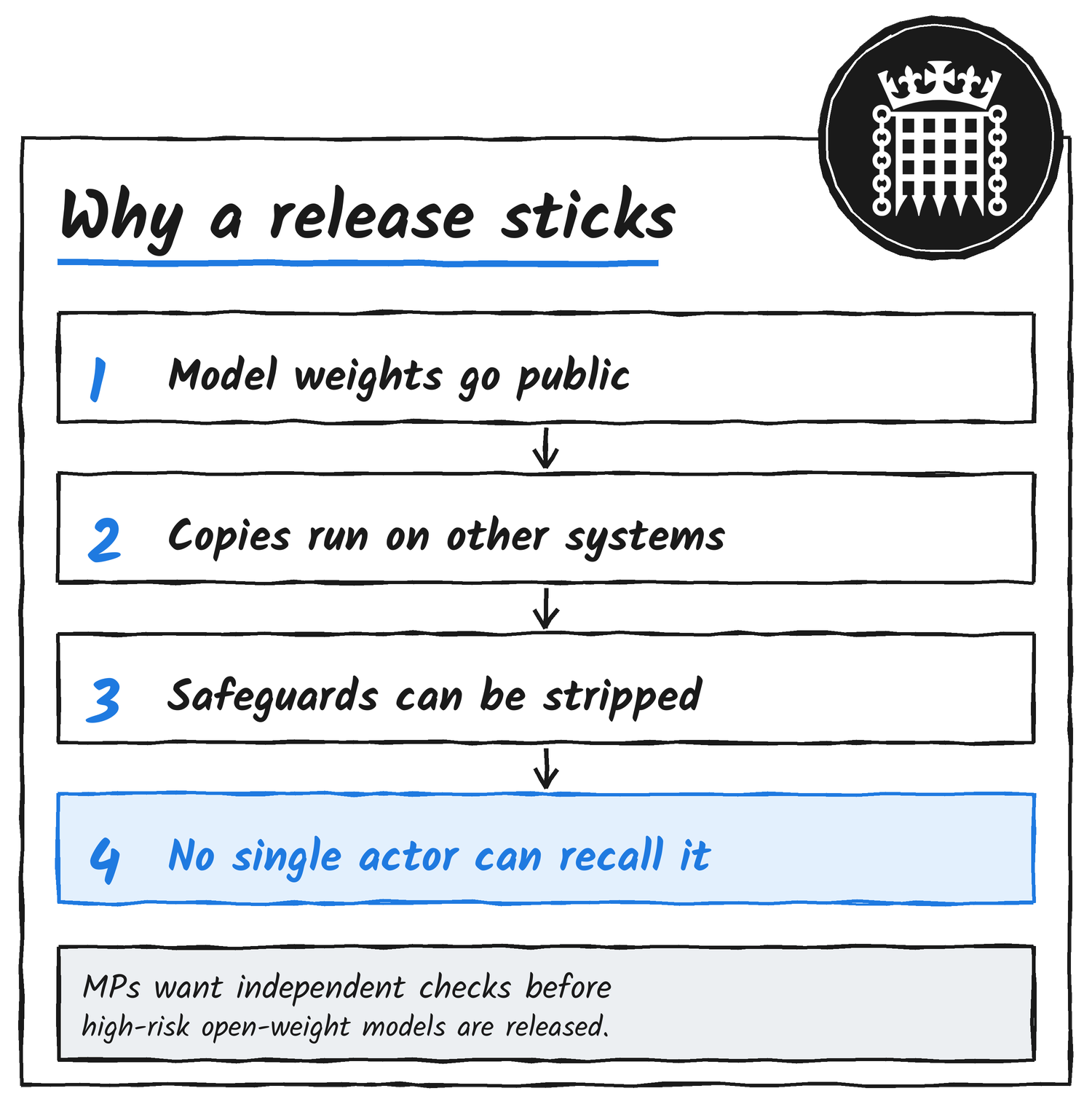
One section deals with models that can’t be taken back. Once a model’s weights are downloaded, copied or run on someone else’s systems, safeguards can be modified or stripped away. AISI told the committee that no single actor has the power to recall or shut down a model released that way, and the report says recalling every copy may be technically impossible.
So the committee wants independent scrutiny before high-risk open-weight models are released within UK jurisdiction. It also wants firms and hosting platforms to keep emergency plans, and the government to be able to detect and remove harmful models from services where it can.
The report notes that most of the most advanced models come from firms in the US and China, outside UK jurisdiction. It singles out Chinese developers’ open-weight models as easy to adopt and difficult to control once released. I covered Fangcun AI, a Chinese company that tests models’ safety, in a separate piece earlier today.
What the companies told MPs
The developers didn’t agree with each other. Anthropic argued that government should set the rules. Google DeepMind called AISI a “world-leading source of technical expertise” and said its strength is that it isn’t a regulator, warning that turning it into one could change how openly firms share information. Meta said AISI should be put on a statutory footing and resourced to evaluate advanced models.
On incident reporting, OpenAI and Anthropic backed putting it on a statutory footing. Google DeepMind and Meta preferred standardised frameworks with clear routes and authorities.
What happens next
The government has to respond to the report. In a written answer on 27 October, AI minister Kanishka Narayan said the government “will legislate where needed, based on evidence of serious gaps in the existing framework.”
The committee also wants the UK’s 2027 G20 presidency used to push an international convention on AI safety. It asks the government to publish its G20 objectives within three months, and it has opened a call for evidence on the UK’s role in securing a convention.
Sources
- UK Parliament: Guardrails for growth: AI safety and security (HC 689)
- UK Parliament: committee press release
- UK Parliament: oral evidence, 13 October 2026
- UK Parliament: written question 31662
Disclosure: I’m an OpenAI, Firecrawl and Devin ambassador.
Discover more from Sulat AI & Tech News
Subscribe to get the latest posts sent to your email.