GAO’s director of information technology and cybersecurity, Dave Hinchman, spoke to NPR’s Leila Fadel on Morning Edition on 18 November US time about outdated government technology and the risk of system failures, NPR says. GAO’s own reports put numbers on that risk: agencies had modernised three of the 10 critical legacy systems it flagged in 2019 by February 2025.
The federal government spends more than US$100 billion a year on IT, and agencies have typically reported spending about 80% of it on operating and maintaining existing systems, GAO says. This report draws on what GAO has published, and ties it to the eight US outages between 12 and 17 November that I covered in a roundup.
The 11 systems GAO ranks worst
In its July 2025 report, GAO asked 24 federal agencies for their three legacy systems most in need of modernisation, got 69 back, scored them on 16 attributes and picked 11 at 10 agencies. The 11 are 23 to 60 years old. Eight of them use outdated programming languages, seven are operating with known cybersecurity vulnerabilities, and four rely on hardware or software that’s no longer supported. GAO doesn’t name the systems, citing sensitivity.
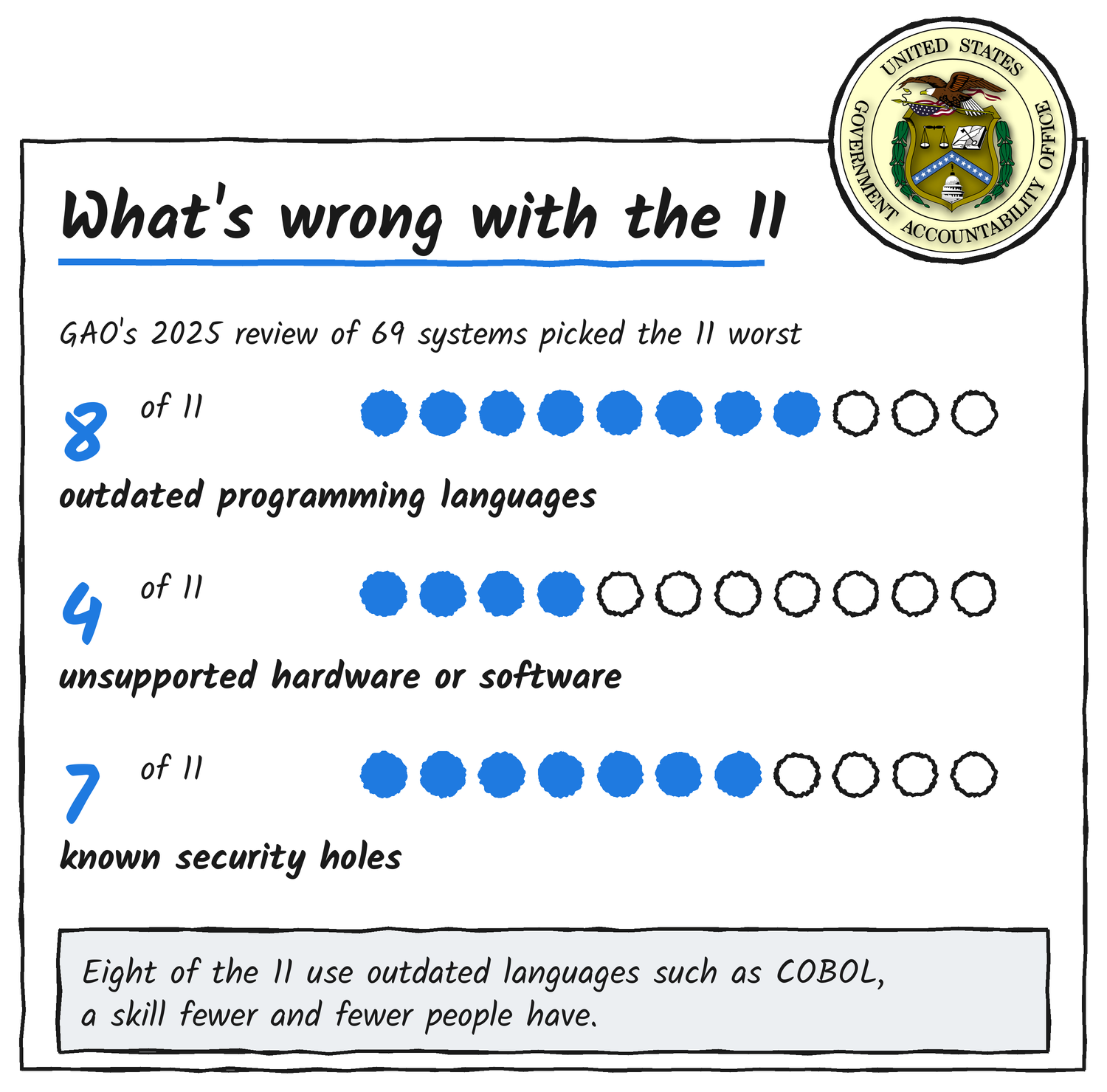
Both of the Treasury Department’s selected systems run on COBOL and Assembly, languages with a dwindling number of people who have the skills to support them. The Environmental Protection Agency’s system has obsolete hardware that manufacturers no longer support, and GAO says its known vulnerabilities can’t be fixed without modernising it.
Agencies had modernisation plans for nine of the 11 systems, but only three plans, at Homeland Security, the Interior and the EPA, included milestones, a description of the work and a plan for retiring the old system. Defense and Energy had no plan. GAO says incomplete plans raise the likelihood of cost overruns, delays and project failure, and prolong the life of vulnerable systems.
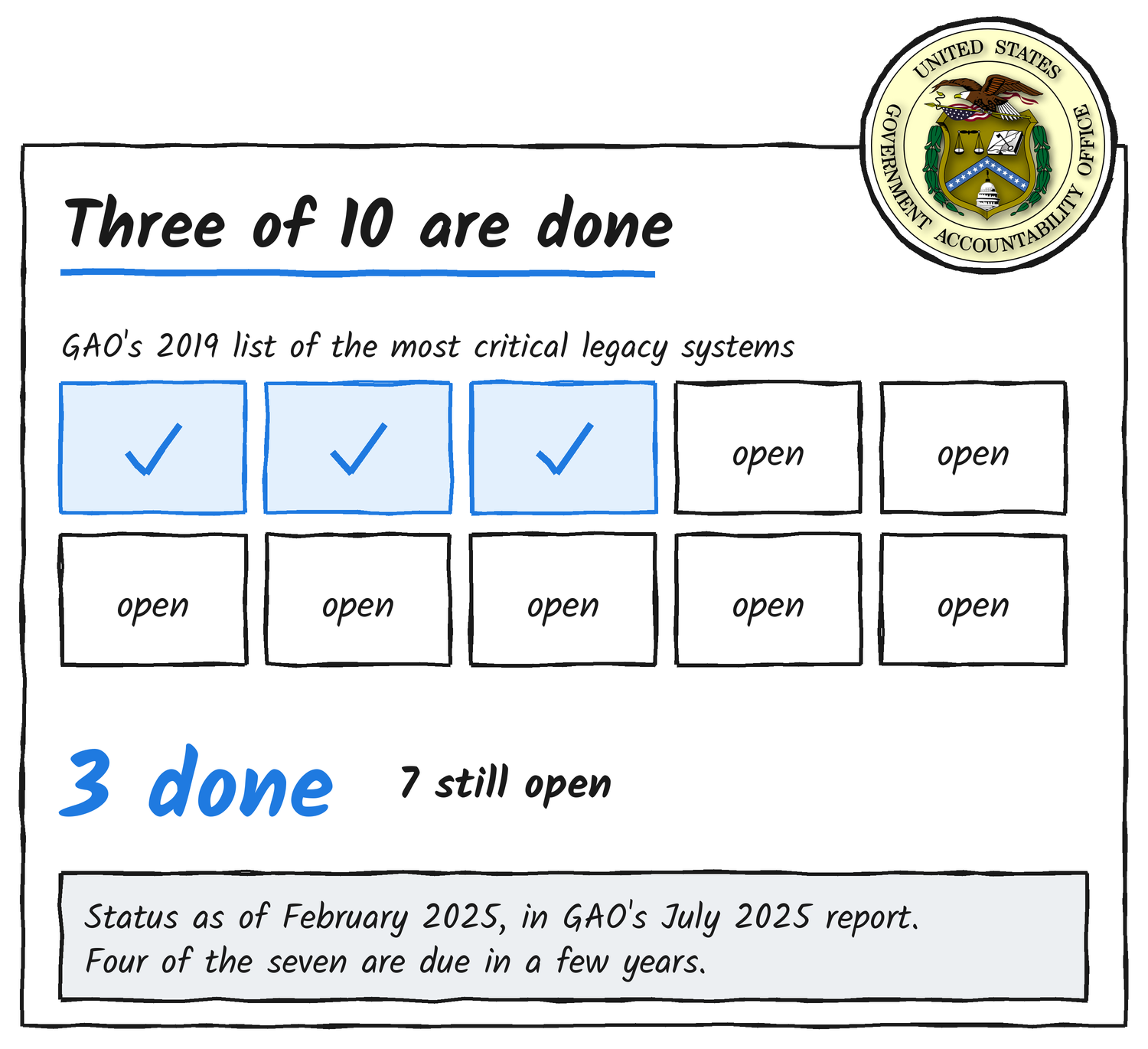
Three of the 10 flagged in 2019 are done
GAO’s 2019 report analysed 65 legacy systems and named the 10 most critical. By February 2025 agencies had completed three of the 10 modernisations. FedScoop reports they were at the Small Business Administration, the Office of Personnel Management and the Department of Defense. Of the other seven, agencies planned to finish four in the next few years and two in five or more years, and one has no completion date.
GAO has asked Congress to require major agencies to write modernisation plans for their critical legacy systems. It says it recommended nearly a decade ago that the Office of Management and Budget direct agencies to identify such systems, and that OMB hasn’t acted. As of February 2026, GAO says, Congress hasn’t either.
Where GAO links old systems to outages
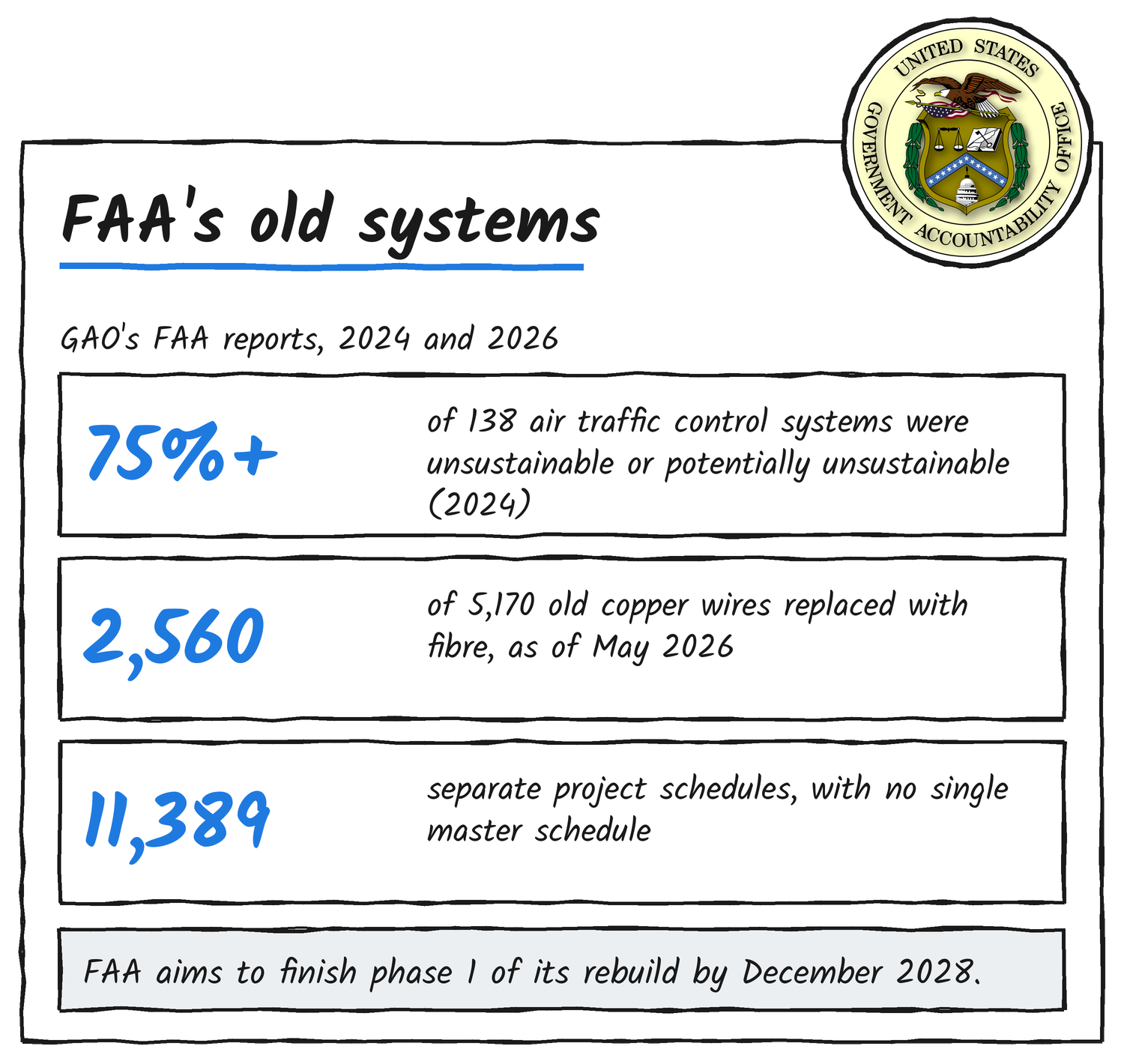
GAO’s clearest outage warning is about air traffic control. A March 2025 GAO post says some FAA voice communication systems are more than 30 years old, and that maintaining them is increasingly expensive and challenging, “raising the safety risk of system outages”. GAO reported in September 2024 that over 75% of the FAA’s 138 air traffic control systems were unsustainable or potentially unsustainable.
GAO’s September 2026 report covers the FAA’s rebuild, launched in May 2025 with US$12.5 billion from Congress. As of May 2026 the FAA had replaced 2,560 of 5,170 old copper wires with fibre. GAO says the FAA has no lifecycle cost estimate and no integrated master schedule, only 11,389 separate project schedules. “If these risks are realized, FAA would need to continue to rely on severely outdated systems that are prone to failure leading to more flight delays and safety incidents,” the report says.
What GAO’s reports don’t cover
GAO’s reports predate the November outages, and none ties them to a legacy system. The FAA says a flood of data from two remote sites made its network unstable on 13 November, and that its contractor L3Harris was installing a new router at one of them. The FAA hasn’t named a root cause.
Six of the eight organisations in the roundup, Microsoft, Workday, Chase, United, Apple and Marriott, are private companies, and GAO’s federal IT work doesn’t cover them. Their stated causes differ, and United hasn’t named one. Homeland Security Secretary Markwayne Mullin took a wider view. He told CNBC that companies are “pushing new technology on top of really old computer systems, and it just seems to overwhelm the system”, Reuters reports.
GAO’s request that Congress require modernisation plans is still open, and the FAA hasn’t said what caused the 13 November ground stop.
Discover more from Sulat AI & Tech News
Subscribe to get the latest posts sent to your email.