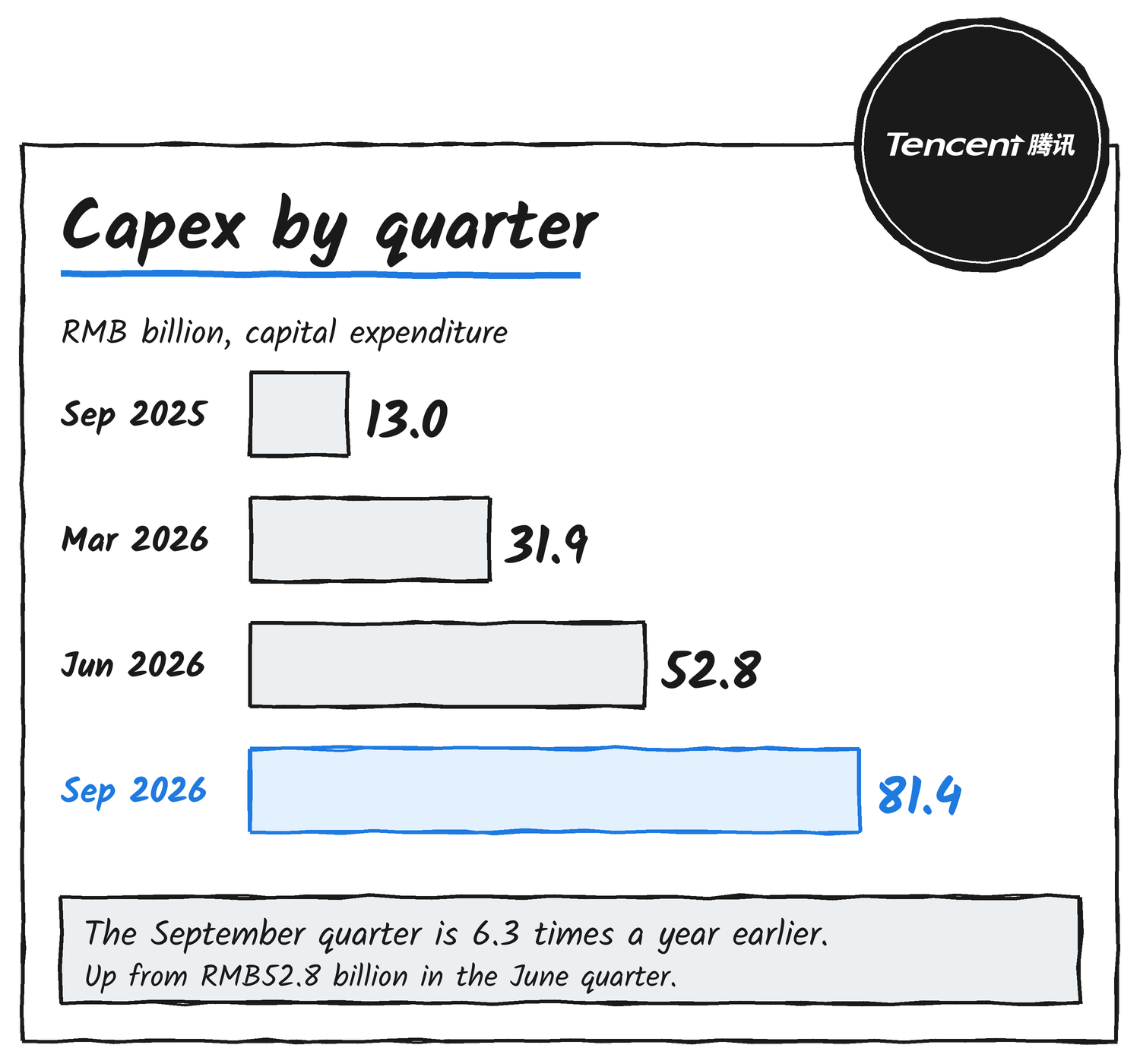
Tencent spent RMB81.4 billion on capital expenditure in the September quarter, 6.3 times the RMB13.0 billion it spent a year earlier, and its adjusted net profit fell 6% to RMB66.5 billion. Revenue rose 8% to RMB207.3 billion. The figures come from its third-quarter results, released on 18 November.
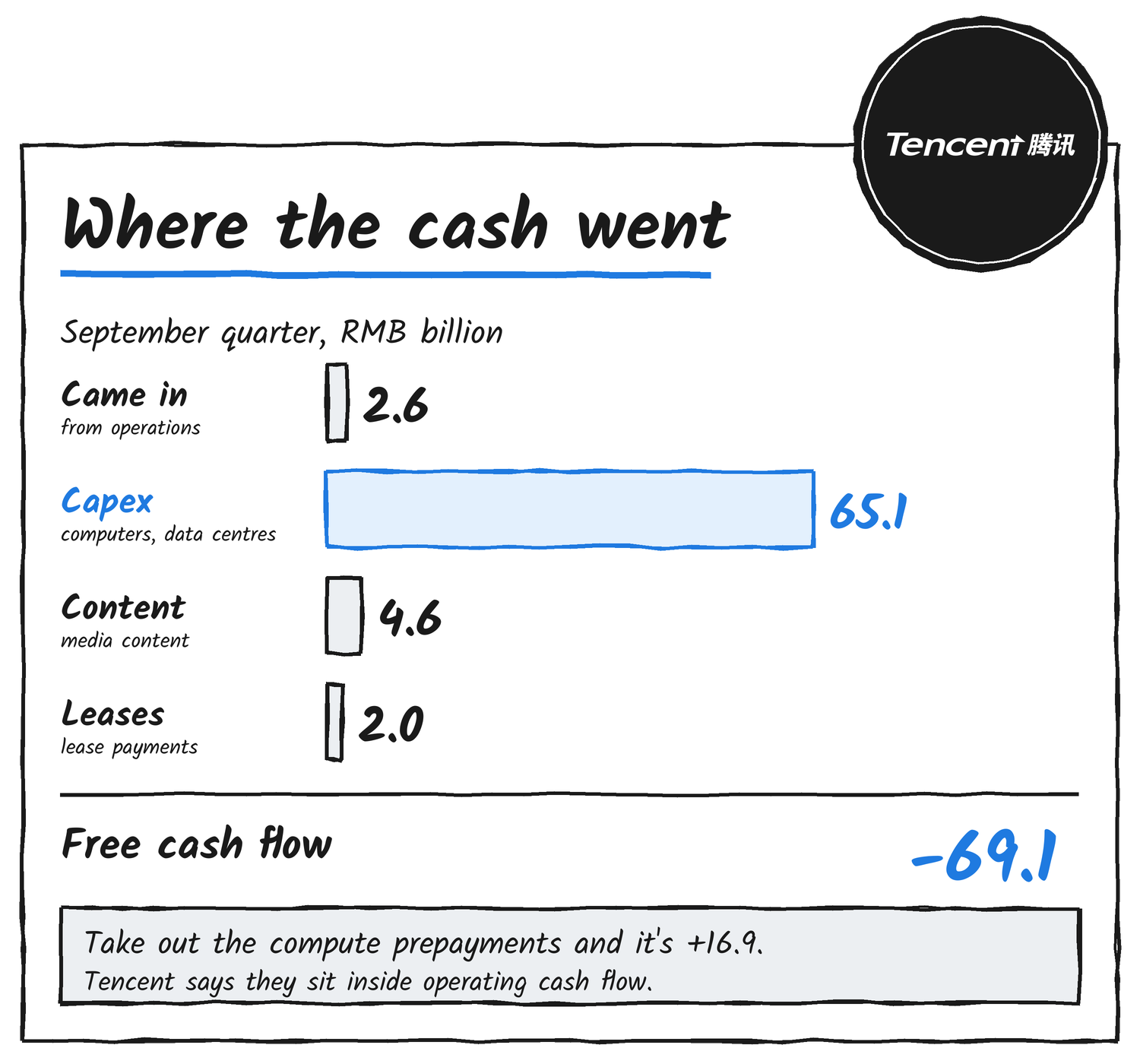
Tencent says the money is going on computing power for its Hy AI models, its WorkBuddy assistant and its cloud customers. Free cash flow was negative RMB69.1 billion for the quarter. Tencent says it would have been positive RMB16.9 billion without the prepayments for that compute.
How much the new AI products cost
Tencent reports its operating profit twice, with and without its new AI products. It lists those as Hy, Yuanbao, CodeBuddy, WorkBuddy and Xiaowei. With them in, non-IFRS operating profit fell 6% to RMB68.1 billion and the margin dropped to 33% from 38%. With them out, operating profit rose 8% to RMB83.3 billion and the margin held at 40%. The gap between the two is about RMB15.2 billion.
On Tencent’s reported IFRS basis, operating profit fell 7% to RMB59.1 billion, and general and administrative expenses rose 29% to RMB44.1 billion. Net profit attributable to shareholders still edged up 0.8% to RMB63.6 billion, because net gains from investments and others were RMB10.1 billion, up from RMB2.8 billion.
Cash went out faster than it came in
Operating activities brought in just RMB2.6 billion. Against that, Tencent paid RMB65.1 billion in capital expenditure, RMB4.6 billion for media content and RMB2.0 billion in lease payments. Free cash flow was negative RMB69.1 billion, against negative RMB13.8 billion in the June quarter.
The balance sheet moved too. Tencent ended September with net debt of RMB13.7 billion. It held net cash of RMB58.2 billion at the end of June and RMB102.4 billion a year ago. Total cash was RMB525.7 billion, up 7%.
What’s still growing
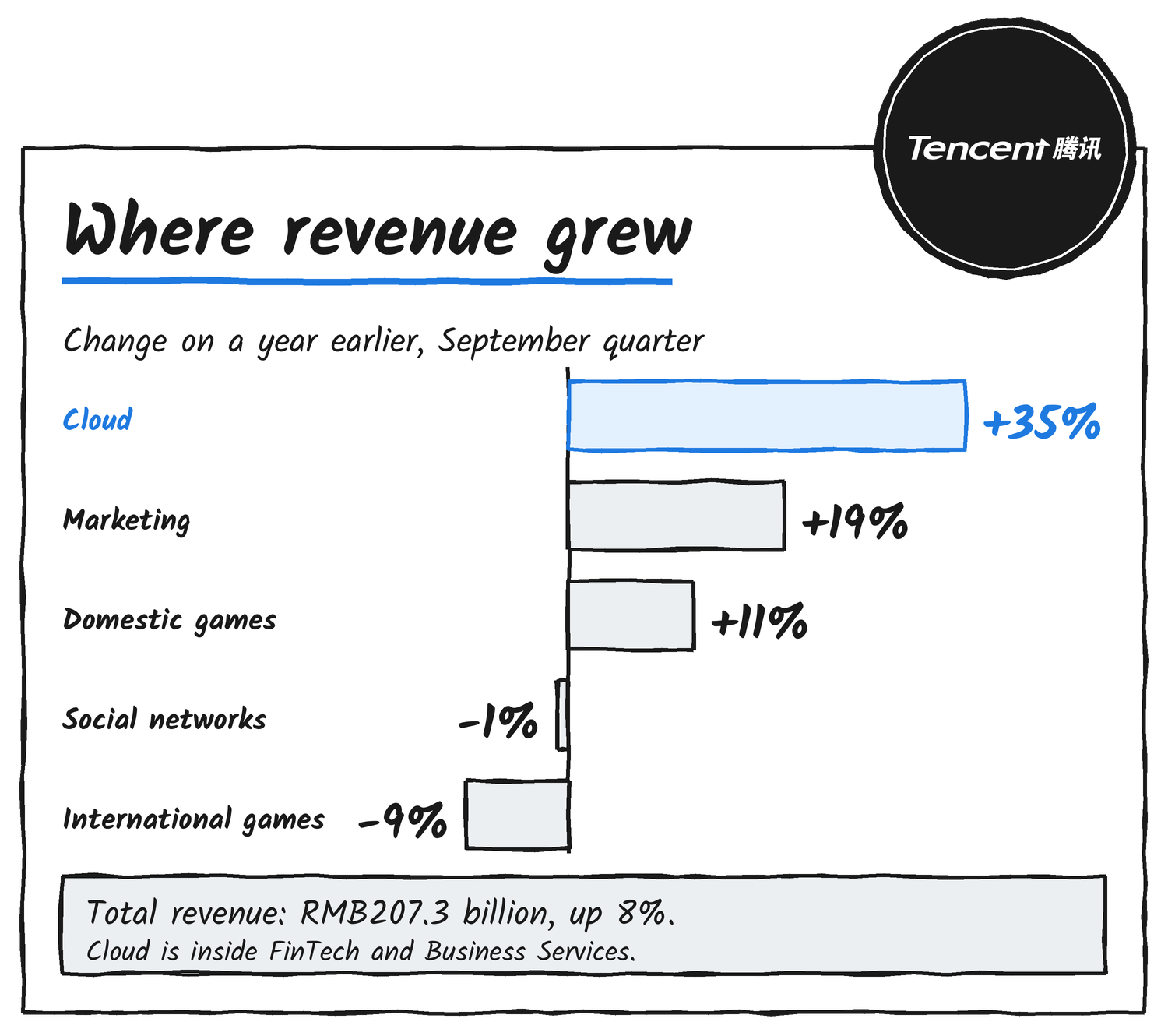
Marketing services revenue rose 19% to RMB43.0 billion, and Tencent credits its AI-driven ad and content recommendation. Cloud services revenue rose 35%, inside FinTech and Business Services revenue of RMB63.7 billion, which was up 9%. Domestic games rose 11% to RMB47.6 billion. International games fell 9% to RMB18.9 billion against a strong year-ago quarter, and social networks slipped 1% to RMB31.8 billion.
What Tencent says it’s buying
The release says WorkBuddy has more than 10 million daily active users consuming more than 100 trillion tokens a day. Tencent released its Hy4 model in November, and I covered the pricing of Hy4 flash earlier this week.
We believe WorkBuddy has grown to become the largest AI application in China, measured by total daily large language model token consumption by users. Our cloud services revenue growth rate increased, driven by WorkBuddy and as we allocated more compute to Model as a Service and GPU rental.
Ma Huateng, Chairman and CEO of Tencent
Discover more from Sulat AI & Tech News
Subscribe to get the latest posts sent to your email.