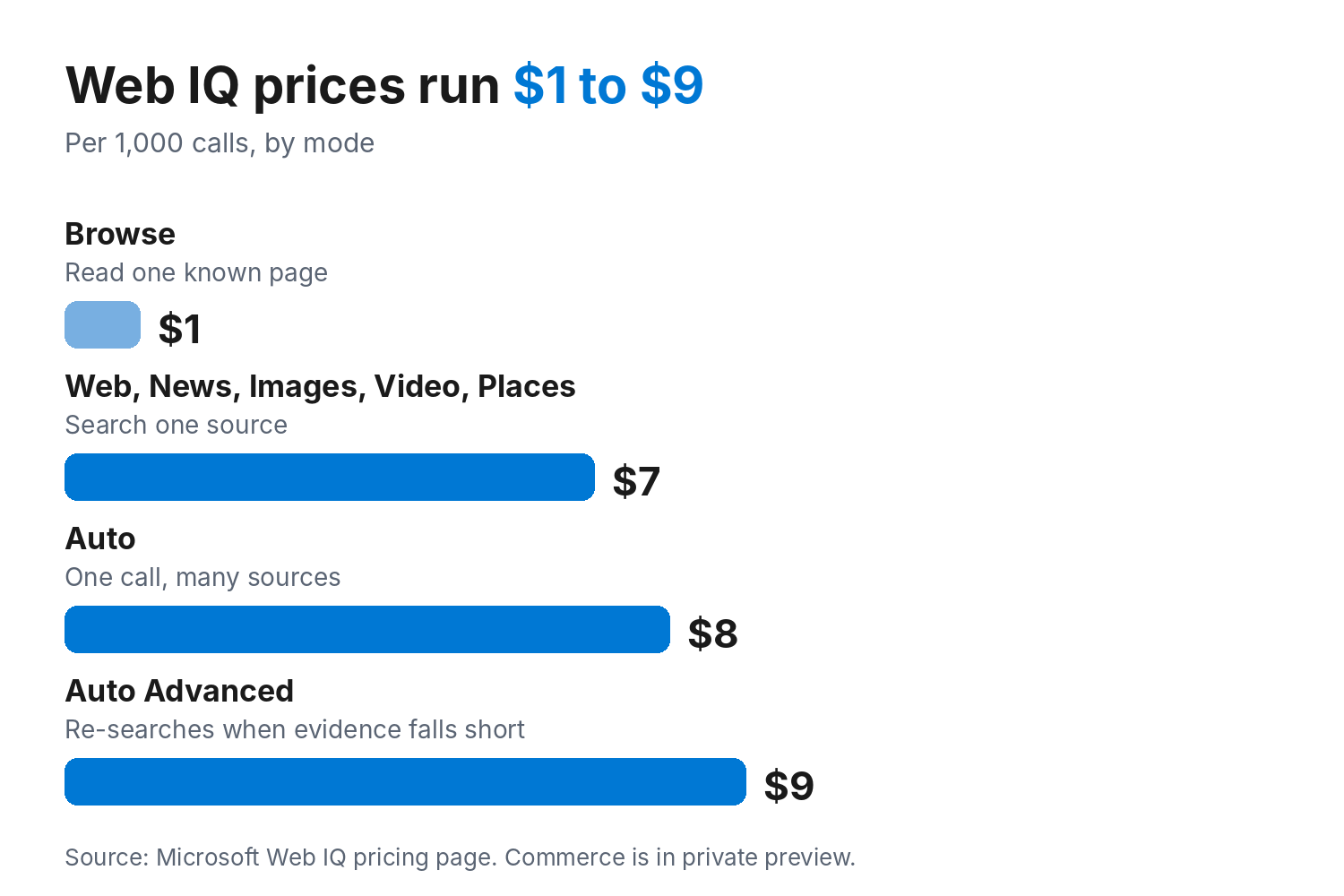
Microsoft says Web IQ, the search engine it built for AI agents, is now available to every Azure customer. There’s no waitlist, and prices run from US$1 to US$9 per 1,000 calls. Microsoft announced it at Ignite on 17 November, which was 18 November in New Zealand, and SEO researcher Marie Haynes flagged it on X as one to watch. It isn’t a brand-new product, since Microsoft first announced Web IQ on 2 June. What changed this week is the opening to all Azure customers, along with lower prices and new modes. Microsoft Learn says Web IQ needs a paid Azure subscription, so Azure credits can’t be used for it.
What Web IQ is
Jordi Ribas, Microsoft’s president of Search and AI, puts it this way: “While Bing is our web search engine for humans, Web IQ is our search engine for AI agents.” He says Web IQ already provides web grounding to ChatGPT, Copilot and Mistral. Grounding means handing a model fresh, cited web content to answer from. Web IQ isn’t a model and doesn’t write the answer; it returns ranked passages with titles, URLs and timestamps, and the agent’s own model does the writing. Microsoft counts it as one of four IQ layers, alongside Work IQ, Fabric IQ and Foundry IQ.
Auto runs the search loop
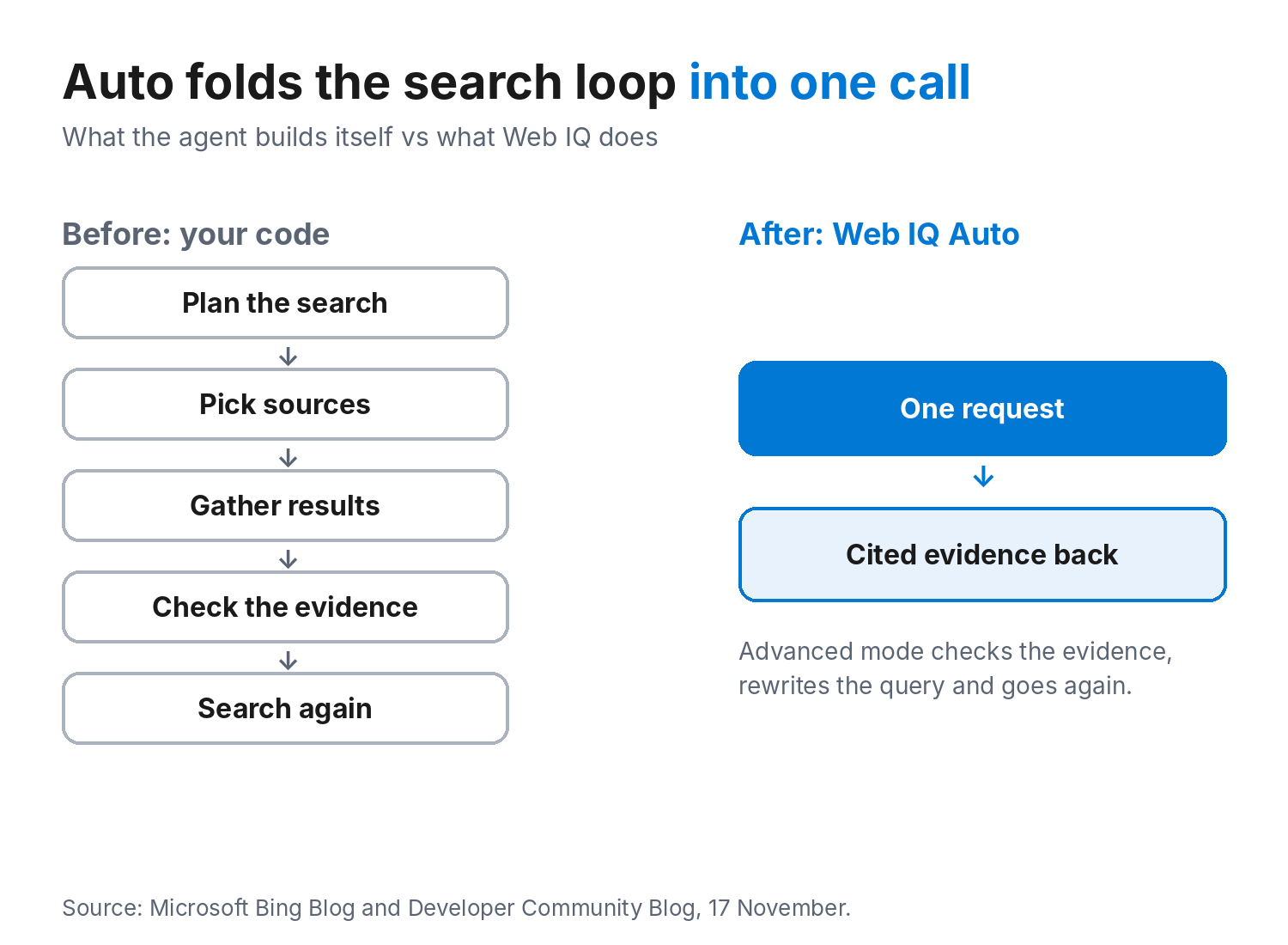
Web IQ Auto is now the default way to call it. One request fans out across web, news, images, video, places and weather, then returns cited evidence instead of whole pages. Setting the mode to advanced turns on Auto Advanced, which checks whether the evidence is enough, rewrites the query and searches again before it answers. Microsoft’s example is a field-service agent that checks the forecast at each job site, confirms a supplier’s opening hours and pulls recall news in a single call.
Prices
Microsoft’s pricing page puts Browse, which reads a page you already have the URL for, at US$1 per 1,000 calls. Searching web, news, images, video or places costs US$7 per 1,000, Auto costs US$8 and Auto Advanced costs US$9. Commerce is priced at US$7 as well, though it’s still in private preview.
New sources
Weather covers 243 countries and territories, using 140,000 observation stations. It returns current conditions, seven daily forecasts, 24 hourly forecasts and government warnings, and it’s generally available through Auto. Places holds structured records for more than 207 million businesses and landmarks across more than 200 markets, with addresses, phone numbers, hours and coordinates. Commerce draws on more than 40 billion product offers, and Microsoft says its own test of 500 product queries returned 57% more matched products than the next closest competitor.
Web IQ also spots health questions and ranks credible sources higher, guided by principles the National Academy of Medicine published. It’s meant for consumer health information, not individual medical advice, and queries shouldn’t carry protected health information because Microsoft’s business associate agreement doesn’t cover Web IQ. Customers can bring their own publisher licences too, and licensed results come back ranked alongside web results.
Controls and publishers
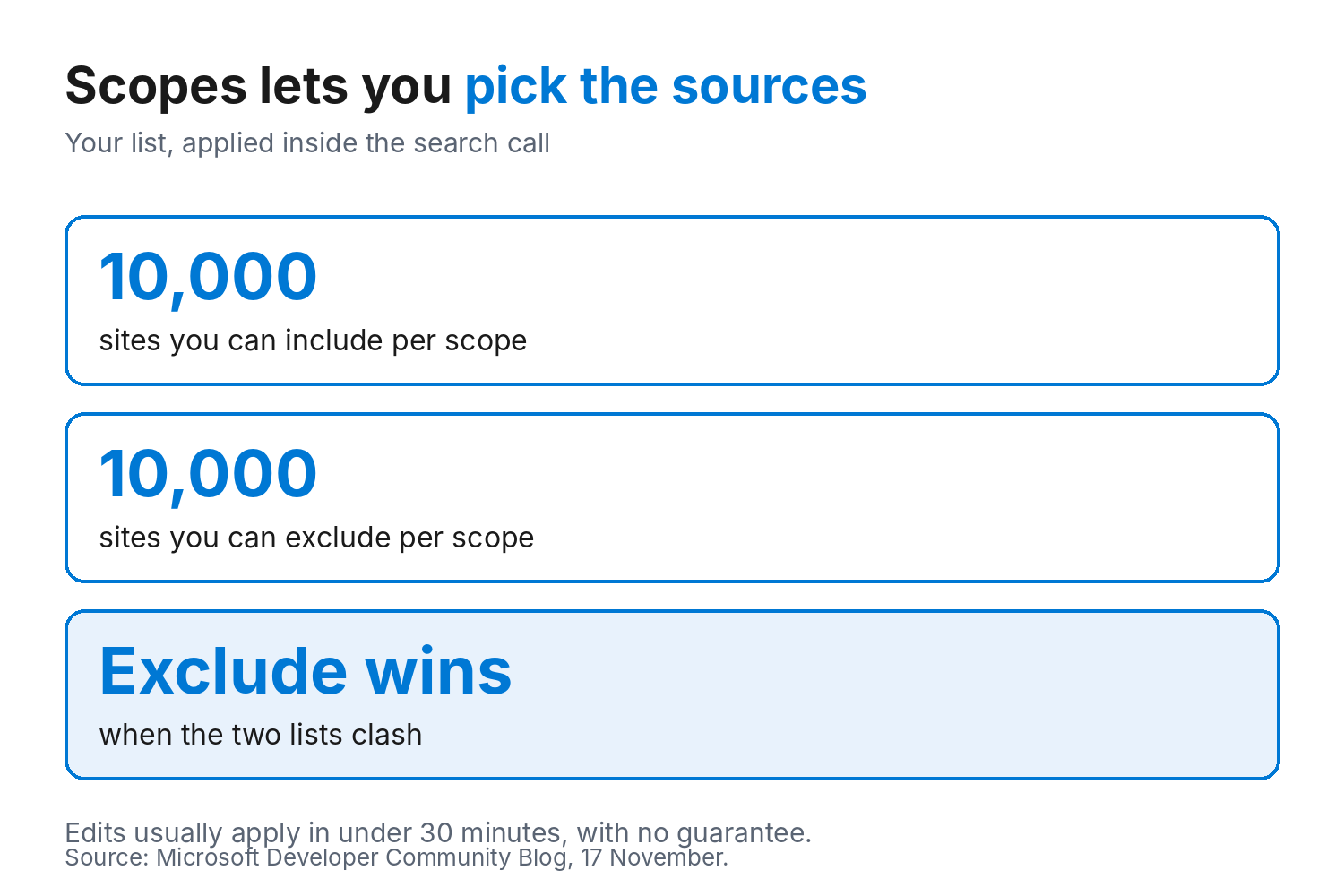
Scopes lets an organisation write a named list of sites to include or exclude and pass its name with each request. A selector can be a domain, which also matches its subdomains, a path prefix or an exact URL. Wildcards, ports and query strings aren’t supported. Scopes is generally available on Web and News, in preview on Auto, and costs nothing extra. Creating a scope through the API needs a separate Microsoft Entra grant, and edits usually take under 30 minutes to apply. Regulated customers can also ask for Zero Query Logging, which suppresses query text from service logs after a case-by-case review.
Publishers get three levers. Web IQ draws on Microsoft’s own index, which Bingbot builds. Bingbot honours robots.txt, so a site it can’t crawl isn’t in the index. A noindex tag keeps individual pages out. Since 30 October, publishers can also set page-level preferences for AI grounding. Microsoft says every result links back to its source.
Microsoft’s numbers
Microsoft Learn lists a 164 ms P95 latency. In FreshSearch, a freshness benchmark Microsoft open-sourced, Web IQ Auto scored 87.5 out of 100. Parallel scored 82.4, Exa 3.0 Auto 73.5 and Perplexity 57.9, and Web IQ’s plain Web mode scored 81.2. Microsoft ran the tests itself and published the code on GitHub. Customers it names include Genspark, Publicis Groupe and National Grid.
Where to use it
In Microsoft Foundry, Web IQ now powers the web search tool in the Responses API, replacing Grounding with Bing, according to Microsoft’s builder guide. Broader Foundry integration rolls out in 2027. Domain-restricted custom search stays on Grounding with Bing Custom Search. Outside Foundry, Web IQ answers over REST and over MCP, so VS Code and GitHub Copilot CLI can connect to it. The Python SDK needs Python 3.11 or later and the Node SDK needs Node 22 or later. Both cover Web, News, Images, Videos and Browse, and Auto is REST only for now.
Discover more from Sulat AI & Tech News
Subscribe to get the latest posts sent to your email.