Netlify launched a new brand, website and app experience on 18 November, with co-founder and CEO Mathias Biilmann calling it “the biggest change in our decade-long history”. The new app experience is live for most new users today, Netlify says, and existing customers can join a waitlist for access over the coming weeks.
Biilmann announced the relaunch on X on 18 November, US time, and in a blog post titled “Why all of you can build with us in Netlify’s next decade”. He writes that the company refocused around what he calls Agent Experience, a term he says he coined, and around “unlocking the next billion builders on the web”.
Today we’re launching a new Netlify. New brand, new website, new app experience, rebuilt from first principles.
— Matt Biilmann (@biilmann) November 18, 2026
It’s the biggest change in our decade-long history, and it comes from a bet we made on ourselves.
This is just the beginning.https://t.co/DpuU1WAIu0
Wade Wegner, Netlify’s SVP of Product, covers the product side in a second post, Inside the new Netlify. It describes three pieces: a redesigned app experience, Connectors for Agent Runners (the feature that lets an AI agent build and change an app inside Netlify), and Netlify Server, a long-running backend that launched the week before.
What Biilmann says was missing
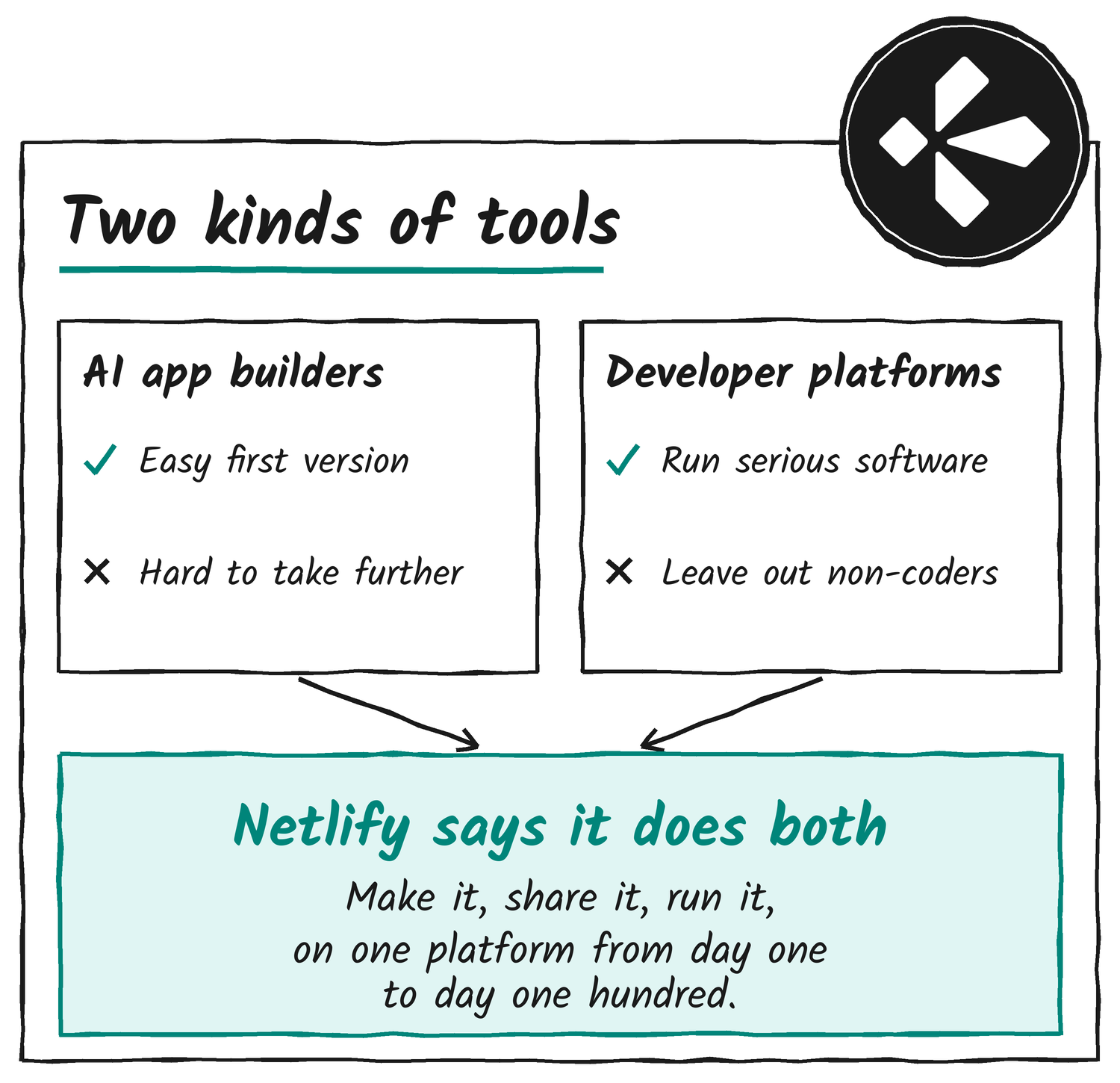
Biilmann argues that today’s tools fall into two groups. AI app builders make it easy to get a first version but hard to take it any further, he says. Developer platforms can run serious software but leave out people who don’t write code. Teams end up moving an app from one world to the other, and “something always breaks along the way”. Netlify says it’s now the place where both ways of building are first-class.
How the new experience works
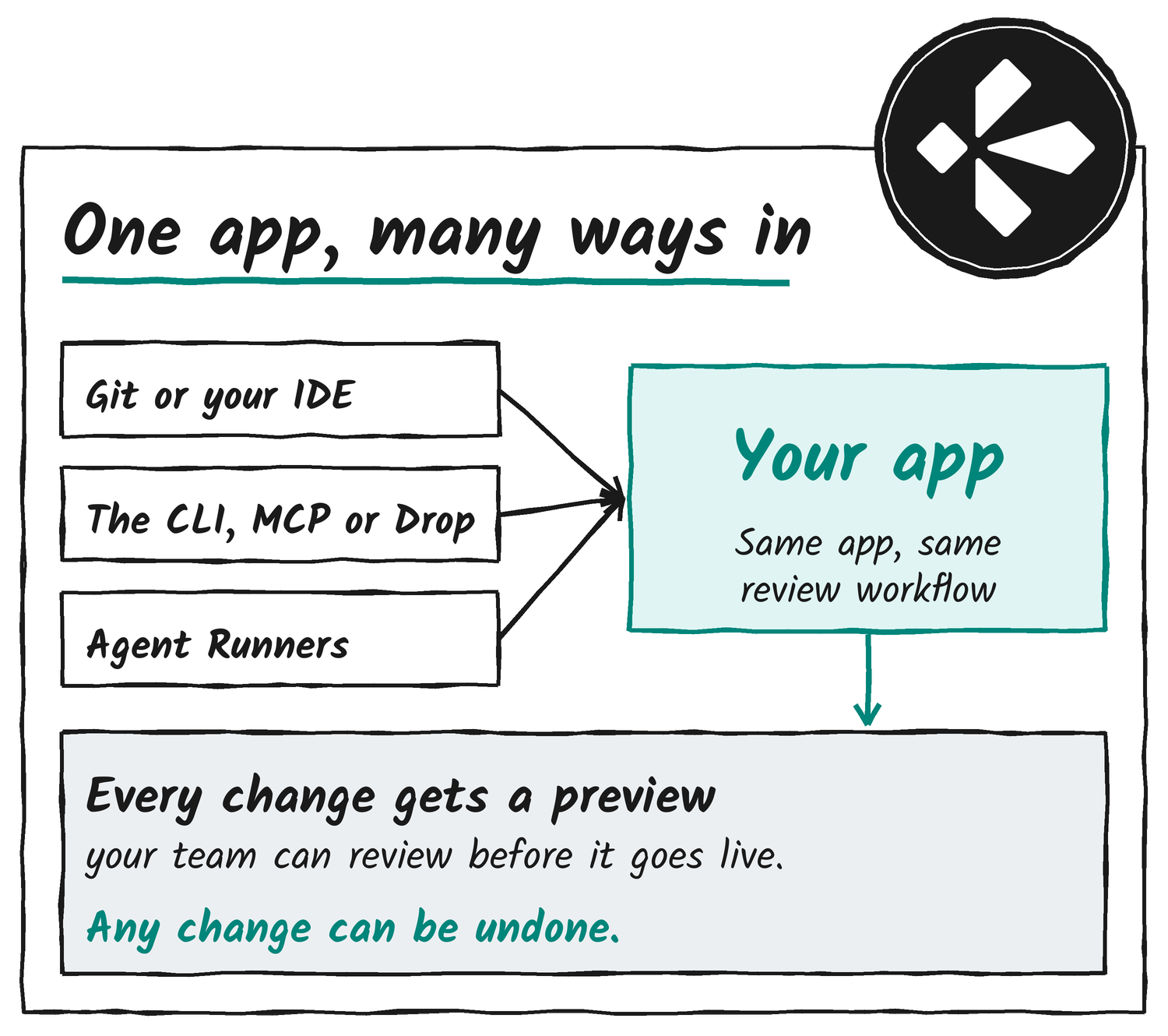
The new experience starts from the app, not the repository. You describe what you want, pick an agent and a model, and watch it take shape in a live preview next to the conversation, Biilmann writes. Data, logins and forms are built in. Every change gets a preview the team can review before it goes live, and any change can be undone.
Wegner adds that the agent can ask you questions before it makes a change, and that you can inspect an earlier version, return to it and choose when to publish. Developers keep their own routes. The same app can be picked up in Git, an IDE or a coding agent, and Wegner says work from external agents can come in through Netlify’s MCP server (the protocol agents use to call outside tools), Drop or the CLI. All of it goes through the same review workflow.
Connectors and Netlify Server
Connectors give agents access to the tools where a project’s context already lives. Biilmann says there are more than 150 integrations, including Stripe, Notion and Linear. Wegner’s example is handing an agent the URL of a Notion document and asking it to build what’s described; if Notion isn’t connected, the prompt asks you to authorise access. Connectors are rolling out for Agent Runners on all plans, including Enterprise customers where credits are enabled.
The connections are personal. Joining a project doesn’t give you a teammate’s connected accounts, and your own connection works across your projects. In this first release, connectors work while the agent builds. Wegner says the deployed app doesn’t get ongoing access yet, and that it’s coming soon.
Netlify Server runs an app’s backend as a long-lived Node.js process that handles many requests at once. Netlify says that suits real-time multiplayer, chat, AI agents and long-running jobs, and that its Functions can’t hold a WebSocket open (a persistent two-way connection between the browser and the backend) because each invocation answers one request and finishes. You can bring an Express, Hono or Fastify app as it is, and Netlify provisions, scales and monitors the instances. Usage is free during early access; other metered features are billed as usual.
Biilmann says more than 10,000 servers already run on it. Wegner says more than 10,000 new projects were built in the first few days after launch, most of them through agent runs, and that one customer’s simulated trading competition handled hundreds of WebSocket connections in its first couple of days.
The numbers Netlify gives
Biilmann describes the company’s turnaround in figures. Netlify onboarded more than 100,000 new users in a single day, crossed US$100 million in annual recurring revenue and is forecasting 130% ARR growth this year, he says, after being “a ten-year-old business that many thought was past its peak”. Wegner says the single-day sign-up spike was last week, and that in the last 30 days more than 500,000 users made more than 1.7 million agent runs, which produced more than 700,000 production deploys.
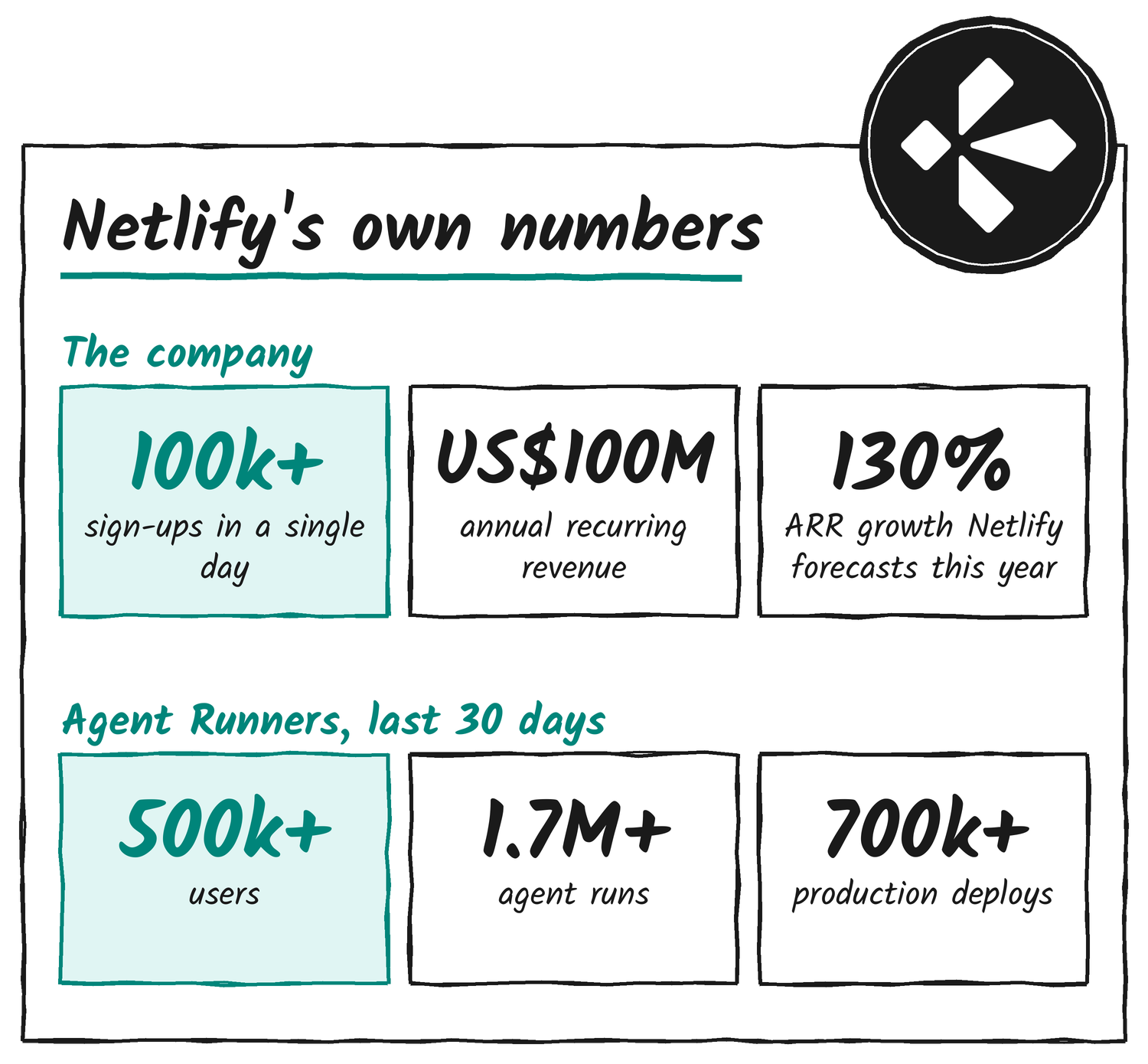
Those figures are Netlify’s own. Netlify hasn’t given existing customers a date for the new experience beyond “the coming weeks”. New users can sign up now, and existing customers can join the waitlist.
Discover more from Sulat AI & Tech News
Subscribe to get the latest posts sent to your email.