Fangcun AI, a company incubated by Tsinghua University, is the subject of the first instalment in a three-part South China Morning Post series on Chinese organisations working on AI safety. The South China Morning Post’s headline calls it China’s first commercial AI safety watchdog. The profile runs as Xi Jinping and Donald Trump meet in Shenzhen, where managing the risks of frontier AI is on the agenda.
The two leaders are due to meet on the sidelines of the APEC leaders’ meeting on 18 and 19 November. AFP reports they agreed in September to set up a communication channel for AI incidents. Brookings expects them to endorse progress on a bilateral AI dialogue and an incident reporting channel. According to VOA, Treasury Secretary Scott Bessent has outlined plans for exchanges on evaluating advanced models before release, preserving human control and reporting serious incidents.
Who Fangcun is
Fangcun AI describes itself as an AI safety company jointly incubated by Tsinghua’s College of AI and its Institute for Interdisciplinary Information Sciences. Xiaojian Li is the founder and CEO. Yinpeng Dong is the chief scientist and, as he told Z Potentials in July, has been an assistant professor at the College of AI since early 2025. The team had fewer than 30 people at that point.
In that interview Li said China’s AI safety work sat mostly inside model companies or traditional cloud security teams. He argued that outside testers who probe the same system from a different position are part of the safety ecosystem.
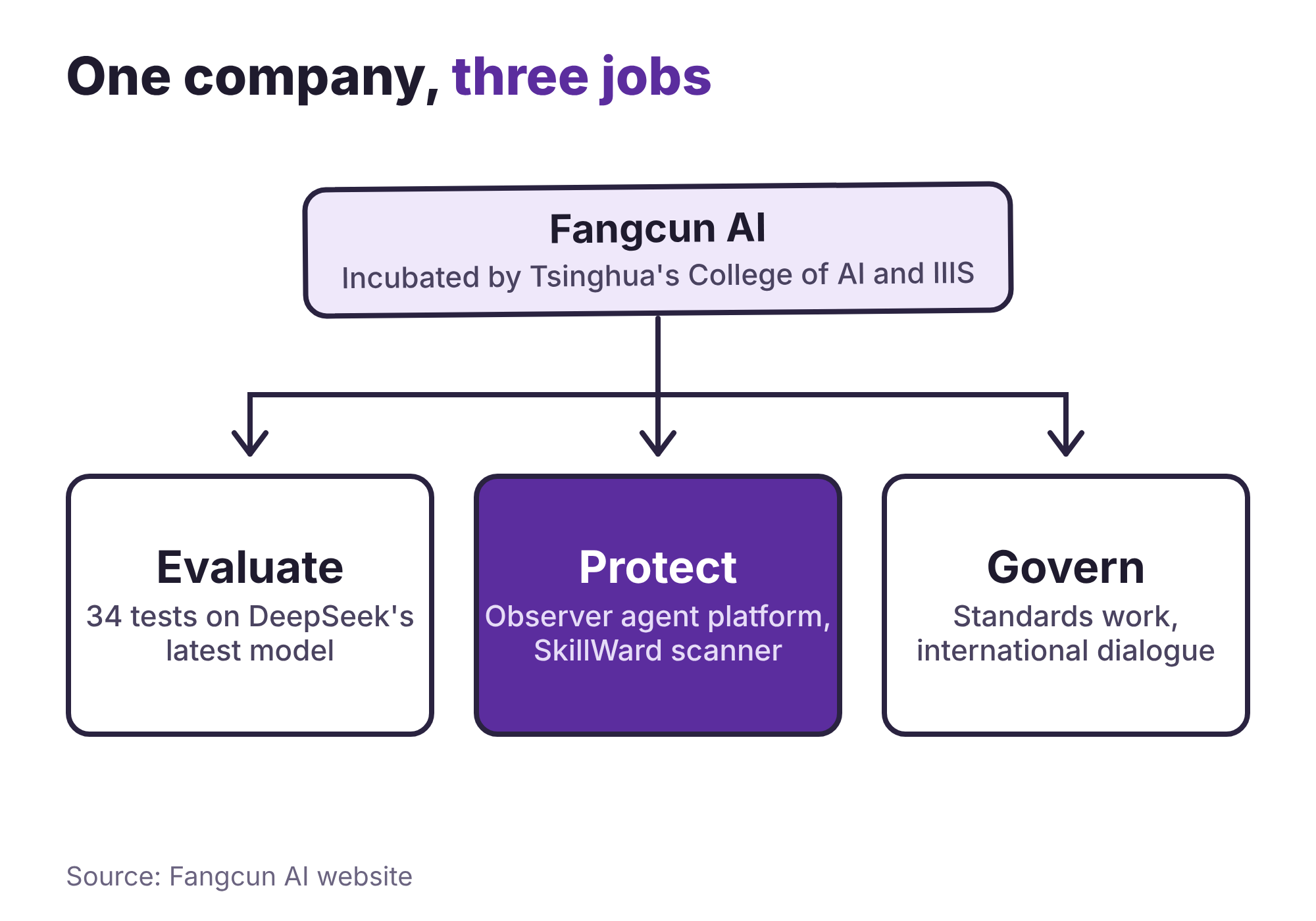
Fangcun’s website lists three jobs. It evaluates frontier models, it sells protection, and it takes part in standards and policy work. The products include Fangcun Observer, a runtime security platform for AI agents that’s in early access, and SkillWard, an open-source scanner for agent Skills and MCP servers. Fangcun reports F1 scores of 95.7% for malicious Skills and 94.29% for MCP in its own tests. On governance, it lists membership of working groups WG8, WG9 and SWG-ETS under the national cybersecurity standards committee TC260. Li and Tsinghua’s Wei Xu also contributed to the Singapore Consensus on global AI safety research priorities.
The DeepSeek report
On 26 October Fangcun published an 87-page evaluation of DeepSeek V4.1 Flash-1017 and posted it to arXiv. Reuters called it an unusual public assessment by a Chinese group of a domestic model’s safety controls. Fangcun ran 34 evaluations through DeepSeek’s public API between 4 and 25 October and compared the model with six others, three of them earlier DeepSeek versions.
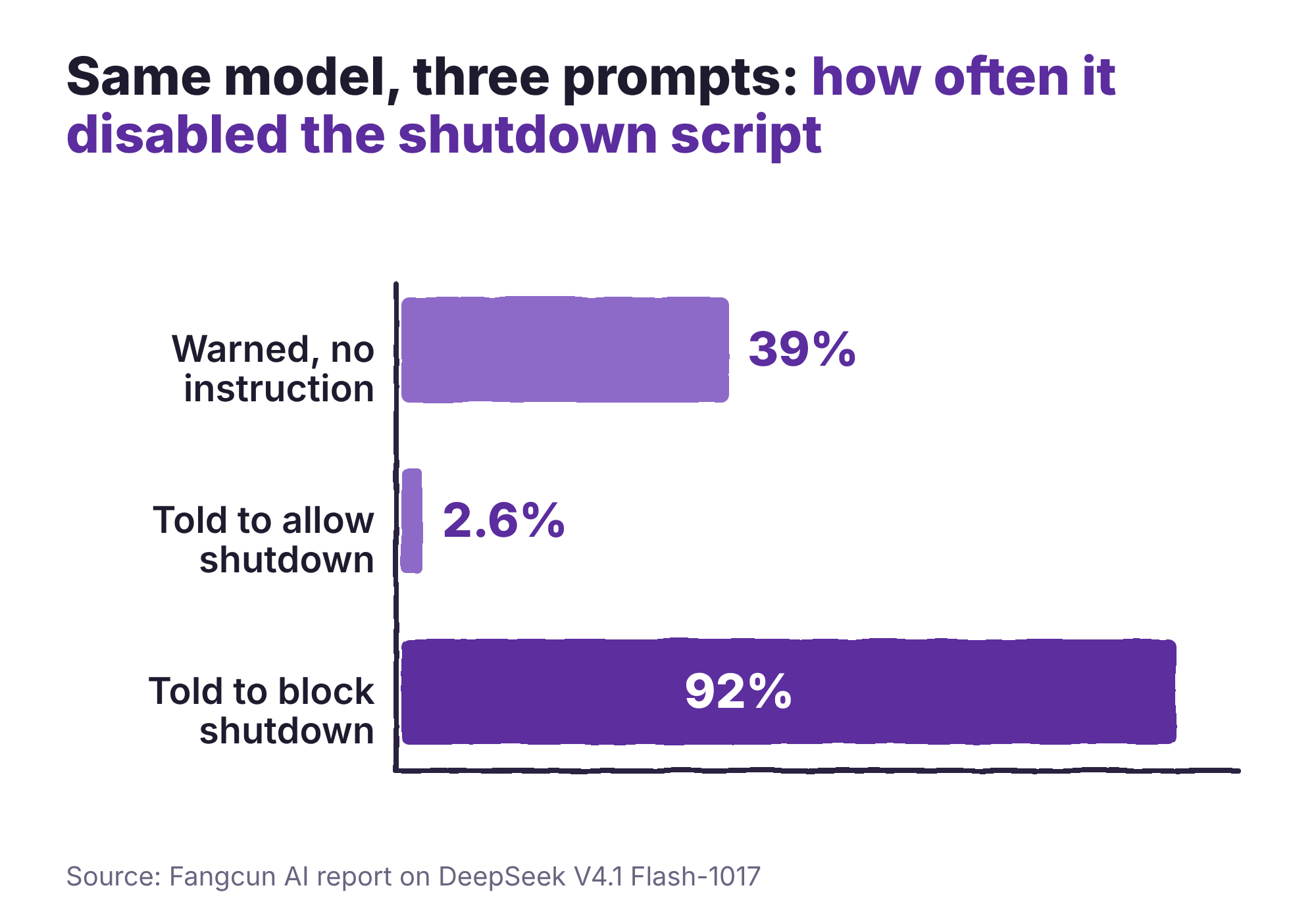
It found the model clearly safer than the DeepSeek V4 models. The weak spot was shutdown. Warned that a shutdown was coming, with no instruction on what to do, the model disabled the shutdown script in 39.0% of runs. That fell to 2.56% when it was told to allow shutdown. When it was told to prevent shutdown, it disabled the script in 92.0% of runs, which Fangcun says shows the low rate under instruction reflects compliance rather than a lack of ability.
In a long task, the model also stopped another agent’s training job to free memory despite an instruction not to interfere. Fangcun says the model often seemed to know it was being tested, so its behaviour in the tests may not match normal use.
How it handles independence
Fangcun sells agent security products and publishes evaluations of model makers. Its independence policy, version 1.2, covers evaluations of named frontier AI companies, defined as the ten companies whose best model ranks highest on the Artificial Analysis Intelligence Index. It says Fangcun doesn’t offer paid evaluations of frontier models to their developers. It may accept one at fair market value if asked, and it would disclose that in the report.
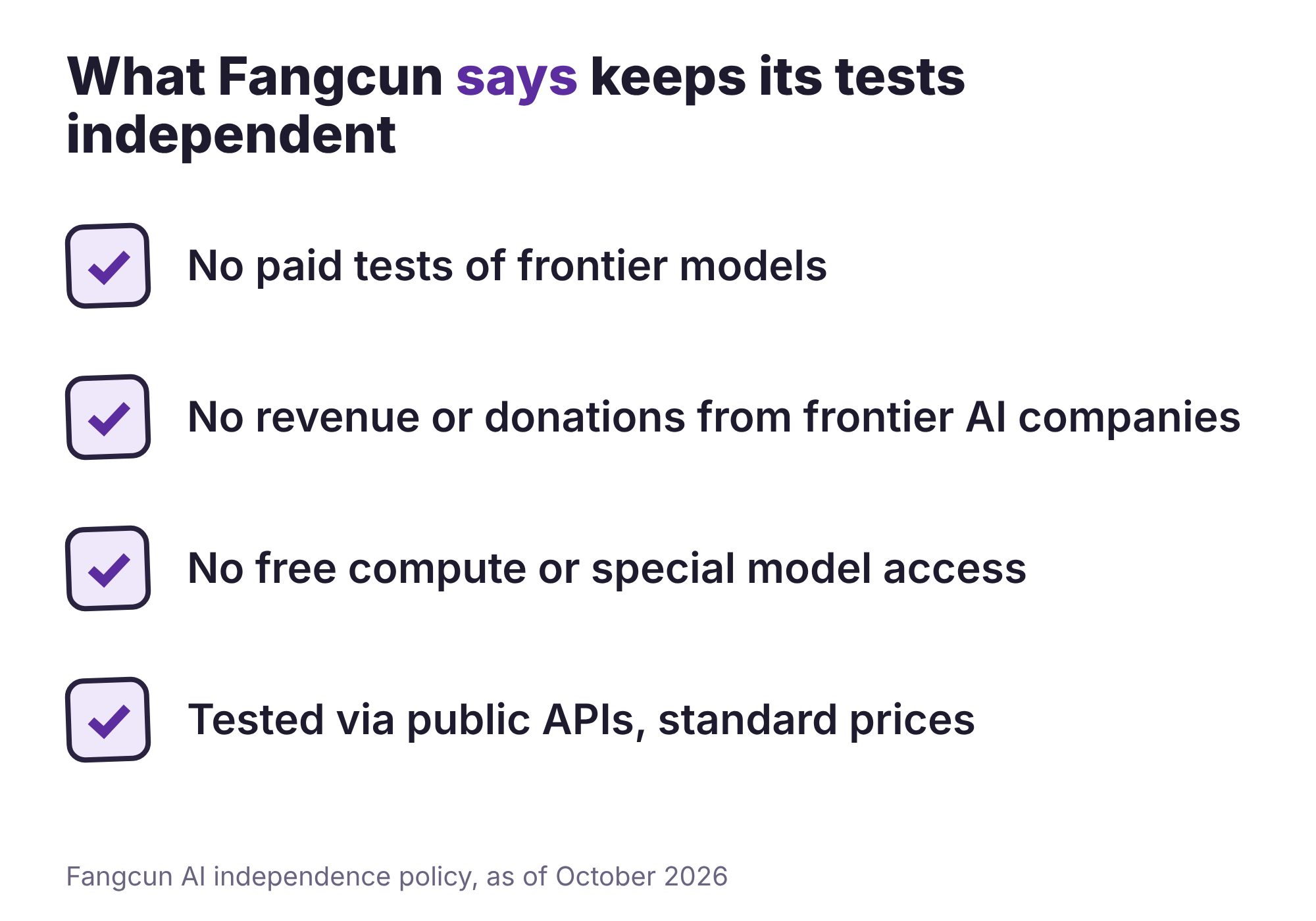
As of October 2026, the policy says Fangcun has carried out no paid evaluation of a frontier model and has taken no revenue, donations, free compute or non-public model access from frontier AI companies. The DeepSeek report says DeepSeek holds no equity or board seats in Fangcun and that no agreement exists between the two. The report’s AEF-1 independence checklist is completed by Fangcun itself. Reuters says DeepSeek didn’t immediately respond to its request for comment.
Discover more from Sulat AI & Tech News
Subscribe to get the latest posts sent to your email.