
Etsy says it will revise its new terms of use after longtime sellers began closing their shops over a clause that lets the marketplace and its partners use their work to train AI. The terms take effect on 16 December.
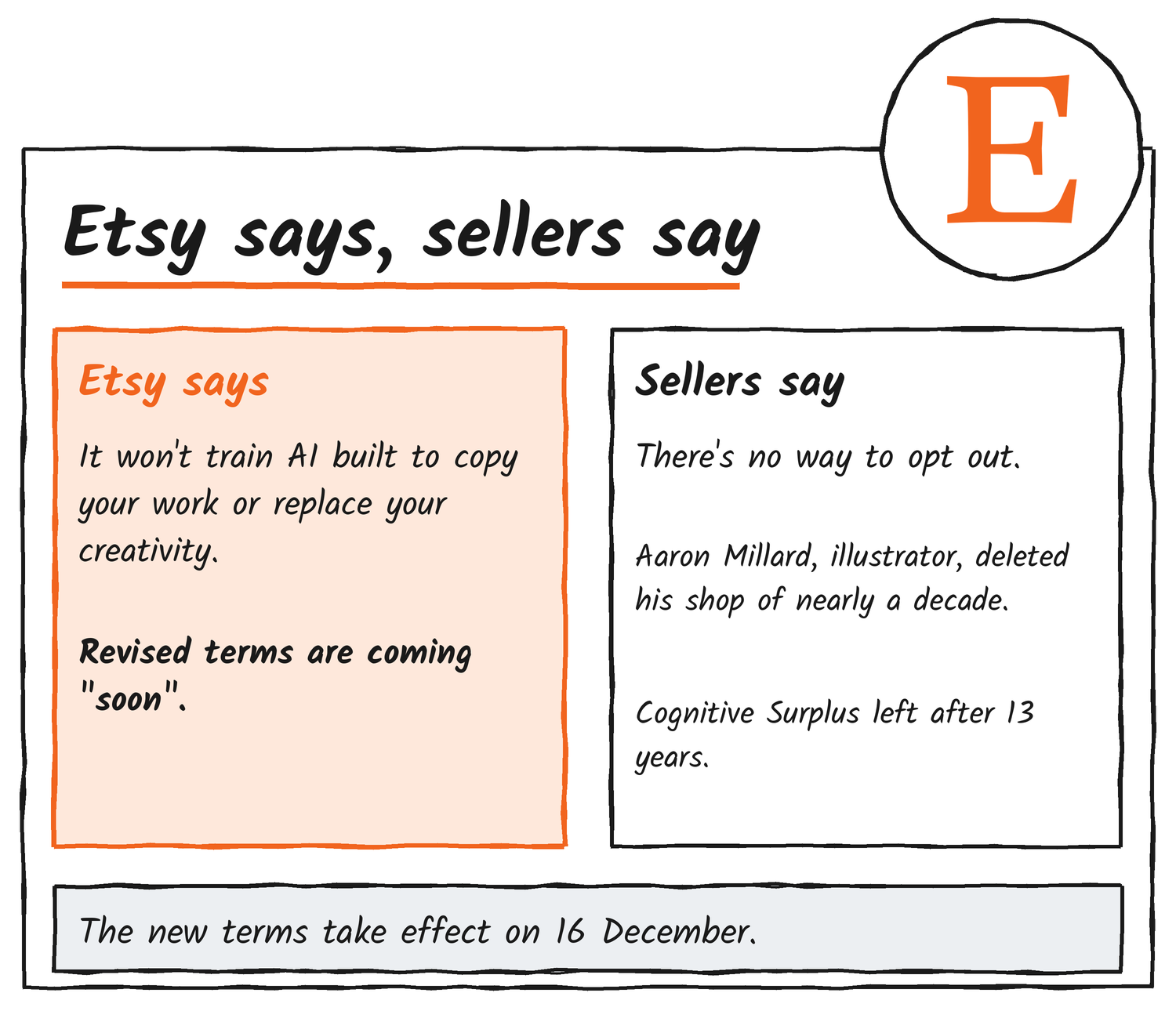
James Ossman, Etsy’s vice president of customer operations, told the New York Times that Etsy plans to “share the revised terms directly with sellers soon,” The Verge reports. Etsy hasn’t published the new wording.
What the clause says
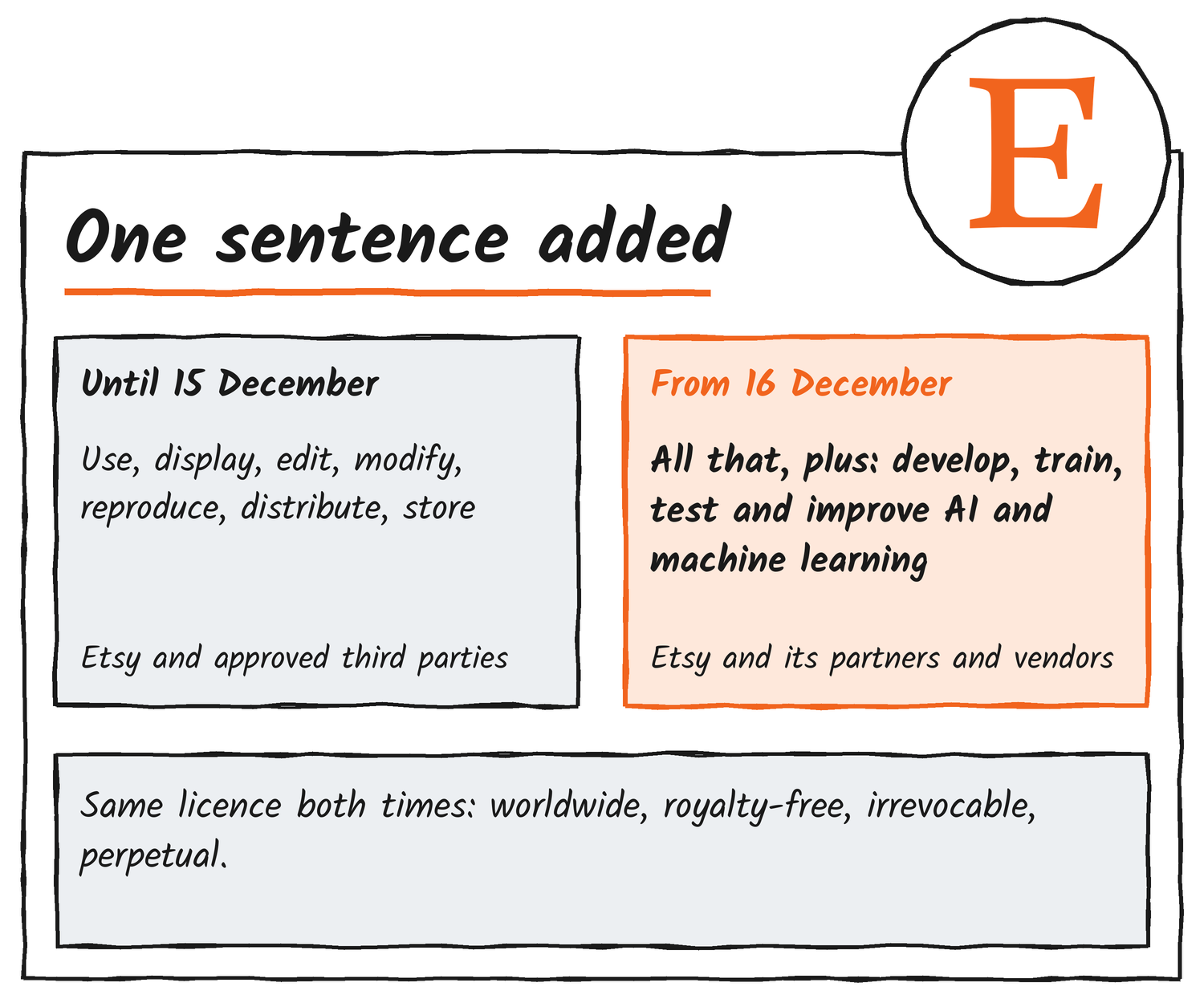
The licence sits in section 5.C of Etsy’s terms, dated 26 October. The version in force until 15 December gives Etsy, and third parties it authorises, a worldwide, royalty-free, irrevocable, perpetual licence to use, display, edit, reproduce, distribute and store a seller’s content. It says nothing about AI. The new version adds one sentence:
This also includes the right for us and our third party partners and vendors to use Your Content to develop, train, test and improve artificial intelligence and machine learning technologies, including to improve the Services and/or help keep them safe, subject to any applicable opt-out rights described in our Privacy Policy.
Etsy Terms of Use, section 5.C
The clause doesn’t name the partners or vendors. It points to opt-out rights in Etsy’s privacy policy, where section 7 gives members a right to object to processing that rests on Etsy’s legitimate interests. Etsy then has to stop unless it has compelling legitimate grounds or a legal reason to continue.
What Etsy says it does with seller content
Ossman answered sellers in a post on Etsy’s community forum on 16 November. “We do not use your content to train AI models designed to copy your original work or replace your creativity,” he wrote. “Again, this is not changing.” He said the new sentence is meant to clarify how Etsy already uses AI in its marketplace.
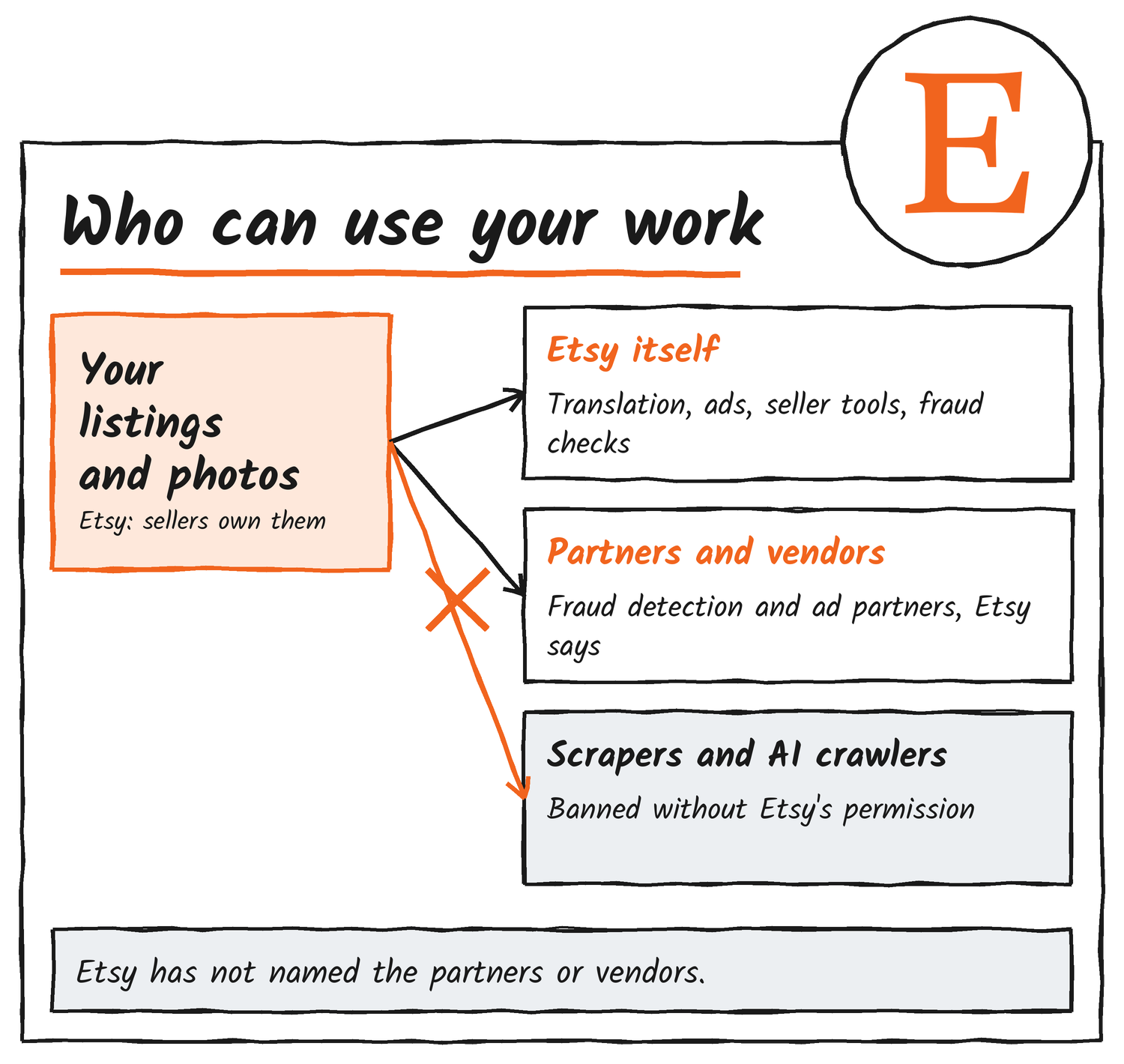
He listed three uses: models that flag potentially fraudulent accounts and listings, AI that maps the marketplace’s inventory so buyers can find items through search and recommendations, and seller tools such as listing optimisation and stats summaries. Outside parties are a separate case. Tools a seller connects, like bookkeeping or multichannel apps, need that seller’s approval. Etsy also lets some vendors reach seller content, and Ossman named fraud detection services and advertising partners that help buyers discover items off Etsy.
He added that Etsy’s terms prohibit scraping the site or using its content to train AI models without permission, and that Etsy runs security tools to detect and limit scraping.
Why sellers are leaving
Reggie Ugwu reported in the Times on Friday 20 November that many longtime sellers had deleted their shops. Aaron Millard, an illustrator who sold on Etsy for nearly a decade, wrote on Instagram about why he was deleting his.
Etsy decided that selling on their platform now means letting them train AI on our artwork AND resell that data to third parties, with no way to opt out. My work took years to learn and create. I won’t let it be stolen.
Aaron Millard, quoted by the New York Times
Kristen and Geoff Zephyrus sold home goods and stationery on Etsy for 13 years as Cognitive Surplus, and they deleted their shop too. “For Etsy to be helping to train algorithms with our human content is just unimaginably awful,” Kristen Zephyrus told the Times.
Tyler Wilde, PC Gamer’s US editor-in-chief, wrote in an opinion piece that the clause reads like blanket permission to train AI on user content for any purpose. He argues Etsy should leave every seller out of AI training by default.
What happens next
Etsy’s terms page still shows the 26 October text. Section 13 says Etsy will tell members about material changes in advance, that using the service after the effective date counts as acceptance, and that a member who disagrees may close their account.
| Date | What happened |
|---|---|
| 26 October | Etsy publishes the new terms of use and privacy policy. |
| 16 November | Ossman posts his clarification for sellers on Etsy’s forum. |
| 20 November | The New York Times reports the shop closures and Etsy’s plan to revise the terms. |
| 16 December | The new terms are due to take effect. |
Etsy hasn’t said which part of the clause it will change or when the revised terms will appear.
Discover more from Sulat AI & Tech News
Subscribe to get the latest posts sent to your email.