China’s biggest tech companies are set to double their AI infrastructure spending this year, and the models they back earn a small fraction of it. The figures come from Rhodium Group’s report Examining China’s AI Financing, published on 17 September. The New York Times covered it on 20 November, with comments from the report’s co-author Logan Wright.
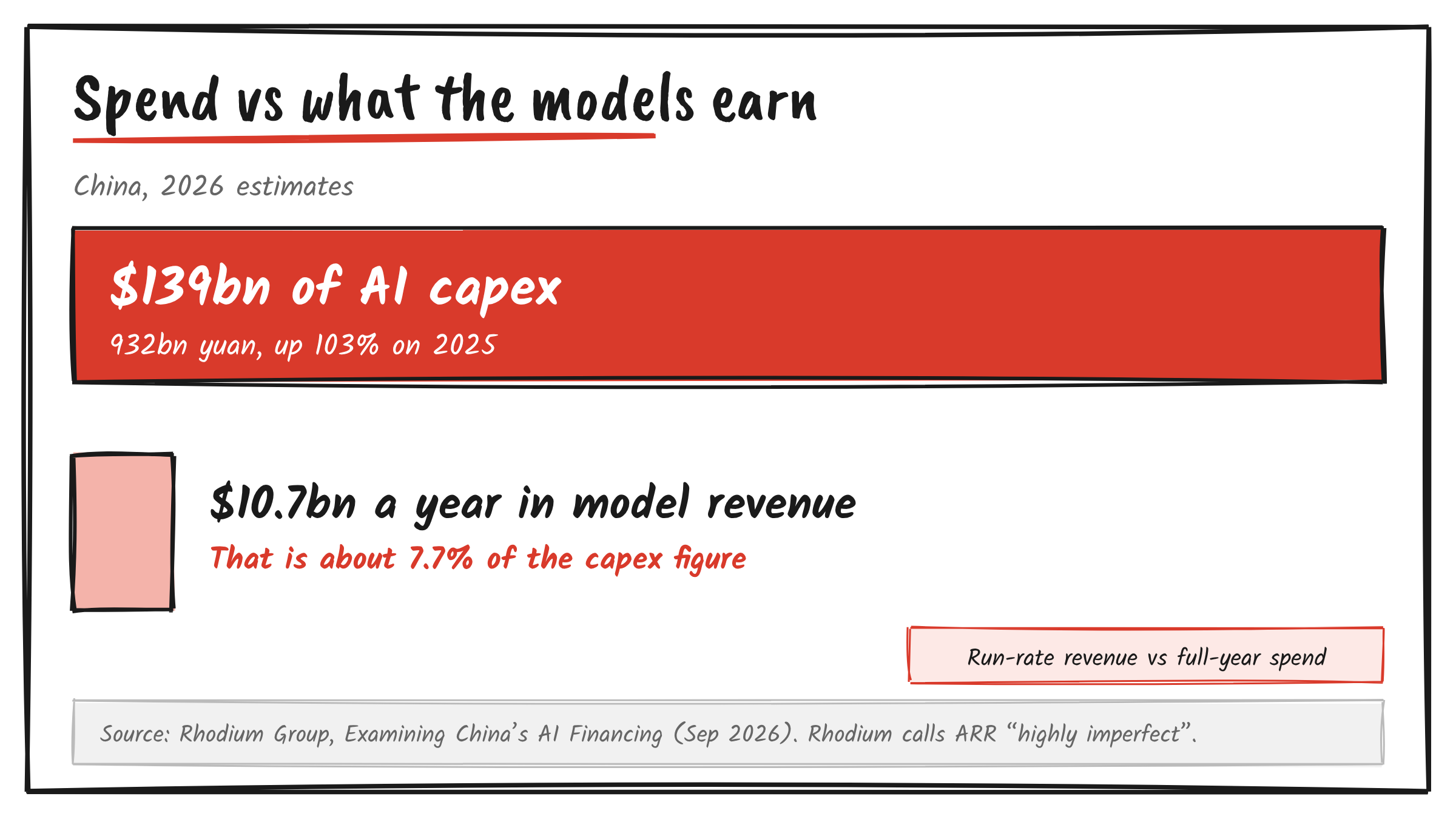
US$139bn
AI infrastructure capex in 2026
+103%
growth on 2025
US$10.7bn
run-rate revenue of China’s AI models
7.7%
revenue as a share of the capex
Rhodium surveyed 13 listed Chinese firms: Alibaba, Tencent and Baidu; Huawei, China Mobile, China Telecom and China Unicom; the labs Zhipu AI and MiniMax; and the data centre operators GDS, VNET, RangeIDC and Aofei. From company guidance it puts AI infrastructure capex at 932 billion yuan (US$139 billion) in 2026, up 103%. It forecasts more than 1.2 trillion yuan (US$193 billion) in 2027, another 39%. ByteDance’s upgraded plan is the biggest single contributor to this year’s jump.
That’s still small next to the US. Rhodium says China’s build-out is 15 to 20% of American investment, which it estimates at about US$800 billion in data centres this year. Even in 2027 the whole Chinese sector would be 1.5 to 2% of the country’s total investment.
Where the under-8% comes from
Rhodium measures revenue as annual recurring revenue, the run-rate figure used for fast-growing firms. It adds up about US$10.7 billion across all of China’s AI models, from the labs and from the hyperscalers’ model businesses. Set against US$139 billion of capex, that’s 7.7%. The report doesn’t print an 8% figure; the Times reports it as under 8% from those two numbers. Rhodium itself calls ARR a highly imperfect aggregate measure. It puts the US$10.7 billion at about a tenth of what the two biggest US labs have reported recently.
Revenue is growing fast from a low base. Zhipu’s model-as-a-service ARR rose twentyfold, from US$74 million in January to US$1.6 billion in August, and MiniMax’s grew fourfold between February and August.
Open weights cap what the labs can charge. When a third-party cloud hosts a Chinese lab’s open model and sells API access, it doesn’t pay the lab. Moonshot and Alibaba are pushing for revenue-sharing deals, and Rhodium says Moonshot is already talking to Microsoft, Amazon and Google, with a share that could be as high as 30%. Overseas customers already carry a lot of the revenue: more than 50% of Moonshot’s since the end of 2025, and 61% of MiniMax’s in the first half of 2026, according to reports Rhodium cites.
Margins are thinner than the prices suggest. DeepSeek’s API gross margin reached a reported 83% by July, close to the 80%-plus Anthropic runs at, despite lower prices. Company-wide, DeepSeek’s reported gross margin was 45% against the mid-60s for Anthropic. Zhipu’s was 26% and MiniMax’s 18% in the first half of 2026. By Artificial Analysis’s estimates, Chinese frontier models cost US$0.04 to US$0.50 per task, while Claude’s top models cost US$2 to US$4.
Spending is outrunning cash
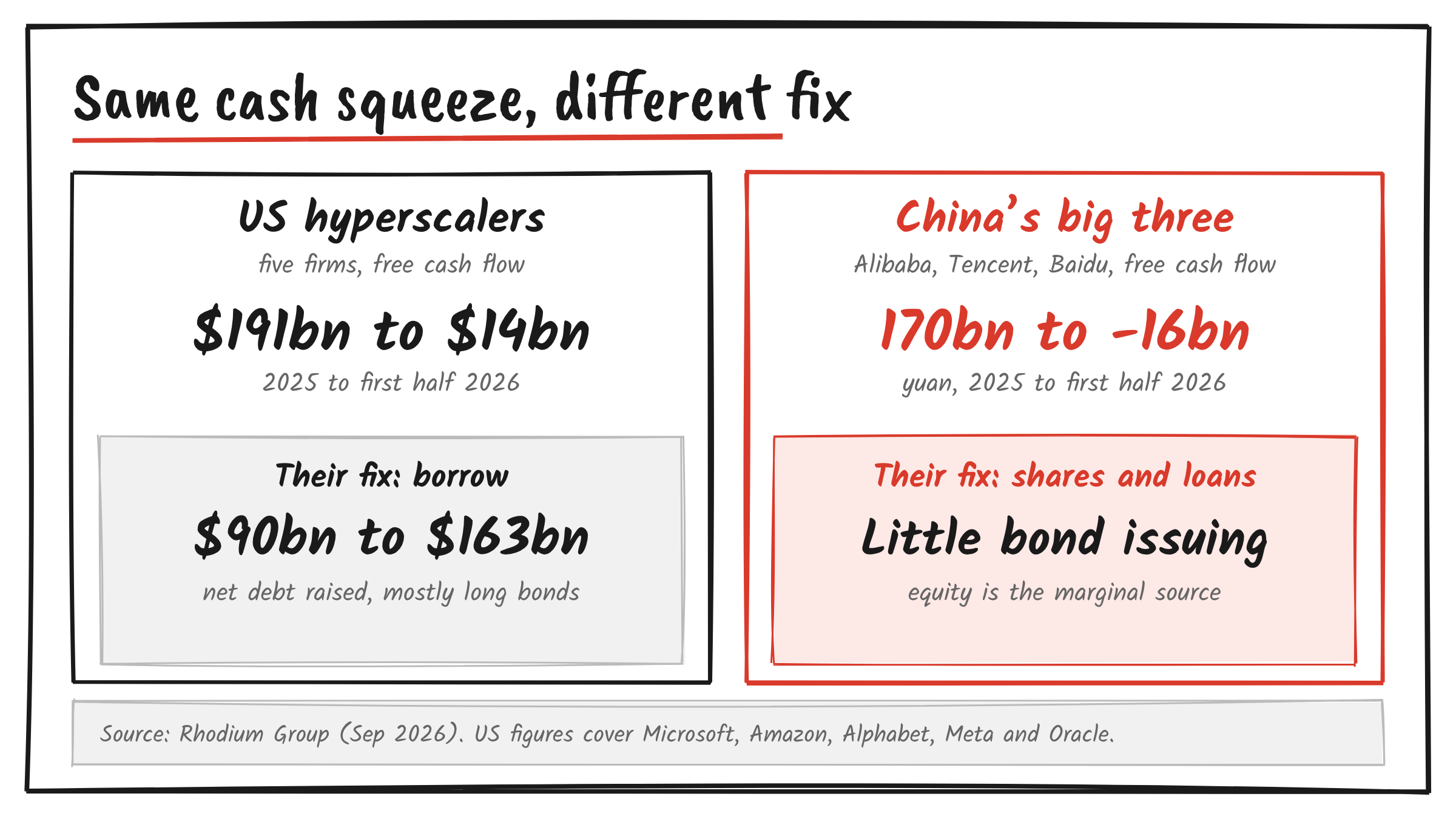
Alibaba, Tencent and Baidu spent 208 billion yuan on capex in the first half of 2026. Their combined free cash flow went from 170 billion yuan in 2025 to negative 16 billion yuan in those six months. Tencent’s second-quarter operating cash flow included about 51 billion yuan of AI-related prepayments, close to its 59 billion yuan of capex that quarter. The e-commerce and advertising businesses that normally fund the bet depend on Chinese households, and Rhodium says their spending is slowing.
When you look at their numbers, it looks like they’re running on a treadmill that’s speeding up and getting harder to run.
Kyle Chan, Brookings Institution, to The New York Times
The US faces the same squeeze and answered it with debt. Free cash flow at Microsoft, Amazon, Alphabet, Meta and Oracle fell from US$191 billion in 2025 to US$14 billion in the first half of 2026, while net debt raised climbed from US$90 billion to US$163 billion, mostly through long-term bonds. China’s firms haven’t gone that way. Rhodium ranks their financing channels as operating cash flow first, then equity, then loans and bonds, then asset-backed securities, REITs and financial leases. At the margin, new equity and new loans matter most.
| Group | Firms | Main financing in Rhodium’s survey |
|---|---|---|
| Hyperscalers | Alibaba, Tencent, Baidu | More loans and bonds, asset sales, buybacks cut, equity growing |
| Huawei and telecoms | Huawei, China Mobile, China Telecom, China Unicom | Almost entirely operating cash flow, minimal debt |
| Frontier AI labs | Zhipu AI, MiniMax | Equity, with negative operating cash flow |
| Data centre operators | GDS, VNET, RangeIDC, Aofei | Cash flow, loans and bonds, equity, and ABS, REITs and leases |
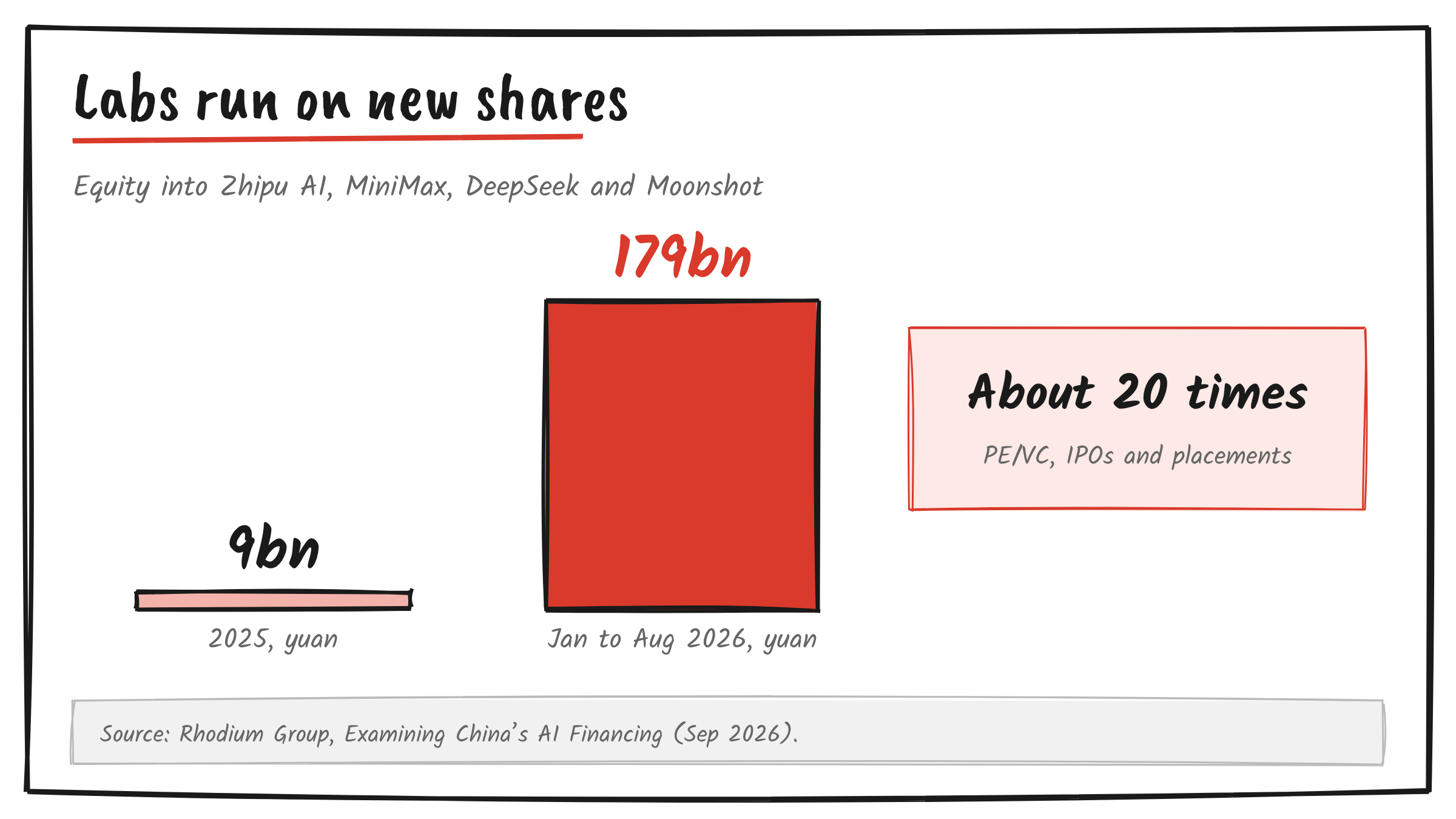
Equity is carrying the labs. PE/VC money into Zhipu AI, MiniMax, DeepSeek and Moonshot came to 9 billion yuan in 2025. From January to August 2026, PE/VC, IPO proceeds and private placements reached 179 billion yuan. Zhipu raised about 4 billion yuan in a Hong Kong IPO in January and 27 billion yuan in a private H-share placement in July. Alibaba announced an HK$80 billion share placement in August, its first since its 2019 Hong Kong listing, with all the proceeds earmarked for AI.
Loans have been cheap. Tencent’s long-term yuan loans carried a midpoint rate of 2.8% in 2025, against 5.1% for long-term US dollar loans, and it added 42 billion yuan of short-term yuan loans in the first half. ByteDance has reportedly funded its spending offshore, with a US$29.6 billion syndicated loan from about 30 banks in September.
Chips still bind, but money bites harder
Rhodium says domestic chip supply from SMIC has risen and access to Nvidia’s H200 has been easing, though US-China tensions could cut that off. The Times reports that Washington moved this week to close one workaround, renting overseas data centres full of Nvidia hardware. Wright told the Times that financing constraints “will be probably more decisive” over the long run.
We simply can’t afford to train the largest models available right now.
Liang Wenfeng, DeepSeek chief executive, in a leaked transcript of an investor call cited by The New York Times
DeepSeek didn’t respond to the Times’ request for comment.
Investors are cooling. The Times reports China’s STAR 50 index has fallen 43% since late July. Rhodium says continued expansion depends on equity market conditions, and the IPOs of Moonshot and DeepSeek are still ahead at uncertain valuations. State money isn’t filling the gap for the labs. Government guidance funds and funding platforms put in 25% of announced AI equity investment this year, down from 30% in 2024 and 2025, and Rhodium expects state-led investment to stay focused on chips rather than frontier labs.
Fundamentally, the frontier labs in China remain highly unprofitable, and they need new pricing models or ongoing infusions of cash to continue operating.
Rhodium Group, Examining China’s AI Financing
Discover more from Sulat AI & Tech News
Subscribe to get the latest posts sent to your email.