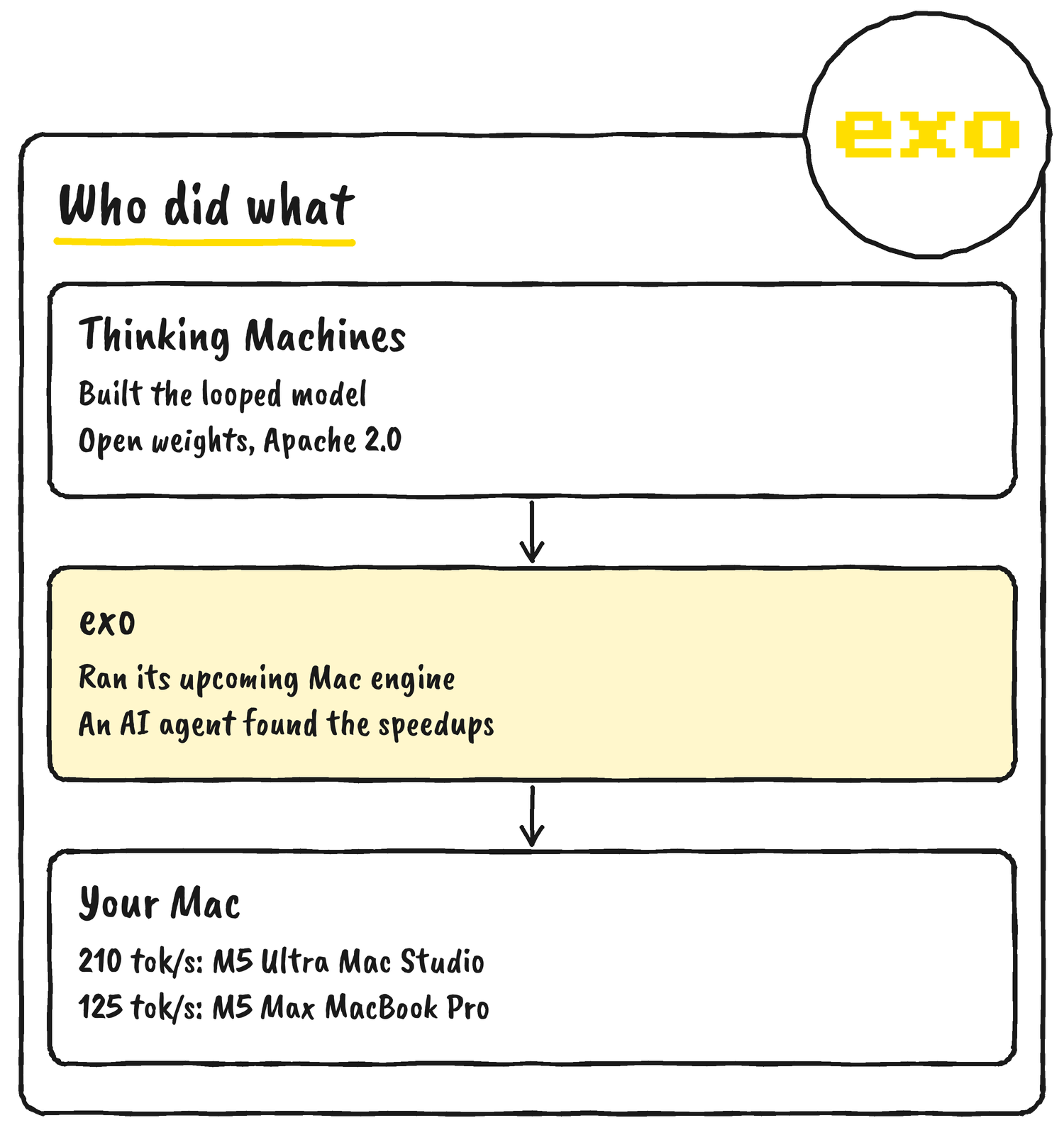
exo says Thinking Machines’ new Inkling 2 Mini runs at 210 tokens a second on a Mac Studio with an M5 Ultra chip and 96GB of memory, and at 125 tokens a second on an M5 Max MacBook Pro with 48GB. The local-AI company posted the figures on X on 21 November, New Zealand time, about five hours after Thinking Machines announced the open-weights model.
exo says it had the model for two days before release and reached the speed with an AI agent running an inference engine it hasn’t shipped yet. The Mac figures are exo’s own. Thinking Machines’ model card lists exo, alongside Ollama, as a way to run the model on Apple silicon.
- What exo posted
- From 30 to 210 in a day
- Why a looped model suits a laptop
- The Claude Sonnet 5.5 comparison
- What tokens a second doesn’t tell you
- Running it now
What exo posted
exo’s post lists two machines. On the 96GB Mac Studio it reports 210 tokens a second for decode and 3,620 for prefill. On the 48GB MacBook Pro it reports 125 and 1,750. Decode is how fast the model writes its answer; prefill is how fast it reads the prompt before it starts.
210
tokens a second written (decode) on the M5 Ultra Mac Studio
3,620
tokens a second read (prefill) on the same machine
125
tokens a second written on the M5 Max MacBook Pro
1,750
tokens a second read on the MacBook Pro
| Machine | Memory | Decode | Prefill | Reads a 10,000-token prompt in | Writes 1,000 tokens in |
|---|---|---|---|---|---|
| M5 Ultra Mac Studio | 96GB | 210 tok/s | 3,620 tok/s | 2.8 seconds | 4.8 seconds |
| M5 Max MacBook Pro | 48GB | 125 tok/s | 1,750 tok/s | 5.7 seconds | 8 seconds |
At those rates the Mac Studio gets through a 10,000-token prompt in under three seconds and a 1,000-token answer in about five. The MacBook Pro needs roughly six seconds and eight.
- Decode
- The model writing its answer, one token at a time. Memory speed sets most of the limit.
- Prefill
- The model reading your prompt before it writes anything. Raw compute sets most of the limit.
- Draft model
- A small, fast model that proposes the next few tokens so the main model can check them in one pass instead of writing each one itself.
- Looped model
- A model that runs some of its layers more than once for every token, so it does more work without storing more layers.
From 30 to 210 in a day
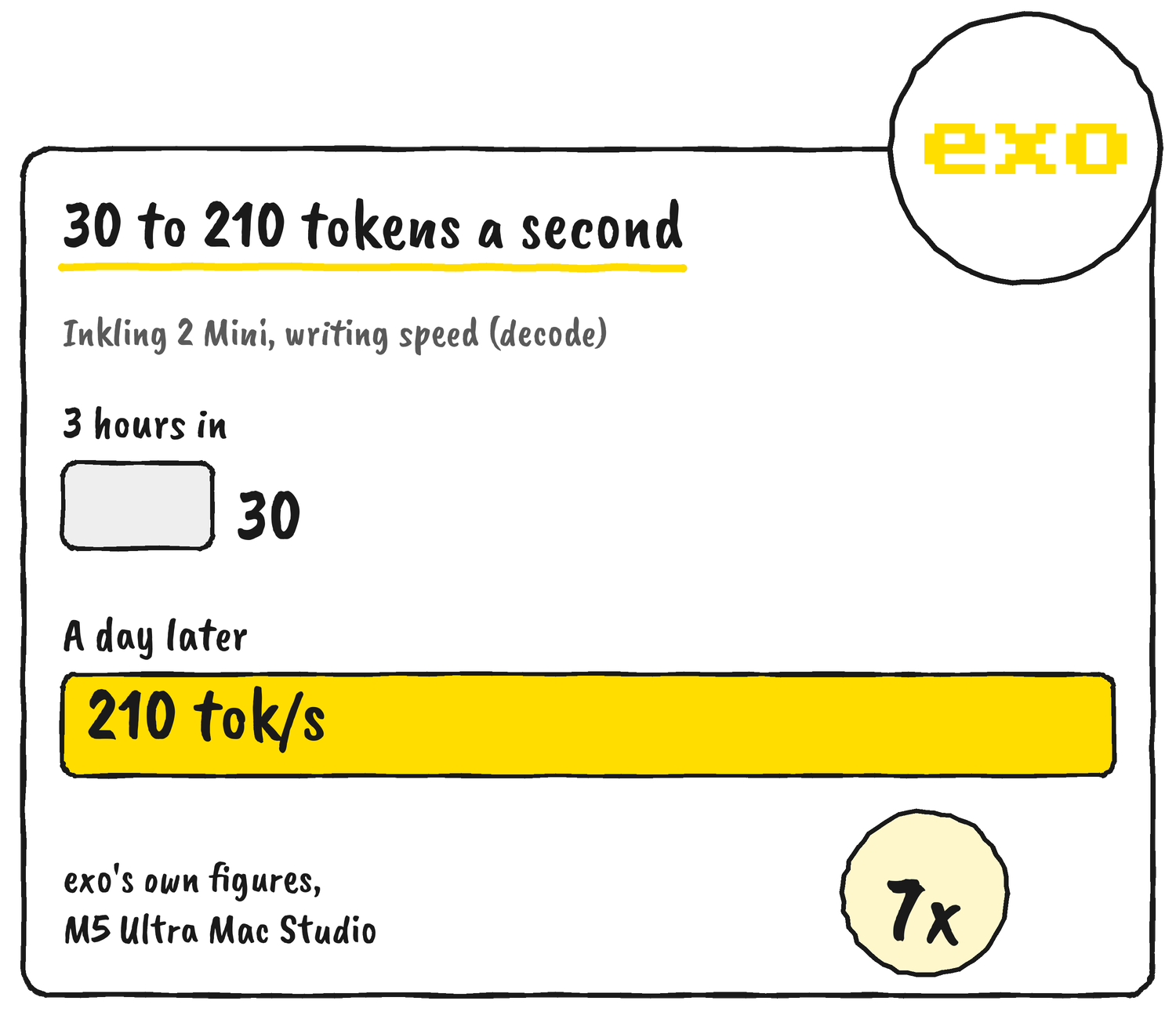
According to exo, access came on Wednesday 18 November. Three hours later the model ran at 30 tokens a second; a day after that it hit 210, a 7x gain by exo’s count. The post attaches a Slack screenshot in which an account named simon, badged as Thinking Machines, writes: “wow what really? already! that is so fast”.
The 210 came out of what exo calls its upcoming Apple silicon inference engine and agent pipeline, a setup it says keeps optimising inference across its fleet of Macs. The agent got no guidance about the looping design, exo says. It still wrote a working implementation, found optimisations specific to the architecture, improved kernels and fusions, and made better use of DSpark with adaptive drafting.
We gave it no guidance about the looping architecture.
exo on X, 21 November (NZ time)
DSpark is the draft model Thinking Machines ships with Inkling 2 Mini, according to Hugging Face. In Hugging Face’s SGLang setup a three-layer DSpark draft proposes tokens and the target model verifies them, at a small memory cost. exo’s post doesn’t split the 7x between drafting, kernels and fusions.
Why a looped model suits a laptop
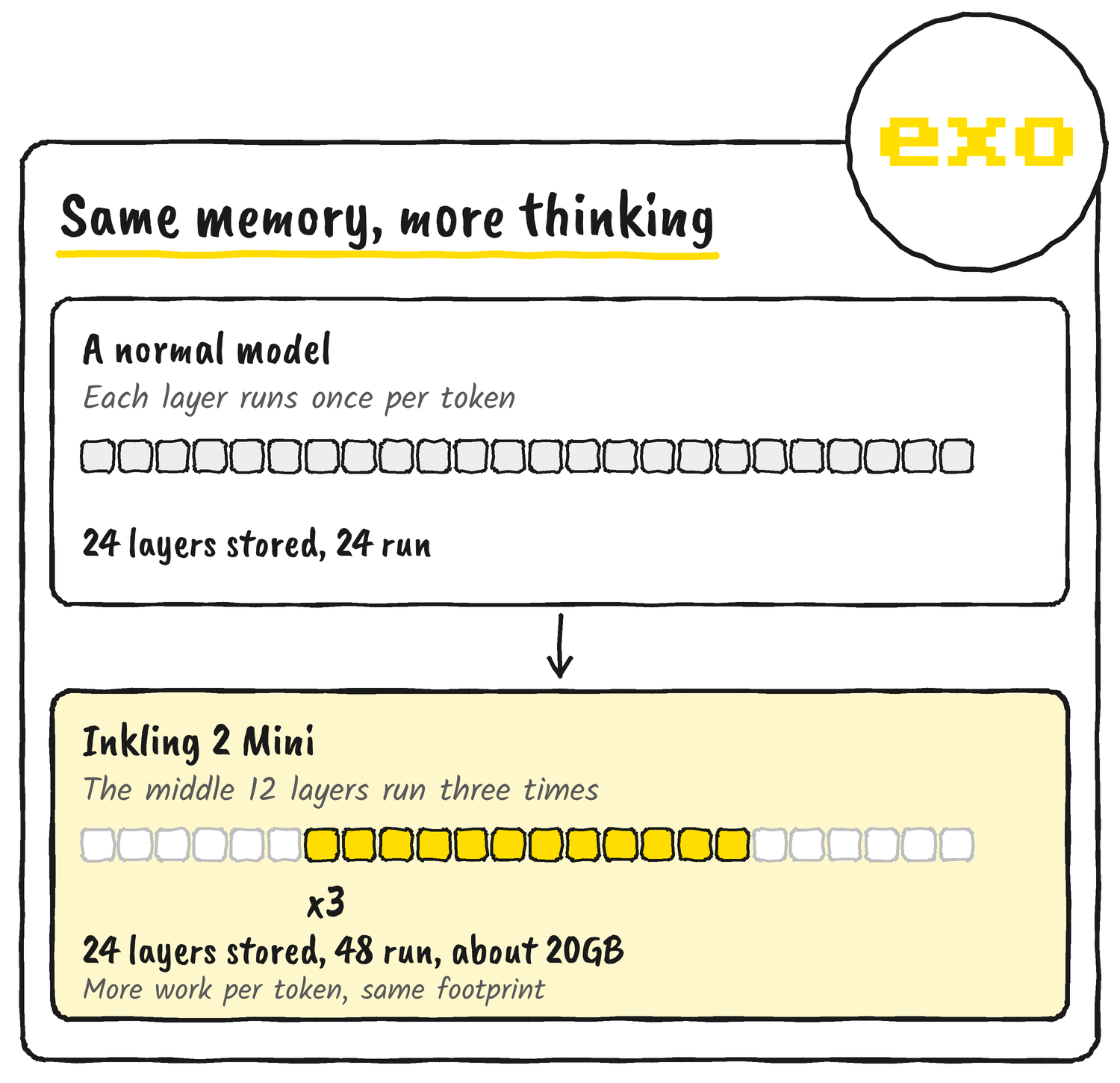
Inkling 2 Mini stores 24 layers and runs the middle 12 of them three times for every token, so each token passes through 48 layer applications, Thinking Machines says. The checkpoint is about 20GB. exo’s argument is that this design fits memory-limited machines.
The looping architecture is ideal for local devices like MacBooks, which are memory constrained. Looping layers of the model increases inference-time compute (and intelligence) without increasing the size of the model.
exo on X, 21 November (NZ time)
Thinking Machines supports Macs with 32GB or more of memory at launch. On the 48GB MacBook Pro in exo’s test, 20GB of weights leaves about 28GB for the context window and everything else the laptop is running.

Alex Cheema, exo’s co-founder and chief executive, posted his own run on the MacBook Pro: 125 tokens a second. He calls the model “competitive with Qwen 27B” and “Probably the best model at this size.” Hugging Face, which wrote one of the launch guides, says its own tests found Inkling 2 Mini at least comparable with Qwen 3.8 27B and that more validation is needed.
The Claude Sonnet 5.5 comparison
exo says Inkling 2 Mini built a native weather app 1.8 times faster than Claude Sonnet 5.5 on an M5 Ultra Mac Studio, and 11 times cheaper at API pricing. The video in the post shows both runs side by side with time and cost counters and a 20x playback label. The post’s text names one task. It doesn’t give the prompt, the number of runs or the prices used for either model.
What tokens a second doesn’t tell you
Speed per token is only half of task time. Artificial Analysis says Inkling 2 Mini averages about 152,000 output tokens per Intelligence Index task, about 38% more than Qwen3.8 27B, as covered in the earlier article. At exo’s rates that’s about 12 minutes of writing on the Mac Studio and 20 on the MacBook Pro, before any prompt reading or tool calls. The figure mixes two sources by arithmetic. Nobody measured it in a single run.
Running it now
At launch Thinking Machines supports Inkling 2 Mini on any Mac with 32GB or more through Ollama, whose library page lists a 20GB download and a 1 million-token context window. Hugging Face says support is upstream in mlx-lm, and llama.cpp builds exist. The speeds in exo’s post come from its engine, which exo calls upcoming.
Commands from Ollama’s and Hugging Face’s pages
Ollama says the model needs a Mac with 32GB or more of memory and, for now, its preview build:
ollama run inkling-2-miniHugging Face gives this llama.cpp command for the 4-bit build:
llama serve -hf ggml-org/Inkling-2-Mini-GGUF:IQ4_NLexo’s own software is open source under Apache 2.0 and uses Apple’s MLX. Its hardware page, last updated 26 October, lists the M3 Ultra Mac Studio, M4 Pro Mac mini, M4 Max and M5 MacBook Pro as tested platforms, and doesn’t list an M5 Ultra Mac Studio. exo’s post gives no release date for the engine behind the 210 tokens a second.
Sources
- exo on X: Mac results and weather-app comparison, 21 November
- exo on X: 30 to 210 tokens a second, 21 November
- Alex Cheema on X, 21 November
- Thinking Machines: Introducing Inkling 2 Mini, 20 November
- Inkling 2 Mini model card
- Hugging Face: Welcome Inkling 2 Mini, 20 November
- Ollama: inkling-2-mini
- exo: What hardware does exo support?, 26 October
Discover more from Sulat AI & Tech News
Subscribe to get the latest posts sent to your email.