
OpenRouter has emailed customers to say a third party may have read the prompts and outputs of requests they sent to MiniMax models. A security researcher hid unique test links in prompts to those models between July and October 2026, and someone opened the links 40 to 130 hours after each request went out. Michael Chomsky posted his copy of the email on X on 21 November.
The email names three forwarding providers, AtlasCloud, Novita and StreamLake, and says each told OpenRouter it passed MiniMax requests on to MiniMax. OpenRouter’s position is that the problem sits with MiniMax and those providers, not with OpenRouter. It has pulled its Zero Data Retention (ZDR) label from the MiniMax-model endpoints while it investigates.
40 to 130 hours
between a request and a third party opening its test link
4
providers on Chomsky’s route: MiniMax, Novita, StreamLake and AtlasCloud
321
requests from his account to MiniMax models, 6 June to 22 October
0
of the researcher’s AWS test keys used
What the email says
The email is headed “Requests you sent to MiniMax models may have been read”. It says the researcher placed unique test URLs in prompts sent to MiniMax models from July to October 2026, and that a third party opened them 40 to 130 hours after the requests were sent, “whether MiniMax served a request directly or another provider forwarded it to MiniMax”. With one exception, the same tests on other models at those providers weren’t opened, and none of the AWS test keys were used.
Chomsky’s copy says his account sent 321 requests to MiniMax models through MiniMax, Novita, StreamLake and AtlasCloud, from 6 June at 09:16 UTC to 22 October at 06:48 UTC.
This means a third party may have read the prompts and outputs of these requests. While we investigate, we have removed the Zero Data Retention label from these MiniMax-model endpoints.
OpenRouter email to customers, as posted by Michael Chomsky
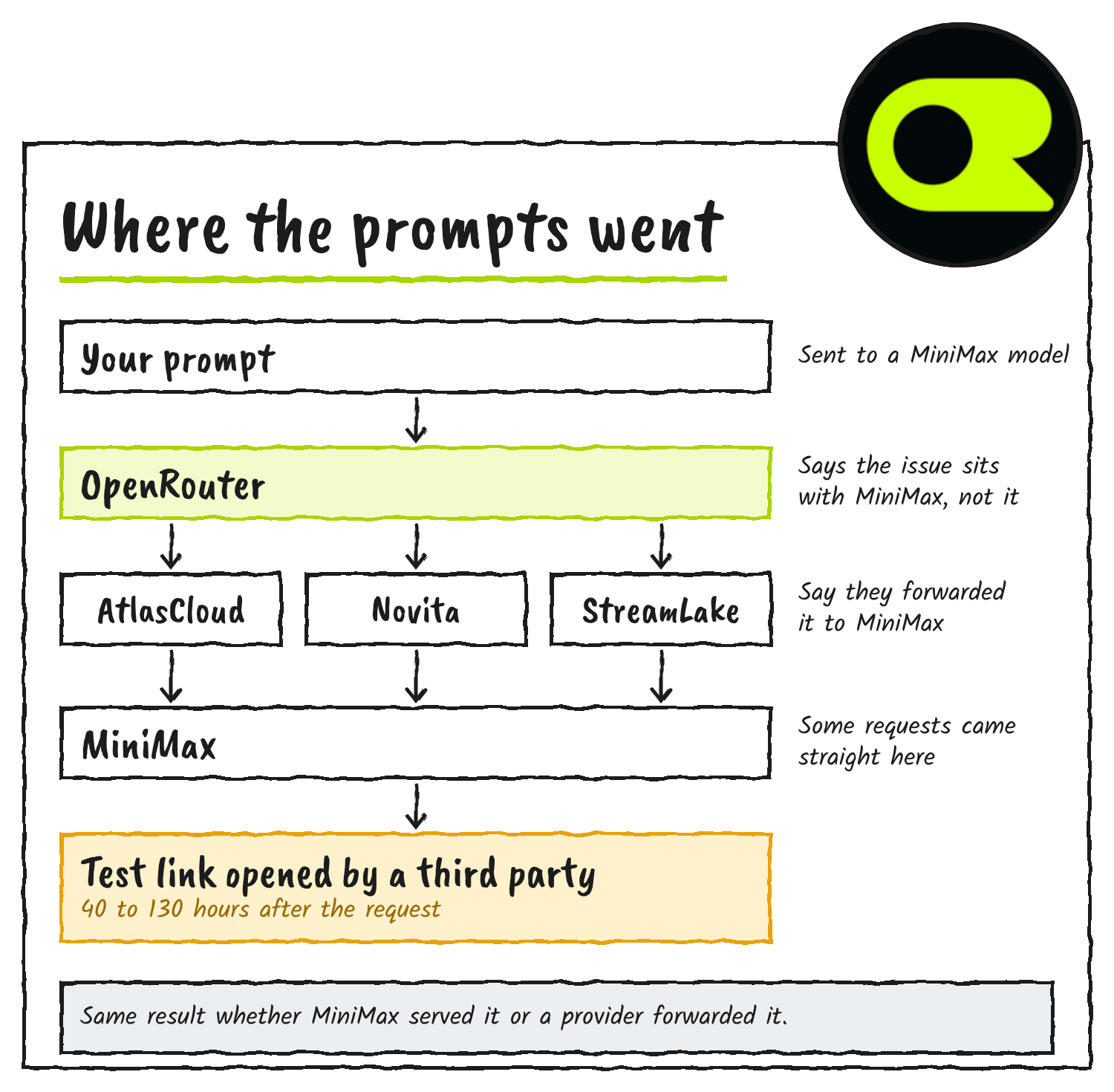
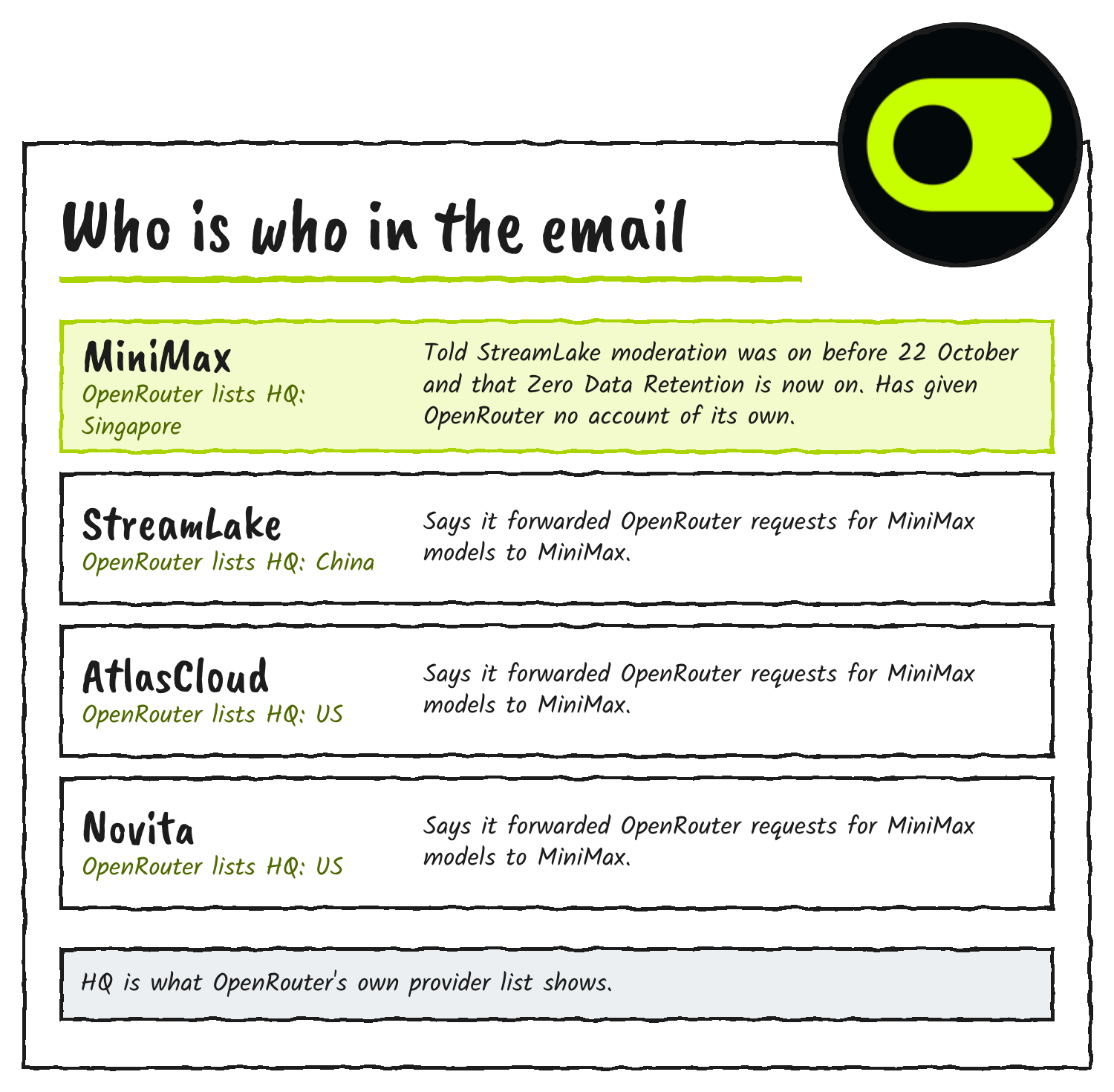
The email passes on what the providers told OpenRouter. AtlasCloud, Novita and StreamLake say they forwarded OpenRouter’s requests for MiniMax models to MiniMax. MiniMax told StreamLake that content moderation was enabled on its endpoints before 22 October and that it has since enabled Zero Data Retention. OpenRouter says it asked MiniMax for its own account and hasn’t received one.
The delay is the evidence
The email doesn’t say how the third party got the prompts. The timing does. A filter that reads a prompt as it arrives would reach a link within seconds, and these links were opened 40 to 130 hours later, between about 1.7 and 5.4 days. That fits a stored copy being opened after the fact.
Why the email says “Zero Data Retention” and not “Safety Retention”
OpenRouter’s docs describe two tiers that don’t train on your data. Zero Data Retention means no routine storage of prompts or responses after processing. Safety Retention lets a provider keep prompts and responses from any request, flagged or not, only to detect, investigate and prevent abuse. The label OpenRouter removed from the MiniMax-model endpoints is the first of those.
Where it sits next to Dragos’s study
Dragos published a five-month canary study on 19 November. HD Moore, its chief research officer, wrote that a Chinese AI lab’s systems fetched the secret URLs from more than half of the prompts Dragos sent to its models between July and October. That included roughly two-thirds of the requests marked as no data collection or ZDR, and the scraper typically showed up two or three days after the request. US hosting providers that resell the lab’s models triggered the same scraper.
Zero Data Retention is supposed to mean something. In practice, these prompts were retained, shared with other companies, and read by people.
HD Moore, Dragos, 19 November
The email doesn’t name the researcher, and Dragos doesn’t name the lab. The July to October window and the delay of days are the same in both, and neither document points to the other. I covered the Dragos study on 20 November.
Phala’s report is a separate case. On 10 November Phala said an attacker had taken over one of its inference servers, and it told anyone whose DeepSeek V4 Flash 0731 requests OpenRouter routed to it between 21 October and 8 November to treat them as exposed.
What ZDR means on OpenRouter
OpenRouter’s docs define Zero Data Retention as “no routine storage of prompts or responses after processing”, with an exception for child-safety screening. OpenRouter says it tracks the data policy of each endpoint and “works with providers to keep these policies up to date”. It’s a label OpenRouter sets from what providers tell it.
| Tier | What OpenRouter says it means | Trained on? |
|---|---|---|
| ZDR | No routine storage after processing | No |
| Safety Retention | Provider may retain any request, only to detect, investigate and prevent abuse | No |
| Retention and Training | Data may be stored and used for training under the provider’s policy | May be |
OpenRouter’s public ZDR endpoint list, which I fetched on 21 November, holds 931 endpoints. Of those, 22 serve MiniMax models, from 16 providers. None of the 16 is MiniMax, StreamLake, AtlasCloud or Novita, and none of the four has an endpoint anywhere on the list. StreamLake still serves MiniMax M3.1 Flash through OpenRouter’s API.
- Zero Data Retention (ZDR)
- A setting that restricts routing to endpoints that don’t store prompts or responses after processing.
- Canary link
- A unique URL that exists nowhere else, so any visit shows someone saw the prompt it was in.
- Forwarding provider
- A host that takes a request from a router and passes it to another company’s model.
What MiniMax’s own terms say
MiniMax’s open platform terms, effective 30 March 2026 and issued by Nanonoble Pte Ltd, say the customer keeps ownership of input and generated content as between the two. They then add:
We may use the input and generated content to provide, maintain, develop, and improve our Services, comply with applicable law, enforce our terms and policies, and keep our Services safe.
MiniMax Terms of Service, effective 30 March 2026
The platform’s privacy policy lists “Messages and content” among the data it uses for monitoring and protecting the services. On retention it says: “We may retain and use your personal data for as long as it is necessary or permitted by law or to fulfil the purpose for which it was collected.” It sets no number of days. OpenRouter’s provider list shows MiniMax as headquartered in Singapore with a US data centre, and StreamLake as headquartered in China.
What to do
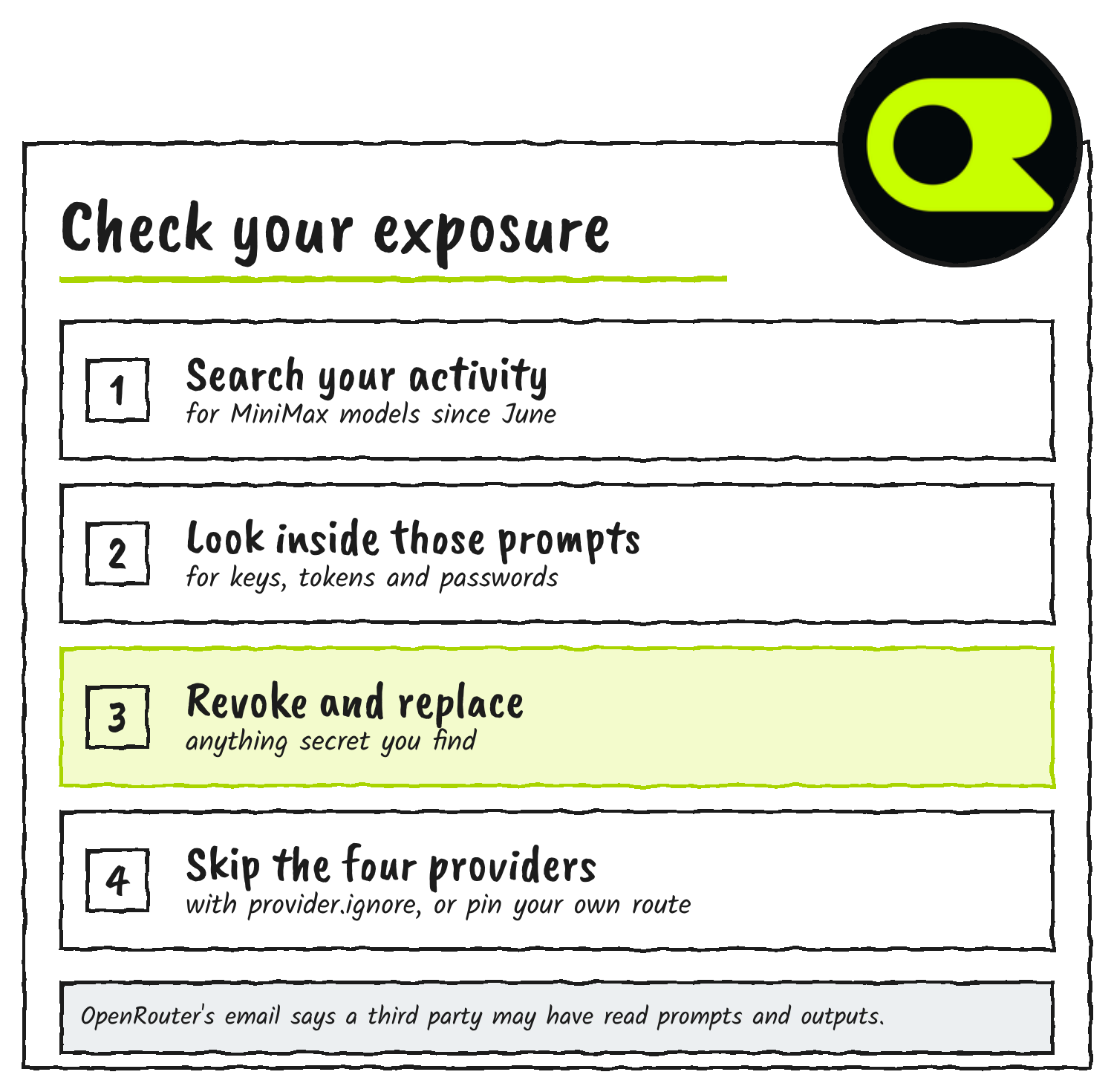
- Search your OpenRouter activity for any MiniMax model since June, including calls that went through MiniMax, Novita, StreamLake or AtlasCloud.
- Look inside those prompts and outputs for API keys, tokens, database URLs and passwords.
- Revoke and replace anything secret you find. Issuing a new key next to the old one leaves the old one live.
- Change the route. OpenRouter’s routing options include
zdrandignore, and the slugs for the four providers come from its providers API. - Plant your own canary. Put a fake credential in the context your agents already send and treat any use of it as an incident. Dragos points to Thinkst’s free Canarytokens.
{
  "model": "minimax/minimax-m3",
  "messages": [{ "role": "user", "content": "..." }],
  "provider": {
    "zdr": true,
    "ignore": ["minimax", "novita", "streamlake", "atlas-cloud"]
  }
}
OpenRouter’s docs warn that ignoring several providers can cut fallback options. The ignore list above leaves the other providers that serve MiniMax M3, such as DeepInfra and Parasail.
What hasn’t been published
OpenRouter hasn’t posted the notice on its blog. The latest post in its feed is dated 16 November, and the email is the disclosure. The email doesn’t name the researcher, say who opened the links or from where, or give the number of customers it went to. MiniMax hasn’t given OpenRouter an account of its own, according to the email, and I found no public statement from the three forwarding providers.
Discover more from Sulat AI & Tech News
Subscribe to get the latest posts sent to your email.