
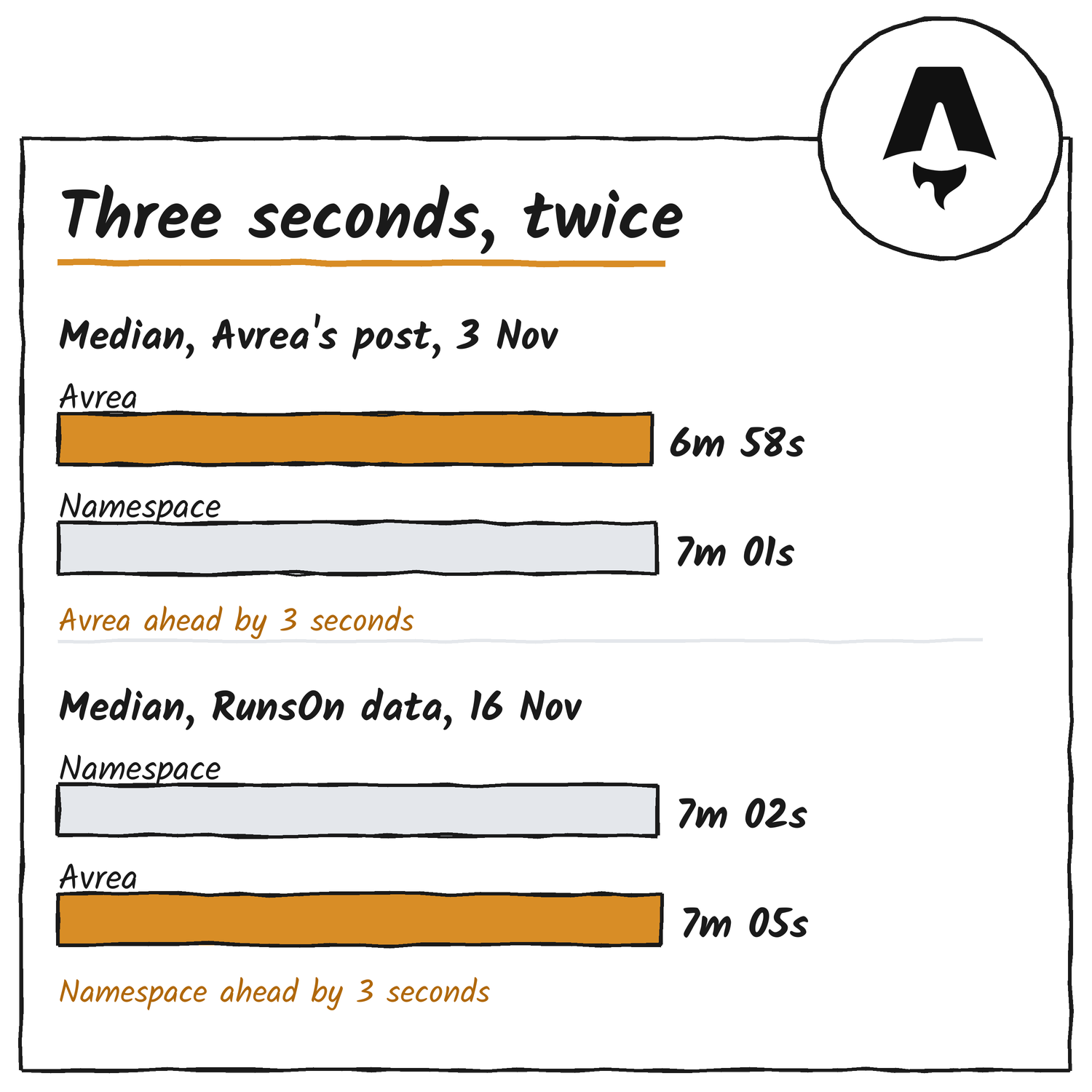
Avrea, a Helsinki startup that runs GitHub Actions jobs on dedicated hardware, says it’s the fastest GitHub Actions runner in RunsOn’s benchmark. On the day Avrea’s write-up went up, its median time for RunsOn’s three test builds was three seconds ahead of Namespace’s. After RunsOn’s 16 November run, the median put Namespace three seconds ahead of Avrea, while RunsOn’s slowest-tenth view has Avrea more than a minute ahead of Namespace.
Avrea’s chief executive, Hannu Valtonen, posted the claim on X at 11:12am UTC on 3 November, just after midnight on 4 November in New Zealand. Valtonen wrote that Avrea is 163% faster than GitHub and 16% faster than Blacksmith, and the post shows 12.9 million views.
What RunsOn measured
RunsOn sells its own GitHub Actions runners and publishes a public benchmark of nine providers’ runners. Avrea’s July post calls these results “externally measured, vendor-published benchmarks”. The test builds three public projects with build caching switched off:
- PostHog’s production Docker image.
- The TypeScript typechecks for the opencode monorepo, installed with Bun.
- spotify-player, a Rust terminal client for Spotify: formatting, tests and Clippy.
RunsOn ranks each runner on the sum of its median build times. The comparison Valtonen cites covers x64 runners with four vCPUs and 16 GB of memory. Avrea’s is an AMD EPYC 4585PX machine on dedicated hardware in France, according to RunsOn’s table. RunsOn publishes its methodology and its benchmark code and job logs.
The numbers in the post
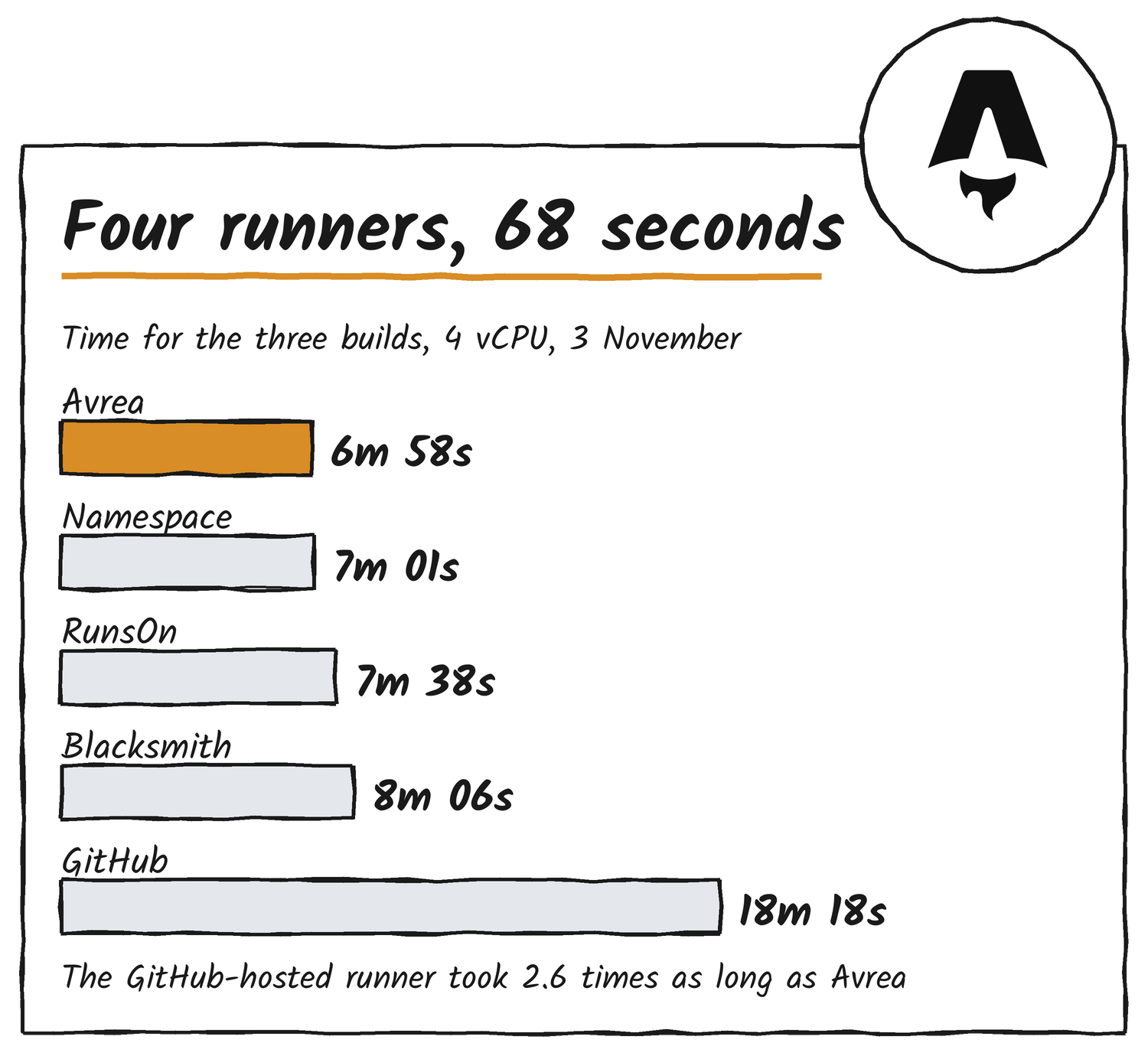
Valtonen’s percentages come from the table in Avrea’s write-up, which reproduces RunsOn’s results. Avrea finished the three builds in 6m 58s. GitHub’s 4-core runner took 18m 18s.
| Runner | All three builds | Rust | TypeScript | Docker | Cost |
|---|---|---|---|---|---|
| Avrea 4 vCPU | 6m 58s | 1m 26s | 40s | 4m 52s | US$0.0625 |
| Namespace 4×16 | 7m 01s | 1m 31s | 50s | 4m 40s | US$0.0904 |
| RunsOn r8a.xlarge (32 GB, tmpfs) | 7m 38s | 1m 51s | 50s | 4m 57s | US$0.0182 |
| StarSling 4 vCPU | 7m 50s | 1m 32s | 47s | 5m 31s | US$0.0683 |
| Blacksmith 4 vCPU | 8m 06s | 1m 40s | 1m 25s | 5m 01s | US$0.0747 |
| Warpbuild 4 vCPU | 10m 43s | 2m 09s | 1m 07s | 7m 27s | US$0.0908 |
| Ubicloud standard | 14m 31s | 2m 19s | 1m 35s | 10m 37s | US$0.0398 |
| GitHub 4-core | 18m 18s | 3m 33s | 1m 52s | 12m 53s | US$0.2612 |
163%
Avrea’s speed advantage over GitHub in the post: 6m 58s against 18m 18s
16%
Its advantage over Blacksmith: 6m 58s against 8m 06s
3 seconds
Its lead over Namespace, the next runner in the table
76%
Avrea’s saving on cost against GitHub for the three builds, by RunsOn’s estimate
How 163% is worked out
GitHub’s 18m 18s is 1,098 seconds and Avrea’s 6m 58s is 418 seconds. Dividing 1,098 by 418 gives 2.63, so Avrea ran at 2.6 times GitHub’s speed. Avrea calls that 163% faster. The same builds took 62% less time. Blacksmith’s 8m 06s is 486 seconds, and 486 divided by 418 gives the 16%.
The post doesn’t name Namespace, which finished the three builds in 7m 01s.
Where the three-second lead went
RunsOn checks for new runs once a day. After its run on 16 November, the 4 vCPU x64 table shows Namespace’s 4×16 runner at 7m 02s and Avrea’s at 7m 05s. These are medians, and they move as runs are added: Blacksmith’s total went from 8m 06s to 8m 27s between the two snapshots.
| Runner | All three builds | Rust | TypeScript | Docker | Cost |
|---|---|---|---|---|---|
| Namespace 4×16 | 7m 02s | 1m 33s | 45s | 4m 44s | US$0.0900 |
| Avrea 4 vCPU | 7m 05s | 1m 28s | 39s | 4m 59s | US$0.0630 |
| RunsOn r8a.xlarge (32 GB, tmpfs) | 7m 36s | 1m 52s | 49s | 4m 55s | US$0.0145 |
| Blacksmith 4 vCPU | 8m 27s | 1m 47s | 1m 19s | 5m 22s | US$0.0741 |
| Warpbuild 4 vCPU | 10m 40s | 2m 18s | 1m 13s | 7m 09s | US$0.0900 |
| Ubicloud standard | 15m 35s | 2m 30s | 1m 37s | 11m 28s | US$0.0422 |
RunsOn’s methodology page sets out how it treats gaps this size:
A type within 5% of the type heading its group shares that place
RunsOn, benchmark methodology
Three seconds is 0.7% of Avrea’s 418 seconds. At eight vCPUs the order is the same: Namespace’s 8×16 runner took 5m 15s, Avrea’s 8 vCPU runner 5m 18s and Blacksmith’s 8 vCPU runner 5m 28s.
The median isn’t the only view RunsOn publishes. Since 12 November it has ranked best value on p90 time and cost, and its all-runners chart plots each runner at its p90, the figure nine runs in ten stay under. There, Avrea’s 4 vCPU total for the three builds is 7m 17s and Namespace’s 4×16 is 8m 24s. Blacksmith’s 4 vCPU runner is at 12m 35s and GitHub’s 4-core runner at 19m 39s. Namespace’s p90 sits 82 seconds above its median and Avrea’s 12 seconds. RunsOn says it ranks on p90 so that a runner that is quick at its median but sometimes much slower is ranked by its slow runs.
RunsOn reworked one part of Avrea’s result a day before Valtonen’s post. Avrea’s runners switch on Turborepo’s remote cache, and the TypeScript typecheck had left Turborepo’s caches on, so some Avrea runs replayed stored results and finished the typecheck in about a second. On 2 November RunsOn changed the test to run the typecheck with those caches off, and it left out Avrea’s earlier runs that finished the typecheck in under five seconds. Those runs stay visible, faded, on Avrea’s profile page. Avrea’s write-up says the caches are off in the figures it published.
What it costs, and how long jobs wait
RunsOn works out the cost of the three builds from each job’s duration and the provider’s per-minute rate. On that basis Avrea cost US$0.0625, against US$0.2612 for GitHub, US$0.0747 for Blacksmith and US$0.0904 for Namespace. RunsOn’s own AWS-hosted runner cost US$0.0182, priced at AWS spot rates without its licence fee. Avrea says it charges US$0.008 a minute for the runner, against US$0.012 for GitHub’s.
RunsOn also queues 15 identical jobs at once, each holding its runner for 60 seconds, and records how long each one waits. In the table Avrea reproduced, Avrea’s median wait was 11 seconds, against 3 on GitHub and 10 on Blacksmith and Namespace. The slowest tenth of Avrea’s jobs waited 10m 10s. GitHub’s slowest tenth waited 5 seconds and Blacksmith’s 13. Namespace’s waited 7m 00s, StarSling’s 13m 50s, Warpbuild’s 13m 29s and Ubicloud’s 19m 44s. After the 16 November run, Avrea’s slowest tenth waited 8m 00s.
Queue time is a property of Avrea’s control plane, not of the instance type: every variant shares it.
RunsOn, Avrea benchmark page
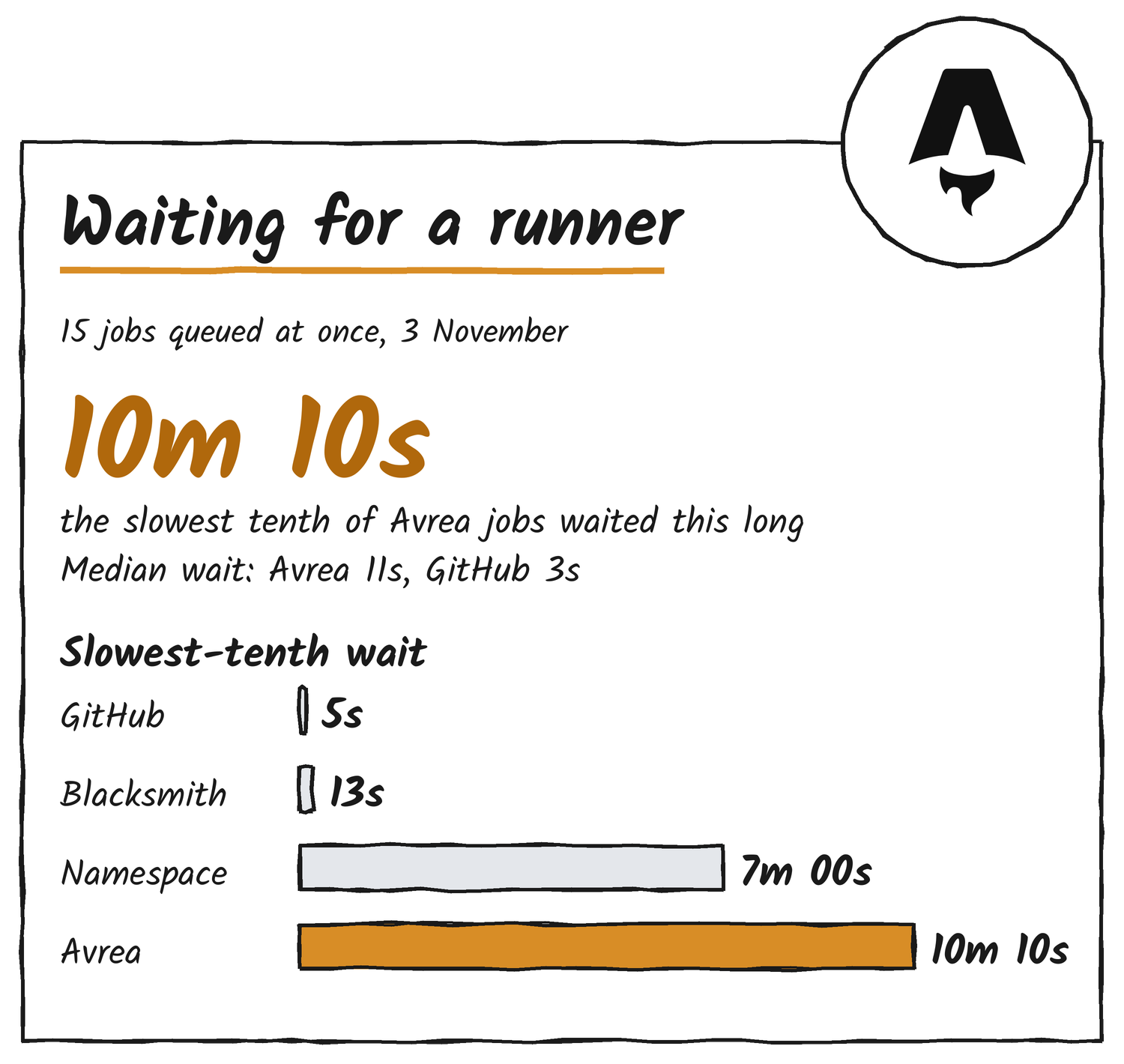
The queue figures sit in the last column of the table in Avrea’s write-up. The 163% and 16% claims rest on build times alone.
Six of the 758 benchmark jobs RunsOn ran on Avrea failed: five TypeScript jobs that ran out of memory, and one cache job. RunsOn says 16 GB of memory passes everywhere, and that Avrea’s 2 vCPU runners, which have 8 GB, ran out of memory on some runs.
Who’s behind the numbers
Avrea launched on 26 May 2026 with US$4.7 million in pre-seed funding led by Earlybird, according to its launch post and The Next Web. Valtonen co-founded the database company Aiven. The other co-founder, Juha Valvanne, co-founded the commerce platform Nosto.
Valtonen’s X post ends with a line telling readers to go try out Avrea. The post is a company’s chief executive promoting its product with results published by a company that sells competing runners. RunsOn’s code and job logs are public, so each figure above can be checked against its source.
Testing it on your own builds
RunsOn’s builds run with caching off, which leaves out the feature Avrea pitches hardest. Avrea says its runners are 2x faster than GitHub-hosted runners on hardware alone and 10x faster with cache hits. The benchmark covers the first claim. Avrea’s write-up tells readers to copy a build or test workflow, change its runner label, run both on the same commit, then run the Avrea one again to see whether caching shortens it. The label for the 4 vCPU x64 runner tested here is:
runs-on: avrea-ubuntu-latest-4-vcpuEligible organisations get a monthly credit equivalent to 3,000 minutes on 2 vCPU Linux x64 runners, Avrea says.
Terms used in the benchmark
- vCPU
- A virtual processor core. A 4 vCPU runner gets four of them.
- x64
- The common desktop and server processor architecture, as opposed to Arm.
- tmpfs
- A disk held in memory, which makes file access faster. RunsOn’s tmpfs runner has 32 GB of memory, twice that of the 16 GB runners it sits beside.
- Slowest tenth
- The p90 figure: the wait that nine jobs in ten stay under.
- Burst test
- RunsOn’s queue test, which starts 15 identical jobs at the same moment.
RunsOn says its site checks for new runs once a day and reviews each refresh before it goes live, so the standings keep moving. The figures here come from Avrea’s 3 November write-up and from RunsOn’s data after its 16 November run.
Discover more from Sulat AI & Tech News
Subscribe to get the latest posts sent to your email.