
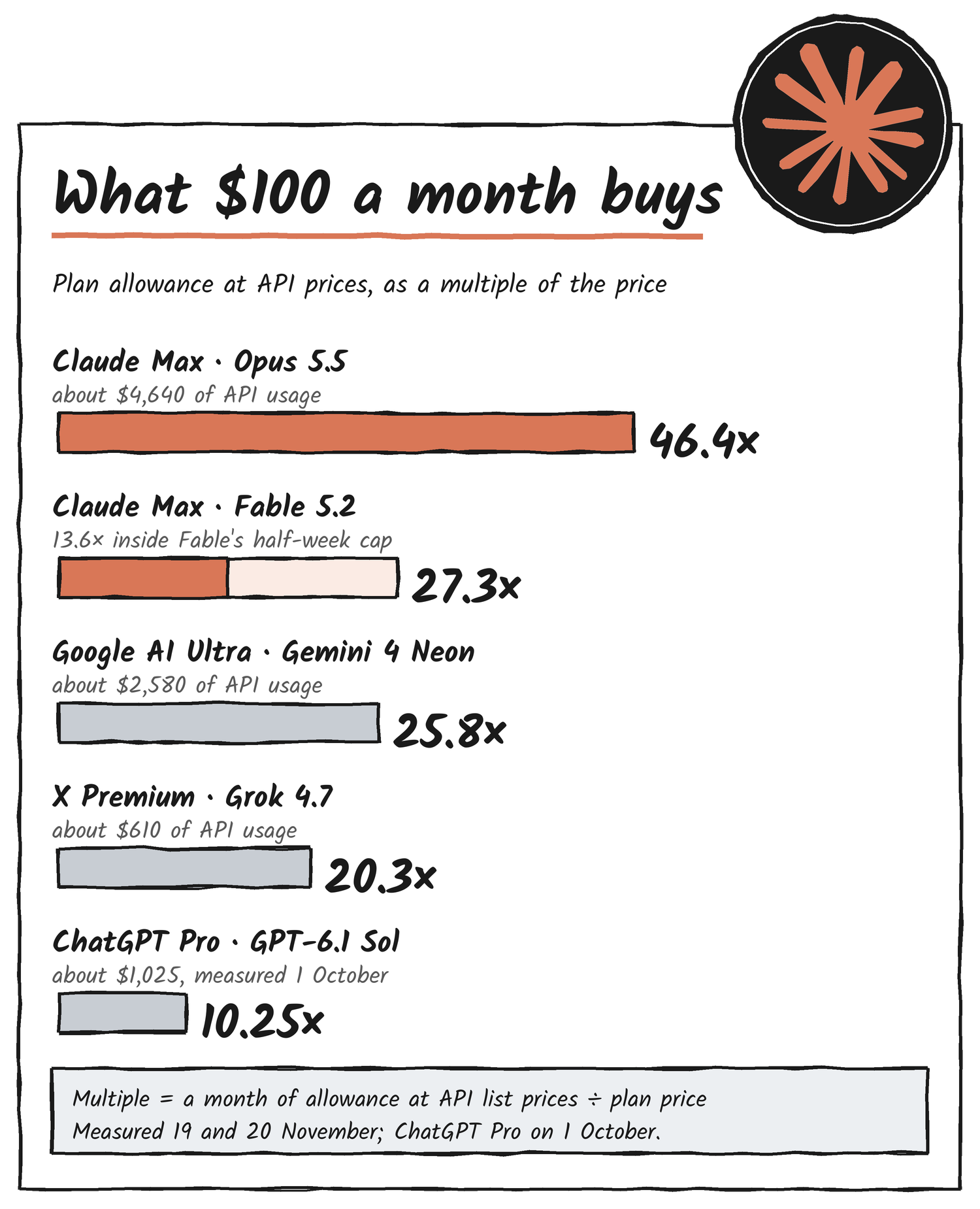
Pawel Huryn, who writes The Product Compass newsletter, measured what a monthly AI subscription buys compared with the same usage at API prices. He posted the results on X at 6:32pm on 20 November, New Zealand time. His headline figure: US$100 of Claude Max buys about US$4,640 of Opus 5.5 at API prices, a multiplier of 46.4x.
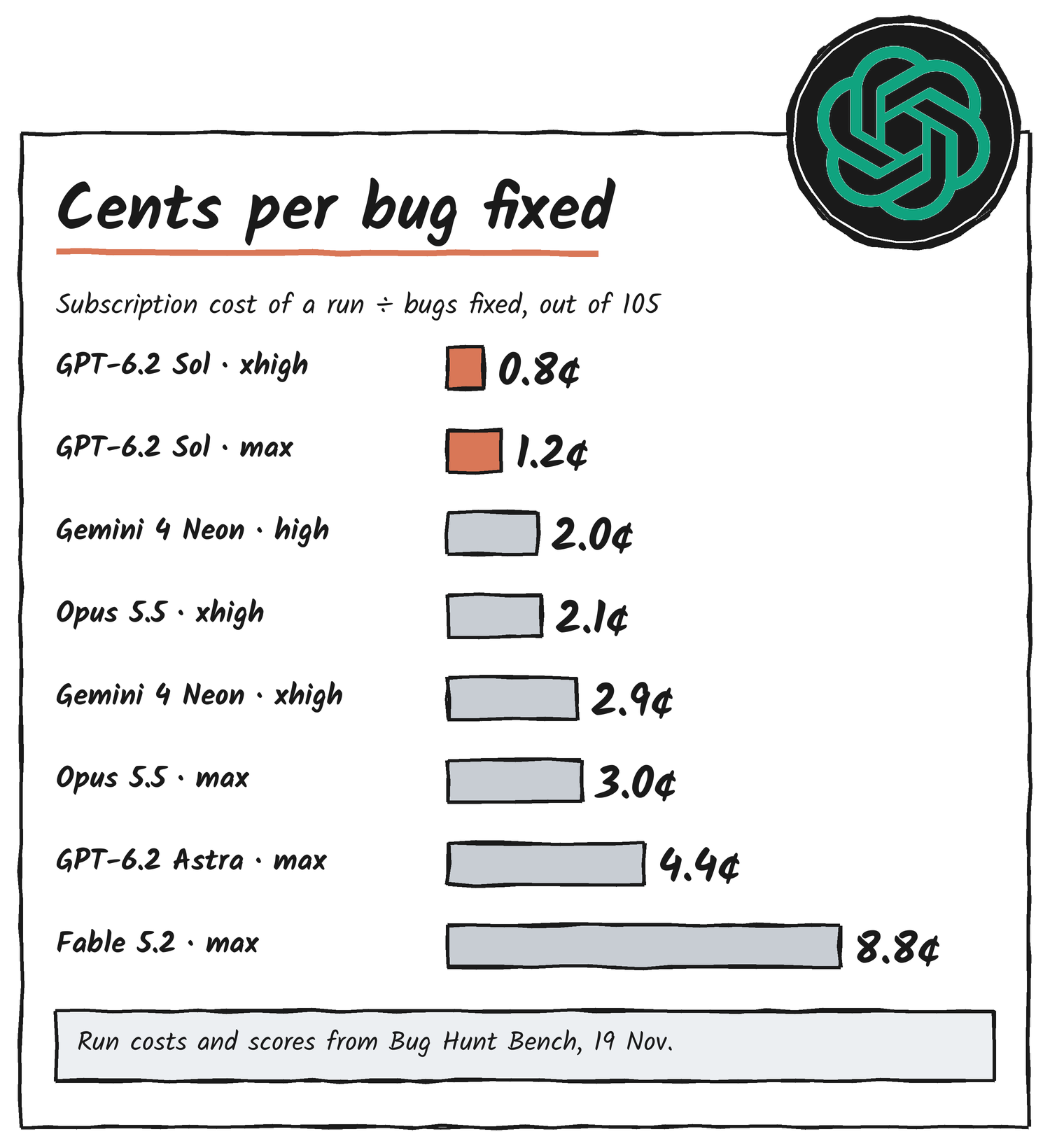
He then used the multipliers to re-price his Bug Hunt Bench, a blind-graded test of 105 planted bugs. On that chart Opus 5.5 still costs nearly twice as much per run as OpenAI’s GPT-6.2 Sol, and fixes fewer bugs.
- What a multiplier measures
- The six plans
- Claude Max and the Fable cap
- Gemini 4 Neon and Google’s terms
- The ChatGPT Pro figure
- What the multipliers do to the leaderboard
- What a multiplier assumes
- Terms in this article
What a multiplier measures
His chart defines it in one line: a month of a plan’s allowance, priced at the vendor’s public API rates, divided by the plan’s price. A multiplier of 46.4x means US$100 a month buys what US$4,640 buys on the API.
$100 of Claude Max buys about $4,640 of Opus at API prices.
Pawel Huryn on X, 20 November 2026
He read each vendor’s own weekly usage meter while logging every model call, then priced the logged calls at list rates. Each plan’s meter moves in whole percentages, so every figure comes with a measured range.
How the figure is worked out
The multiplier turns the API cost of the logged calls into a month of allowance and divides by the price. “Per point” below means one whole percent of the weekly meter.
multiplier = (API dollars per point) x 100 x (30.4375 / 7) / monthly plan priceThe 100 turns percent into a full week, and 30.4375 / 7 turns a week into an average month.
The six plans
46.4x
Claude Max, Opus 5.5
25.8x
Google AI Ultra, Gemini 4 Neon
20.3x
X Premium, Grok 4.7
10.25x
ChatGPT Pro, GPT-6.1 Sol
Huryn measured Claude Max, Google AI Ultra and X Premium on 19 and 20 November. The ChatGPT Pro and Muse Code figures date from 1 October.
| Plan | Price a month | Model and CLI | Multiplier (range) | API usage a month |
|---|---|---|---|---|
| Claude Max | US$100 | Opus 5.5, Claude Code | 46.4x (45.2 to 47.6) | about US$4,640 |
| Claude Max | US$100 | Fable 5.2, Claude Code | 27.3x (25.6 to 29.0) | about US$1,360 of Fable |
| Google AI Ultra | US$99.99 | Gemini 4 Neon, Antigravity CLI | 25.8x (25.3 to 26.3) | about US$2,580 |
| X Premium | US$30 | Grok 4.7, Grok Build | 20.3x (20.1 to 20.5) | about US$610 |
| ChatGPT Pro | US$100 | GPT-6.1 Sol, Codex CLI | 10.25x (9.95 to 10.55) | about US$1,025 |
| Muse Code High Usage | US$15 | Muse Spark 1.3, Muse Code | 9.3x (8.9 to 9.7) | about US$140 |
Claude Max and the Fable cap
Claude Max has two rows because the plan treats the two models differently. On Max, Fable models count toward the plan’s limits, but Anthropic’s help page says you can use up to 50% of your weekly usage limits on them, and that they draw the allowance down faster than other Claude models.
Huryn’s chart shows both numbers. Fable 5.2 reaches 27.3x if the whole week goes to it, and 13.6x on Fable alone once the 50% cap applies, about US$1,360 of Fable a month.

Gemini 4 Neon and Google’s terms
Huryn ran Gemini 4 Neon through Google’s own Antigravity CLI on a Google AI Ultra plan and got 25.8x, about US$2,580 of API usage a month. He adds that the CLI’s token counts read 10 to 38% low, which he estimates would put the true multiplier at 28 to 41x.
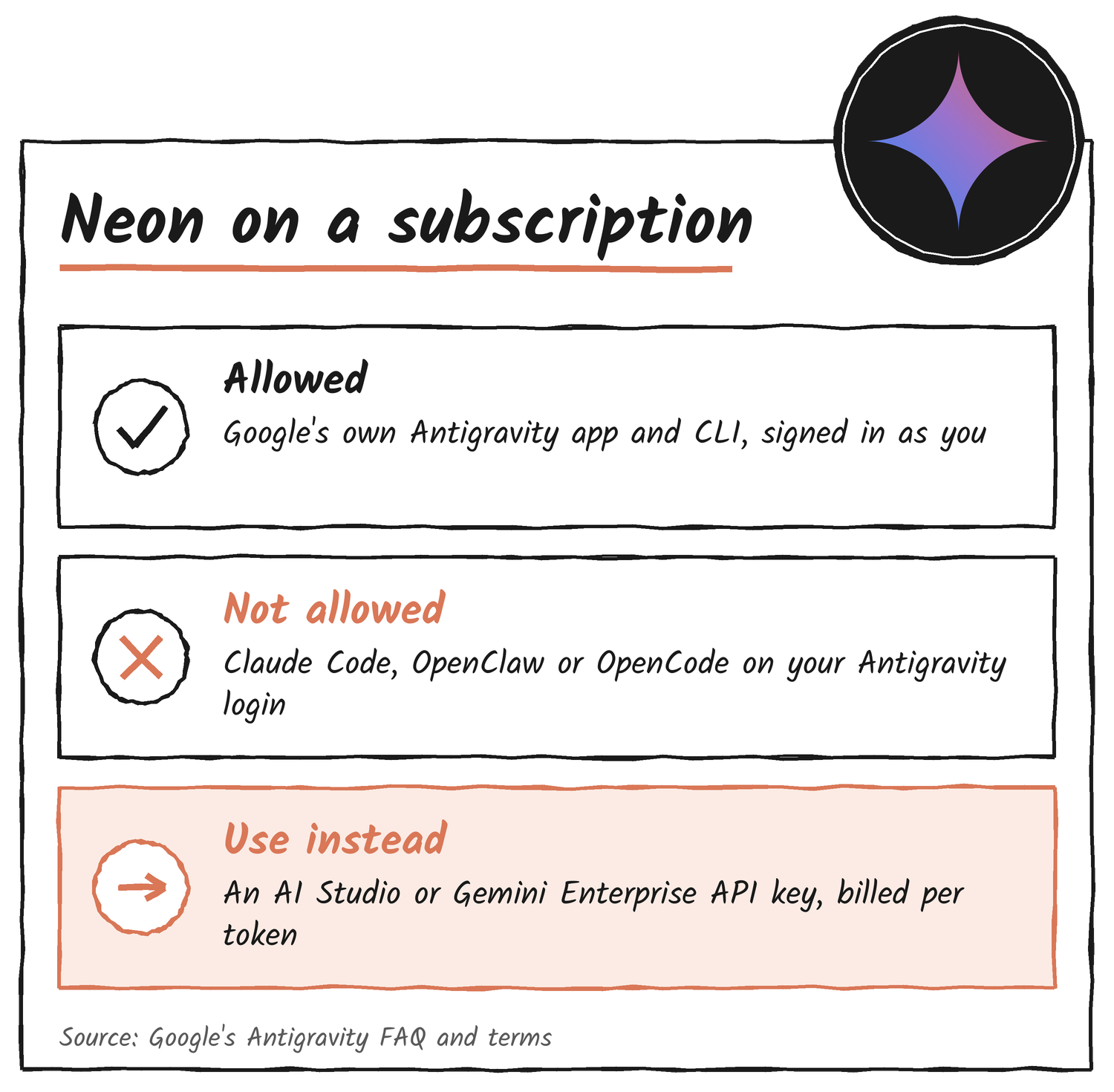
The figure only holds inside Google’s tool. Google’s Antigravity terms say that using third-party software, tools or services to access the service, with OpenClaw on Antigravity OAuth as the example, breaches the agreement and can get Antigravity and Gemini CLI accounts suspended. The Antigravity FAQ names Claude Code, OpenClaw and OpenCode, and recommends a Gemini Enterprise or Google AI Studio API key for third-party coding agents.

The ChatGPT Pro figure
Huryn measured ChatGPT Pro on 1 October with GPT-6.1 Sol in the Codex CLI and got 10.25x, about US$1,025 of API usage a month. His chart labels that figure historical. On 29 October, OpenAI’s release notes said Pro 100 and Pro 500 plans now include twice their previous Work and Codex allowance.
His leaderboard divides every ChatGPT Pro run by the 10.25x figure.
What the multipliers do to the leaderboard
Bug Hunt Bench gives each model one round on each of two production codebases holding 105 planted bugs, in its own agentic CLI. An independent judge grades the diff against a withheld answer key, and only planted bugs count. Huryn’s 19 November update lists 28 runs across six models and every effort level, with each run’s list-rate cost divided by its plan’s multiplier.
Gemini 4 Neon at xhigh effort leads with 63 of 105 bugs for US$1.80 a run. GPT-6.2 Astra at max follows with 62.7 for US$2.77, and Fable 5.2 at max scores 58 for US$5.12.
The pair to watch is Opus 5.5 and GPT-6.2 Sol. Of the plans on the bench, Claude Max has the biggest multiplier and ChatGPT Pro the smallest. At list prices Opus 5.5 costs US$4 in and US$20 out per million tokens, against US$2 and US$10 for Sol. Even so, Sol costs less in four of the five effort levels and fixes more bugs at every level.1
| Effort | Opus 5.5 bugs fixed | Opus 5.5 cost | GPT-6.2 Sol bugs fixed | GPT-6.2 Sol cost |
|---|---|---|---|---|
| Low | 22.3 | US$0.18 | 36 | US$0.19 |
| Medium | 30.3 | US$0.34 | 45.7 | US$0.31 |
| High | 31.7 | US$0.48 | 49.7 | US$0.40 |
| Xhigh | 36 | US$0.75 | 49 | US$0.38 |
| Max | 41.7 | US$1.26 | 54.7 | US$0.68 |
At max effort the gap is 1.85 times, from US$1.26 to US$0.68, and at xhigh it is about 2 times. The cost per bug fixed, which I worked out from his chart, runs from about 0.5 US cents for Sol at low effort to 3 cents for Opus 5.5 at max.
What a multiplier assumes
- A usable week. His chart’s footnote says it assumes the whole week’s allowance can be used.
- List prices. Everything is priced at each vendor’s public API rates.
- Each plan’s own meter. The measurement relies on whatever the vendor’s meter reports. Grok’s CLI reports context occupancy, not billing, so the bench’s Grok costs are a reconstructed lower bound.
- No API credits. Claude Max’s US$100 of monthly API credits aren’t counted.
- A date. Plans change. OpenAI’s allowance doubled after the ChatGPT Pro measurement, and Anthropic’s Fable cap shapes the Claude figure.
The multiplier moves only the cost column. A bug count doesn’t change when a plan’s allowance does, so the planted-bug scores stay the same whichever plan pays for the run.
Terms in this article
- Multiplier
- A month of a plan’s allowance, priced at API list rates, divided by the plan’s monthly price.
- API list price
- The vendor’s published price per million tokens, before any plan or discount.
- Planted bug
- A defect deliberately put into a codebase, so a grader holding the answer key can check whether a model fixed it.
- Effort level
- A setting that tells a model how long to think. Bug Hunt Bench runs each model at every level it offers.
- CLI
- A command-line coding tool such as Claude Code, Codex CLI or Antigravity CLI, which is where each plan’s usage gets metered.
- At list prices, an Opus 5.5 max run is about US$58 and a Sol max run about US$7, which is the chart’s US$1.26 and US$0.68 multiplied back by 46.4 and 10.25. Those two figures and the 1.85 gap are my arithmetic from his numbers. ↩︎
Sources
- Pawel Huryn on X, 20 November 2026 NZ time, with its three charts
- Bug Hunt Bench, its method page and the GitHub repository, updated 19 November 2026
- Claude Help Center: Claude Fable models on your plan
- Google Antigravity Terms of Service and Antigravity FAQ
- OpenAI Help Center: ChatGPT release notes, 29 October 2026 entry
Disclosure: I’m an OpenAI, Firecrawl and Devin ambassador.
Discover more from Sulat AI & Tech News
Subscribe to get the latest posts sent to your email.