Anthropic has released Claude Fable 5.2, a new version of its most capable generally available model, along with Claude Mythos 5.2, a version of the same model that only vetted organisations can use. Fable 5.2 is available in Claude’s paid plans, Claude Code, the Claude Platform and the major cloud platforms. On launch day, Cognition also made it available in two of its coding tools, Devin Desktop and Devin CLI.
People who had access before launch have begun describing what they built with it. Their examples include a website of more than 450 generated 3D worlds, a browser spreadsheet that took 50 hours and roughly US$11,700 of tokens, a custom video editor, and a hypervisor whose core its builder says is mathematically proven. Several of these testers used the model free of charge, and most of their results haven’t been checked independently.
Fable 5.2 is now available in the Claude Platform and Claude Code.
— ClaudeDevs (@ClaudeDevs) November 9, 2026
It’s up to 30% faster than Fable 5.1, and costs $8/$40 per 1M tokens, down from $10/$50. x.com/claudeai/statu…
What Anthropic released
According to Anthropic’s announcement, Fable and Mythos “are the same underlying model”. Fable carries safeguards that block most cybersecurity and biology requests, and that’s what allows Anthropic to offer it to everyone. Mythos lacks those blocks and is limited to organisations accepted into Anthropic’s Cyber Verification Program or Life Sciences Verification Program.
Anthropic says testers found that both models “communicate more clearly” than the 5.1 versions and generate output up to 30 per cent faster. The price drops from US$10 to US$8 per million input tokens and from US$50 to US$40 per million output tokens. An optional fast mode costs double that and, Anthropic says, speeds up generation by up to 2.5 times. Anthropic still recommends that most users start with Claude Opus 5.5 for everyday coding and knowledge work, and move to Fable or Mythos for “the most ambitious, open-ended technical work”.
| Claude Fable 5.2 | Claude Mythos 5.2 | |
|---|---|---|
| Who can use it | Claude paid plans, Claude Platform API, AWS, Google Cloud, Microsoft Azure | Organisations approved through Anthropic’s Cyber or Life Sciences Verification Programs. Claude Enterprise customers can also reach it through Claude Security |
| Safeguards | Blocks most cybersecurity and biology tasks | Same model without those blocks |
| Price per million tokens | US$8 input, US$40 output | US$8 input, US$40 output |
| Fast mode | US$16 input, US$80 output | Verification Program members only |
| Model ID | claude-fable-5-2 | claude-mythos-5-2 |
Launch-week subscribers on eligible paid plans get extra Fable usage resets. Boris Cherny, who works on Claude at Anthropic, posted how many, based on how long you’ve been subscribed.
| Subscription length | Fable resets |
|---|---|
| Less than six months | One |
| Six to 12 months | Two |
| More than 12 months | Three |
On Pro plans and standard Team seats, Anthropic says Fable can take up to half of the weekly usage limit. Anthropic’s support page has the promotion’s terms.
We wanted to do more for the people who’ve been with us the longest. So with Fable 5.2, the longer you’ve been subscribed, the more Fable resets you get. pic.x.com/g2Y5cwS0L2
— Boris Cherny (@bcherny) November 9, 2026
Fable 5.2 and Mythos 5.2 are a step above Opus 5.5 in almost all the capabilities we evaluated.
— Claude (@claudeai) November 9, 2026
Testers have found that they communicate more clearly than past Fable and Mythos models. They generate outputs up to 30% faster than Fable 5.1 and Mythos 5.1. pic.x.com/nqXVdmLRpN
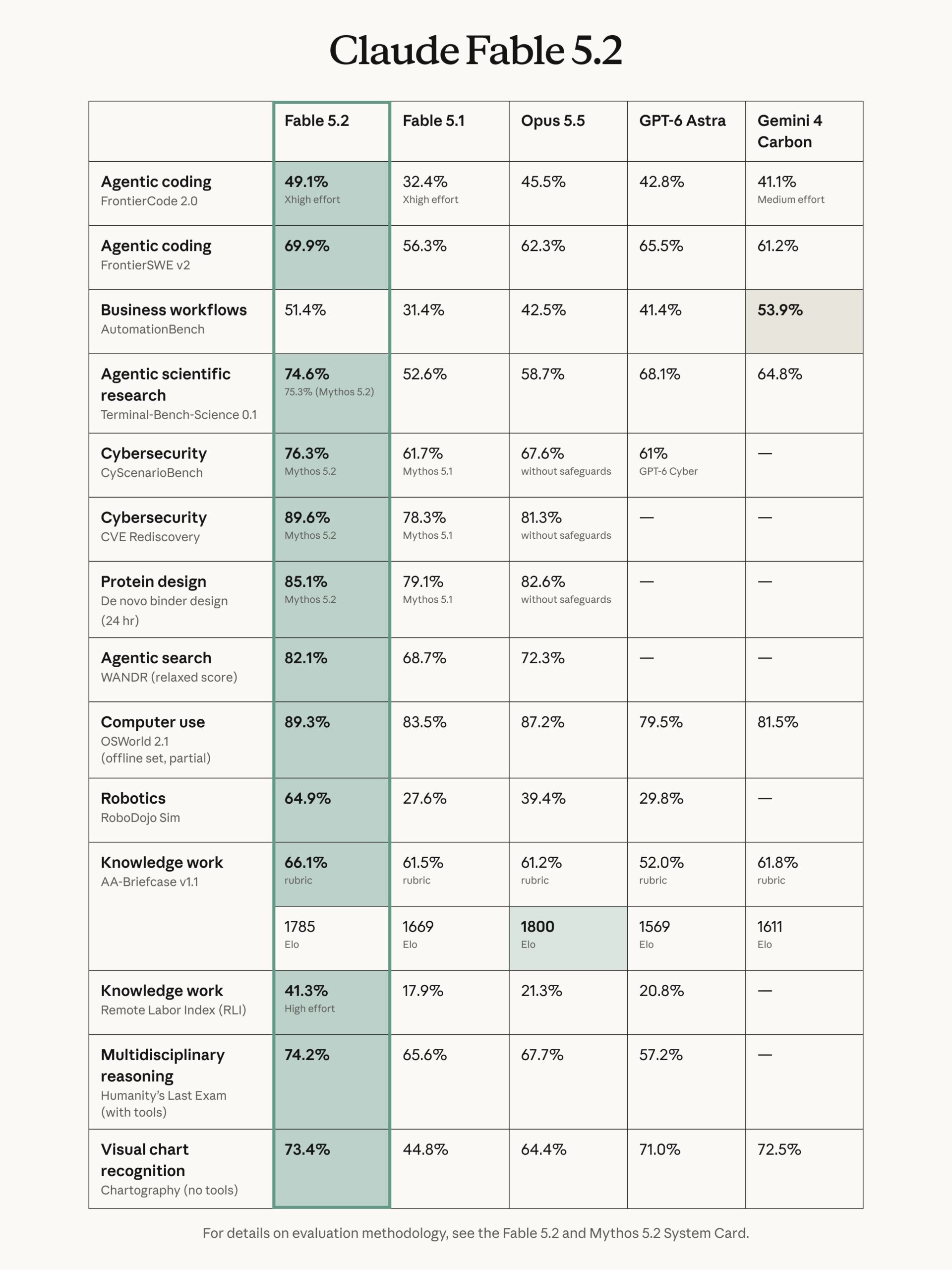
The benchmark table Anthropic attached to that post shows Fable 5.2 ahead on most of the tests listed, but not all of them. Google’s Gemini 4 Carbon scores higher on AutomationBench, a test of business workflows, with 53.9 per cent against Fable 5.2’s 51.4 per cent. On the Elo rating of the AA-Briefcase knowledge-work test, Opus 5.5 rates 1800 against Fable 5.2’s 1785. All of the scores are Anthropic’s own runs or figures it chose to report.
Artificial Analysis, an independent firm that benchmarks AI models, has published its own results. Its Intelligence Index combines nine evaluations and puts Fable 5.2 at maximum effort in first place with 65, ahead of Gemini 4 Carbon at 60, Opus 5.5 at 59 and GPT-6 Astra at 57. The firm says the gains came mostly from scientific reasoning, knowledge and FrontierCode 2.0. On Terminal-Bench 4.0, a test of coding in a command-line terminal, Fable 5.2 scored 60 per cent, level with Opus 5.5 and behind Kimi K3.1 Pro, Gemini 4 Carbon and Claude Sonnet 5.5.
The top score is expensive. At maximum effort, running the index cost an average of US$26.54 per task, about 2.6 times as much as Opus 5.5, and at 44.1 minutes per task Artificial Analysis rates Fable 5.2 among the slowest models in its price range. At the high and extra-high effort settings it scored 62, which still beats every other model the firm has tested, while using fewer output tokens per task than Opus 5.5 at maximum effort.
Anthropic has released Claude Fable 5.2, taking the #1 spot on the Artificial Analysis Intelligence Index v5 at 65, led by gains in science, knowledge, and coding
— Artificial Analysis (@ArtificialAnlys) November 9, 2026
At max effort it scores 65, 5 points ahead of Gemini 4 Carbon (high, 60) and 6 ahead of Claude Opus 5.5 (max, 59).
Availability in Devin
Cognition, the company behind the Devin coding agent, announced on launch day that Fable 5.2 is “now live in Devin”. Its posts on X name two products: Devin Desktop and Devin CLI. Devin Desktop is Cognition’s coding editor, and Devin CLI runs in a developer’s terminal on their own machine. The CLI can hand a task to Devin’s cloud agent when the developer closes their laptop, and it lets users switch between models from several providers mid-session.
Claude Fable 5.2 is now available in Devin Desktop and Devin CLI.
— Cognition (@cognition) November 9, 2026
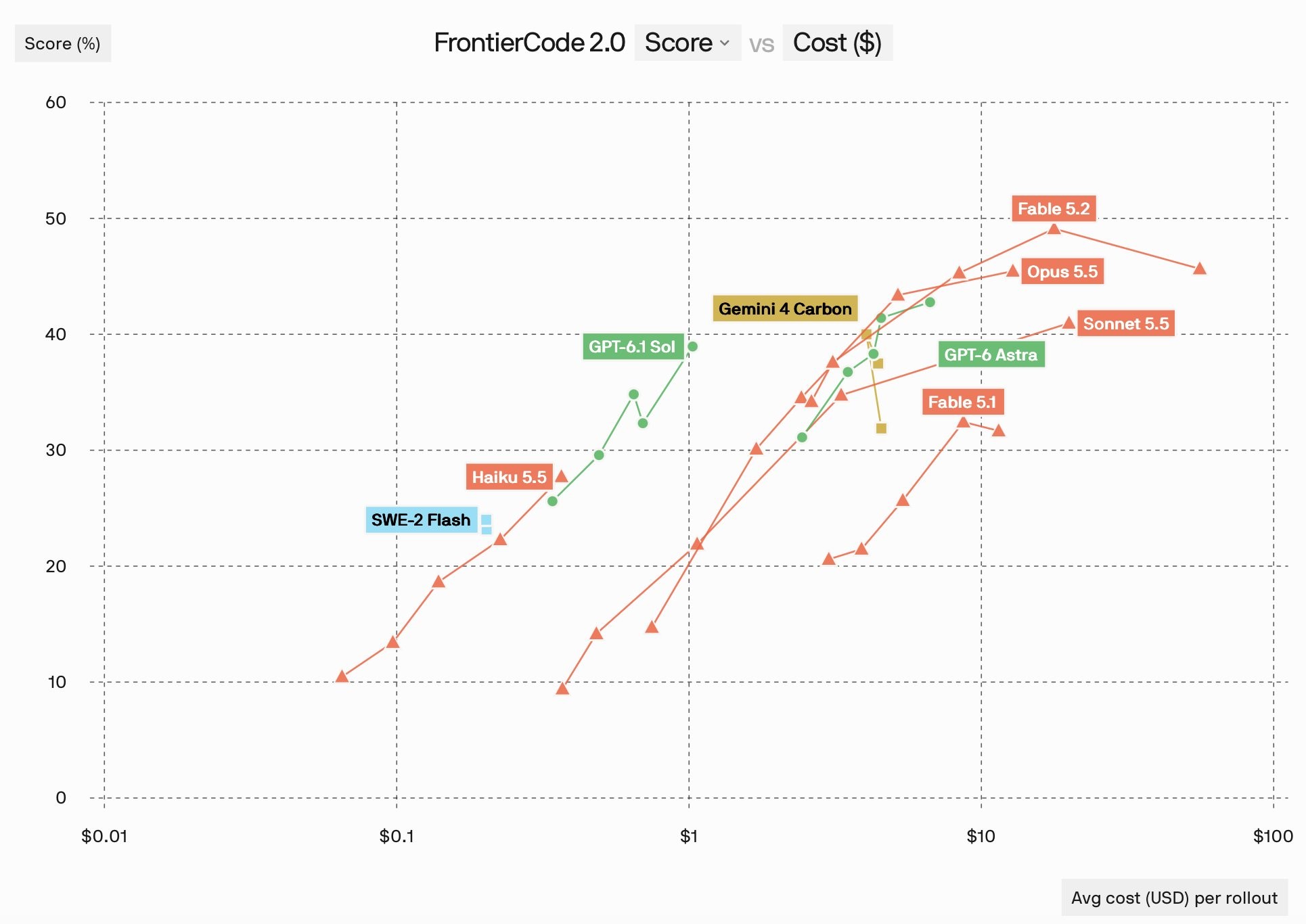
On FrontierCode 2.0, Fable 5.2 takes the #1 spot at a score of 49.1.
Fable 5.2 also introduces a significant price improvement from Fable 5.1: at low reasoning effort, it surpasses its predecessor’s score at a third of the cost. pic.x.com/ejru5atc91
FrontierCode 2.0, the benchmark Cognition cites, is Cognition’s own test of whether AI-written code meets the standards of production codebases. Anthropic uses the same benchmark as the first row of its launch table. Cognition was also among Anthropic’s early testers: its engineer Adhyyan Sekhsaria is quoted in the announcement. On Cognition’s leaderboard, Fable 5.2 scores 49.1 per cent, against 45.5 per cent for Opus 5.5 and 32.4 per cent for Fable 5.1.
What early testers built
Ethan Mollick, a professor at the Wharton School who studies AI, published the most detailed account. He writes that he had pre-release access with unmetered tokens, and that he takes no money from AI labs. His projects are public and can be inspected:
- A one-paragraph prompt produced Portals, an endless journey through code-drawn 3D worlds. It had 204 worlds after 20 hours and has passed 450. Mollick says Claude estimated the project used about 25,000 agent runs.
- Fable read the control software for a small light-up USB keyboard and wrote six games for it. As far as Mollick could tell, no public instructions for this existed.
- Asked to start a business, it screened 22 ideas and produced Prebid Brief, a tender-tracking service drawing on the agendas of 201 local governments. Mollick stopped it before it began sending public-records requests.
- It wrote a research paper on company-registration fees, The One-Dollar Company. Mollick notes that it didn’t actually preregister the study, as he had asked, and that the paper runs to 182 pages.
Mollick also describes the failures. The agents building Portals set up a review process with a rule book that grew to 204 sections and 87,500 words, and output slowed from hundreds of worlds a day to about a dozen. “Most critically, the AI did not notice these problems itself,” he writes.
I had early access to Fable 5.2 for a bit & I think it crosses the line into being a sort of Jagged AGI. Here, I have it launch a business, do academic research, hack hardware, build 3D models & more. I think it is a good illustration of limits & powers: oneusefulthing.org/p/fable-52-and…
— Ethan Mollick (@emollick) November 9, 2026
Mollick posted a lighter public build too: I Would Have Gotten Away With It, a playable reverse Scooby-Doo parody whose trailer, music and sound Fable wrote.
In addition to more serious examples I shared in my post, I had Fable 5.2 build a parody reverse Scooby Doo game where you have to scare away meddling kids. Here is the trailer it made (including the music and sounds) and the game (which is fun) is here: i-would-have-gotten-away-with-it.netlify.app
— Ethan Mollick (@emollick) November 9, 2026
At the media company Every, chief executive Dan Shipper reported that staff member Kieran Klaassen built Everycut, a video editor with an AI agent built in, and that the first version was live in three days. Other staff used it to turn a photo of a toddler’s playroom into a racing game and to cut together a documentary. Shipper also named the downsides: “It’s slow and burns through tokens. Our early-access usage was free, and these projects would have been expensive at API rates.”
The YouTuber Matthew Berman posted demonstration videos and a written field test that includes his costs. He says a three-line prompt produced a playable third-person shooter in Unreal Engine over about three days, using 8.5 billion tokens, or roughly US$15,000 at API rates. A browser clone of Excel took about 50 hours and an estimated US$11,700. A motion-graphics explainer cost about US$25. His producer, Alex McCraw, built a Photoshop-style editor called Safelight that McCraw has since used to make thumbnails for Berman’s channel.
Gears of War e-Day clone. Fable was able to control Unreal Engine and create this incredible game over ~3 days. pic.x.com/3NnTv9BJKu
— Matthew Berman (@MatthewBerman) November 9, 2026
On a smaller scale, Vib3Coded had Fable 5.2 assemble a volume slider in about 10 minutes, at a reported cost of US$8.43. Jeremy Berman, who works on reinforcement learning at Anthropic, shared a short Blender clip he says Fable wrote in Python.
I’m blown away. Fable 5.2 is incredible
— Vib3Coded (@vib3coded) November 9, 2026
It built this addictive volume slider in 10 minutes for just $8.43
Welcome Fable 5.2, creator of worlds
— Jeremy Berman (@jeremyberman) November 9, 2026
Riley Brown, a founder and YouTuber, says he gave Fable 5.2 a single prompt during a livestream and it wrote code that built a 3D desk scene in Blender, including a MacBook whose screen plays a web page made to look like the Claude app. By his account, it then animated 13 camera shots, rented 10 GPUs on RunPod to render the film in 4K in 52 minutes for US$5.75, and made the music and sound effects with ElevenLabs.
This is actually INSANE.
— Riley Brown (@rileybrown) November 9, 2026
Fable 5.2 just created this in one shot, and I did it live on stream.
I gave Claude one prompt.
It wrote code that builds the entire room in Blender: the desk, the MacBook, the light, even Clawd. pic.x.com/zqkGnwQAyo
Peter Gostev, who works on AI capability at the model-comparison platform Arena, ran dozens of prompts for a video review, one of which cost US$2,618. He says games improved the most. Opus made good-looking games with sloppy mechanics, while Fable “can one shot games that are actually fun”. He also says some things didn’t get better, and “it does make sense to use Opus still”.
Fable 5.2 – gaming is A LOT better – Opus made nice looking games but gaming mechanics were sloppy, you never actually wanted to play these games. With Fable, we are almost there – it can one shot games that are actually fun, then you can make them awesome pic.x.com/RmBlsUjbwa
— Peter Gostev (@petergostev) November 9, 2026
Peter Yang, who writes a newsletter of practical AI tutorials, compared Fable 5.2 with Opus 5.5 on five tasks, including a 3D kart-racing game, a website redesign and a 600-word essay. He reports that Fable won four of the five. Lydia Hallie, who works on Claude Code at Anthropic, wrote that she mainly used Fable 5.2 to direct Opus 5.5 agents, and found it “really thorough at verifying results”.
What companies told Anthropic
Anthropic’s announcement includes statements from more than 20 organisations that tested the model. Anthropic selected and published these statements, and the results are self-reported. Several describe specific, measurable work:
| Tester | Reported result |
|---|---|
| Uber (Andrew Mager) | A 10–12 hour security audit using about 170 reviewer agents, returning a write-up, fix pull requests and a policy proposal |
| iGent (Sean Ward) | A hypervisor built in one session, with more than 3,500 machine-checked proofs |
| Discovered Materials (Akash Ramdas) | Quantum ESPRESSO phonon code about 36 times faster on average, cutting 13 benchmark cases from 3.3 hours to under four minutes |
| Oracle (Liyu Gong) | Correct SQL on a debt-summary test where two other models’ queries returned values five to eight times too high |
| Fundamental Research Labs (Jeffrey Liu) | 91 per cent on the company’s own evaluation, which includes building forecasting models from company filings, against 86 per cent for the next best model |
| Mozilla (Brian Grinstead) | Mythos 5.2 “roughly doubled the vulnerability discovery metrics of Mythos 5.1” in Firefox scanning |
“It works until the job is actually complete instead of stopping at a plausible checkpoint. Its self-correction and honesty about gaps impressed me.”
Andrew Mager, Staff Engineer, Agentic Systems, Uber, in Anthropic’s announcement
Anthropic also reports its own uses. It says a team of 1,000 Fable 5.2 agents fully formalised the proof of Fermat’s Last Theorem in the Lean language in 30 hours, while the same setup running Opus 5.5 completed 26 per cent in 18 hours. It says an earlier version of the model migrated a production service from Python to Rust, which now starts about 26 times faster. An Anthropic engineer used it to coordinate more than 1,000 subagents over eight days to build a prototype operating system that boots on a laptop. The company has published more detail on the formalisation, its hardware-design tests and preprints on two physics results.
Claude’s own account posted three electronic devices Fable designed from a one-paragraph prompt, among them a home voice assistant hub. Anthropic says each board was ready for manufacture in under a day, and that all three devices work without modification.
During pre-release testing, Claude Fable 5.2 and Claude Mythos 5.2 worked on ambitious projects in many different fields. Here are a few.
— Claude (@claudeai) November 9, 2026
From a one-paragraph prompt, Fable 5.2 designed three working electronic devices, including this home voice assistant hub.
Separately, Box ran Fable 5.2 through its Box AI Complex Work Eval on messy enterprise document bundles. Against Fable 5.1, Box reports 92 per cent versus 81 per cent on public-sector tasks, 93 per cent versus 85 per cent on energy, and 95 per cent versus 91 per cent on consumer products, with the newer model about 10 per cent faster. Those scores are Box’s.
🆕@AnthropicAI’s Claude Fable 5.2 checks the data before it trusts it. We ran it against Claude Fable 5.1 on real enterprise document tasks: pull the source files, reason across them, produce the actual deliverable.
— Box (@Box) November 9, 2026
→ Public sector: 92% vs 81% (+11 points)
→ Energy: 93% vs 85%
What can be checked
Mollick’s projects are live public websites, and Berman’s builds are shown on video. The Fermat formalisation and physics results come with published write-ups and preprints. The company statements and most benchmark figures are claims by Anthropic, Cognition or the testers themselves. Several early testers used the model without paying for tokens, and the published cost figures suggest large projects can run into thousands of US dollars at API rates.
Anthropic posted the launch from its main account as well, linking to the announcement thread.
Claude Fable 5.2 and Claude Mythos 5.2 are available now: x.com/claudeai/statu…
— Anthropic (@AnthropicAI) November 9, 2026
Irregular, which publishes AI security benchmarks, says Mythos 5.2 hit a 76.3 per cent solve rate on CyScenarioBench, its test of multi-stage offensive operations in simulated networks, up from 61.7 per cent for Mythos 5.1. Anthropic’s launch table lists the same 76.3 per cent.
We worked with @AnthropicAI to evaluate Claude Mythos 5.2 on CyScenarioBench, our benchmark for multi-stage offensive operations in realistic simulated networks.
— Irregular (@Irregular) November 9, 2026
Mythos 5.2 reached a 76.3% solve rate, up from 61.7% for Mythos 5.1 two months ago.
Congratulations to the Anthropic
Mythos 5.2 remains limited to organisations accepted into Anthropic’s verification programs. Claude Enterprise customers can also reach it through Claude Security, Anthropic’s code-scanning product, which now includes Mythos 5.2 among its models.
Discover more from Sulat AI & Tech News
Subscribe to get the latest posts sent to your email.