Morph, a small Y Combinator-backed company that runs AI models for coding agents, has launched Morph Ultra, a $200-a-month plan with no per-token billing on two open-weight model families, Moonshot AI’s Kimi K3 and DeepSeek’s V4.1 Flash. It’s capped at 1,000 subscriptions and open to individuals and teams.
Introducing Morph Ultra
— Morph (@morphllm) November 9, 2026
Unlimited Kimi and DeepSeek for $200/month
1,000 subscriptions available
Details below
morphllm.com/products/ultra
Read the plan documentation and “unlimited” turns out to mean there’s no bill per token. Each subscription still has per-minute limits, and requests can bounce when Morph’s servers are full. Within hours of the launch, early subscribers were posting about slowdowns, and Morph’s founder and one of its engineers were answering them in the replies.
What the $200 covers
Four model IDs run without a meter: morph-kimik3 (Kimi K3), morph-kimik31 (Kimi K3.1), morph-dsv41flash and a dated snapshot, morph-dsv41flash-1017. Every other model on Morph, including the faster morph-kimik3-fast and the restricted morph-dsv41flash-abliterated, bills per token at list price. The plan includes no credits, so any of that other usage draws on prepaid credit. Morph’s pricing page labels morph-kimik31 as “Kimi K3.1 Pro”, while the Ultra documentation calls the same ID “Kimi K3.1”.
You use it through the coding agents you already run. Morph’s setup prompt handles Claude Code, Codex, Pi, OpenCode, T3 Code and OMP, and for Claude Code the documentation simply points Anthropic’s environment variables at Morph’s server:
export ANTHROPIC_BASE_URL="https://api.morphllm.com"
export ANTHROPIC_AUTH_TOKEN="YOUR_MORPH_API_KEY"
export ANTHROPIC_MODEL="morph-kimik3"
export ANTHROPIC_SMALL_FAST_MODEL="morph-dsv41flash"
claude
An organisation subscription is billed per member and covers the organisation’s API keys, but the documentation says it “pools all members under one set of rate limits”. An Ultra subscription replaces any existing Morph subscription, with the unused part of the old plan taken off the first charge, and remaining subscription credits don’t carry over. When an Ultra subscription ends, use of the same models goes back to per-token billing.
The limits behind “unlimited”
Unlimited does not mean unthrottled.
Morph, Ultra plan documentation
There are two meters per model family, both counted per minute. One tracks uncached input, meaning fresh text the server hasn’t already processed and cached; the other tracks output, what the model writes back. Anything served from cache, such as the long repeated start of an agent’s prompt, is free of both. The two Kimi models draw on one pool, and the two DeepSeek versions on another.
| Model pool | Uncached input per minute | Output per minute | Output per second, sustained |
|---|---|---|---|
| Kimi K3 and K3.1 (shared) | 24,290 tokens | 6,162 tokens | about 103 tokens |
| DeepSeek V4.1 Flash, both versions (shared) | 701,079 tokens | 76,559 tokens | about 1,276 tokens |
In practice the Kimi output cap is roughly one model writing flat out. Morph’s own product menu lists Kimi K3 at 100 tokens per second, and 6,162 tokens a minute comes to about 103 a second, so three Kimi agents running side by side on one subscription would get around a third of that each. The Kimi input limit matters more for coding agents, which often send large files: a fresh 100,000-token prompt uses a little over four minutes of the Kimi input allowance. The documentation says a request bigger than a limit still runs, and “your next request waits”.
There’s also no guaranteed share of Morph’s hardware. When Morph is at capacity, requests can return an HTTP 429 error until capacity frees up, whether or not a subscriber has reached their own limits, and the documentation tells developers to retry with backoff. The documentation says “The plan does not reserve capacity” and directs customers who need reserved capacity and a service-level agreement to Morph’s paid dedicated endpoints.
For comparison, Kimi output is listed at $14 per million tokens on Morph’s pay-as-you-go pricing, so $200 covers about 14.3 million of them. Someone running Kimi at the Ultra output cap would get through that much in about 39 hours. DeepSeek V4.1 Flash output is far cheaper at $0.80 per million, which puts the break-even at 250 million tokens.
Morph’s $42,000 claim
Nick Khami, whose X profile describes him as working on inference at Morph, quoted the launch post with the company’s strongest value claim. He attached a Morph graphic that sets out how many times the $200 fee a subscriber could get back in list-price tokens, depending on how much of their input is cached.
morph ultra is insane
— Nick Khami (@skeptrune) November 9, 2026
with optimal caching, you can get up to $42k in tokens for $200
if you're doing long context coding work that's 90+% cached anyway, the value is incredible. we've added a ton of storage to our clusters & want to see it get used.
1,000 plans available
morphllm.com/products/ultra
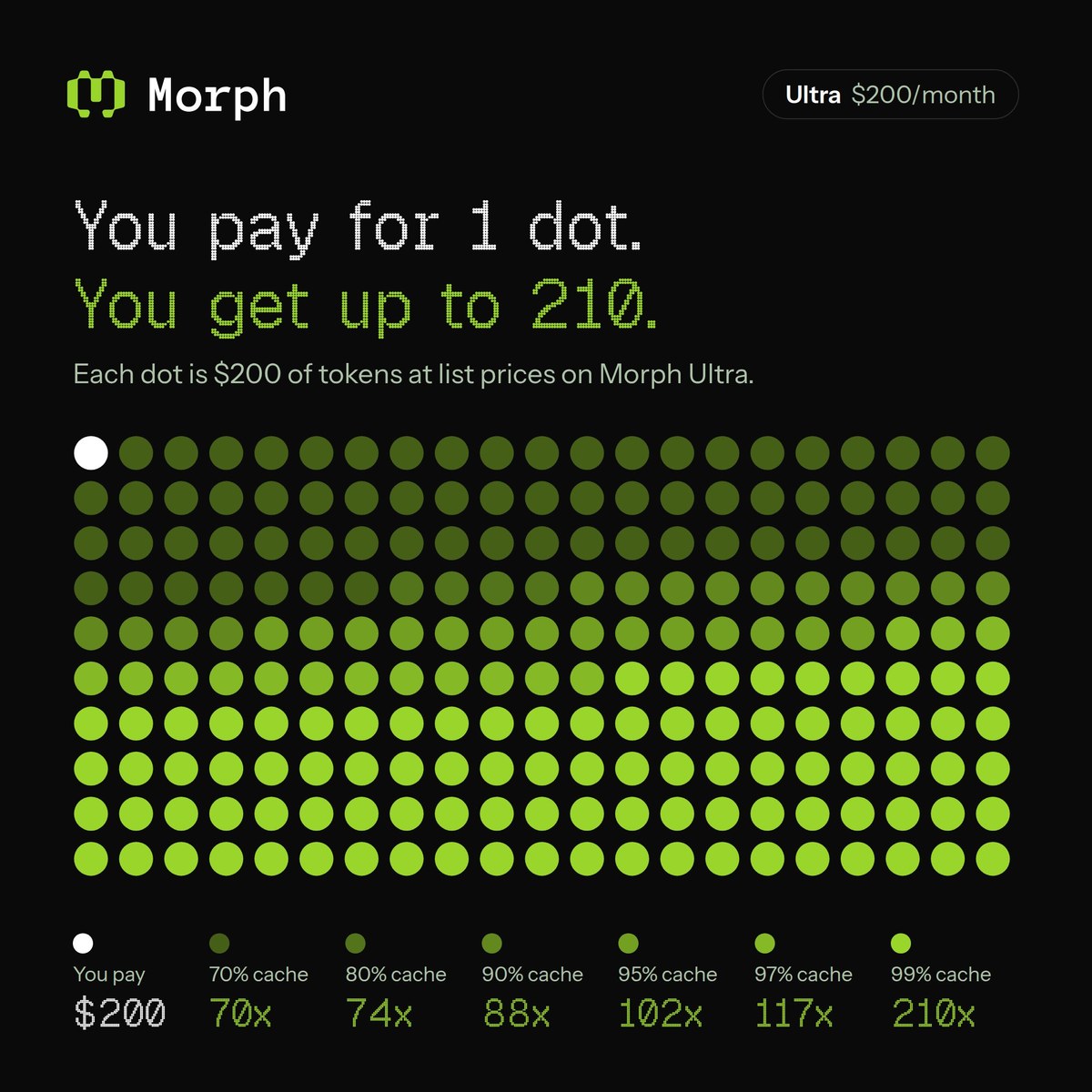
Morph didn’t show its working. We rebuilt the sum from the published limits and list prices, assuming a subscriber keeps both model pools at their uncached input and output limits every minute for 30 days, and that cached input adds to that in proportion to the cache rate. That method lands on Morph’s figures at 70%, 80% and 90% cache: about 70, 74 and 88 times the fee, or roughly $13,900, $14,800 and $17,600. At 95% and above it gives higher numbers than Morph’s chart, about 334 times the fee at 99% against Morph’s 210, so Morph must be capping something at the top end that it hasn’t explained.
What the $42,000 figure assumes
Every version of the figure needs both Kimi and DeepSeek running at their per-minute ceilings around the clock for a month, with Morph never turning requests away. It’s a measure of list-price value, not money a subscriber saves, and only applies to someone who would otherwise have paid Morph’s per-token rates for that volume.
Khami also told one user, linking to the documentation, “there are only rate limits for uncached prefill”. Prefill is the input-processing step, but the documentation lists output limits for both model pools as well.
What the founder said
Tejas Bhakta is Morph’s only listed founder. His Y Combinator company page names him as the sole active founder, and his X profile describes him as “solofounder @morphllm” who previously worked on inference at Tesla Autopilot. He quoted the launch post with a short description of who the plan is for, and a goal for cached input.
launching an unlimited plan intended for use with coding agents
— Tejas Bhakta (@tejasybhakta) November 9, 2026
we're working on driving the cost of cache hits down to 0 twitter.com/morphllm/status/2119841770767089796
He gave no date. Under Ultra, cache hits already sit outside the per-minute limits, and on Morph’s pay-as-you-go pricing cached Kimi input is $0.29 per million tokens, against $2.50 for fresh input.
In replies on launch day, Bhakta answered several questions about the plan. Asked “what interactivity?” by a developer wanting to know how responsive Ultra would be, he wrote: “no guarantees but just as fast our main traffic”. When one user found the subscription option missing from their billing page, he replied that “previous customers have old plans grandfathered in. fixing”. Asked about the abliterated model, a DeepSeek variant with its refusal behaviour removed, he said those models “are gated to verified company use only”, which matches Morph’s terms of service. Asked why there were only 1,000 subscriptions, he answered: “gpus dont grow on trees”. To a user who called the Kimi output limit “unusable”, he wrote “working on improving”.
A day before the launch, Bhakta quoted another account’s post of a Bernstein research chart comparing annualised revenue per megawatt of data-centre power at CoreWeave, Nebius, IREN and other infrastructure companies. In the chart, the highest figure was Nebius’s, at $11.1 million per megawatt. Bhakta’s post, which he edited after posting, reads “morph monetizes at 4x the best one” in its final version. Morph is a private company and hasn’t published revenue or power figures, so the claim can’t be checked.
First reports from subscribers
Early reports were mixed. One subscriber, posting as PandaSt0rm, said Kimi K3.1 ran at “between 40 and 70” tokens per second, then reported that with “barely” a 70% cache hit rate, Kimi was “restricted to working in super short ‘bursts’ for like 10s before its rate limited”, and that DeepSeek “seems to be a lot better”. The same user later posted a screenshot captioned “k31, 13 minutes for a single turn”. Another developer, Hal Wayland, quoted the launch post with: “Pretty hilarious rate limits, completely unusable Kimi”.
Khami responded to PandaSt0rm’s report with a promise of changes.
@PandaSt0rm @tejasybhakta @morphllm dammit, let me fix. will try to give higher limits to new sessions starting and will also enable vision
— Nick Khami (@skeptrune) November 9, 2026
As of writing, the limits in Morph’s documentation hadn’t changed. A public monitor of Morph’s models on the OpenRouter marketplace, modelstatus.dev, showed Kimi K3.1 Pro at about 90 tokens per second and the two DeepSeek V4.1 Flash versions at about 55 and 79. Those are rolling averages of Morph’s ordinary paid traffic through OpenRouter, so they don’t measure Ultra.
The rest of the fine print
Morph’s general terms of service, last updated on 23 October, also apply. Payments are non-refundable “except as required by law or for SLA breaches”, and prices can change with 30 days’ written notice. On free and paid tiers, Morph keeps prompts and outputs only to run the service and show customers their own request history, and deletes them within 30 days. Full zero data retention is limited to enterprise customers under a signed addendum. The terms say Morph doesn’t use customer inputs or outputs to train, fine-tune or evaluate its models on any tier.
Who Morph is
Morph is the trading name of AutoInfra, Inc. It was part of Y Combinator’s Summer 2023 batch, and its YC page lists a team of three. The company launched on Hacker News in July 2025 with Fast Apply, a model that merges code edits written by larger models into existing files. In that thread, a developer reported that the playground’s sample edit added code it hadn’t been asked to add, and Bhakta at first said a hard-coded example was to blame. Michael Neale, one of the authors of the open-source Goose coding agent, wrote that Morph had cut down his iterations with “the main expensive LLM”. Morph now sells hosted open-weight models alongside its own editing, search and context-compaction models. On its website, it claims “sub-second edit application at 10,500 tok/s”.
Ultra is Morph’s second subscription. Its existing Scale plan costs $100 a month and comes with 20 million credits, which Morph’s pricing page values at $200. Morph lists Ultra at $200 a month, with the limits above, for the first 1,000 subscribers.
Sulat has a referral link for Morph’s sign-up page. It goes to Morph’s ordinary sign-up, and Sulat may earn a commission if you use it.
Discover more from Sulat AI & Tech News
Subscribe to get the latest posts sent to your email.