Timee has outlined how Cognition’s Devin can connect incoming work, code changes, review and learning into a software factory. Cognition Japan highlighted the engineering team’s account on 9 November, pointing to Automations and the recently released Devin Review 2.0.
The Timee article describes a framework for extending the company’s existing Devin use. Its author, a manager in the developer-productivity team, says Timee has yet to adopt all the components discussed.
Featured image: official Devin symbol from Cognition’s brand assets; composition by Sulat.
Start with an event, then decide what deserves work
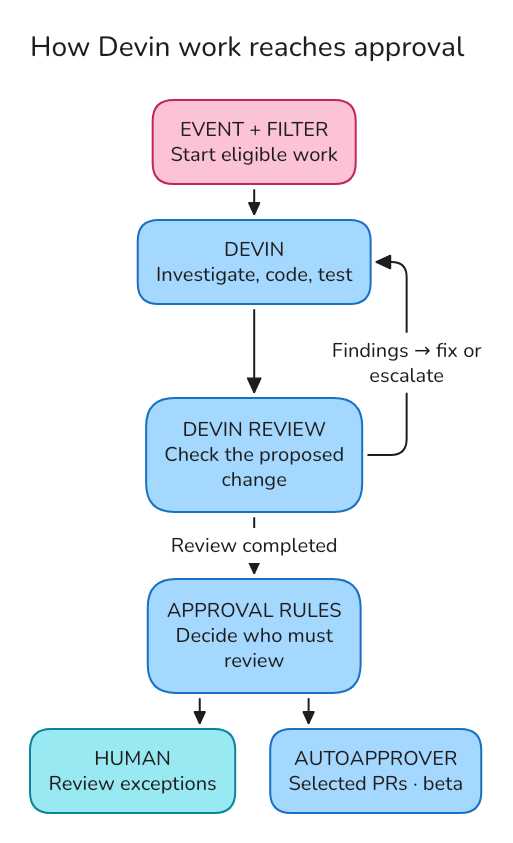
A software factory needs a way to start useful tasks without someone writing a fresh prompt each time. In Devin’s Automations documentation, an incoming Slack message, GitHub event or scheduled run can trigger work. Conditions narrow the selection to a particular repository, label or other criterion.
An optional preflight check then decides whether an eligible event should reach the agent. A language-model filter interprets a plain-language condition; a script can apply custom logic or split an event into separate work items. Scripts are still rolling out, so their availability varies by organisation.
Consider a hypothetical bug-report workflow. A team could select issues carrying its bug label, filter out reports outside the relevant service, then ask Devin to investigate and prepare a tested change. This is an illustration of the documented components, not a claim about Timee’s exact configuration.
The same documentation provides controls for spending, run frequency and concurrency, alongside notifications. These settings determine how much work starts, how many sessions run together and who hears about the result.
Review feeds back into the coding session
Devin Review 2.0, announced on 5 November, makes review part of the ongoing work rather than a single check at the end. Cognition says repeated reviews focus on changes since the previous pass. When paired with Devin, findings are investigated and either fixed, dismissed or escalated to a person.
Cognition reports an 82% reduction in review cost since August, putting a typical review at US$0.25 to US$0.75. Those are the vendor’s figures, not a measurement of Timee’s savings. Automatic review rules and per-pull-request spending limits let teams choose where to run the checks.
There is a separate decision about who may approve the result. According to the product documentation, the beta Autoapprover evaluates selected pull requests and either approves the reviewed commit or leaves it for human review. Enabling ordinary automatic reviews does not also enable Autoapprover.
Teams can put review instructions in REVIEW.md and approval guidance in AUTOAPPROVE.md. The latter is read from the target branch, preventing a proposed change from supplying its own approval rules. A pull request changing that file requires human review. Beta access and some instruction features vary by account.
Security findings can enter a related workflow. Devin Security 2.0 combines scanning and prioritisation with remediation sessions that investigate findings, test changes and open pull requests. It can also ingest findings from existing tools such as Snyk and Wiz. Cognition says findings remain open until a fix is merged and Devin checks the attack path.
Carry lessons forward, then improve the system
Finishing one task is only part of the idea. Later runs should benefit from what earlier work revealed, while teams use review outcomes to improve the instructions and machinery around the agent.
Memory and Dreaming, introduced on 5 October, supply one layer. Cognition describes Memory as short, source-linked notes about preferences, corrections and project lessons. It is personal to each user within an organisation, rather than a shared company instruction store. A daily background process consolidates those notes and removes stale or transient material.
Timee’s account also identifies an automation scratchpad for lessons carried between runs of an automation. That is a different scope from personal Memory.
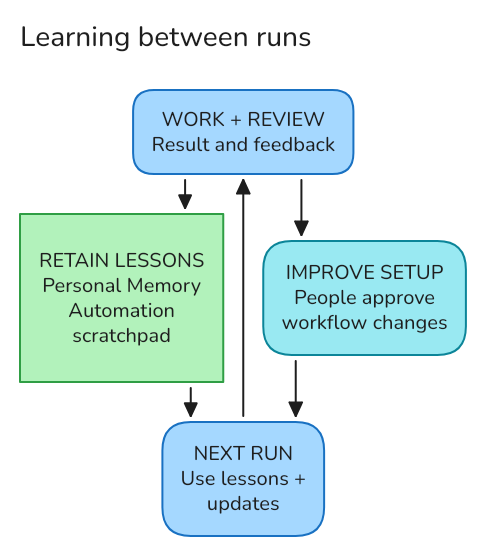
The larger improvement loop still needs people. Timee proposes scheduled reviews of automation sessions to suggest better instructions or configuration, with humans judging which changes to adopt.
For an engineering team, this makes the practical question broader than how much code an agent writes. It also matters which tasks start, how findings return to the agent, what information survives a session and who authorises the final change. The diagrams separate those decisions so that each can be configured and checked.
Related: How Meta’s Astryx gives developers and coding agents a shared interface toolkit.
Discover more from Sulat AI & Tech News
Subscribe to get the latest posts sent to your email.