Silk Compute sells API access to open-weight AI models with their refusals removed, and pitches it to “teams doing red teaming, security research, synthetic data and ML research that mainstream platforms aren’t built for.” It put that line in a post on X at 4am on 21 November, New Zealand time.
The company’s terms of use have one rule: no sexual content involving anyone under 18, and no using the models to abuse or exploit a child. Silk says its models are served without content filters, that it doesn’t read requests, and that it stores neither prompts nor answers. Its terms, privacy policy and trust page name no company, founder or address.
- What Silk is selling
- What “abliterated” means
- The models and what they cost
- The terms
- What Silk says it keeps
- How Silk got here
- The Hy4 licence
- What outside researchers say
- What Silk doesn’t publish
- What security teams can check
- Terms in this article
What Silk is selling
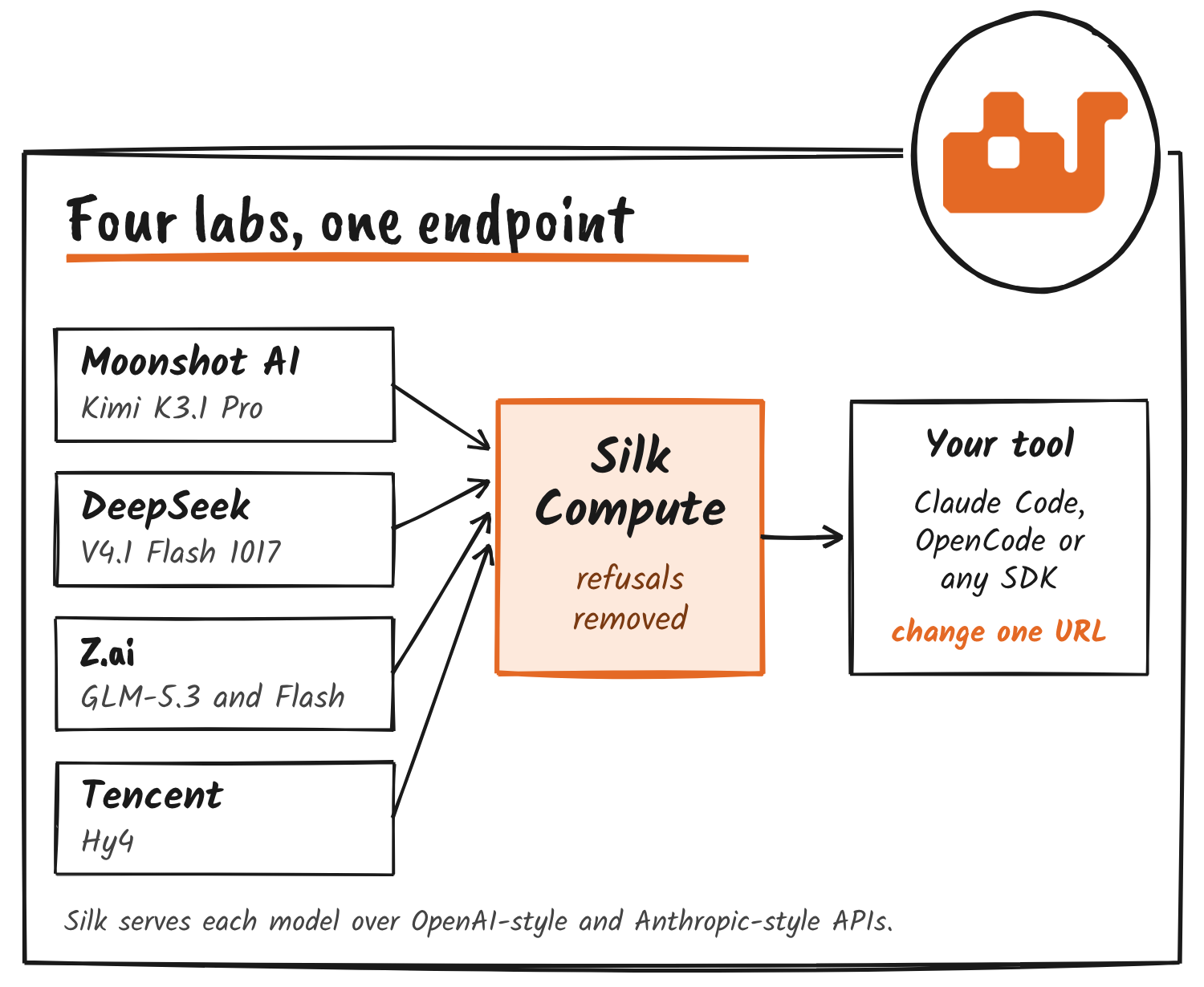
Silk’s llms.txt file calls the service “an uncensored LLM API” that serves abliterated open-weight models “with their refusal behavior removed and no content filters added.” It speaks three formats, OpenAI Chat Completions, OpenAI Responses and Anthropic Messages, so a developer keeps their SDK or coding agent and changes two settings: the base URL, which becomes api.silkcompute.com, and the API key.
Customers buy prepaid credits from US$5 or take a monthly plan, and pay by card or in Monero, Bitcoin, Ether, USDT or USDC. On the pricing page, plans run from US$9 a month on yearly billing for Go, which includes US$12 of usage, to US$167 a month for Ultra, which includes US$300.
6
model ids, from four labs
1M
tokens of context on each
US$5
smallest credit top-up
1
rule in the terms
What “abliterated” means
Abliteration edits an open-weight model so it stops refusing. A 2024 paper by Andy Arditi and six co-authors, “Refusal in Language Models Is Mediated by a Single Direction”, found that in 13 open-source chat models of up to 72 billion parameters, erasing one direction from the model’s internal activations stopped it refusing harmful instructions. Silk’s explainer describes the recipe in four steps and says it needs no new training data and no fine-tuning.
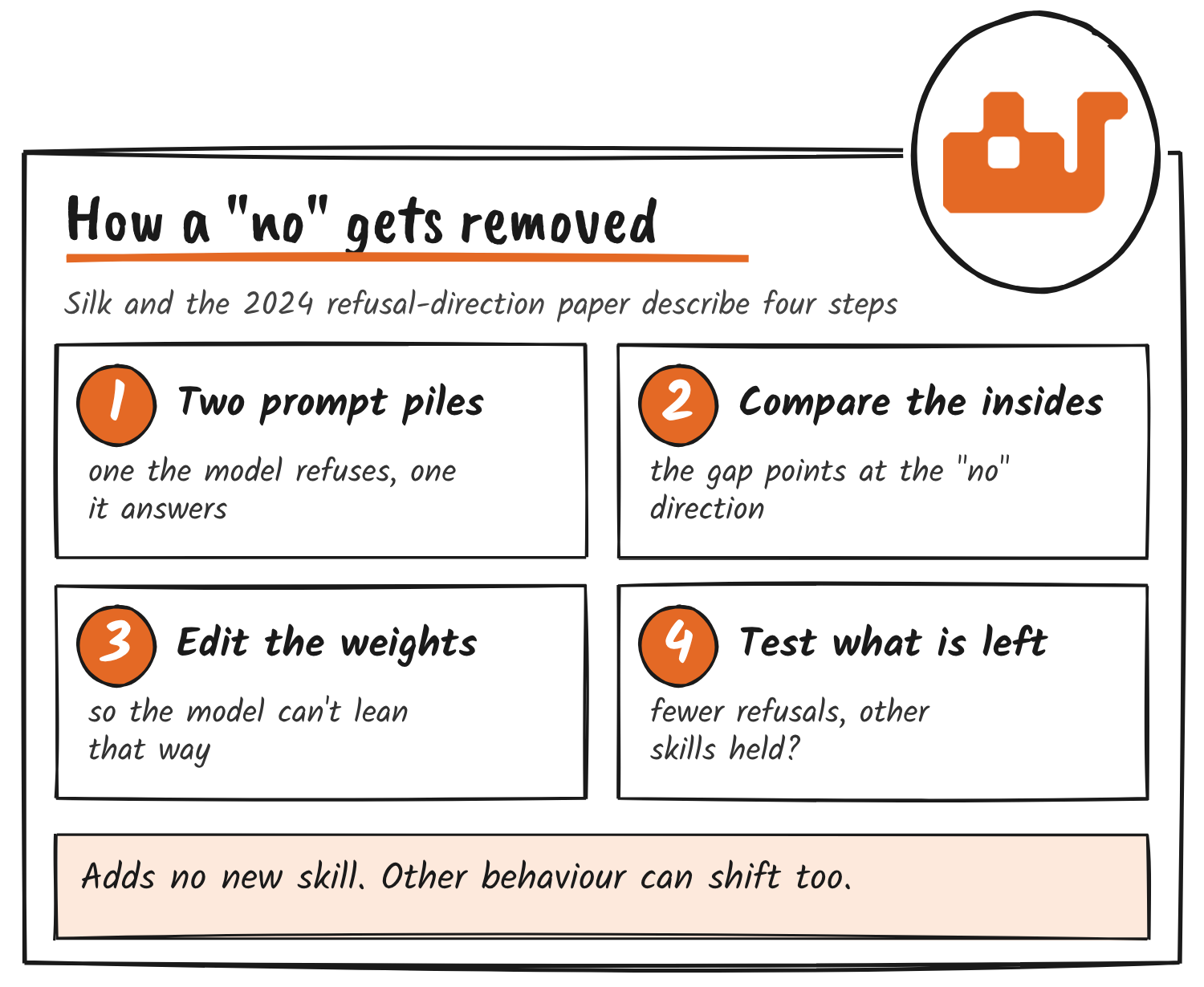
The method needs the weights, so it only works on open-weight models. LevelBlue’s SpiderLabs, in a 16 November report on the unrestricted AI market, says editing refusals out of a model takes a downloadable copy, and that once someone has one, the publisher generally can’t recall it. Silk’s own comparison table lists the catch: an abliterated model “can still refuse, and other behavior can shift.”
The models and what they cost
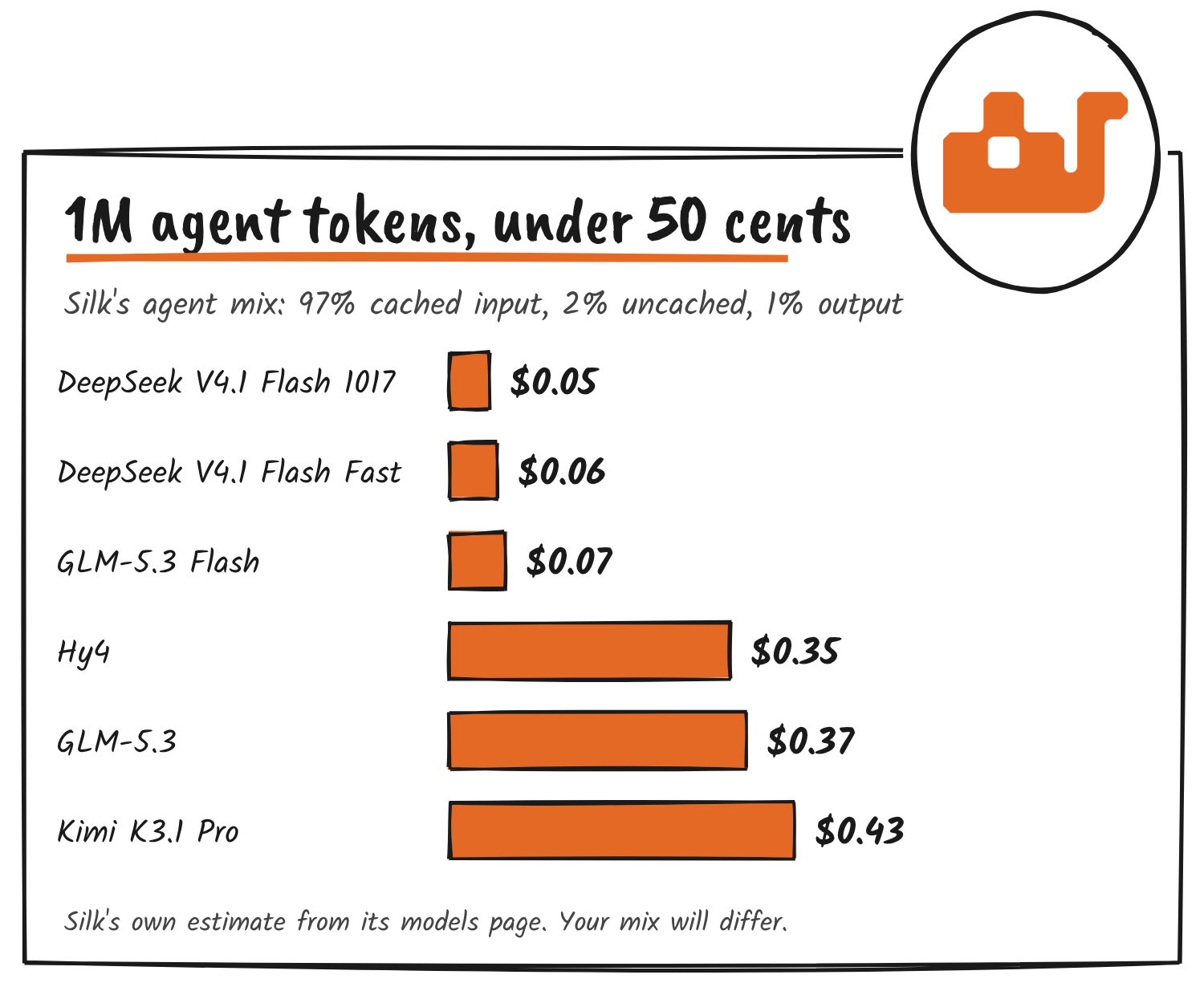
Silk lists six model ids from Moonshot AI, DeepSeek, Z.ai and Tencent. It labels Kimi K3.1 Pro “Best at cyber” and recommends it for security research and red teaming. The models page marks Kimi down from US$5 input, US$0.50 cached and US$20 output to the prices below.1
| Model | Maker | Input | Cached input | Output |
|---|---|---|---|---|
| Kimi K3.1 Pro | Moonshot AI | US$3.00 | US$0.30 | US$8.00 |
| DeepSeek V4.1 Flash 1017 | DeepSeek | US$0.24 | US$0.038 | US$0.90 |
| DeepSeek V4.1 Flash 1017 Fast | DeepSeek | US$0.24 | US$0.05 | US$0.90 |
| GLM-5.3 | Z.ai | US$2.00 | US$0.30 | US$4.00 |
| GLM-5.3 Flash | Z.ai | US$0.24 | US$0.06 | US$1.00 |
| Hy4 | Tencent | US$1.60 | US$0.30 | US$3.20 |
For a coding agent, Silk estimates the bill at US$0.05 per million tokens on DeepSeek V4.1 Flash 1017 and US$0.43 on Kimi K3.1 Pro. The estimate assumes 97% cached input, 2% uncached input and 1% output, a mix Silk says is an assumption.
The terms
The models are served without content filters, and we do not read your requests.
Silk Compute, Terms of use, last updated 5 November 2026
That line sits in a section headed “Your responsibility.” It goes on: “What you do with Silk Compute is up to you, and so is the responsibility for it.” The next sentence says security research, red-teaming and testing your own systems are welcome. The only banned use is in the section headed “Our only rule.” Customers must be 18 or older, and the terms bar sharing or reselling access without asking Silk first.
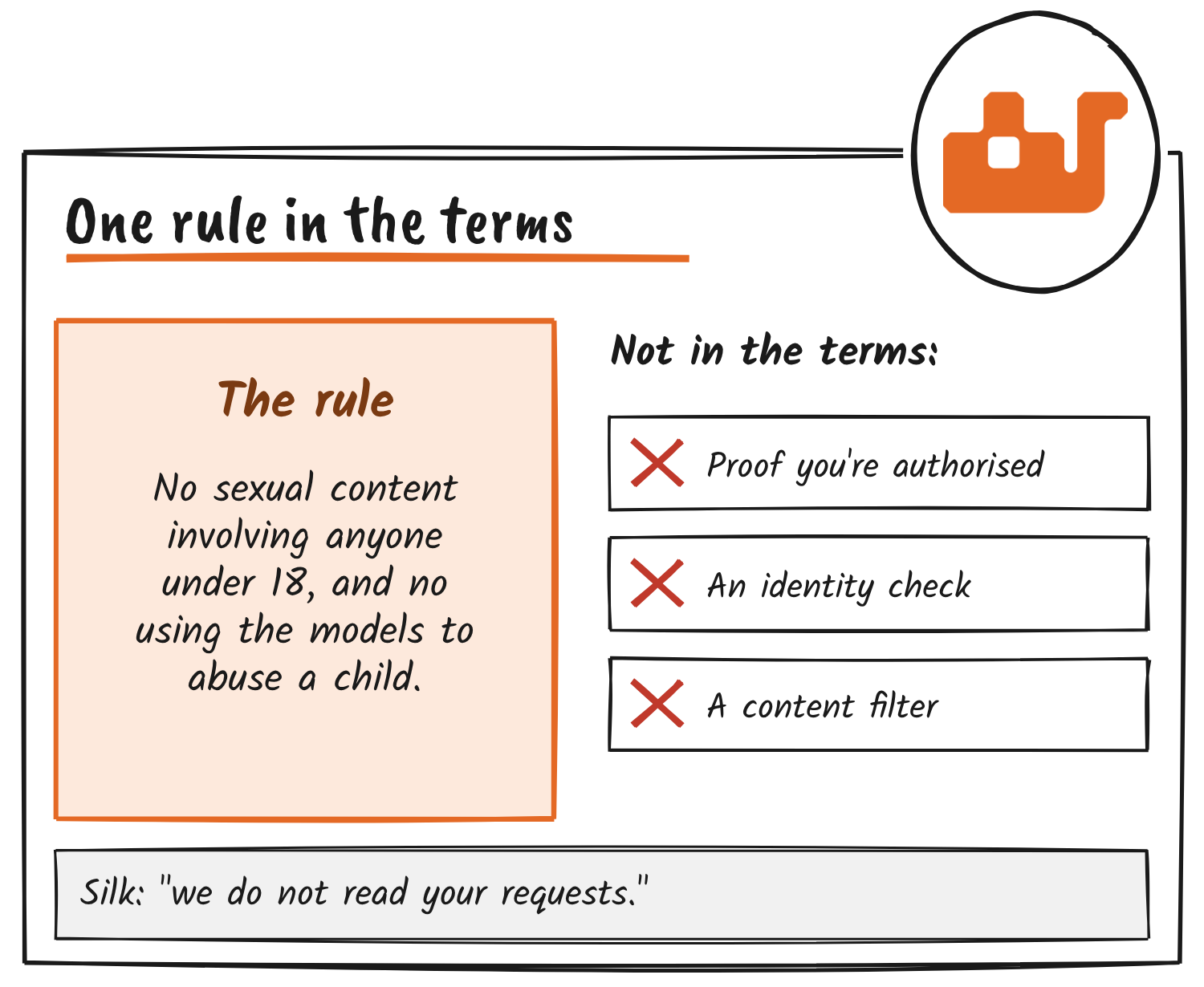
Abliteration.ai, a US rival that The Decoder covered on 6 September, says it requires written authorisation for target systems and compliance with applicable laws, and blocks sexual content involving children. Silk’s terms ask for no authorisation statement. The same article names Silk among providers that “also host abliterated or largely unrestricted models for security use cases.”
What Silk says it keeps
Silk says prompts and model outputs “pass through our servers and are not stored.” It says it keeps account, billing and usage records, and technical logs that include IP addresses.
What the privacy policy says Silk keeps, and what it doesn’t
- Kept: email address, username and a hash of the password; hashes of API keys; for each request, the model, token count, cost, time and key used.
- Kept: top-ups, credits and payment status, plus the deposit address and transaction for crypto payments; messages sent to Silk by email.
- Kept: server logs with IP addresses, which older entries leave as new ones come in.
- Not stored: prompts and the models’ answers. Silk says the same goes for its infrastructure providers, “with no exceptions.”
- Handled by others: Stripe for cards, CryptAPI for crypto other than Monero, Cloudflare for protection and account emails, Mailgun for product news. Silk’s trust page also lists OVHcloud and an unnamed “AI inference infrastructure” provider.
The trust page lists SOC 2 Type II, ISO 27001 and CSA STAR Level 1 as in progress, and an internal penetration test attestation dated November 2026.
How Silk got here
| When (NZ time) | What happened | Source |
|---|---|---|
| August 2026 | The @silkcompute account joins X. | X profile |
| 6 September | The Decoder lists Silk among providers hosting abliterated models. | The Decoder |
| 4 November | Silk posts launches for DeepSeek V4.1 Flash 1017 and GLM-5.3 Flash, and comparison posts against Venice AI, Abliteration.ai and OpenRouter. | Silk blog |
| 5 November | Hy4 goes on sale a day after Tencent’s launch. The terms get their current text. | Silk blog, terms |
| 14 November | The privacy policy is updated. | Privacy policy |
| 16 November, 3:04pm | Silk teases Qwen 4 Uncensored, “coming soon to our API.” | Silk on X |
| 17 November, 1:28pm | Silk apologises for outages “over the last two days” and puts Kimi K3.1 Pro 50% off for 24 hours. | Silk on X |
| 18 November, 9:57am | Silk says it added compute, so Kimi stays 50% off: US$3 input, US$8 output, US$0.30 cached. | Silk on X |
| 20 November, 4:52pm | Tencent announces open weights for Hy4. | Tencent on X |
| 20 November, 6:21pm | Silk says its refusal-free Hy4 is “already live.” | Silk on X |
| 21 November, 4:00am | Silk posts its introduction. | Silk on X |
The Hy4 licence
Silk added Hy4 on 5 November, when only a preview of the weights was out. Its launch post cites the preview’s Apache 2.0 licence and says Tencent planned to publish the final weights “in the coming days.” They arrived 15 days later.
Tencent’s post says a system card with “a comprehensive safety evaluation report” came with the weights. Silk’s launch post quotes Tencent saying “offensive materials related to exploitation are explicitly excluded from the training dataset.” Silk’s own reading is that Hy4 should trail on exploit work, and it sends that work to Kimi.
Removing refusals can’t add training data, so we’d expect Hy4 to trail on exploit work. That’s our reading, not a benchmark.
Silk Compute, Hy4 Uncensored launch post, 5 November 2026
The final weights moved off Apache 2.0. As I reported on the day, they’re under the Tencent Hy License 1.0, whose Section 10 requires a separate written licence from businesses that sell model access above US$50 million in worldwide gross revenue in any 12 months, or that put the model in a product with more than 100 million monthly users. The licence counts fine-tuned, quantised, distilled, merged and pruned versions as derivative works.

Silk doesn’t publish its revenue or user numbers, and its Hy4 pages don’t mention the licence change. They don’t say whether the Hy4 it serves was built from the preview weights or the final ones.
What outside researchers say
LevelBlue’s report covers the market Silk sells into. Its analyst, Serhii Melnyk, counted 290 GitHub repositories with “abliterated” in the name, description or topics on 30 October, 278 of them created in 2026, and nearly 9,000 models under that word on Hugging Face. He writes that hosted services often promote crypto payments, minimal registration and promises that prompts aren’t retained, and that the promise has limits:
A statement that sessions are not stored does not say whether content is held temporarily, whether metadata is kept for abuse monitoring, whether backups exist, or what upstream infrastructure providers can see.
LevelBlue SpiderLabs, 16 November 2026
LevelBlue assesses “with moderate confidence” that the services lower the barrier to entry more than they raise the ceiling of what attackers can do. It also says defenders “should not treat every unrestricted model or public modification tool as malicious.”
On capability, NIST’s CAISI said on 17 September that GLM-5.3, the base of two Silk models, is “the most cyber-capable open-weight model released to date” and trails the US frontier by about four months on its aggregate cyber measure. That assessment covers Z.ai’s model, not an abliterated copy.
Red teams are split on whether abliteration is needed. In TechCrunch’s 3 September report on Abliteration.ai, Ahmed Aly, CEO of agent red-teaming firm Fabraix, said his company relies more on fine-tuning open models, and that abliteration removes some of a model’s knowledge and capabilities. David Slater of Armadin said abliterated models “are not part of the process” so far.
What Silk doesn’t publish
- A company name, founder or address. Silk’s terms, privacy policy and trust page name none, and its contact options are an email address, a form and a PGP key.
- A test of its own modified weights. The benchmark figures on its pages come from Z.ai, DeepSeek, Vals AI and Tencent, measured on the original models. Silk’s Hy4 post says so: “Every score is for the original model, not the abliterated one.”
- Who made the edits. Silk’s guides say it “serves” the models and don’t say whether it or a third party removed their refusals.
- A customer count, or any figure for abuse reports or accounts closed.
- Completed compliance work. SOC 2 Type II, ISO 27001 and CSA STAR Level 1 are all listed as in progress.
Silk has two more models on the way. Its X account says Qwen 4 Uncensored is “coming soon,” and its guides say GLM-5.5 is coming soon.
What security teams can check
Silk’s pitch is that you change one URL. For a security team, that URL is the thing to look for. LevelBlue’s report lists six steps, and Silk’s hostname goes straight into the first two.
- Inventory AI endpoints: record base URLs, API keys and local inference servers, and compare them with an approved provider list. Search for
api.silkcompute.com. - Watch proxy, DNS and egress logs for unfamiliar inference gateways, model hubs and new API-compatible endpoints on developer machines.
- Treat coding agents as execution environments: isolate their workspaces, restrict outbound connections and require human approval before destructive actions or access to credentials.
- Keep secrets and regulated data away from unapproved third-party inference, and use scoped, short-lived credentials.
- Check model provenance: approve publishers, pin versions and hashes, and test unfamiliar weights in an isolated environment.
- Don’t rely on refusals as a security control. Enforce security with identity controls, network policy, sandboxing and human approval.
Terms in this article
- Abliteration
- Editing an open-weight model’s weights to remove the internal direction that drives its refusals.
- Open-weight model
- A model whose trained weights are published for download, which is what makes editing it possible.
- Refusal
- A model declining a request, such as “I can’t help with that.”
- Base URL
- The address an SDK or coding agent sends requests to. Changing it moves the traffic to another provider.
- Cached input
- Input tokens the provider has already processed and bills at a lower rate. Agents resend their context every turn, so most of their input is cached.
- Model-as-a-service
- Selling remote access to a model, for example through an API. Tencent’s Hy4 licence has separate terms for it.
- Silk’s pricing and models pages list Kimi K3.1 Pro at US$3.00 input, US$0.30 cached and US$8.00 output per million tokens. Its homepage and the model list on its Hy4 page show US$3.50 input and US$0.35 cached. ↩︎
Sources
- Silk Compute on X, 21 November 2026 NZ time, and its profile
- Silk Compute: terms of use, privacy policy, trust centre, models, pricing and llms.txt
- Silk Compute: Hy4 Uncensored, 5 November 2026, and What is an abliterated model
- Tencent Hy on X, 20 November 2026
- Arditi et al., Refusal in Language Models Is Mediated by a Single Direction, arXiv, 2024
- LevelBlue SpiderLabs: Tracing the Unrestricted AI Ecosystem, 16 November 2026
- NIST CAISI: Assessment of Z.ai’s GLM-5.3 Cyber Capabilities, 17 September 2026
- The Decoder, 6 September 2026, and TechCrunch, 3 September 2026
Discover more from Sulat AI & Tech News
Subscribe to get the latest posts sent to your email.