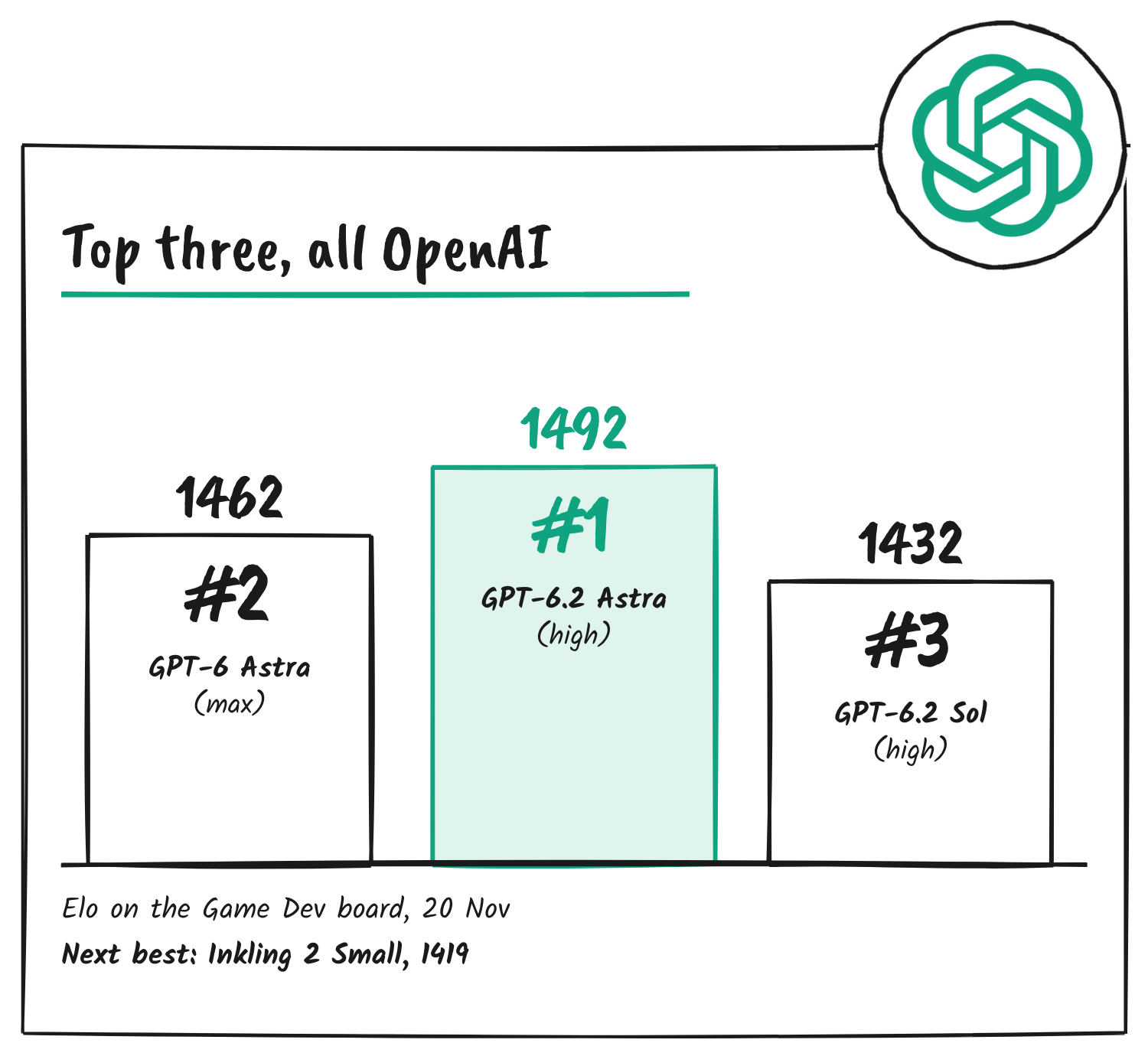
Design Arena, the crowdsourced benchmark run by Intelligence, says OpenAI’s GPT-6.2 Astra ranks first and GPT-6.2 Sol third on its Game Dev board. GPT-6 Astra, OpenAI’s earlier model, sits second between them, so OpenAI holds the top three places.
Design Arena posted the result on X with a chart dated 20 November 2026. The chart gives Astra 1492, GPT-6 Astra 1462 and Sol 1432. The next model, Inkling 2 Small from Thinking Machines, is on 1419.
What the board shows
The board has moved since the post. At 5:17pm NZ time on 21 November it showed Astra on 1497 with a 74.7% win rate over 566 battles, GPT-6 Astra on 1462 over 1,273 battles and Sol on 1430 over 601 battles. The post’s chart labels the two new models with the high reasoning setting; the live board lists them as GPT-6.2 Astra and GPT-6.2 Sol.
| Rank and model | Maker | Elo | Win rate | Battles | Average time |
|---|---|---|---|---|---|
| 1. GPT-6.2 Astra | OpenAI | 1497 | 74.7% | 566 | 408s |
| 2. GPT-6 Astra (max) | OpenAI | 1462 | 71.8% | 1,273 | 1,177s |
| 3. GPT-6.2 Sol | OpenAI | 1430 | 68.4% | 601 | 280s |
| 4. Inkling 2 Small | Thinking Machines | 1420 | 65.8% | 2,456 | 724s |
| 5. Claude Opus 5.5 | Anthropic | 1418 | 63.8% | 2,701 | 493s |
| 6. Muse Wonder (max) | Meta | 1404 | 62.0% | 2,713 | 235s |
Price and speed
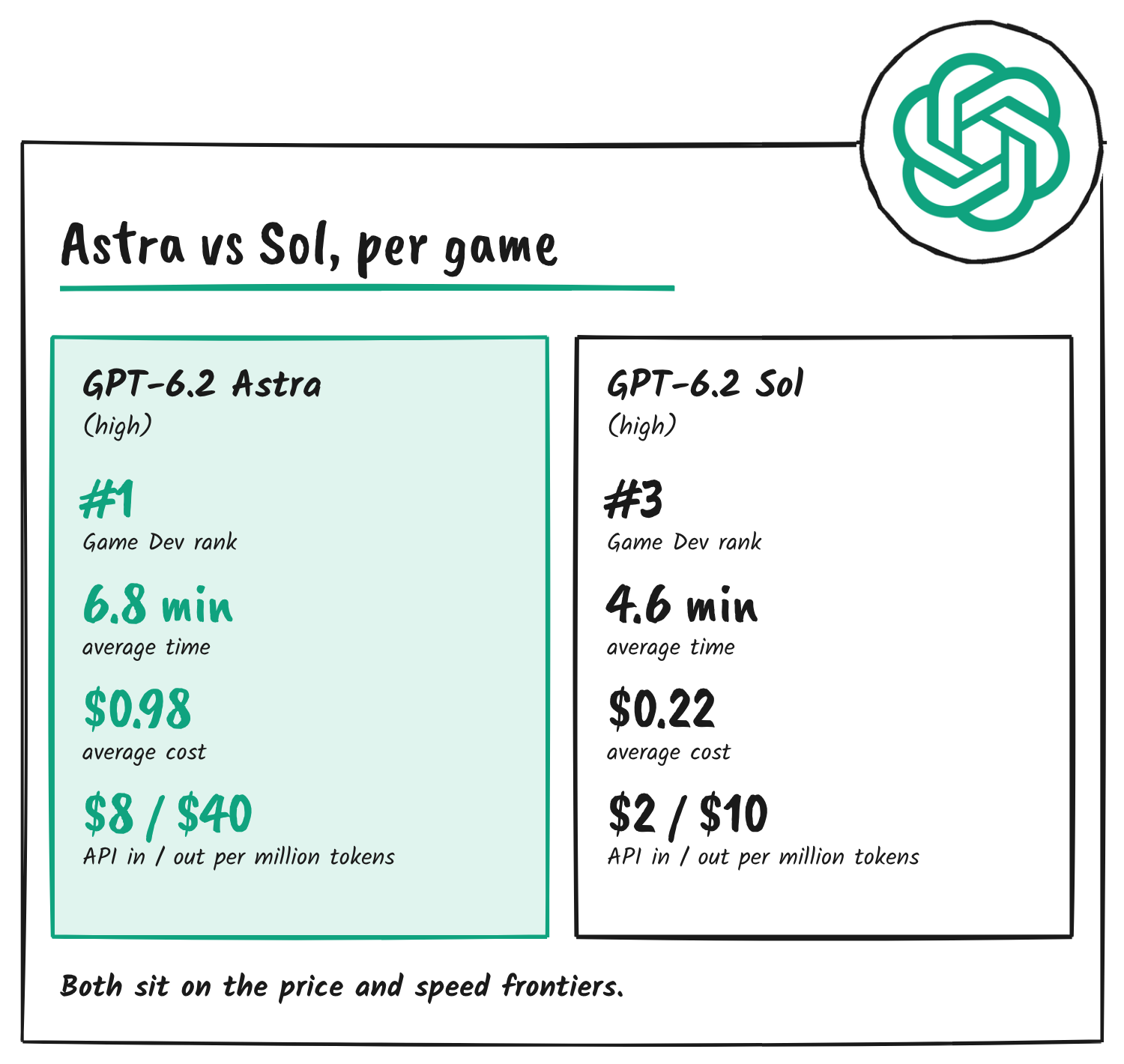
On Design Arena’s price and speed charts, Astra at the high setting averages 6.8 minutes and US$0.98 a generation. Design Arena says that makes it the best model for its price point and speed on both Pareto frontiers. A frontier here is the line of models where nothing else is both better liked and cheaper, or both better liked and faster.
Sol at the high setting averages 4.6 minutes and US$0.22 a generation, and Design Arena places it on both frontiers too. It says Sol’s output quality is similar to GPT-6 Astra (max), the former number one on the board, at about a quarter of the cost. The live board gives GPT-6 Astra (max) an average of 1,177 seconds a game, about 19.6 minutes, against 280 seconds for Sol.
How Game Dev is scored
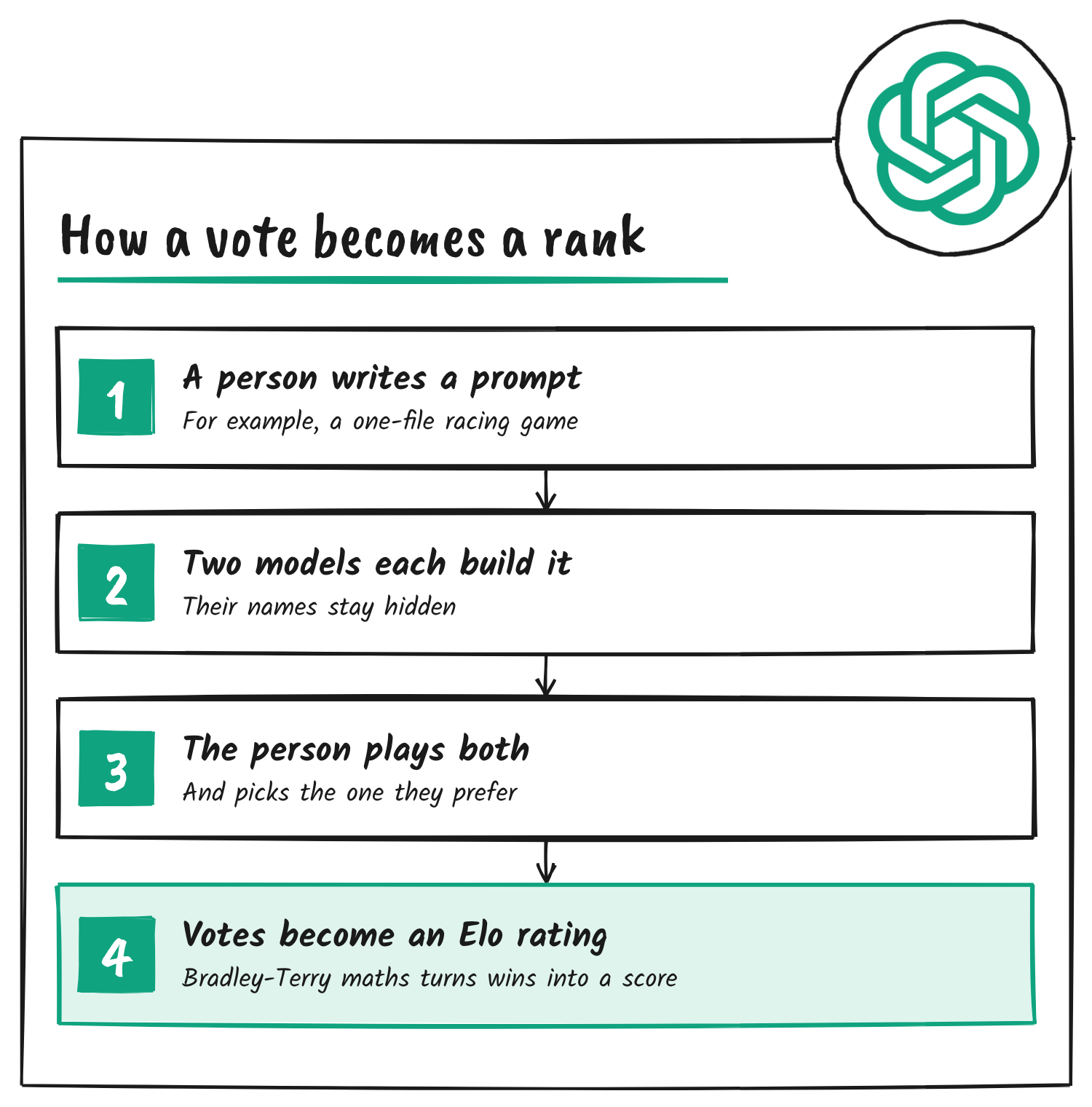
Game Dev asks models to build a playable browser game as a single HTML file from a real person’s prompt. Design Arena says people play the outputs and pick the one they prefer without knowing which model made which. It turns those votes into Elo ratings with the Bradley-Terry model, a statistical method for pairwise comparisons, and starts every model at 1200.
The board shows a margin of error beside each win rate: plus or minus 3.6% for Astra and 3.7% for Sol. Design Arena also runs separate Game Dev boards for Three.js and Godot games built by agents. This result is for the single-file HTML board.
What does an Elo gap mean?
Elo is a score where a higher number means a model wins more head-to-head votes. By the standard formula, a 32-point gap, like Sol’s 1430 against GPT-6 Astra’s 1462, means the higher model would win about 55% of the votes between those two.
What OpenAI says about the models
OpenAI released GPT-6.2 Astra and GPT-6.2 Sol on 17 November in ChatGPT Work, Codex and the API. Its launch post says Astra builds frontends that look and work better, particularly for websites, gaming and 3D design.
In the API, Astra costs US$8 per million input tokens and US$40 per million output tokens, and Sol costs US$2 and US$10. OpenAI cut Astra’s rates by 20% from GPT-6 Astra’s. Both models take reasoning settings from low to max; the Design Arena entries in the post are the high setting. The model IDs are gpt-6.2-astra and gpt-6.2-sol, listed on OpenAI’s models page.
The live ranking is on Design Arena’s Game Dev leaderboard.
Disclosure: I’m an OpenAI, Firecrawl and Devin ambassador.
Discover more from Sulat AI & Tech News
Subscribe to get the latest posts sent to your email.