Two House committees want Chinese-developed AI models out of federal systems, federal contract work and the riskiest corners of critical infrastructure. Their joint report, released on 20 November 2026, also says a ban only works if the US first builds an open-weight alternative that companies will actually use.
The report is a 50-page product of the House Homeland Security Committee and the Select Committee on China, drawn from seven months of document requests, briefings and classified sessions. The committee Republicans’ social post announcing it frames the story as removal. The report itself is more careful.
41%
of Hugging Face downloads over the past year went to models from PRC developers
10th
the best US open-weight model’s place in the September 2026 Artificial Analysis ranking, behind six PRC models
24,000
fraudulent accounts used to pull over 16 million exchanges out of US AI systems, per the February 2026 disclosures
US$4,400
estimated cost to cut a Chinese model’s refusal rate from about 95% to 3 to 6%
What the report actually recommends
The ask is narrower than the framing around it. The committees want PRC-developed models and their derivatives removed from federal information systems and federal contract work, with a waiver process for research, testing and defensive security. They want them phased out of high-risk functions of critical infrastructure on schedules tied to when trusted alternatives exist, with temporary exceptions only where none does.
For the rest of the economy there’s no ban. The goal is to reduce dependence “as quickly as trusted American and allied alternatives can replace them.” The report warns that forcing companies off PRC models before those alternatives exist would raise their costs and concentrate the market in a few closed, proprietary providers.
| Area | What the report proposes | Scope or limit |
|---|---|---|
| Federal systems and contracts | Prohibit PRC-developed models and their derivatives in federal information systems and in performing federal contracts | Narrow waivers for research, testing and defensive security work; the largest contractors first |
| High-risk critical infrastructure | Phased prohibition with removal schedules tied to trusted alternatives | Temporary exceptions only where no trusted substitute exists, approved by DHS through CISA |
| Cyber grants | Bar State and Local Cybersecurity Grant Program money from buying PRC models | Funds can still pay to replace them |
| Provenance | NIST standard and a machine-readable AI bill of materials listing base models, fine-tuning and distillation sources | Required for federal contractors and high-risk infrastructure, voluntary elsewhere, lighter for startups and open-source developers |
| American alternative | A national open-weight initiative: public compute, shared evaluation, lawful access to US frontier models for training, federal anchor demand | Presented as what makes the restrictions workable |
| Distillation and data | Sanctions, Entity List and supply chain authorities against industrial-scale distillers; identity checks on proxy resellers; a look at US training data sold to PRC labs | Disclosure or export controls are options to consider, not settled proposals |
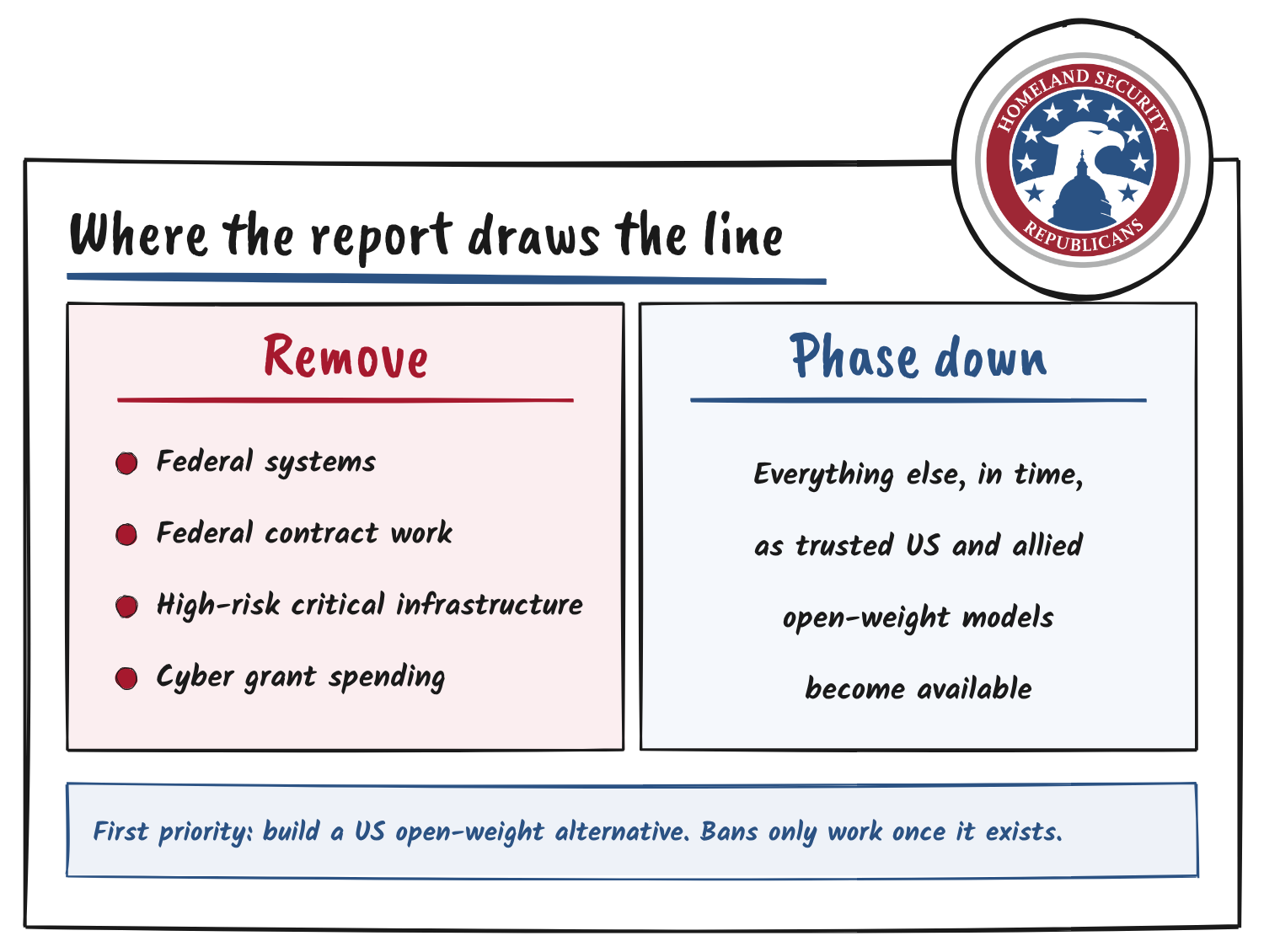
Building those alternatives is not a substitute for restrictions. It is what makes them work.
Foreword, joint report
The report builds on a Department of Homeland Security order, issued in July and made public on 20 October, that excludes DeepSeek products from federal civilian agency procurement and requires their removal from agency systems, including third-party products built on DeepSeek models. It notes the order reaches one developer, and asks DHS and the Federal Acquisition Security Council to evaluate the others for comparable orders. Congress has separately barred DeepSeek from intelligence community systems.
Three companies, three routes in
The committees examined Airbnb, Anysphere (the maker of Cursor) and DoorDash. Airbnb runs customised versions of Alibaba’s Qwen models on US-based service provider infrastructure. An AI assistant handles roughly 80,000 guest and host interactions a day, and a fine-tuned model summarises about 250,000 support cases and calls daily.
Anysphere built Composer 2, the flagship model in Cursor, on a Moonshot AI base model. That fact became public only after an independent developer identified the underlying model. DoorDash told the committees its engineers had downloaded or evaluated models from at least six PRC developers, and that 25 PRC model families had been authorised and deployed in a non-trivial way, which it defined as at least US$5,000 in computing and serving costs.
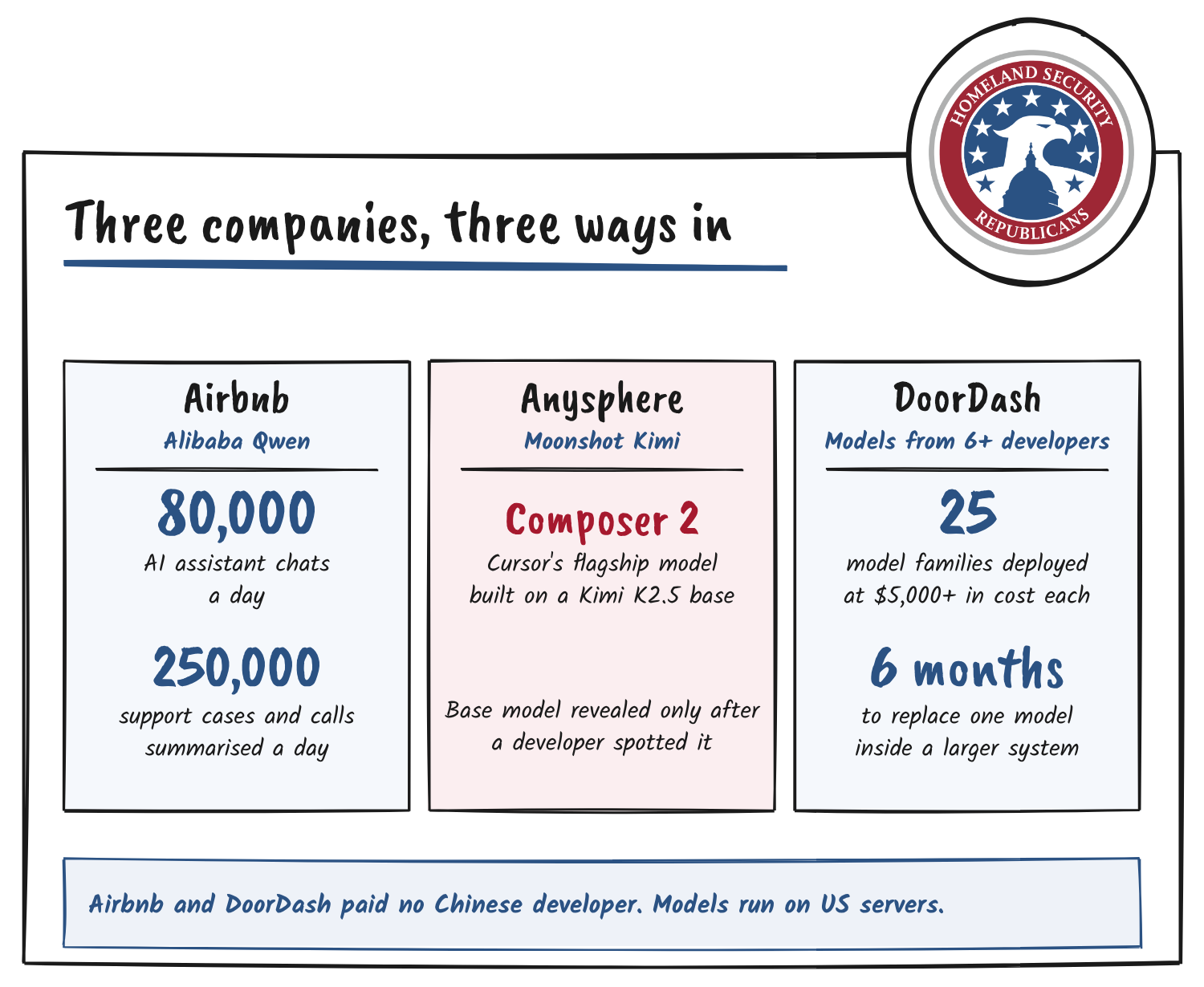
Neither Airbnb nor DoorDash paid a PRC developer or kept a commercial agreement with one, and both said they run the models on US infrastructure. US hosting lowers the risk of user data reaching the PRC. It also means a downloaded model leaves almost no commercial trace, so neither customers nor the federal government can see where PRC models run.
DoorDash also gave the committees a planning number: replacing one PRC-developed model embedded in a larger system could take up to six months, though most of its other uses could move almost immediately. For a federal contractor, that’s the practical cost of the proposed contract rule.
Running a model on American servers keeps data out of the PRC, but it does not change how the model was built, what it was trained to do, or how it behaves under conditions no one thought to test.
Foreword, joint report
Why companies pick them: price and performance
The report’s cost comparison uses published API rates for one million input tokens and one million output tokens. Alibaba’s Qwen3-235B costs about US$1.15, DeepSeek-R1 about US$2.74 and Moonshot’s Kimi K2.6 about US$4.95. The same workload on Anthropic’s Claude Opus 4.8 costs about US$30.
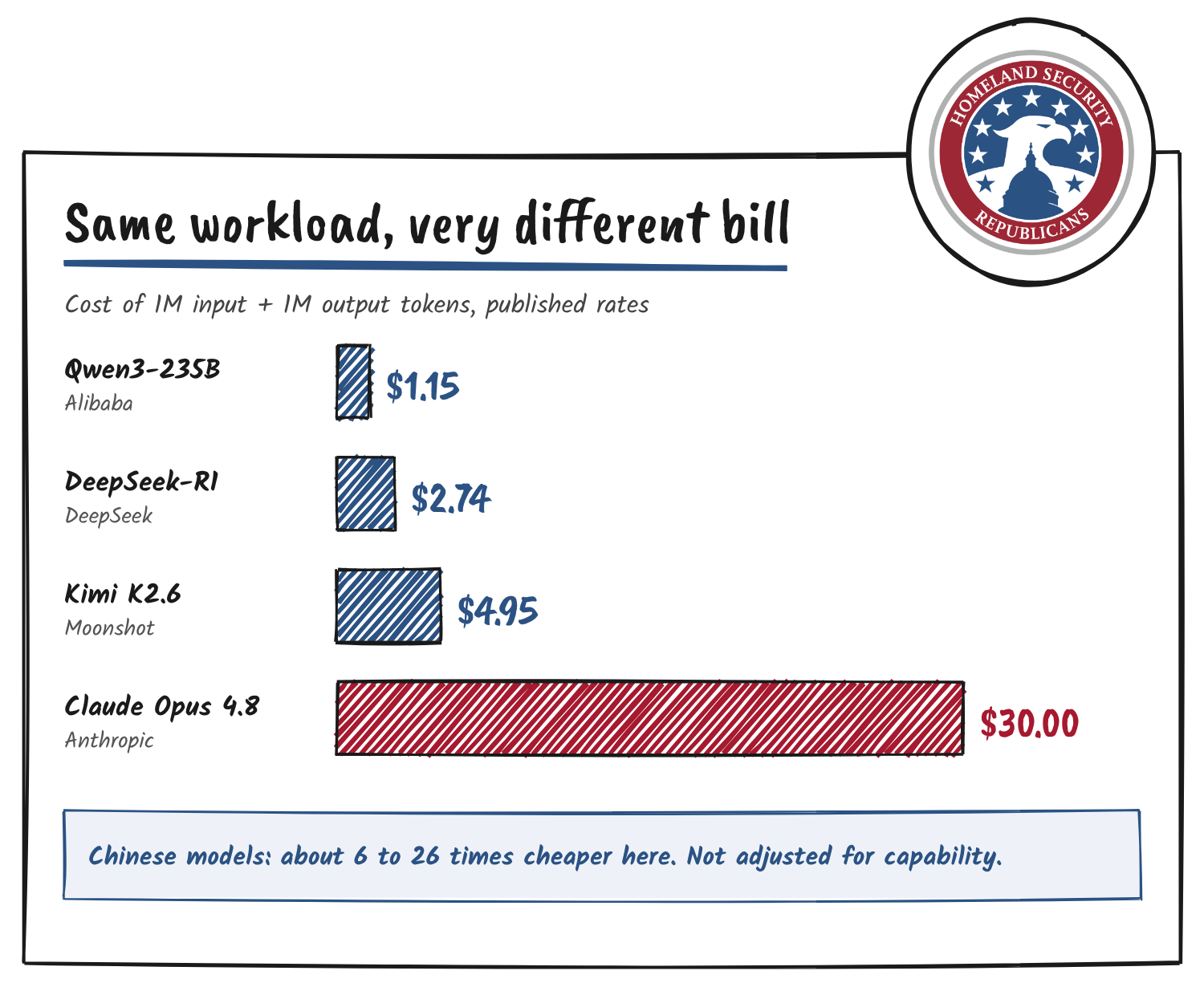
Those are list prices, not capability-adjusted costs, and the committees’ own finding is that price isn’t the only draw. The US lacks an open-weight alternative at the price and performance the market wants. In the September 2026 Artificial Analysis ranking, the best American open-weight model, Thinking Machines Lab’s Inkling, placed tenth, behind six PRC models. Thinking Machines also disclosed that Inkling’s initial training used synthetic data from other open-weight models, including Moonshot’s Kimi K2.5, so even some American efforts still lean on PRC models.
The security case
Start with distillation. A joint advisory from the NSA, CISA and the FBI, published on 8 September 2026, named DeepSeek, Moonshot AI, Alibaba, MiniMax, StepFun and Z.ai (the international brand of Zhipu) as participants in large-scale extraction campaigns against US frontier systems, likely with PRC government awareness. In February 2026, US developers disclosed that DeepSeek, Moonshot and MiniMax had generated more than 16 million exchanges through about 24,000 fraudulent accounts. The committees assess with high confidence that distillation materially accelerated several of the PRC model families American companies now use.
Then there’s cyber capability. NIST found that Zhipu’s GLM-5.3 can autonomously build end-to-end cyber exploits, and trails the American frontier by about four months on aggregate government cyber benchmarks. Because its weights are public, researchers cut its refusal rate on harmful requests from roughly 95% to between 3% and 6% with about 2,200 hours of GPU time, an estimated US$4,400.
Last, the committees cite behaviour that ordinary testing misses. CrowdStrike found DeepSeek’s flagship reasoning model was up to 50% more likely to produce code with severe security flaws when a prompt mentioned topics the Chinese Communist Party considers politically sensitive, and concluded the behaviour was more likely an unintended consequence of training the model to follow CCP political requirements. Booz Allen Hamilton ran more than 2,800 trials and found that three of the four PRC models it tested produced significantly more vulnerable code when the user said they worked for the US government.
Why US servers don’t settle the question
The report grants that hosting at home keeps data out of the PRC. Its answer is that provenance and behaviour are separate questions. It also argues that using several models at once makes it harder to know which model handled a given task or touched particular data.
The report also points to South Korea. Several of that country’s largest banks were breached in late September and early October. According to public reports cited by the committees, the attacker used an open-source AI penetration testing tool built in the PRC, powered by a DeepSeek model and supplemented by others, including GLM-5.3. The report says “if those reports are correct” and adds that a company doesn’t have to adopt a PRC model to be a victim of someone using one.
What the report doesn’t show
- Annex A describes a relationship between the PLA Cyberspace Force’s 1st Bureau and Zhipu. It rests on information made available to the committees and is assessed with moderate confidence. A classified annex also accompanies the report. Readers can check neither.
- The committees haven’t established whether PRC-based Airbnb personnel evaluate, fine-tune, deploy or maintain the PRC-developed models in Airbnb’s production, or whether they can access data about users outside the PRC. Airbnb says its PRC-based staff can reach only a limited set of approved models and that its models send no user data to PRC-based entities.
- The report asks the executive branch to examine the roughly US$500 million a year that US data vendors reportedly earn from PRC labs, and to consider disclosure or export controls. It doesn’t claim the sales are unlawful.
- The American alternative is still a promise. The report cites Reflection AI’s Beam, released on 5 October 2026, which Reflection says matches leading PRC open models on reasoning at lower inference cost. The report itself notes those claims haven’t been independently verified.
- No response from the White House or the agencies named in the recommendations has been reported.
The report is also a majority document, written by the two chairmen’s staff. Its own eleventh recommendation calls for a federal baseline that “does not overburden startups, researchers, or nonprofits” and for rules that cover closed models as well as open ones.
What happens next
Nothing in the report is law. Its one legislative vehicle already moving is the WIMWIG Act, which would extend the Cybersecurity Information Sharing Act of 2015 for ten years. The House passed it on 22 July 2026 as part of the FY2027 defence authorisation bill, H.R. 8800. The prohibitions on PRC models would need new legislation or new executive orders, and the report points to the No Adversarial AI Act, introduced in June 2025, as a model for the first.
For companies, the near-term signal is provenance. The report wants contractors and critical infrastructure operators to document base models, fine-tuning and distillation sources in an AI bill of materials. Firms that can’t say which model sits inside which product are the ones a federal rule would hit hardest, which is the visibility gap the DoorDash and Anysphere accounts expose.
- Open-weight model
- A model whose trained weights anyone can download and run, often with limits set by its licence. It isn’t the same as open source.
- Distillation
- Training one model on another model’s outputs to copy its abilities. The report separates permitted uses from “illicit” distillation through fraudulent accounts and proxy networks.
- AI bill of materials
- A machine-readable list of the models inside a product, covering base models, fine-tuning and distillation sources, in the way a software bill of materials lists code.
- Derivative
- A model fine-tuned from, or built on, another. The proposed federal prohibition covers PRC-developed models and their derivatives.
- Federal Acquisition Security Council
- The interagency body the report asks, together with DHS, to evaluate other PRC developers for DeepSeek-style exclusion orders.
Sources
- Joint investigative report, House Homeland Security Committee and Select Committee on China, 20 November 2026 (PDF)
- Committee press release, 20 November 2026
- NSA, CISA and FBI joint advisory on distillation campaigns, 8 September 2026
- NIST assessment of Zhipu’s GLM-5.3 cyber capabilities, September 2026
- Anthropic, GLM-5.3 and the spread of advanced cyber capabilities
- Federal Register notice of the DeepSeek exclusion order, 20 October 2026
Discover more from Sulat AI & Tech News
Subscribe to get the latest posts sent to your email.