Tencent has released the open weights for Hy4, its flagship model with 770 billion parameters, 49 billion of them active for each token, and a one-million-token context window. Tencent announced it on X on 20 November. The weights are on Hugging Face, ModelScope and GitCode, and a system card came out alongside them.
Hy4 first launched on 4 November through Tencent Cloud and OpenRouter, at US$0.834 per million input tokens and US$2.501 per million output tokens, with Tencent saying it planned to open the weights later. Its launch post described Hy4 as the model that put Hy among the strongest open models for the first time.
Today, we’re releasing the open weights for Hy4.
— Tencent Hy (@TencentHunyuan) November 20, 2026
Our natively multimodal flagship MoE (770B total / 49B active, 1M context).
Alongside the Hy4 System Card with a comprehensive safety evaluation report.
Three checkpoints
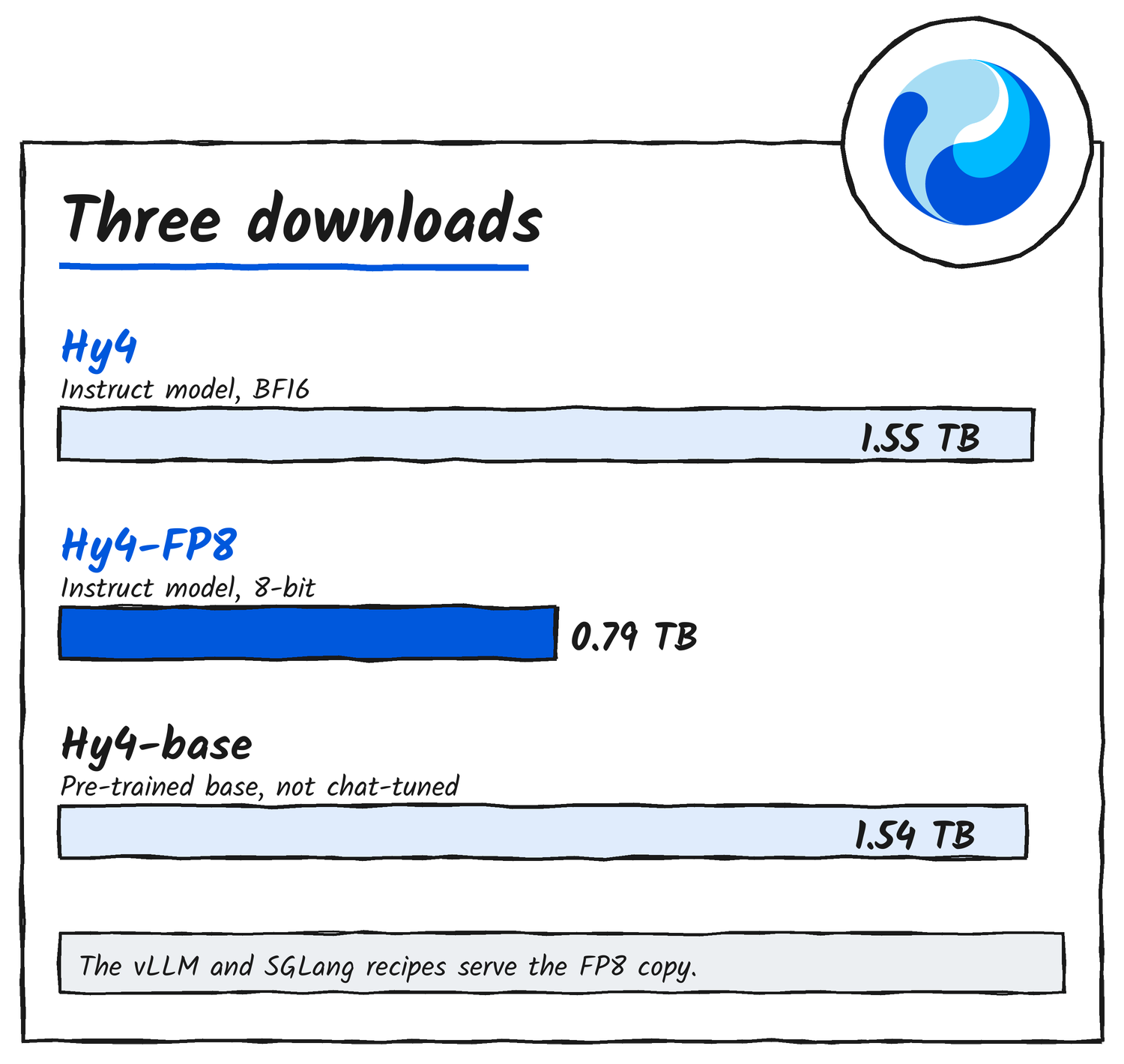
Tencent put three sets of weights up. Hy4 is the instruct model, Hy4-FP8 is the same model stored in 8-bit numbers, and Hy4 base is the pre-trained model before any chat tuning. The shard files on Hugging Face add up to about 1.55TB for Hy4, 0.79TB for the FP8 copy and 1.54TB for the base model.
What is inside
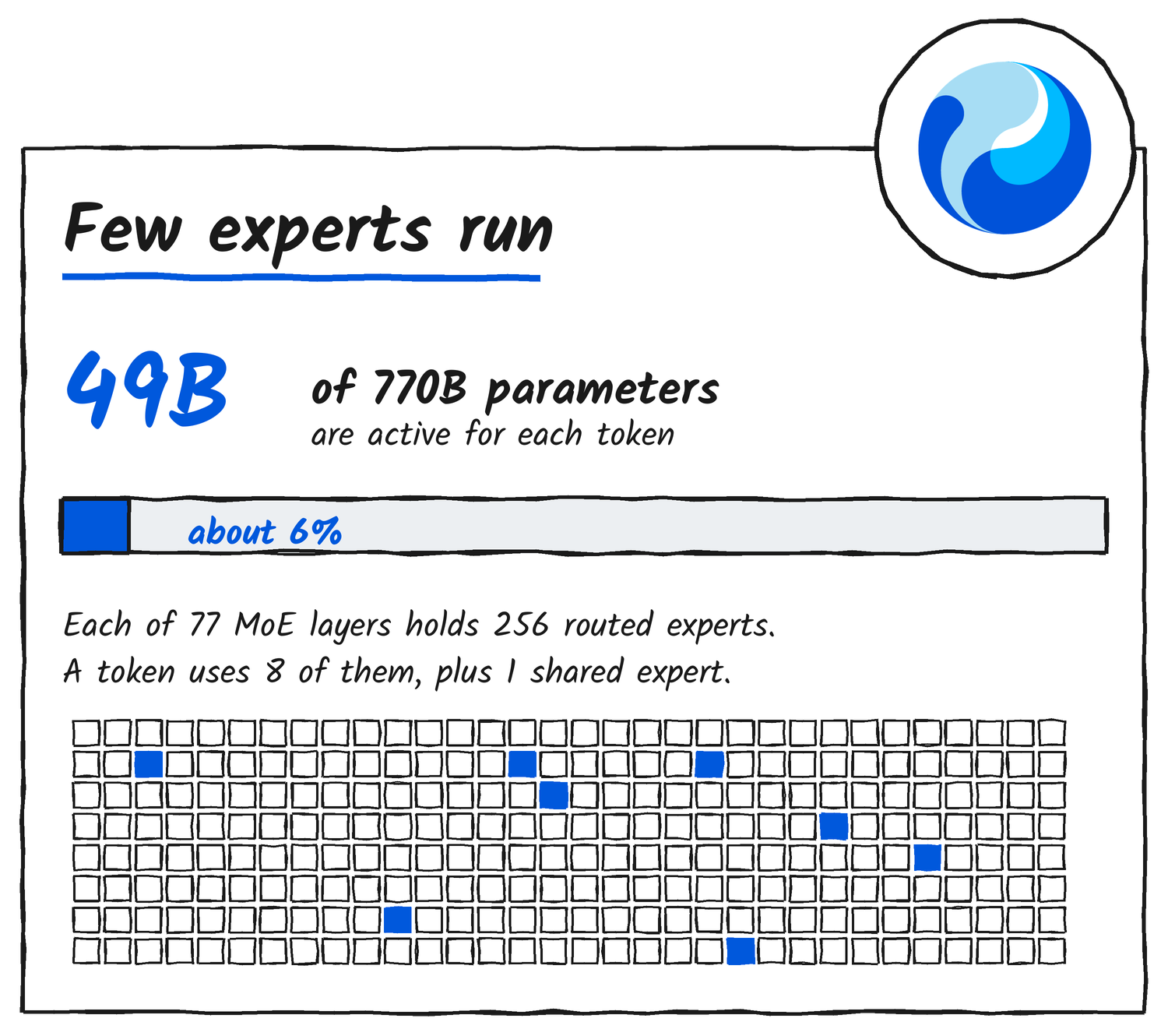
Hy4 is a mixture-of-experts model, so most of it sits idle for any one token. The language backbone has 78 layers: one dense layer, then 77 layers that each hold 256 routed experts and one shared expert. A router picks 8 routed experts per token. That works out to 49 billion active parameters, plus 1.23 billion for the vision encoder, which lets the model read images and video.
For long inputs, Hy4 uses Gated DeepSeek Sparse Attention with IndexCache. An indexer picks the top 2,048 tokens for each query to attend to, instead of the whole million. The model card says the design was inspired by DeepSeek and GLM.
Hy4 also ships with DFly2, a 3.3-billion-parameter drafter for speculative decoding, where a small model guesses the next few tokens and the big one checks them. DFly2 reuses Hy4’s KV cache and the indexer’s chosen positions. Tencent says that means each drafted token looks at about 2,000 keys at most, however long the context runs, and the drafter needs no KV cache of its own.
The licence changed
Hy4 preview, which Tencent released on 28 August, was under Apache 2.0. Hy4 uses the Tencent Hy License, version 1.0. It’s derived from Apache 2.0, and Tencent says its main change is the commercial terms for large model-as-a-service businesses in Section 10.
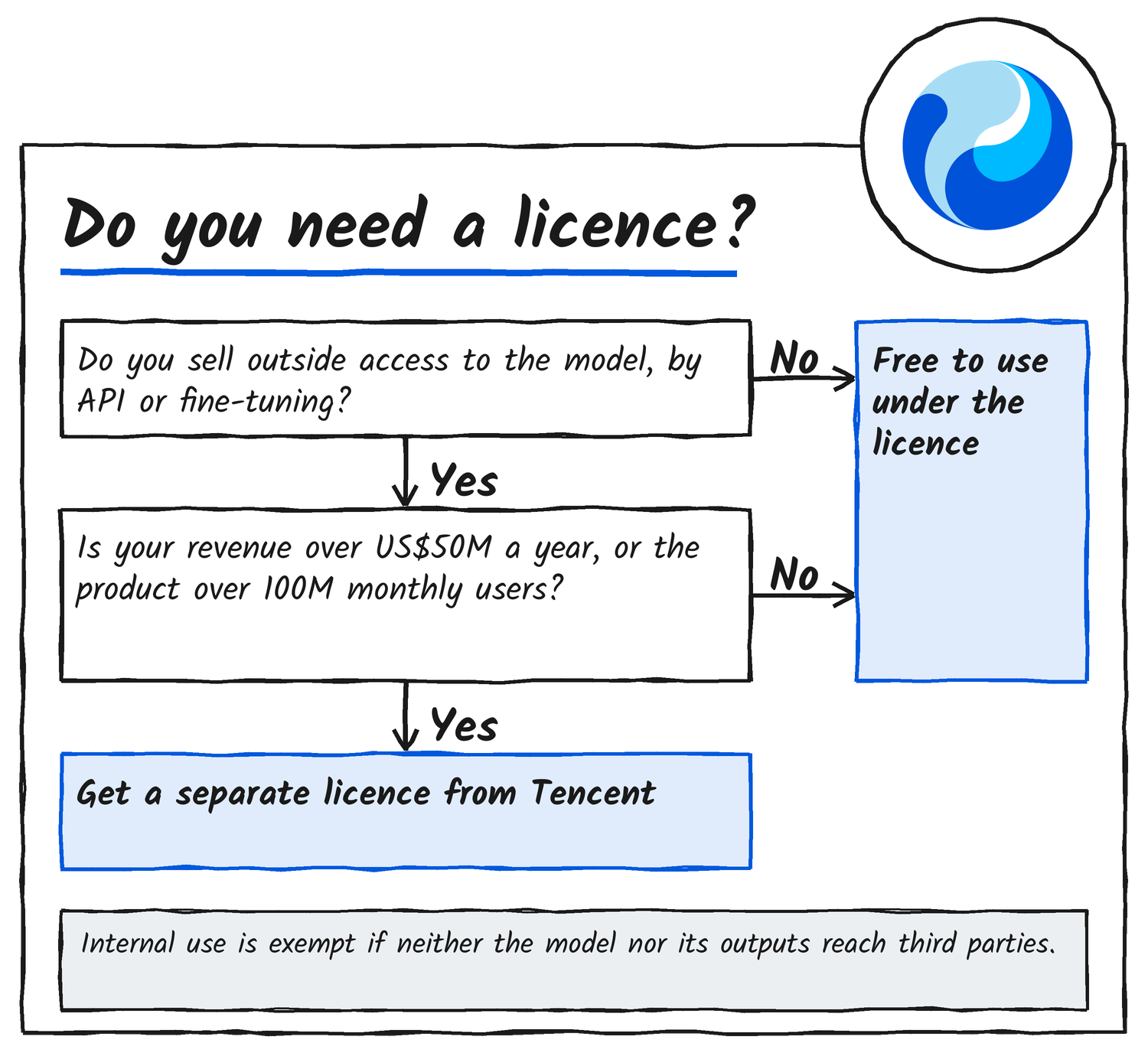
Section 10 defines model-as-a-service as giving third parties remote access to inference or fine-tuning, for example through an API. A business that runs one needs a separate written licence from Tencent if its worldwide gross revenue tops US$50 million in any 12 months, or before it uses the model in a product with more than 100 million monthly users. Internal use is exempt, as long as neither the model, a derivative nor their outputs reach third parties. The licence counts fine-tuned, quantised, distilled, merged and pruned versions as derivative works, and Tencent takes licensing requests at [email protected].
Running it
Both inference projects have prebuilt images: vllm/vllm-openai:hy4 and lmsysorg/sglang:hy4. The example commands on the model card serve the FP8 copy with a tensor-parallel size of 8 and DFly speculative decoding switched on. The repo also carries fine-tuning scripts for DeepSpeed, LLaMA-Factory and ms-swift.
Tencent recommends a temperature of 0.9 and a top_p of 1.0. Reasoning defaults to high, which runs a deep chain of thought. For direct answers, the card passes this through the chat template:
extra_body={"chat_template_kwargs": {"reasoning_effort": "no_think"}}What the numbers say
The only benchmark table in the model card’s text covers the base models, scored few-shot by Tencent. Hy4 Base leads Hy3 preview Base on every row below except one, and sits ahead of DeepSeek-V4-Pro-Base on all but the coding row.
| Benchmark | Hy4 Base | Hy3 preview Base | DeepSeek-V4-Pro-Base |
|---|---|---|---|
| MMLU | 91.6 | 87.5 | 91.1 |
| MMLU-Pro | 73.9 | 65.8 | 73.4 |
| SuperGPQA | 62.7 | 52.3 | 54.8 |
| SimpleQA | 57.2 | 26.4 | 52.1 |
| U-MATH | 71.6 | 60.9 | 64.8 |
| MBPP-plus | 74.0 | 77.4 | 79.1 |
For the instruct model, Tencent’s claims come from its own evaluations. In a blind test of 579 financial tasks, judged by 213 finance professionals, Hy4 scored 3.04 out of 4 against 2.97 for DeepSeek-V4.1-Flash-1017 and 2.68 each for Kimi K3.1 Pro and GLM-5.3. Tencent says Hy4 cut its hallucination rate from 15.76% on Hy4 preview to 5.45%, and improved 19.1% on its GameDev benchmark and 9.8% on GameLogic.
Tencent also lists where Hy4 trails the best proprietary models: research-level mathematics, long-horizon coding, model self-improvement and advanced visual question answering.
Safety
Tencent says it kept cybersecurity data in training to defensive material, such as proof-of-concept generation and vulnerability patching, and filtered out exploit development, reverse engineering and penetration testing. Red teams from Tencent’s Xuanwu Lab and Keen Security Lab found no elevated risk in reversing cryptography, defeating binary obfuscation or exploiting vulnerabilities. On biology, the model scored 30.4 out of 100 on Tencent’s Hy-BioExperimentBench, a result Tencent puts well below its high-risk threshold. Tencent’s safety evaluation report is in the Hy4 system card.
Ask the team
Tencent’s Hy team is holding a live AMA from 8 to 10am Pacific on Friday 20 November. That’s 5 to 7am on Saturday 21 November in New Zealand. Hy4 flash, the cheaper 224-billion-parameter sibling, launched on 16 November, and I covered it in an earlier post.
Discover more from Sulat AI & Tech News
Subscribe to get the latest posts sent to your email.