
Tim Genewein, a research scientist at Google DeepMind, argues in a DeepMind Institute essay published on 19 November that AI could move from human-level AGI to artificial general superintelligence (ASI) along four routes at once. Restricting one input, such as the computing power used for training, “won’t be enough to stop overall progress”, he writes. The Institute’s disclaimer says the piece reflects the author’s ideas and research and isn’t Google’s official view.
The essay, titled “What comes after AGI?”, is based on a technical report, From AGI to ASI, that Genewein wrote with 13 co-authors including Shane Legg and Marcus Hutter. The report was first posted to arXiv on 10 June, and its latest version is dated 10 November. AGI, or artificial general intelligence, is AI that matches humans across nearly all cognitive tasks.
How the essay defines ASI
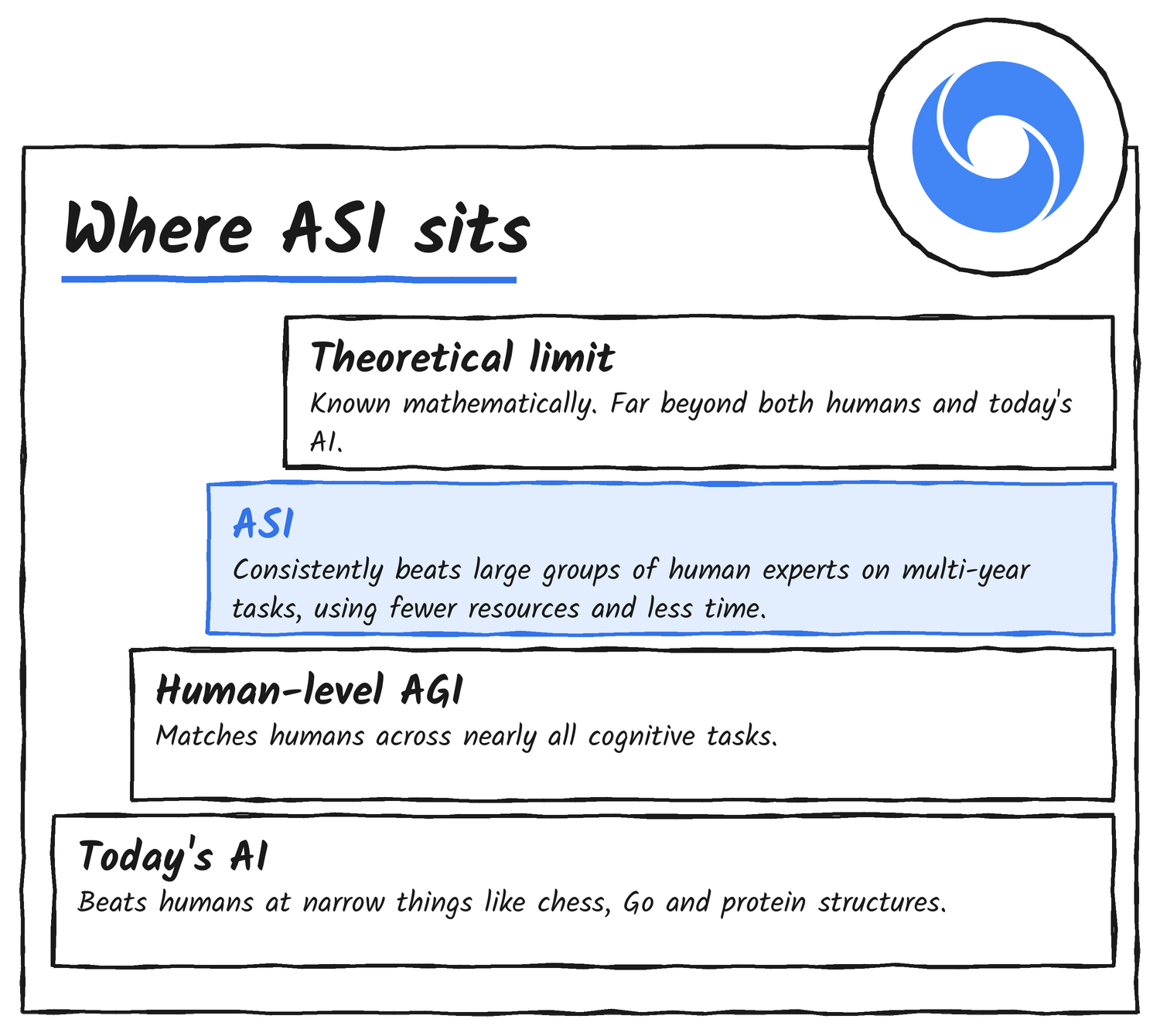
Genewein treats general intelligence as a continuum, with human-level AGI as one point on it. ASI sits further along as a system that “consistently outperforms large groups of human experts on tasks that could take them years to complete, using fewer resources and less time”. His examples are making the same scientific progress as an entire research field in a fraction of the time, or matching a year of chip-design progress at a large company.
The bar covers virtually all tasks of human interest, not narrow domains. The essay notes that some systems already do this in narrow areas: they beat any human at chess and Go, predict protein structures from amino acid sequences and prove theorems that resisted mathematicians for decades.
Why compute keeps compounding
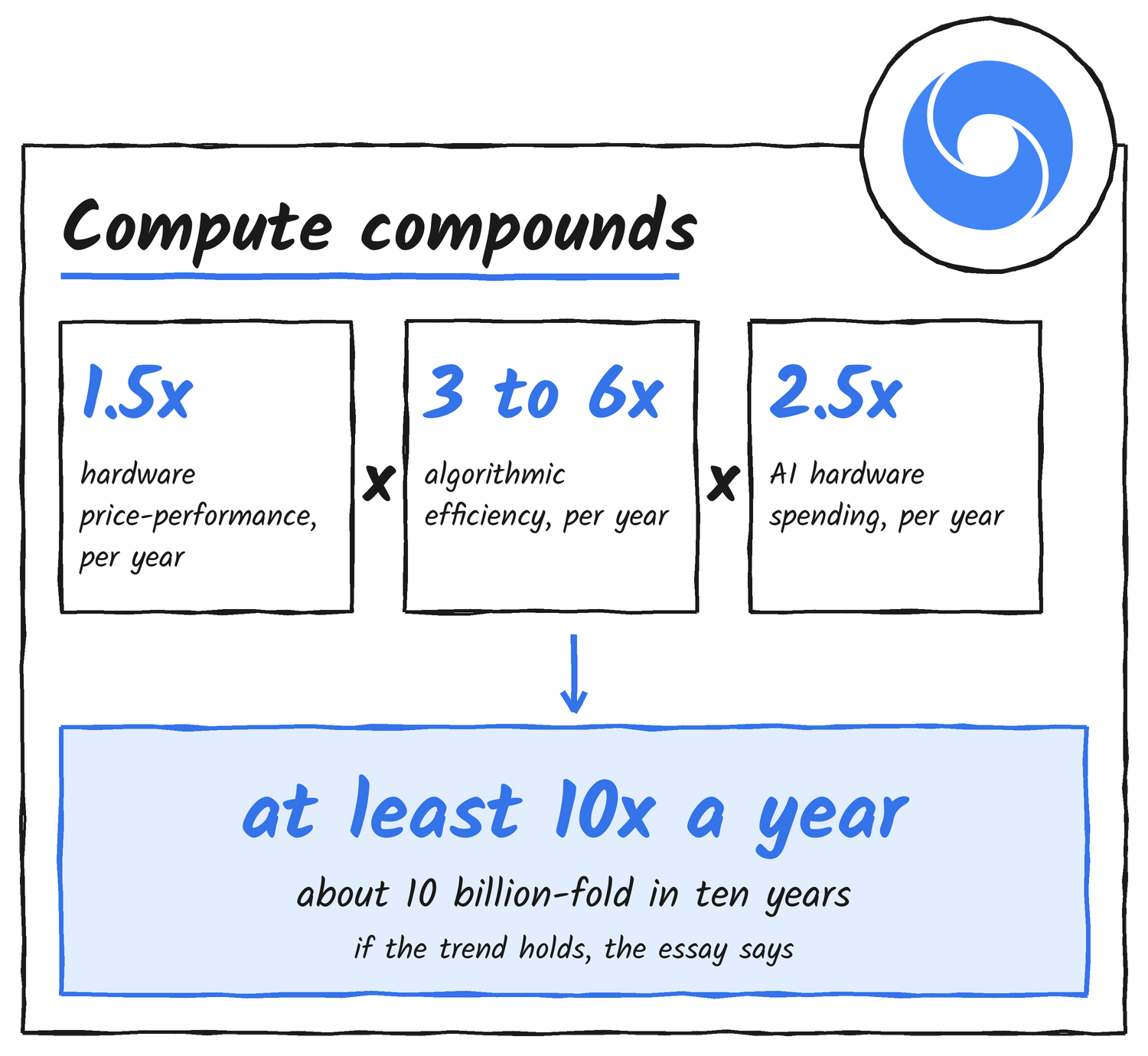
The essay says AI progress over the past decade came from growth in effective compute, driven by three factors. Compute per dollar has risen roughly 1.5x a year for six decades. The training compute needed to reach a fixed performance level has fallen roughly 3 to 6x a year. Spending on AI hardware has grown roughly 2.5x a year. Multiplied together, Genewein writes, global effective compute grows at least 10x a year, a factor of 10 billion over ten years if the trend holds.
Running AI gets cheaper at the same time. Efficiency gains alone would cut the compute needed for a fixed workload by about 4x a year, the essay says, so a cognitive workload that costs US$1 billion in compute tokens today would cost about US$1,000 in ten years. Genewein calls the result “cognitive industrialization”, where routine cognitive work becomes a commodity the way mechanical industrialization commoditised physical labour. He says the effective population of today’s AI agents could grow more than a thousand-fold by 2030 and more than a billion-fold within ten years, though it’s “not a given”.
The four routes from AGI to ASI
More agents running faster doesn’t cover every gap, the essay says: “While Einstein did figure out general relativity, a conference of one hundred thousand Ptolemaic astronomers probably wouldn’t have.” It lists four routes to new capabilities, each with its own bottleneck.
| Route | Bottleneck the essay names |
|---|---|
| Scaling models and data | Data exhaustion, diminishing returns on model scale, and limits on power plants, grids and chip fabs. |
| Technological paradigm shifts | Today’s models trail humans on continual learning, some forms of world modelling, decision-making and sample efficiency. Researchers disagree on whether simple extensions fix that. |
| Improving agent coordination | Coordinating thousands or millions of agents could produce collective superintelligence, but coordination inefficiencies bring diminishing returns as the population grows. |
| Recursive self-improvement | AI automating improvements to later AI. The loop can stall if the feedback is poor, so it should move fastest where checking is automated, such as mathematical proofs. |
Why a cap on one input falls short
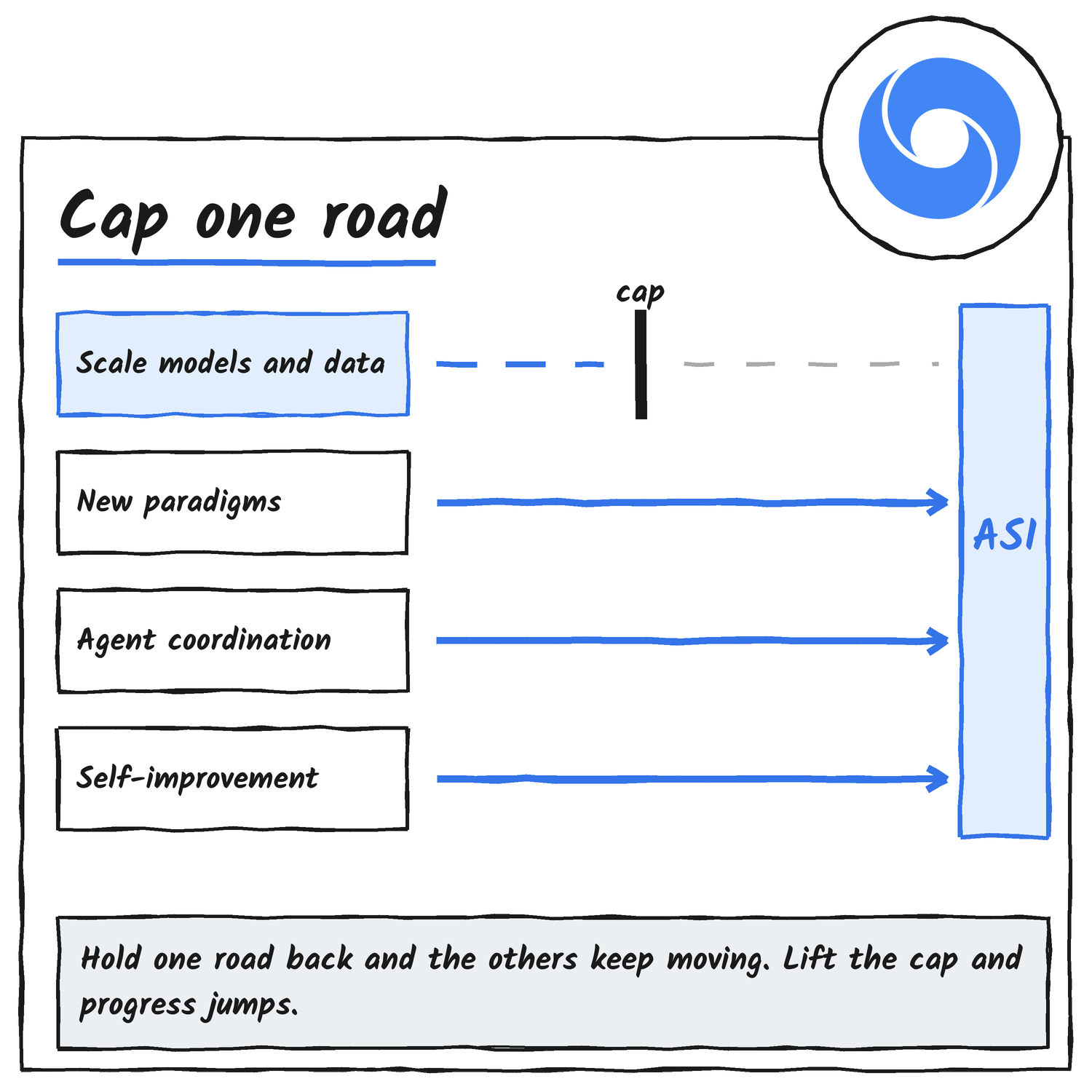
The routes compound, the essay says, and if one stalls, “economic and geopolitical competition will likely shift effort toward the others”. From that Genewein concludes that “trying to slow down AI development by restricting just one area – like the computing power for training an AI model – won’t be enough to stop overall progress.”
He adds a second problem. Where several inputs have to be combined to make progress, holding one back while the others advance would lead to “sudden, steep jumps in progress when the suppressed dimension is relaxed”, a capability overhang. The essay doesn’t name a specific cap or law.
What the essay doesn’t claim
Genewein writes that none of the predictions are certain and calls continued fast progress over the next decade “a serious possibility”. The essay gives no date for ASI. It says that scaling up today’s AIs in speed and number alone might not even count as full AGI, and that whether self-improvement leads to runaway gains is “largely an empirical question”. The Institute describes its pieces as conversation starters.
What it recommends
Genewein’s answer is “model, measure, forecast, and repeat”. He says tracking the routes needs frontier-model access and sizeable amounts of evaluation compute, plus new benchmarking methods, and calls for work across frontier labs and national and global institutions. For self-improvement, he says evaluation has to reach the superhuman regime, where even large groups of humans can’t easily assess AI outputs.
The full technical report is on arXiv.
Discover more from Sulat AI & Tech News
Subscribe to get the latest posts sent to your email.