Broadcom patched a critical VMware vCenter authentication bypass on 19 November, and Google’s Mandiant says a suspected China-linked espionage group was already using it. Mandiant saw the group exploit CVE-2026-123890 in early September, about ten weeks before the fix. Broadcom’s advisory credits Mandiant with the report and doesn’t mention exploitation.
vCenter is the control panel for a company’s virtual servers, so an administrator session there reaches everything it manages. The flaw scores 9.8 on CVSS 3.1, Broadcom lists no workaround, and the advisory names no fixed build for vCenter 7.0.
The flaw: a password-free admin session
Broadcom describes an authentication bypass in the VMware Directory Service that anyone with network access to vCenter can use. Mandiant’s report supplies the mechanics. The bug leaks a Secure Remote Password (SRP-6a) session key over DCE/RPC without any login, and Mandiant traces it to predictable UUIDv1 timestamps in the SRP interface. With that key an attacker gets a session as [email protected] and never needs the password.
From that session the attacker can run commands and copy files, including the directory database, data.mdb, through the vmdird RPC interface. The service listens on TCP port 2012, which vCenter’s single sign-on uses for control traffic.
How the intrusion ran
Mandiant doesn’t name the victim. It attributes the activity to ARMORY CASTLE, formerly tracked as UNC5221, a suspected PRC-nexus group. On 15 October the same team reported that the group used CVE-2026-102764, a zero-day in BeyondTrust Remote Support. The vCenter report picks up inside that network.
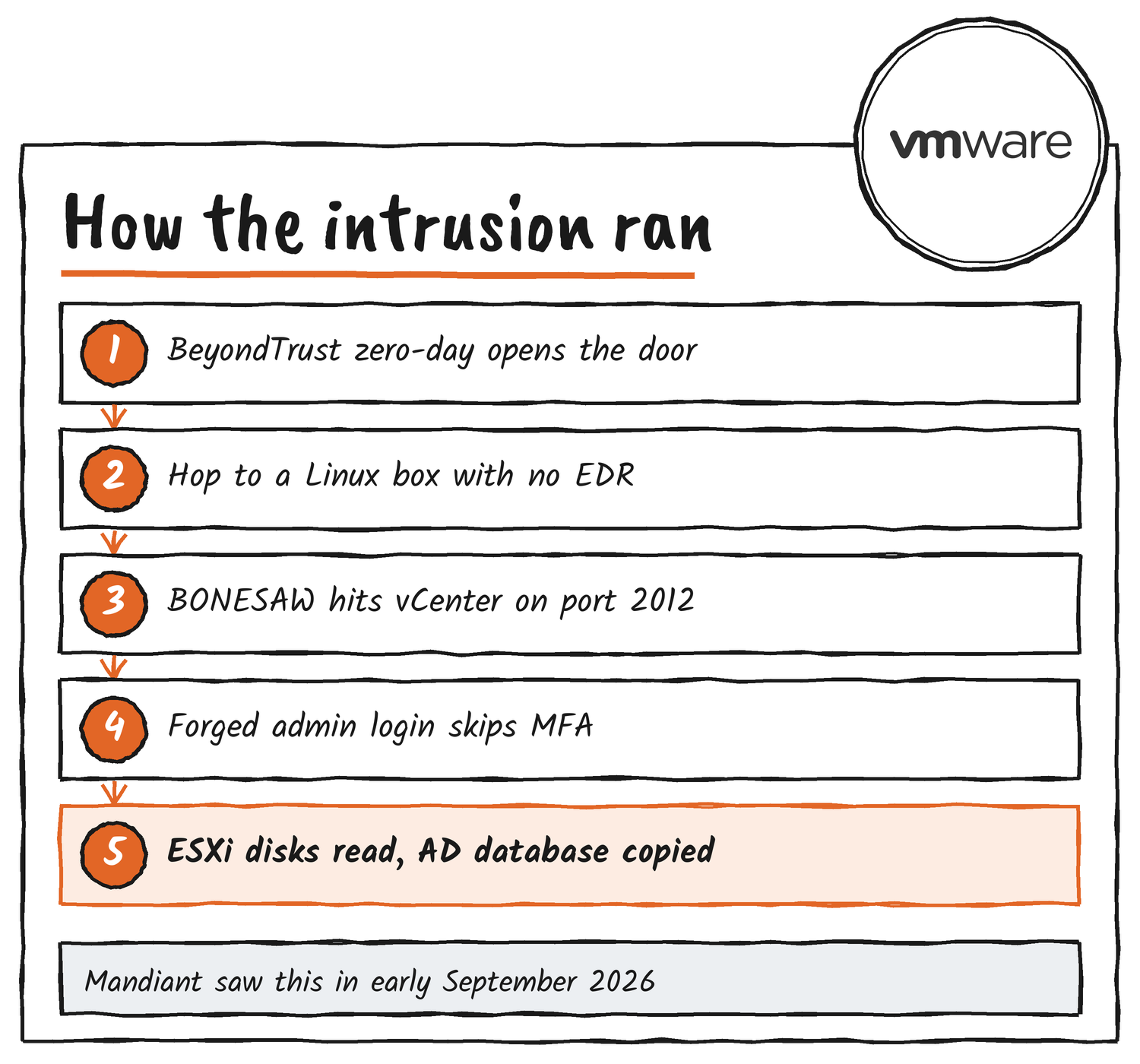
From the Remote Support appliance the group moved to an internal Linux appliance that had no endpoint detection and response (EDR) software. It dropped a web shell called SLIMSAVAGE, added a second called CAGEMATCH about four hours later for uploading files, and made itself root by setting the SUID bit on /bin/env with gdb. Then it ran nmap for VMware ports, 2012 among them.
Next came BONESAW, a Go tool that, Mandiant says, streams out the directory database, extracts the signing key for vCenter’s SAML token service, and creates a new SSO administrator account. A second tool, SAWSNAKE, used the stolen key to forge administrator SAML tokens. That’s a Golden SAML attack, and it skips MFA and lets the attacker pose as any user. Mandiant says SAWSNAKE is a Go port of a public Python tool for vCenter SAML logins.
With admin access the group made a local administrator account and switched SSH on through the appliance’s management API. It copied vCenter’s master encryption key and its PostgreSQL password, then switched SSH off again. Next it logged in to the ESXi hosts, first through vCenter’s vpxuser account and then over SSH as root.
On ESXi the group ran a script called vmfs_browser.py to read virtual machine disks directly. It pulled the Windows Active Directory database (NTDS) and registry files out of a guest, packed them into an archive and copied that off the host. Mandiant says the group likely exfiltrated the data. A third tool, BEARBONES, is a backdoored build of the Dropbear SSH server that accepts a hardcoded password and logs the plaintext passwords other people type.
Two flaws, not one
vCenter had a separate authentication bypass in July. Broadcom disclosed CVE-2026-59309 on 29 July, and Mandiant says the two share one trick: each hands over the session key without the password. They sit in different places. The July flaw is in vmdir’s LDAP handling on TCP 389 or 636. This one is in its DCE/RPC interface on port 2012.
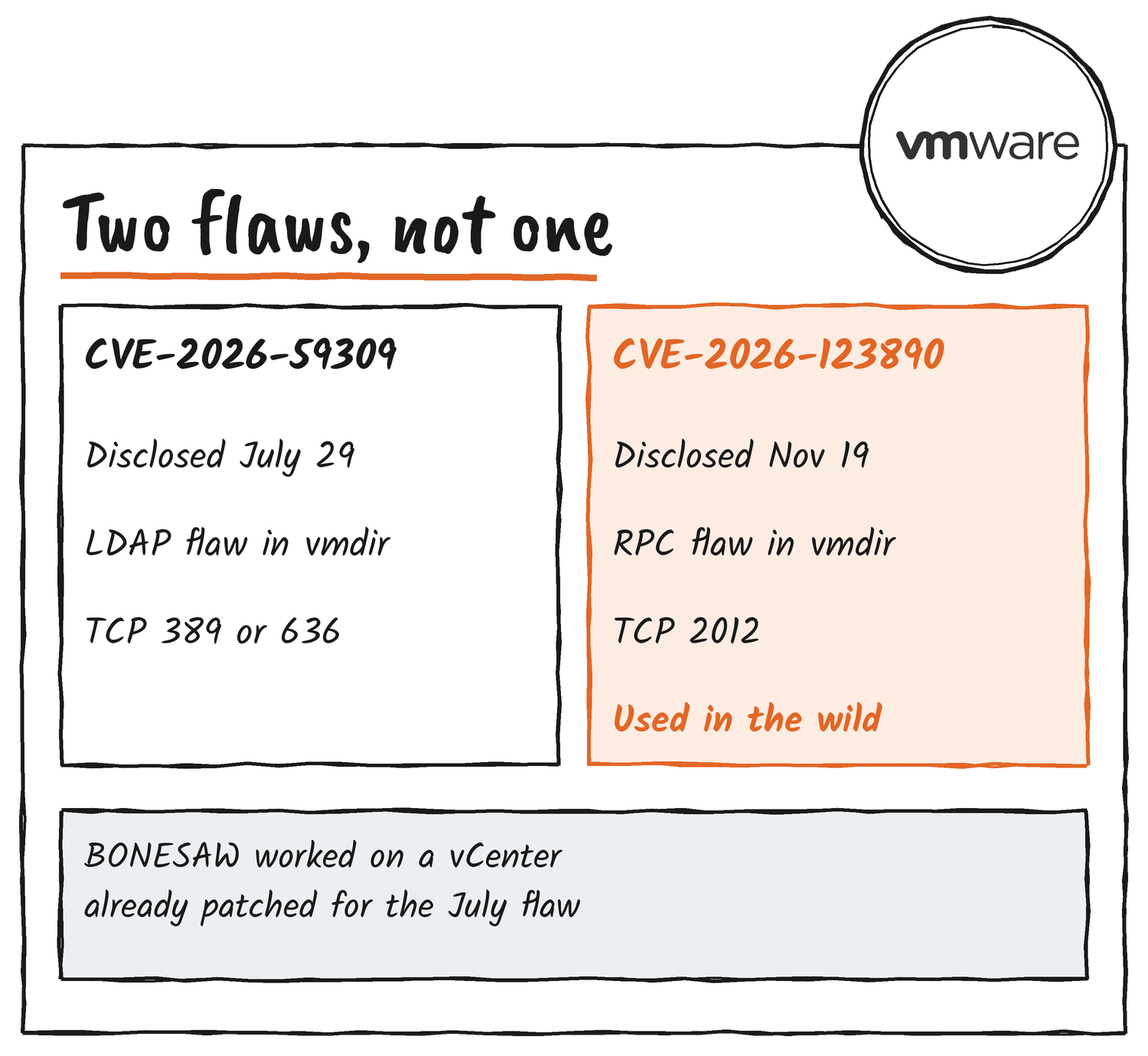
BONESAW ran in early September against a vCenter server that already had the July patch. Mandiant says the group knew about CVE-2026-123890 before the July disclosure, because the recovered BONESAW binary carries a build timestamp of 13 July, 16 days before it. Mandiant adds that Go build metadata can be modified.
Which builds are fixed
Broadcom’s VMSA-2026-0009 fixes five flaws. CVE-2026-123890 is the only vCenter bug. The other four are three in SDDC Manager and one in VMware Tools for Windows, rated 6.7 to 8.1. Mandiant says BONESAW works against vCenter 7.x and 8.x, and Broadcom lists 9.0 and 9.1 as affected too.
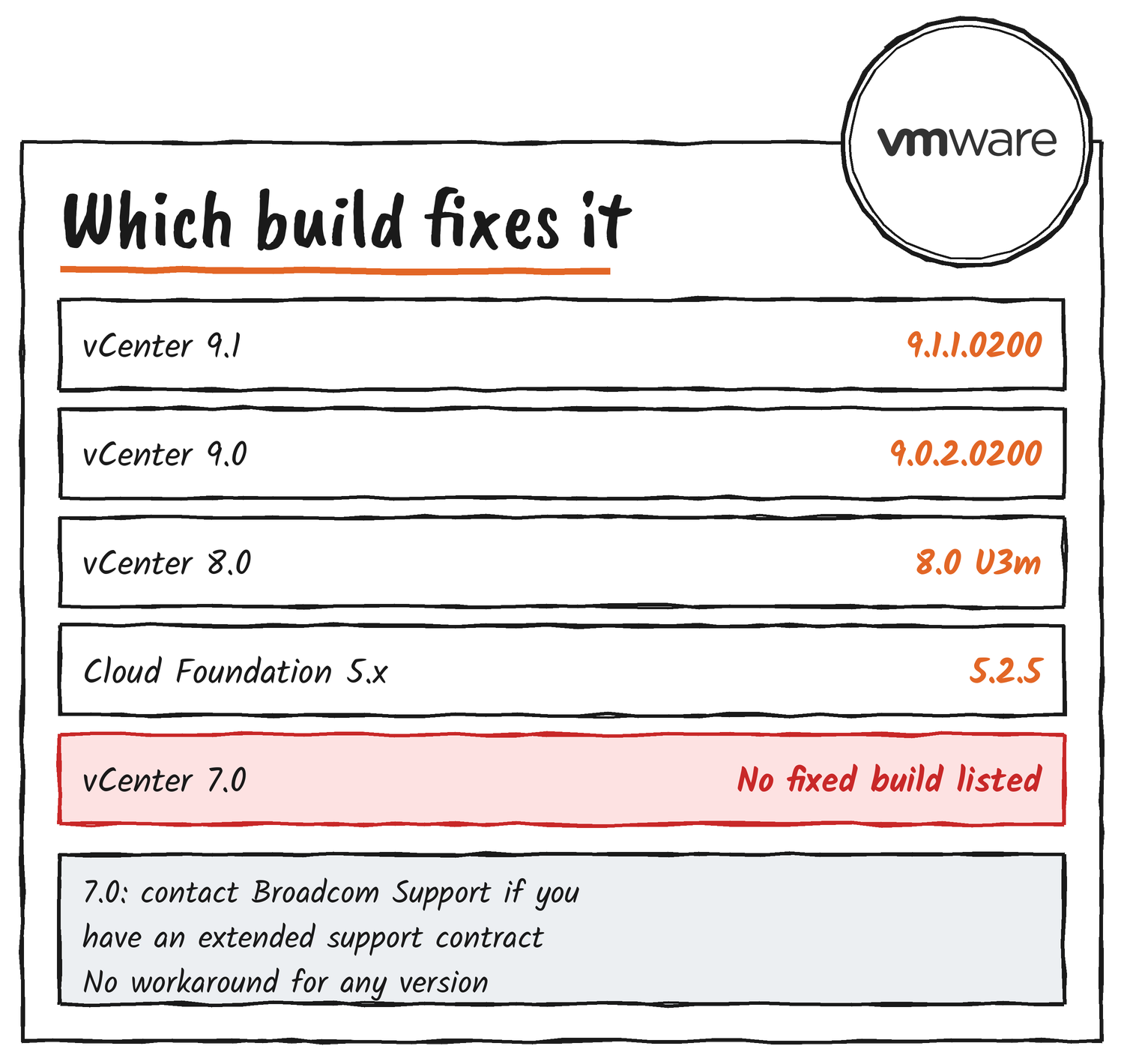
VMware Telco Cloud Platform and Telco Cloud Infrastructure vCenter builds are fixed through Broadcom’s KB463116. For vCenter 7.0 the advisory says only to contact Broadcom Support if you have an extended support contract. SecurityWeek reports that 7.0 reached end of general support in October 2025.
What the report says about the group
Mandiant says the group has exploited zero-days and known flaws in edge and security appliances for initial access since 2023, and calls BONESAW “a significant expansion into post-compromise use of zero-days.” Two zero-days and three sets of malware tailored to specific appliances in one compromise point to substantial resource backing, Mandiant says. The BONESAW build date also predates the intrusion by over a month, and Mandiant says that suggests it was “likely developed for broader operations.”
The group also used a Slack-based backdoor, LAZYBONES, on another Linux appliance. It encrypts its Slack messages and checks in every 150 to 450 seconds. Mandiant saw the same backdoor in early 2025 after the group exploited an Ivanti flaw, CVE-2025-22457.
What to do today
- Update vCenter to 9.1.1.0200, 9.0.2.0200, 8.0 U3m or, for Cloud Foundation 5.x, 5.2.5. Broadcom lists no workaround, so the update is the fix.
- On vCenter 7.0, contact Broadcom Support if you have an extended support contract. Until you have a build, I’d cut network access to the appliance down to the hosts that need it, starting with TCP 2012.
- Look for what the group left behind. Mandiant lists an unexpected local or SSO administrator (this one was named sps- followed by a redacted string), SSH switched on and off through the appliance management API, the files /tmp/123, /tmp/sss, /tmp/dbr and /usr/bin/vmtoolscs, the web shells ActiveSer.jsp and u.jsp, and the SSH banner SSH-2.0-pulsesecure_23345.
- Treat the SAML signing key, the vCenter master key and the database password as stolen if you find any of that. The group copied all three in this intrusion.
- Harden the appliance itself. Mandiant says the firewall in the appliance’s management interface isn’t enough, because it can’t limit by port, it’s managed through the same interface an attacker can reach, it logs nothing remotely and it ignores outbound traffic. Its VCSA Hardening and Logging tool sets default-deny inbound rules, filters outbound traffic and sends events to a remote SIEM.
Discover more from Sulat AI & Tech News
Subscribe to get the latest posts sent to your email.