The Monetary Authority of Singapore (MAS) said on Thursday 19 November that it issued S$100 million of tokenised MAS Bills on 6 November, recorded only on a ledger it runs and settled in wholesale central bank digital currency. In his keynote at the Singapore FinTech Festival the same day, MAS managing director Chia Der Jiun said he wouldn’t advise giving personal AI agents the login credentials to financial accounts, because there is “insufficient assurance of safety”.
MAS Bills are short-term debt that the central bank sells to banks. A tokenised bill is the same instrument held as a digital token on a shared ledger, and wholesale central bank digital currency (CBDC) is digital central bank money that banks use to pay each other. The figures below come from MAS’s media release, and everything attributed to Chia comes from his speech text.
What MAS issued
The bills run for four weeks and mature on 4 December 2026. Five primary dealers, the banks MAS approves to make markets in its securities, took part in the auction: DBS, HSBC, OCBC, Standard Chartered and UOB. MAS says applications came to more than double the amount issued. The release doesn’t give a split by bank.
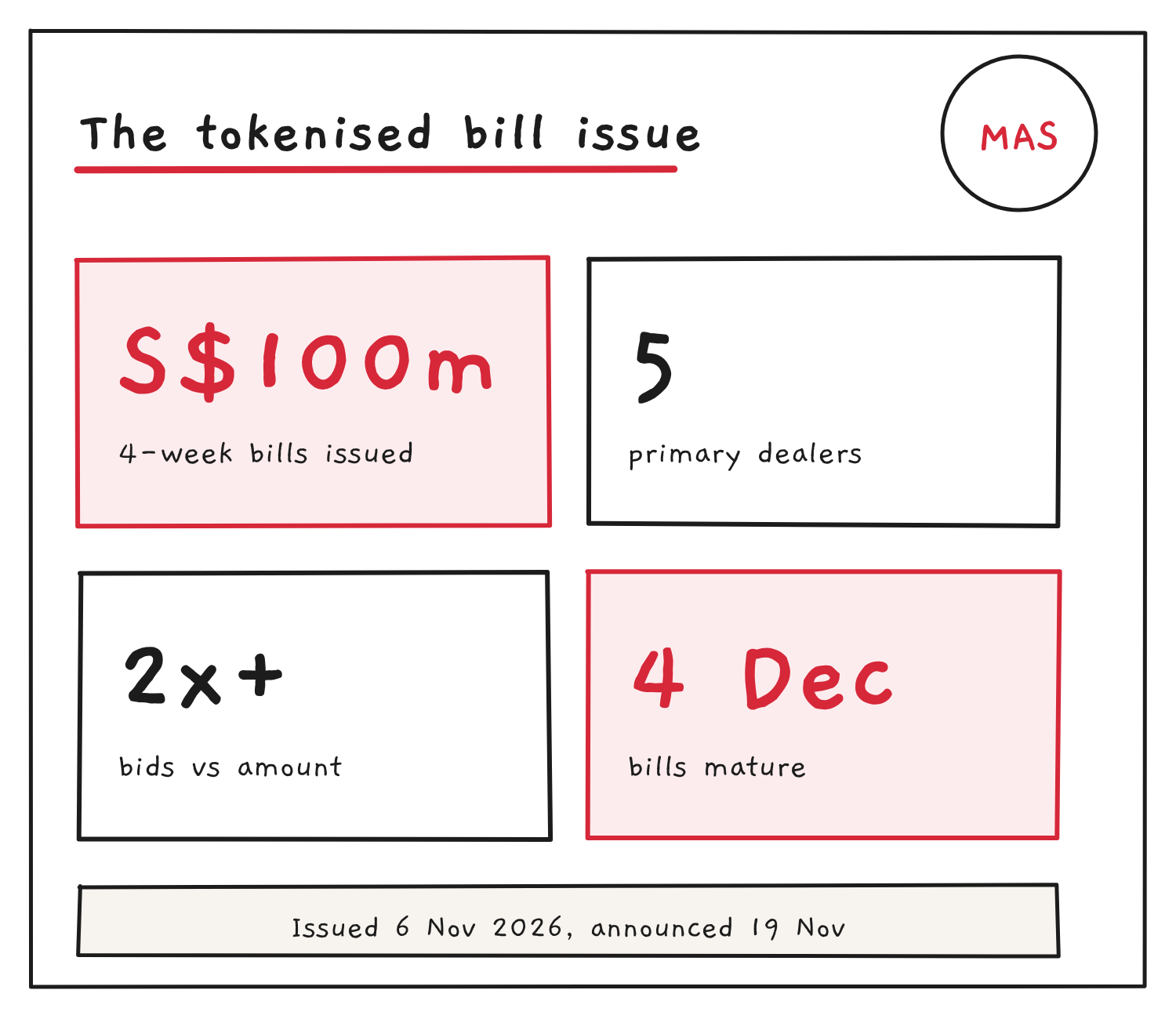
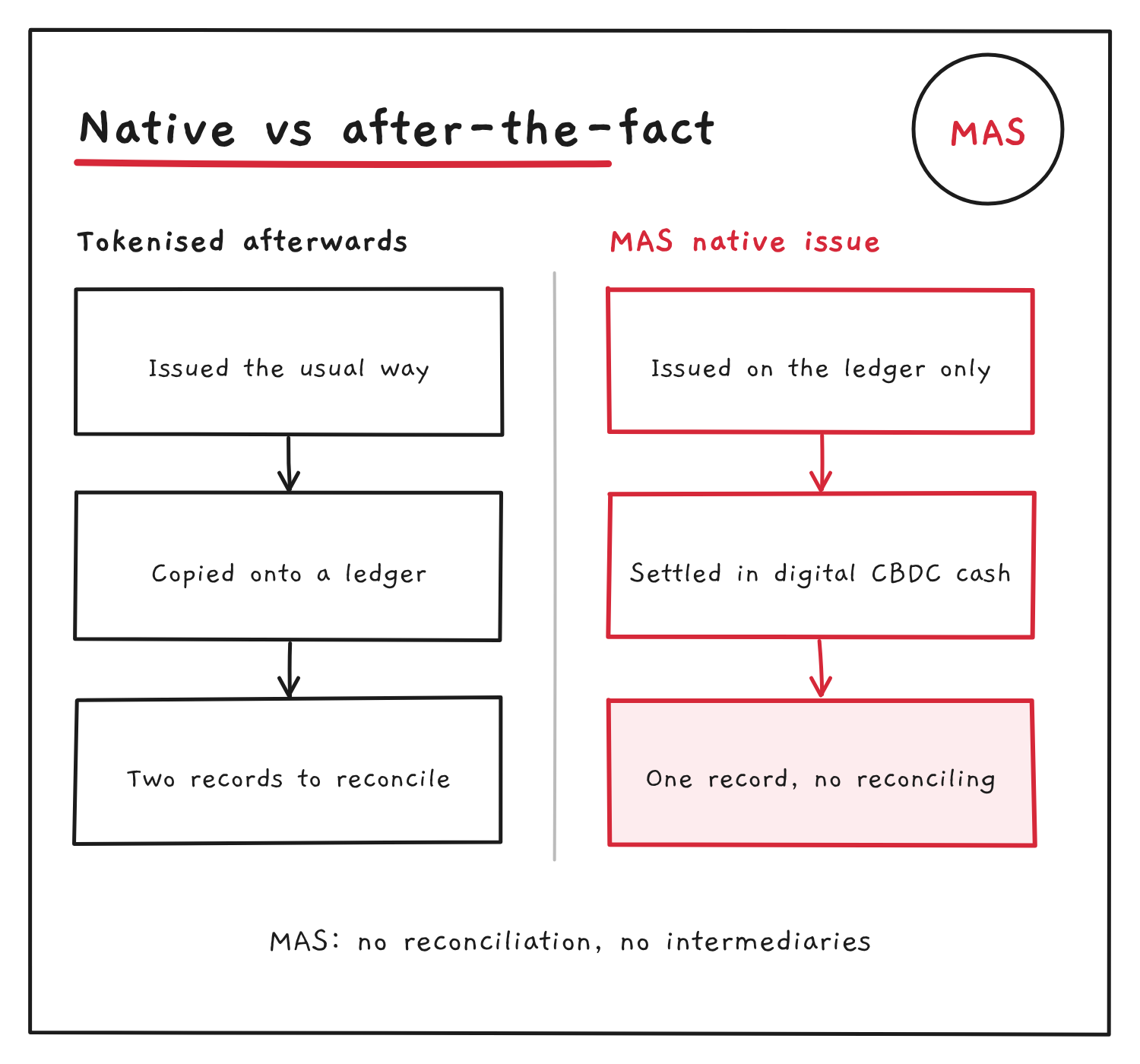
MAS issued the bills natively on the Singapore Dollar Test Network, which it operates. Native issue means the bill exists in tokenised form and is recorded directly and solely on the ledger. MAS says that removes the need for reconciliation and intermediaries, unlike a bill issued the conventional way and tokenised afterwards.
The issue follows the live interbank overnight lending transaction that MAS settled with wholesale CBDC in 2025. MAS says it gives banks a tokenised version of a trusted Singapore dollar asset that settles in central bank money, and that it paves the way for secured lending with tokenised assets on the network.
The banks’ comments are in the annex to the release. DBS’s Lim Soon Chong said settling tokenised central bank money and securities together, delivery versus payment, reduces settlement risk. HSBC’s Ruby Ho described the issue as taking place “on a private blockchain”. SGX Group’s Ng Yao Loong said SGX intends to work with MAS to explore using the bills in collateral management.
Collateral is the first use MAS wants
Chia said the value of tokenised financial assets “remains small relative to that of conventional markets”, and that three things are needed to scale: commercially compelling use cases, trusted digital money and interoperable settlement infrastructure. MAS has picked collateral, the assets posted to back derivatives and secured funding, as the use case to push first. It says tokenising collateral changes the rails that ownership moves on, not the economic substance of the underlying asset.
MAS and industry partners published the Guardian Tokenised Collateral Framework on 19 November. It covers eligibility, custody, valuation, return and enforcement across the collateral life cycle. MAS says it will work with industry to tokenise other commonly used collateral, including widely used foreign government securities and money market funds, and that how quickly this scales is “up to industry adoption”.
The test network will be renamed SG Digital Ledger and repositioned as an operational utility, with take-up “led by market demand”. MAS also published the BLOOM Field Guide, from its digital money platform that Chia said brings together 24 industry members and policymakers. In the next phase of the bill work MAS plans larger issues and more participating institutions, and institutions can ask to join live trials in 2027.
| Item | Status in MAS’s own words |
|---|---|
| Tokenised MAS Bills | S$100 million issued on 6 November, maturing 4 December |
| SG Digital Ledger | Test network to be renamed and run as an operational utility |
| Guardian Tokenised Collateral Framework | Published 19 November with industry partners |
| BLOOM Field Guide | Published 19 November |
| Know-your-agent protocol | MAS will facilitate its development in the next phase of SAFR |
| Agentic Money Sandbox | MAS will set it up with the Future of Finance Institute |
What Chia said about AI agents
Chia said that “as agents move into activities with financial consequences, authority, accountability and control become essential”. He said some payment providers and financial institutions are building agent interfaces, but many haven’t set terms or channels for agents to access financial services. On personal agents he was direct: “Some users are giving agents their login credentials to financial accounts. I would not advise giving personal agents such access, as there is insufficient assurance of safety.”
He named three problems. The bank doesn’t know whether the agent is acting with the customer’s full authorisation and control, or whether it’s transacting within its mandate and instructions. The third is who bears responsibility if an agent transacts incorrectly or beyond its instructions.
MAS published its Safeguards for Agentic Finance at Runtime work, known as SAFR, earlier this year. Chia gave its first-phase lessons: agents need bounded autonomy, their identity and authority must be clearly established, mandates must be clear and specific, and controls must grow with the authority an agent holds. In the next phase MAS will facilitate a “know your agent” protocol. It would let customer agents and banks exchange who the agent is and whom it represents, what authority and mandate it has, and what assurance exists about its provenance and reliability. Banks could then set terms and open a dedicated secure channel for agent access.
Hong Kong’s finance chief used the same idea on 16 November, saying banks will need to know their agent as well as their customer, and Fed Governor Michael Barr warned that agents could speed up bank runs, as reported earlier this week.
The sandbox, and the agent economy
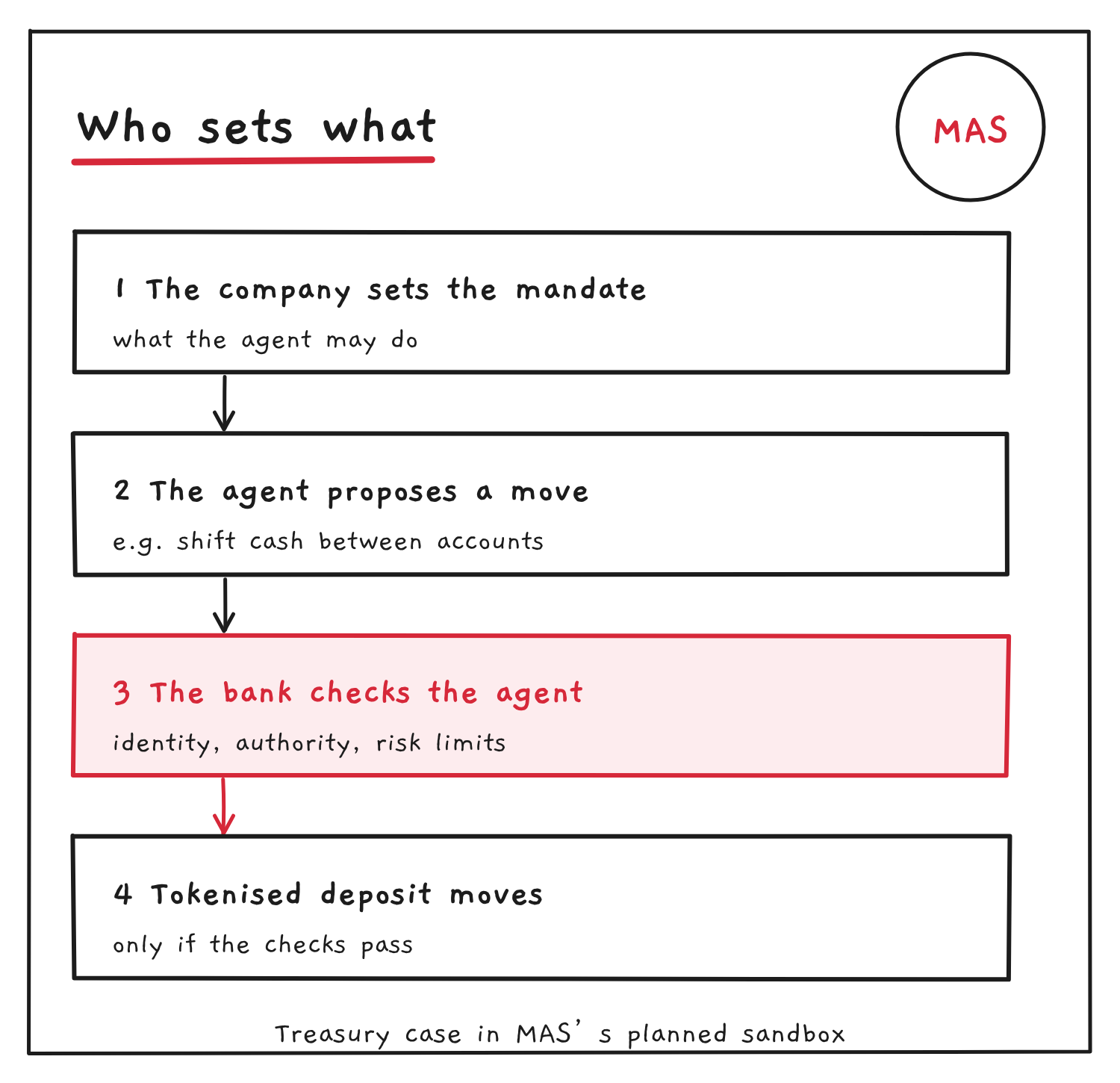
MAS will set up an Agentic Money Sandbox with the Future of Finance Institute, combining AI agents with programmable money. It starts with two cases. In corporate treasury, a bank could let a company’s agent monitor liquidity and due payments and move funds with tokenised deposits; the company sets the mandate and the banks set the controls. In payments, banks or payment providers would let customer agents pay with tokenised deposits or stablecoins, after verifying the agent’s identity and authority and applying risk controls.
Chia also looked past single transactions. He said agents can lower search costs and enable more dynamic pricing, and cited simulation studies that point to risks: agent collusion “even in the absence of an instruction to collude”, which leads to higher prices or weaker competition, and more capable agents securing better terms than less capable ones. He said banks may need limits on agent-instructed transactions, and that regulators will have to consider financial stability. He ended that part of the speech with: “Autonomy has to be bounded. Actions and outcomes have to come with accountability.”
MAS hasn’t given a start date for the sandbox or a timetable for the protocol. The next date on the record is 4 December, when the tokenised bills mature, and MAS has set live trials with more institutions for 2027.
Sources
- MAS announces successful issuance of tokenised MAS Bills, MAS
- Annex: quotes from the industry, MAS
- Advancing the Future of Finance: From Foundation to Scale, keynote by Chia Der Jiun, MAS
Discover more from Sulat AI & Tech News
Subscribe to get the latest posts sent to your email.